
by Regan Bervar | Mar 4, 2022 | Main Articles
“The road to hell is paved with good intentions.” English proverb
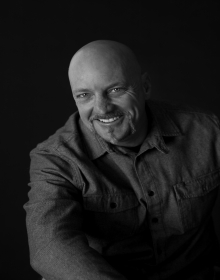 by Luke Schmaltz
On a typical day, Dwayne Peterson awakens at 4 a.m. to go to the gym. Until recently, he would begin his day at the Colorado Village Collective (CVC)-run housing facility known as Beloved Community Village (BVC) in Denver’s Globeville neighborhood. On his way out of the gated “tiny home” enclosure, he would regularly witness other residents getting high on illicit substances, engaging in the trade of illegal drugs, and selling packages of dope through the chain-link fence. “I chose to get up early and leave the premises for the day to minimize the amount of interaction I would have with other residents,” he explains.
Peterson is a longtime Colorado resident who attended CU Boulder for undergraduate and postgraduate studies. He is a professional ballet dance instructor, teaching students of all ages and ability levels through his company, This is Dance, LLC. Four years ago, his landlord of 17 years sold the house where he was renting an apartment. The property was quickly slated to be demolished — leaving Peterson and four other residents suddenly unhoused.
An Unwelcome Guest
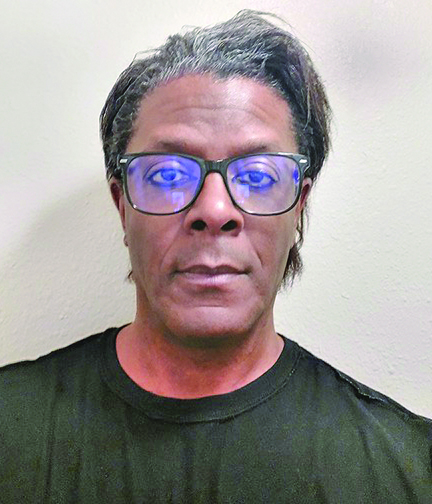
Dwayne Peterson encountered racism, violence, a death threat, and other adverse conditions at the CVC’s Beloved Community Village. Image courtesy of Dwayne Peterson
Peterson is sober with no criminal record and has never been a drug user — nor has he ever been diagnosed for mental health conditions. These factors not only made him an outcast among the BVC residents, but also made him the target of stalking, death threats, and racial attacks — which ultimately forced him to move out for the sake of self-preservation. “I was in an altercation the first day I moved in,” he begins. “There are constant disputes among residents because of the drug economy and the problems which inevitably arise” he explains.
At weekly BVC resident meetings, “there were heated disputes and physical altercations,” Peterson says. While he was quick to voice his concerns about the nonstop illegal activity, the resident-on-resident fighting, the all-night noise, and the open use of drugs — his protests fell on deaf ears as he was ignored by administrators and harassed by fellow residents. He could not shake the feeling of being constantly scrutinized by his neighbors as a non-drug user. Essentially, he was seen and treated as a rat.
Looks Great On Paper
CVC is headed by Cole Chandler, an ordained minister with a Master of Divinity (M.Div.) degree from Baylor University. He runs a non-governmental organization on a mission to “bridge the gap between the streets and stable housing by creating and operating transformational housing communities in partnership with people experiencing homelessness.” The CVC website further states, “We embody radical solutions to homelessness: housing that centers human dignity, empowerment of marginalized voices, and design solutions that are affordable, sustainable, and community oriented.” While the part about “radical solutions to homelessness” is definitely true, the rest — according to Dwayne Peterson’s eyewitness accounts — is window dressing at best.
Not What It Seems
Peterson firmly states, “Cole Chandler is lying to you. Plain and simple. The BVC is just a haven for criminal activity — a sanctuary for people to openly engage in crime — a contamination of resources and the community as a whole.” Peterson repeatedly went through the established CVC protocol for filing complaints about other residents who were making meth on site, preparing other drugs such as cocaine and heroin for distribution, and selling them directly from the property. “There was trafficking between residents and outsiders,” he says. “Exchanges were taking place right through the fence. People would drive up, make the trade and the customer would either drive off or just sit there and get high in their car before leaving.”
Blatant Disregard
When Peterson would file a complaint through the on-site “complaint portal” he would then receive notice that the situation was being investigated. “What would happen,” he states, “is that an administrator would knock on the resident’s door and casually tell them there was a complaint against them without having a discussion or conducting an investigation of the premises in question.” Essentially, the offending party was given ample time to cover their tracks, remove evidence, and come up with an excuse as to why they were being accused of drug trafficking, assault, etc. Peterson maintains, “These were haphazard investigations with unsubstantiated conclusions.”
Another instance of negligence on the part of CVC/ BVC staff occurred late one night when an outsider climbed over the fence and jumped into the enclosure to pursue a resident. An altercation ensued followed by a fight and the intruder stabbed the resident. “There was blood all over one of the decks,” Peterson explains. “Then, staffers started cleaning up the crime scene without even calling the police. The Tiny Home Village Director, Dorothy Leyba, was on site and said to a protesting Peterson, ‘We will handle this internally.’”
Rampant Racism
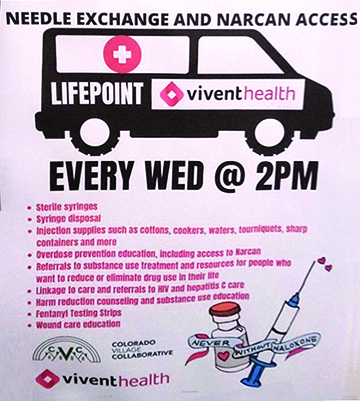
The CVC hosts Lifepoint Needle Exchange so their SOS residents can have plenty of fresh supplies for shooting up illicit, highly addictive drugs. Image courtesy of: Dawn McNulty
In an open letter to law enforcement and all others who should be concerned with his plight, Peterson describes a racially hostile environment where Caucasian residents repeatedly harass, threaten, and use racial slurs against African-American residents like himself. “I know of two previous individuals of color who resided at Beloved “Community” Village [who] left not because they located housing but attributed their weariness to being violated by Caucasian individuals residing at this emergency homeless shelter,” he writes. In the same letter, he elaborates further, “A current individual of color residing at this emergency homeless shelter, who continues to be violated by Caucasian individuals residing at Beloved “Community” Village and their guests, is reticent to communicate their being harassed. This individual believes [that by] reporting their being violated that they will be evicted.”
During the two years he lived at BVC, Peterson’s vigilance placed him in the crosshairs of one particularly aggressive Caucasian resident. “This person called me ‘a f***ing n***er’ and threatened to kill me by shooting me with a gun,” he explains. In the aforementioned letter, Peterson states, “I report these crimes to the city of Denver, law enforcement, and Denver City Council. Beloved “Community” Village staff, Cole Chandler, and Colorado Village Collaborative, et al have not performed their due diligence investigating these crimes. In ignoring the individuals committing these crimes, Colorado Village Collaborative, et al has only emboldened these individuals to continue their nefarious and insidious activities and lifestyles. Cole Chandler, regardless of the funding Colorado Village Collaborative, et al is receiving, is lying to the public and those he engages for funding.”
At The Crossroads
Peterson estimates that during the time he resided at BVC, he made at least 50 complaints with the Denver Police Department. “Nothing was ever done,” he explains. “That’s why I started blanketing Denver with what’s going on in BVC.” Drawing on his postgraduate-level college education, the well-spoken Peterson has drafted and sent articulate letters explaining the conditions, the lawlessness, and his specific circumstances to news outlets, lawmakers, government officials, law enforcement, and more. Peterson has recently been featured in articles by The Denver Post, Westword, and other publications. “Before I left,” he says, “They [CVC staff] became more aggressive towards me. They don’t want me talking to the Denver City Council or the press.”
At the time of this interview, 02/04/2022, Dwayne Peterson had been out of the BVC/CVC system for just two days — speaking from the parking lot of a Denver motel. His frustration is palpable, as he weighs his options for the foreseeable future. The irony of his situation is truly baffling, as a plethora of local agencies such as Colorado Coalition for the Homeless, St. Francis Center, and many others have refused to give him assistance because he is “high functioning” and “low risk.” “I was told by Colorado Coalition for the Homeless that I can’t be helped because I don’t have any problems,” he says.
To compound matters, Peterson has been diagnosed with cancer and is wary of overnight shelters. “They are unsanitary and unhygienic (think Hepatitis A, B, and C). Homeless shelters, in general, invite disease and violence,” he states. Additionally, and it should go without saying — the Covid-19 pandemic has made it difficult, and at times impossible, for Peterson to run his business which is built on in-person learning.
Reach Out
In yet another effort to remedy his situation, Peterson has started a GoFundMe campaign to raise funds so that he can secure long-term housing without having to endure the deplorable conditions in places like CVC’s properties and overnight shelters. Concerned readers who are interested in helping Mr. Peterson can donate here: https://www.gofundme.com/f/seeking-to-secure-housing.
Proliferation Of Dysfunction
Across town, the battle for the sanctity of the Lincoln/La Alma neighborhood continues, as Dawn McNulty — a resident of the adjacent Baker neighborhood — continues to fight the CVC’s recent installment of a Safe Outdoor Space (SOS) at 780 Elati St., on the outskirts of the Denver Health and Medical Center campus. Among her many concerns is the glaring reality that this property is governed by the same policies as the CVC’s other villages — including the BVC — former home of Dwayne Peterson. The fact that the Lincoln/La Alma SOS is within 1000 feet of three Denver Public School properties is in itself cause for alarm. “This is a bipartisan issue with well-intentioned, compassionate people working on both sides,” McNulty explains. “We must demand more of our city’s officials to ensure public health and safety. SOS sites are an incubator for crime and disease.”
Citizens for a Safe and Clean Denver do not want addicts and people with mental illness living next to schools and families with children. Image courtesy of Terry Hildebrandt, PhD
McNulty and fellow citizens of a group known as Citizens for a Safe and Clean Denver are staunchly against Safe Outdoor Spaces. They intend to address and remove the glaring oversights and extreme safety hazards to neighborhoods populated by families with children. As it turns out, their fight just got a whole lot tougher, as Denver City Council recently voted to allot $3.9 million of Denver taxpayer money to Cole Chandler and CVC so that they can install more city-sanction drug camps. If you think this issue doesn’t affect you, think again. An encampment of mentally ill, drug-addicted, illness enabled people could be coming to your zip code very soon. These folks do not stay in the camp all day, so they will most certainly be dropping by for a sprawl and an afternoon dope fix on your front lawn. Welcome to the new Dystopian Denver.
Adding insult to injury, the CVC enables the use and injection of illegal drugs by allowing Lifepoint/Vivent Health to distribute — for free — supplies such as syringes, needles, tourniquets, cotton swabs, cookers, and sharps containers to residents of Safe Outdoor Spaces. Also, should their assisted addiction service prove to be too effective, they supply Narcan for overdosing addicts and Fentanyl testing strips for suspicious-looking illegal narcotics that are well known among users to be deadly. Saintly enablement indeed.
Your Tax Dollars Not At Work
Meanwhile, Dwayne Peterson’s parting statements are stark, harrowing, and ring as true as the pavement under his feet. “Homelessness is being managed, not rectified. What astounds me is that no matter how much money is being thrown at it, it keeps getting worse.”

by Mark Smiley | Mar 4, 2022 | Main Articles
Glendale Launching 10-Acre Entertainment Site; Denver Planning Massive Office/Apartments/Condos On 13 Acres Of Cherry Creek Shopping Center
by Glen Richardson
Entertainment Anticipation: Glendale’s Four Mile Entertainment District is finally breaking ground this year. A concert venue, movie theater, restaurants, shops, a proposed gaming hall, a 200-room hotel and more will make the venue one of the state’s top entertainment sites.
Just 1.8 miles apart, along the north bank of Cherry Creek, two massive projects are starting to go through the respective planning processes in Glendale and Denver with very different markets in mind. In Denver, 13 acres of retail space of the Cherry Creek Shopping Center will be converted into seven 12-story tall buildings composed of offices/condos/apartments. Conversely, the Glendale Planning Commission is expected to approve a 10-acre $150 million retail Entertainment District along its portion of the north bank of Cherry Creek this month.
Destined to become Colorado’s most unique entertainment locality, the 10-acre site now officially named the Four Mile Entertainment District is finally set to break ground in 2022, provided the Glendale City Council also approves the project at its May 2022 meeting. In Denver, the $1 billion redo of the west end of the Cherry Creek Shopping Center is just beginning the planning process, with the project projected to take up to 12 years with the first phase possibly completed in five years.
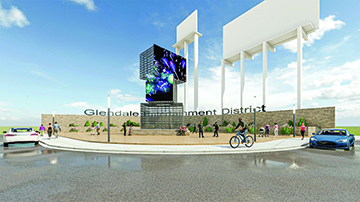
Corridor Sign Concept: Rendering illustrates what the entrance to Glendale’s Four Mile Entertainment District might look like along Colorado Blvd.
GLENDALE PROJECT
The Four Mile Entertainment District, along the banks of Cherry Creek, is bounded by East Virginia Ave., South Colorado Blvd., and South Cherry St. Plans call for the project to feature a vast array of choices including a 40,000-sq.-ft. live music site, an Alamo Drafthouse Cinema, plus restaurants and pubs.
A new 200-room resort hotel with an outdoor plaza, plus exclusive retail shops and a proposed app-based sportsbook gaming hall are also planned.
One-Stop Spot
The project is being designed as a one-stop destination where friends and family gather, take a date, or just relax at the adjacent resort hotel.
Valley residents and visitors can stroll tree-lined streets, shop, liste

Alamo: Rendering shows the Alamo Drafthouse Cinema owned by developer Central Street Capital which will be an anchor in Glendale’s Four Mile Entertainment District.
n to music, or relax in landscaped outdoor plazas. Multiple indoor and outdoor restaurants will offer casual and fine dining options.
The district will feature a common consumption area where patrons can purchase drinks from different bars. With Glendale’s liberal last-call laws, clientele can buy drinks until 4 a.m. Moreover, Glendale Deputy City Manager Chuck Line suggests the area could also become the site of “Oktoberfest-type events” once the district opens.
Drive, Bike, Or Jog
Glendale and Denver take very different approaches to parking. Car friendly Glendale intends to mandate an abundant amount of parking spaces for its Entertainment District. Unlike many entertainment sites, visitors will have no trouble parking. Two large parking structures will be located within the district, and there will be a dedicated drop-off-pick-up area for Uber and Lyft.
Bordered on the southwest by Cherry Creek and its popular trail, visitors can easily walk, jog, or bike to the district.
Glendale is already Colorado’s destination for rugby and also houses some of the state’s leading event venues. In addition to the sports stadium, the enclave’s 16-acre Infinity Park is an indoor-outdoor entertainment hub.
Returning To Roots
“For the last decade, we’ve been working on trying to get this project going,” acknowledges Line. The development is designed to once again make Glendale the Cherry Creek Valley’s dining, drinking, and entertainment hot spot.
Many Valley old-timers still recall Cork ‘n Cleaver, Colorado Mine Company, The Lift, and other food and beverage spots that blossomed in Glendale’s earlier heydays. By developing the site as the Four Mile Entertainment District — Colorado’s entertainment stage stop — the transformation project will try to recapture Glendale’s bygone spirit.
Initially dubbed “Riverwalk,” the site was later named “Glendale 180” under a second false start by Lincoln Properties five years ago. Under a deal approved by Glendale’s City Council last summer, Denver-based Central Street Capital led by Rob Salazar, CEO-Founder, will develop the 10-acres of city-owned land. The investment management company invests only the funds of the family and its affiliated entities. The firm has invested in a wide variety of industries for more than 25 years. Information: Info@GlendaleEntertainmentDistrict.com.
DENVER PROJECT

Casual Connection: Vision of proposed green space with amphitheater that would connect the Cherry Creek Shopping Center’s proposed west end to the mall’s retail space on the east.
While it hasn’t been easy for shoppers and residents in crane-studded Cherry Creek North over the last few years, a mammoth skyline-altering mixed-use project named Cherry Creek West will potentially be a different story. Plans for redevelopment with a $1 billion budget for the west end of the Cherry Creek Shopping Center will make the site much taller and denser, and will face significant parking and traffic challenges.
The big changes unveiled by East West Partners as 2022 commences would add office, residential, and retail in seven structures up to 12 stories tall on about 13 acres of land at the west end of the mall. A public amphitheater with green open space will connect the Shopping Center’s east end retail space to the new development.
Makeover is expected to start with four buildings that will have approximate

Mammoth Project: Rendering submitted to the City of Denver by East West Partners shows a layout of seven 12-story buildings to replace the Cherry Creek Shopping Center’s west end with offices/condos/apartments. Parking and traffic challenges are expected to be significant.
ly 780,000-sq.-ft. of office space, plus three condo-apartment homes with about 600 units. Each structure will also have retail space. The buildings will range in stature from eight to 12 floors, or 100 to 160-feet-tall.
West End Empty
Veteran Denver-based East West Partners, whose projects include Riverfront Park and Union Station, has a leasehold with owner Buell Foundation and mall owner Taubman on the 13 acres.
The project is planned from University Blvd. on the west to Clayton St. and from First Ave. on the north to the Cherry Creek waterway. Construction of a “landscape bridge” along a section of Cherry Creek North Dr. will provide pedestrian access to Cherry Creek.
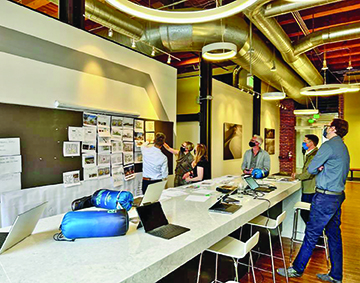
Working Wonders: Staff of developer East West Partners study images and development plans for building, landscaping, appearance, mass orientation, and usage details for creek site.
Existing mall structures on about 2.7 acres will be demolished before construction begins. That is approximately half of the new construction area site. The additional development plot is currently parking lot space. Subsequent to the decision by Bed Bath & Beyond to relocate from the mall’s west end to Glendale in 2016, the west side has been mostly vacant. Soon thereafter Macy’s Furniture Galleries and The Container Store relocated to the east end of the Shopping Center. Only Elway’s and the Boulder Running Company remain on the west side.
Talks Began In 2015
Talks between East West Partners and Taubman about the project began in 2015. By 2019 the discussions became serious with both Taubman and the Buell Foundation in 2020, according to Amy Cara, managing partner of East West Partners. Cara, managed the Denver Union Station transit hub redevelopment and much of the adjacent residential and office.
Cara expected the city to begin its review of the plan and new zoning for the property by January 2022, or earlier. She also indicates the developers will work with their traffic engineers and the Department of Transportation & Infrastructure on the very significant impacts from traffic and construction.
Other companies that will work on the massive project include Gensler, Design Workshop, and BuildMark.

by Valley Gadfly | Mar 4, 2022 | Valley Gadfly
From a bit of o’ sun to a bit of o’ cheer, March can be wild. From basketball’s March Madness to a wee bit o’ mania, Valley is the rocky road to Dublin St. Paddy’s Day parties.
Valley munchkins march to their own drums as spring mumbles. The road rises up as we spring forward to Daylight Saving March 13, then the earth tilts as spring starts March 22.
To help you celebrate all things green, here are our choices for shopping, dining, and entertainment to bring you good luck as you daydream of rainbows, clover, and pots of gold:
3 Begin the month by celebrating Mardi Gras with the No Hands Brass Band playing at Dazzle@Baurs, March 1, 6-7:30 p.m. You’ll enjoy pop, hard-hitting funk, contemporary jazz, plus Dixieland swing. Information: 303-839-1500.
3 Support Athena Project’s 10th fundraiser enjoying cocktails and comedy while noshing at the Maven Hotel, March 5, 7:30 p.m. Information: 303-219-0882.
3 For a Celtic blast catch the bagpipes, hammered dulcimer, and tenor sounds of the Denver Brass in the Newman Center, March 11-13. Information: 303-871-7720.
3 Folk duet Gobs O’Phun brings you luck singing Irish-Scottish songs at Swallow Hill Music’s Quinlan Café, March 12, 8 p.m. Information: 303-777-1003.
3 Herald spring enjoying diverse dining choices and unique shopping along Aurora’s On Havana Street. Choose from 100+ restaurants, 20 international markets plus nearly two dozen retail centers. Information: OnHavanaStreet.com.
3 Does inflation have you looking for cash? With 30 years of fair evaluation and pricing go to Colorado Gold Mart on S. Colorado Blvd. Loaning cash or buying gold jewelry, watches, diamonds, and vintage coins. Information: 303-692-0555.
3 Get ready for spring by attending the International Sportsmen’s Expo and Wildlife Youth Fair in the Convention Center, March 24-27. Information: 800-545-6100.
3 Laugh-out-loud to end the month by attending the uproarious musical comedy Tootsie at the Buell Theatre, March 29-April 10. Information: 720-865-4200.
3 March downtown to see the 60th St. Patrick’s Day Parade on Saturday, March 12, 9 a.m.-noon. The parade starts on Wynkoop St. at 19th, turns down 17th St. in front of Union Station, then turns down Blake. St and goes to 27th St. Afterwards plan to stay for the gobs of fun Downtown Party at 22nd & Blake, 11 a.m.-8 p.m. Located in the parking lot next to Coors Field, there will be music by top local DJs, plus cocktails, beer, and vendors. Information: denverparade.com.
Yeah, this is the month of St. Patrick’s Day fêtes-festivities. It’s time to go green — and no, we don’t mean recycling. Plan to enjoy the best parts of Irish culture, food, and music.
Celebrate by listening to Irish harmony, be it a harp, bagpipe, fiddle, or just singing. Try yummy Corned Beef & Cabbage or Bangers & Mash at a neighborhood restaurant or pub.
Grab your party pants, dust off your green hat, and get ready to shake your shamrocks. Nonetheless lads-lassies, don’t press your luck by ironing a four-leaf clover.
— Glen Richardson
The Valley Gadfly can be reached at newspaper@glendalecherrycreek.com.

by Glendale Sports Center | Mar 4, 2022 | Glendale City News
by Jennifer Lease, RD, CDN, Director of Nutrition Initiatives, YMCA of Metro Denver
Eating more plant-based foods, which simply means food that comes from plants versus animals, can have great benefits for our health. This is because plant-based foods are filled with essential vitamins, minerals and fiber, an important nutrient we can only get from plants! These nutrients help support our health in tons of ways, from heart health to brain health, to keeping digestion running smoothly, to keeping your bones strong, your skin healthy, and just about anything else you can think of!
But eating more plant-based foods doesn’t mean you have to stop eating animal-based foods or adopt a vegan lifestyle. Here are some simple tips to start adding more plant foods into your usual meal routine:
- Swap one animal-based protein, like beef or pork, for a plant-based protein in one meal each week. You may have heard the phrase “meatless Monday” — a phrase that simply encourages you to enjoy one meatless meal per week. Our standard American way of eating tends to lean heavily on meats and many of us don’t eat enough plant foods, which can mean we’re lacking certain nutrients. A swap of just one meal per week can make a difference in supporting your health! Swap a beef or pork-based meal with a whole food plant-based protein like beans, lentils, or tofu. Not ready to dive into a fully plant-based meal? Try subbing out half of the animal protein for a plant protein.
- Keep it simple and convenient. There are tons of plant-based protein options available, and it can feel confusing on what to choose or how to cook those foods. Start off simple with a plant-based protein choice like canned beans or lentils, or options you can heat in a ready-to-cook pouch. These ready-to-eat plant-based proteins make it easy to toss into a meal. Try using canned beans or lentils as a topping for a salad or a whole grain, a replacement for taco night or add into a big, warm pot of chili or soup.
- Do a little advance planning to make it easy. Your meatless meal doesn’t need to be dinner. Maybe for you, lunch makes more sense. Everyone’s lifestyle and goals look different and planning ahead of time can help you choose what works best for you. This might mean you choose a new recipe to try with a plant-based protein for the week ahead, or you add a plant-based protein to your grocery list, so it makes it into your cart. It’s easy to fall into old habits, so when you’re working toward a new goal, like including more plant-based foods into your eating pattern, planning ahead can help you stay on track.
Remember: small changes lead to bigger, lasting changes over time! If you’re looking for support and motivation to get started with eating more plant-based foods, you might be interested in the YMCA of Metro Denver’s Meatless March Challenge during March’s National Nutrition Month. Through Facebook community, you’ll get to share pictures and recipes, tips and ideas on how to enjoy more meatless meals with support from YMCA Nutritionists!
Follow the YMCA of Metro Denver on Facebook at facebook.com/DenverYMCA and check out the Meatless March Challenge. 웷