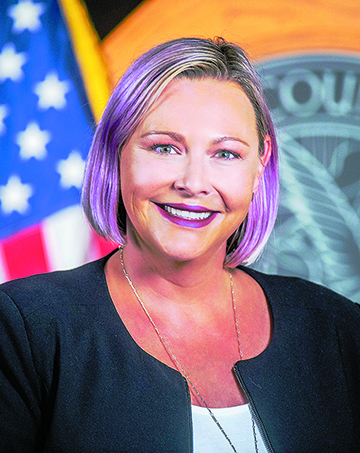
Councilwoman Amanda Sawyer is the Denver City Council representative for District 5. You can follow her on social media at @Denver Council5 and sign up for her newsletters at bit.ly/council5news.
This time last year looked very different in Denver. Run-off election results were just coming in, and the citizens had spoken loudly and clearly. When the dust settled, Mayor Hancock had won a third term, but three challengers had unseated incumbent Councilmembers — something almost unheard-of in our City that left political insiders scratching their heads and with mouths agape. What did it all mean?
As one of the winners who came into office riding that wave of political discontent last June, I believe that when the citizens of Denver chose new City Councilmembers they were saying they wanted to bring checks and balances to local government, more accountability and transparency, and more communication from their leaders.
My first year in office, I have worked hard to live by those values and bring them back to our government in a number of ways. I’ve researched how other cities with strong-mayor forms of government (like Denver’s) function, and what kinds of processes and procedures these cities use to bring balance, transparency and accountability to their communities. In my research I found something very interesting: the majority of Denver’s strong-mayor “sister” cities in the U.S. — those cities we look to when considering similar policies — participate in a process where their City Councilmembers have some form of approval power over the Mayor’s appointees. Denver is the only strong-mayor system in the State of Colorado that does not follow this practice. It’s time we institute it in Denver.
This month, I am introducing an amendment to the Denver Charter that, if referred to the voters by City Council, will require City Council approval of all Mayoral Cabinet appointees, as well as confirmation of the three heads of Denver’s Safety departments. This proposal gives Denver residents a voice through their independently elected City Council representatives. It respects our strong-mayor form of government while bringing a bit more balance to the system. If approved by voters in November 2020, it would mean that in addition to the Chiefs of Police and Fire, and the Denver Sheriff, a majority of City Councilmembers would have to approve the Executive Directors of: Aviation, City Attorney, Community Planning & Development, Dept. of Public Health & Environment, Dept. of Transportation & Infrastructure, Excise & License, Finance, General Services, Human Services, Parks & Recreation, and Safety.
This proposal is not popular with Denver’s current Mayor and his camp. Their concern is that this may overly-politicize the process and deter qualified candidates from applying for these positions. Those are valid concerns, but those risks already exist even without this Charter amendment in place. These are political appointments and public positions. These are jobs with salaries set by ordinance, and whose emails are subject to the Colorado Open Records Act. In short, they are jobs that enjoy a lower expectation of privacy than an ordinary job, and any candidate applying for one of these positions is aware of that.
Furthermore, every executive-level job search has an element of this risk associated with it, no matter whether the position is in government or the private sector. Council approving Mayoral appointments is analogous to a situation in the private sector where corporate boards approve C-suite appointments in a corporation. If a candidate for one of the most powerful positions in Denver cannot garner the support of seven members of a 13-member City Council, they shouldn’t be in the position in the first place. Instituting a process that brings more balance, transparency and accountability to our strong-mayor form of government makes sense. It is good governance. It is a policy that many other strong-mayor cities follow successfully, and it is time to bring it to Denver. This proposal will go before City Council’s Finance & Governance Committee on June 9, 2020, at 1:30 p.m. I urge you to reach out to your local City Councilmember and ask them to refer this initiative to the November 2020 ballot so that the citizens of Denver can vote on it.
Ted Trimpa is the Principal and CEO of Trimpa Group, a national political consulting and government relations firm that specializes in progressive public policy advocacy and political strategy.
Governor Jared Polis blazes his own trail and is now living in a whirlwind. Self-made before those of his age hadn’t decided whether they liked vodka or tequila, and never a beacon of fashion — he makes Hickenlooper seem stylish, our Governor has always been on a determined path. Iconoclastic, entrepreneurial, a disrupter and always willing to question the norm, he calls them as he sees them. And thank God for that.
As this once-in-a-lifetime pandemic keeps hitting him between the eyes, he continues not to flinch. While some are ditching and dodging and others reacting with too quick a heavy hand or no hand at all, our governor is being stern, but thoughtful. Methodical but calibrated. Are there civil liberties in question and possible infringements on one’s personal freedoms? Well, of course, yes, but we also must consider what we’re facing.
At the beginning of the pandemic in Colorado, our governor was one of the first to take bold action. Faced with a proven, imminent, public health threat at our ski resorts, one of the most impactful economic drivers of our state, he closed them down.
When Castle Rock restaurant and bar owners, proclaiming respect for, and an exercise of, personal freedom opened their business, blatantly defying the governor’s statewide closure order for non-essential businesses, he closed them down. And it’s near unfathomable that this exercise of personal freedom was done with a packed house on Mother’s Day.
And most recently, when told COVID-19 deaths were being over counted in Colorado, our governor went public explaining what happened and how Colorado would report the new numbers. He even went on FOX — a move that won’t get any kudos at partisan parties any time soon.
And let us not forget he was the first Democratic governor in the country to make methodical and calibrated moves to reopen a state.
Now, with all that said, his COVID-19 press conferences can be, well, an experience. Sometimes you squirm in your seat. The sound system never seems to work quite right. You rarely, if ever, can hear the reporters’ questions. And the governor can get lecture-like, oddly weaving in biblical references, later analogizing music lyrics from a generation way before him, and then use sports analogies.
Oh, and the Cuomo-esque powerpoint slides of data? With font sizes smaller than an ant, formulas that are impossible to follow, I keep having flashbacks to my frustrations during college statistics.
But Jared’s quirks and clear obsession for being in the weeds is endearing and refreshing. Cut through this thicket, and you’ll see that our governor is rocking it. Paraphrasing Queen from the ’70s, “he will, he will, rock you.”
Now, there are some who question the governor’s authority to do any of this, and that he’s infringing on their personal freedoms — concerns that are valid. But we live in a constitutional, democratic, republic and empower and trust our elected leaders to protect us. We must respect them, and let them do their jobs.
Now this does not mean that COVID-19 should be the go-to excuse to suspend laws at will. There must always be a high bar to suspend laws or regulations, particularly when businesses may be closed. Our public and community health must be in imminent risk. We’re still above that high bar in Colorado, and yes, the governor is drawing lines, effectively picking winners and losers, but he’s having to do it at 100 miles per hour. It will never be perfect.
If you’re upset about the governor’s present policies, his approach, or whatever, by all means, speak your mind. But do so in a way that won’t threaten the lives of others, and preferably without the intimidating presence of firearms. In times like these, we should be asking ourselves whose personal freedoms are truly being threatened.
It’s undeniable an asymptomatic person can unknowingly spread the virus to many, who in turn can spread it to many more. Some will get ill; some gravely so; and some will die. Flowing from the initial exercise of personal freedom, one can effectively deny it to others. It’s tautological that a dead person can’t exercise his personal freedoms.
Now I would be disingenuous if I didn’t mention that I too, like many others, have my own frustrations and quibbles with some of the COVID-19 policies. What really are “essential businesses” and shouldn’t we be talking in terms of “essential products and services?” Alcohol and adult use marijuana are “essential,” but adult vaping is not? Target and WalMart get to stay open while small businesses that sell many of the same or similar products do not? This simply is not fair.
But no matter how many tiny-print slides we have to suffer, song lyrics from the ’70s we have to hear, or biblical references that take us back to vacation Bible school, I sleep soundly knowing Governor Polis and his team are in charge. I guess one could say they truly are hitting home runs.
It’s been proven that people who have a strong mind-body connection have better overall health. But just what is the mind-body connection and how can you strengthen yours? The mind-body connection means that our attitudes, beliefs and emotions can positively or negatively affect our biological functioning. As the expression goes, “healthy mind, healthy body.”
Especially now during the COVID-19 pandemic, many of our worlds have been turned upside down; daily habits, routines, travel and interaction with others is all off balance. But we can still strive for that healthy mind-body connection using the simple steps below.
Before you get started, remember, don’t be hard on yourself. As with everything, practice makes permanent; grant yourself grace as you find what works for you and what doesn’t.
1. Practice Mindfulness
Whether you realize it or not, your body responds to the way you think, feel and act. Poor emotional health can weaken your body’s immune system. For example, after a stressful event, such as a job loss, you may suffer from lack of sleep, headaches or even high blood pressure — it’s your body’s way of reacting to your brain.
Be sure to spend some time each day focused on the things that you are grateful for in your life. Relaxing methods include meditation, diaphragmatic breathing, listening to music, among many other practices to bring your emotions to balance. A variety of calming and empowering mind-body exercises have been provided to help people decrease anxiety and pain, and also enhance sleep.
Les Mills is a resource providing free, online mindfulness videos during the COVID-19 pandemic; you can access them on the YMCA of Metro Denver’s website.
2. Feed Your Body Healthy,
Nutritious Foods
Are you familiar with the notion, “you are what you eat?” Food is fuel for your body — feed it a healthy balance of fruits, vegetables, carbohydrates and lean proteins to sustain not only your physical health but also your mental health.
Allow yourself sweets and other treats you enjoy in moderation and don’t beat yourself up for their enjoyment.
Looking for ideas and inspiration? Check out a few of the YMCA of Metro Denver’s free, healthy nutrition and cooking classes on our website. www.youtube.com/ channel/UCmTacP0rz2k4CyDwRtIrFUg.
3. Exercise Daily
Regardless of age, body type or ability, every “body” benefits from daily physical exercise. Depending on your fitness goals, just 20 minutes of daily physical movement can help improve your health and wellness and help you lead your fullest life possible.
If your fitness center is still closed due to COVID-19 precautions or if you’re interested in working out from home, you can access free, on-demand workouts on the Y’s website from the comfort of your own home.
4. Connectedness
Find a source of inspiration that is bigger than you. Whether it’s church, your spiritual practice, volunteerism or connecting with family and friends, devote time to things that matter to you and make you feel centered and connected.
5. Take Care Of Yourself
At the end of the day, establishing strong emotional and physical health is like a recipe — add the key ingredients, along with a dash of creativity and, like with all good recipes, improvise what works for you and what doesn’t. The key is to feed your mind, body and soul to nurture the best possible you.
Caitlin Stackpool is the Director of Community Integrated Health for the YMCA of Metropolitan Denver. With a background in clinical exercise physiology and health education, she has a passion for disease prevention through making small lifestyle changes.
“What is so rare as a day in June?” asked Russell Lowell. “Then if ever come perfect days,” he proclaimed. To be sure we still have the coronavirus or June Bug jitters. But this is the perfect month to start living, to start reaching into the soul of every single moment and find the magic contained in it. Vulnerable yet invincible!
June is opening to jitterbug’s downbeat, but the upbeat second step is set to swing: Do wah diddy diddy dum diddy do, corona, corona stay-away-from me and you!
Here are our bold choices for shopping, dining and entertainment to help you begin the devilishly divine dance steps to take you back to the Distancing future.
3 Register and participate in the country’s second largest ovarian cancer run-walk gone virtual. Race through the neighborhood, a park or on your treadmill to raise funds for Jodi’s Race Virtual Dash, June 1-30. Information: 720-971-9436.
3 Enjoy a cornucopia of arts and crafts plus food at the Denver Urban Market at Skyline Park June 6, 13-14 and 18, 11 a.m.-7 p.m. Information: 720-272-7467.
3 Listen to the virtual talk by eating disorder expert Dr. Susan McClanahan hosted by the Lowry Speaker Series June 16, 7 p.m. Information: lowryfoundation.org.
3 Grab a cup of coffee and join the Habitat for Humanity Breakfast that’s changed to a virtual 30-minute program on June 24, 8 a.m. Information: 303-996-5468.
3 Make your move now to see the collection of 90 luxury condominiums opening at The Met at Boulevard One in Lowry. You’ll discover one-level living, dual master suites plus two acres of scenic open space. Information: 720-840-0484.
3 With a variety of restaurant choices for takeout, curbside pickup, drive-thru and delivery options, head to Aurora’s Havana Street. Dozens of top eateries are located between Dartmouth and 6th Ave. Information:onhavanastreet.com.
3 Let the piano keyboard repertoire of New Orleans pianist Jon Cleary help you forget the pandemic at Swallow Hill’s Daniels Hall June 26, 8 p.m. Information: 303-777-1003.
3 See artists Anna Charney, Koko Bayer overhaul alleyway at 11th Ave. Hostel with live music for Colorcon June 28, 6-9 p.m. Information:coloradocolorcon.com.
3 Take the family on a recess from being shut-ins as Monday Movie Madness opens at Glendale’s Infinity Park June 29, 7:30 p.m. (gates open 6:30 p.m.). You’ll see the animated superhero film Spider Man: Into the Spider-Verse. It’s a raucous adventure with comics-inspired visuals. Park is following reopening procedures and there’s ample room for social distancing on the rugby-ready lawn. Free movies continue through Aug. 10. Information: infinityparkglendale.com.
It was the kooky Chicken Little that first warned us as kids, “The sky might fall.” Young Chicken Little threw his town into panic just as the coronavirus did for us. But despite the virus dance and the crowd of doubtin’ Thomases, we still need to gather, celebrate and brainstorm to help us unwind, even when it has to be at a distance.
The Chicken Little story is to have courage, even when it feels like the sky is falling. Today, we need courage to fit into a culture with a shifting, newfangled dance.
Jive, bop, boogie woogie and doo wop: Rather than the jitters, it’s time to get rhythm and dance, even when it’s hotter than noon in June with the flutes, trumpets and tubas out of tune. We can’t let life’s performance be cancelled by the corona June Bug. For those that tell you “it’s too hot to Handel,” merely reply: Don’t July to me!
— Glen Richardson
The Valley Gadfly can be reached at newspaper@glendalecherrycreek.com.