ASHE IN AMERICA
OPINION
Colorado’s schools are known nationwide for their “inclusion,” promising safe spaces and diversity, and respect for all. But while the Centennial State celebrates inclusivity as the highest civic virtue, a troubling paradox has emerged: Exclusion in the name of inclusion.
Conservative students across the state are learning that their ideas are often labeled “unsafe,” “harmful,” or “divisive” — and that their expected First Amendment protections may depend on whether the prevailing culture approves of what they have to say.
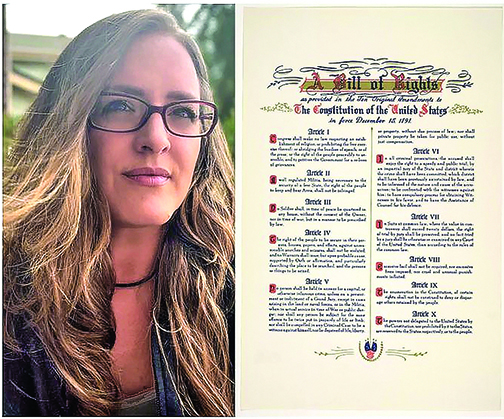
The First Amendment doesn’t promise comfort — it guarantees freedom of speech and assembly and religion and expression. Public institutions, from high schools to state universities, are legally bound to viewpoint neutrality. That means they cannot suppress expression because others dislike it or claim to feel unsafe.
But, that’s exactly what is happening to right-of-center students across our state.
In late October, the student government at Fort Lewis College in Durango voted to deny recognition of a new Turning Point USA (TPUSA) chapter. The Associated Students of Fort Lewis College justified the decision by citing “community safety” and the need to protect campus inclusivity. As the vote was announced, students in the gallery reportedly erupted in cheers.
For TPUSA students — who had followed all the procedural steps to become an official organization — the message was clear: Your ideas are not welcome here.
The College’s administration later released a statement reaffirming that Fort Lewis upholds free-speech rights consistent with the law; but it rings hollow for students whose peers, empowered by an institutional process, effectively vetoed their ability to organize.
Public colleges cannot delegate viewpoint discrimination to student governments. The mob does not get to decide whose ideas are protected — if the reason for denial rests on viewpoint, it crosses a constitutional line. Fort Lewis is a public college, and courts have repeatedly ruled that student governments exercising delegated authority act as state actors.
And this targeted suppression is not contained to universities.
In Eagle County, parents have circulated petitions opposing newly approved TPUSA clubs at Eagle Valley and Battle Mountain High Schools. The petition argues that TPUSA’s national reputation and past controversies make it unfit for public schools, claiming the organization “spreads hate.”
Despite the backlash, the school district allowed the clubs. Legally, they’re required to — the federal Equal Access Act bars public secondary schools from discriminating against student clubs based on viewpoint. Just like in Fort Lewis, the law is on TPUSA’s side. But the uproar has had a chilling effect.
Anecdotes from conservative students suggest that many students, who might otherwise have joined these clubs now won’t. Despite their constitutional protections, fear of retaliation — for their ideas — is preventing conservative students from organizing.
“This isn’t about speech, it’s about spreading hate!” Who decides what constitutes “hate?”
Perhaps the most egregious example of chilling student ideas comes from our state’s flagship land-grant university, Colorado State University (CSU). According to a 2025 report by the Foundation for Individual Rights and Expression (FIRE), 43 percent of CSU students say they self-censor on campus at least once or twice a month, and more than a quarter believe that violence is sometimes acceptable to stop a speaker. FIRE’s overall free-speech ranking gives CSU an “F” grade.
I wonder which quarter of the Rams want to use violence to stop ideas they disagree with. I’m quite confident it’s not the conservative students. And it’s not just that conservative students are quiet — it’s that they’re embracing silence for survival. When nearly half of a student body reports self-censoring, the marketplace of ideas is closing its doors.
Ironically, the campus most associated with liberal politics — the University of Colorado Boulder — has emerged as a relative model of free-speech protection. FIRE gives CU Boulder a “green light” rating, meaning its written policies fully respect First Amendment standards. Administrators there have repeatedly affirmed that all viewpoints, including controversial ones, are welcome.
The takeaway of that Rocky Mountain Showdown is that a campus can be both supportive and robustly open to dissenting ideas. Whether it will is another matter.
Conservative students are not asking for special treatment, only to participate in the same open dialogue promised to everyone else. Yet too often, their clubs are denied recognition, their peers cheer their exclusion, and their institutions justify violating their rights in the name of “safety.”
Safety is important — but safety cannot be defined as freedom from offense. The First Amendment was written precisely for moments like this, when Americans are divided, emotions are running high, and majorities are tempted to silence minority ideas.
The answer to speech that offends is not censorship, but more speech — reasoned, courageous, and unafraid. Free speech is not a gift bestowed by those in power; it is a right that limits their power. When inclusion is redefined to mean exclusion, education is properly defined as programming — and when the upcoming generations are programmed to devalue our most sacred American rights, the impacts are not contained to the campus.
Ashe in America is a writer and activist. Find all her work at linktree.com/asheinamerica.