by Charles Bonniwell
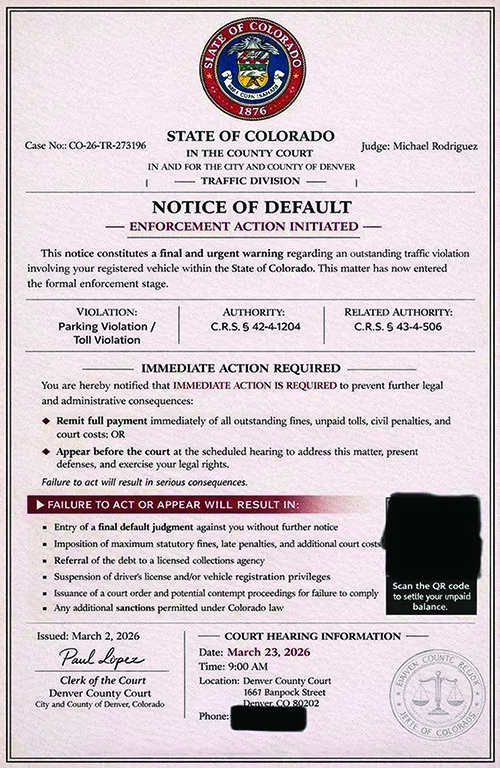
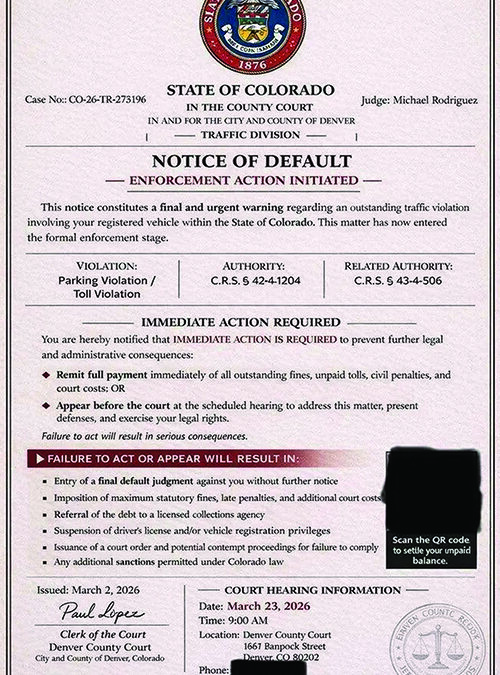
Scam: This fake court notice, circulated by scammers posing as Denver County Court officials, used official-looking seals, legal citations, and threats of penalties to trick recipients into providing credit card information.
Many readers in the Cherry Creek Valley assume that the individuals who are convinced by mail and phone scammers to send hundreds or even thousands of dollars to untraceable accounts are either gullible individuals or elderly people with diminished mental capacities. But fraud schemes are becoming increasingly sophisticated, and bright, very capable people are finding themselves duped, to their embarrassment as well as financial detriment.
The Federal Trade Commission states that since 2020, imposter scams reporting losses of $10,000 or more have tripled. The AARP estimates that total losses in the last year have reached as much as $196 billion.
These days, scammers use phone calls, texts, and e-mails to perpetrate many of these crimes. While email, mail, and text messages are the most frequent fraud methods, telephone solicitation is the most profitable vehicle for fraudsters by a two-to-one margin.
Recently, fraudsters have become increasingly effective at pretending they are law enforcement officers or representatives from financial institutions, including credit card companies.
Various Recent Scams
Court Order Scam
One recent successful scheme involved scammers sending a very official-looking text purportedly from the District Court of Colorado for Denver County, informing recipients that they were delinquent on parking, speeding, and toll fines. A fake court order instructed the recipient to pay the fine or appear in court the following Friday morning at 9 a.m.
Two hundred people appeared at the designated time at the City and County Building, only to discover that it was all a ruse. Hundreds more paid the requested $6.00 fee by credit card. The fraudsters were happy to take the small payment, but what they really wanted was the credit card information so they could go on a shopping spree.
Police And Jury Duty Scam
Scammers are now able to make whatever entity or person they want appear to be calling recipients, including banks, police stations, or federal agencies.
In one scam directed at Cherry Creek Valley residents, the caller ID indicated that the Denver Police Department was calling. If the potential victim answered the phone, the scammer would identify himself as a Denver police officer and indicate that the victim had a warrant for arrest for failure to appear in response to a jury summons. The pretend officer would instruct the victim to pay a bond or report to a local police station for arrest.

Call Centers: Many of today’s most successful scams originate from organized call center operations that are often overseas that use convincing scripts, caller ID spoofing, and psychological pressure to persuade victims to surrender money or personal information.
The scammer would direct the victim to obtain hundreds or even thousands of dollars in cash and go to a local Walgreens to wire the funds to a specific account. The potential victim was required to stay on the telephone line to prevent him or her from contacting anyone else. The funds would then go to an untraceable account controlled by the scammer.
Credit Card Scam
Another popular scam involves a fraudster calling from a number that appears on caller ID to belong to a bank or financial institution with which the potential victim does business. The fraudster’s number may even match the one on the back of the victim’s credit card.
The fraudulent caller tells the potential victim there is “suspicious activity” regarding his or her account. The caller may even know the victim’s name, home address, and the last four digits of his or her Social Security number. The fraudster then uses high-pressure tactics to get the victim to hand over key information such as PINs, passwords, or one-time passcodes.
The victim is instructed to send money to a “safe and secure account” that is actually controlled by the scammers and is untraceable.
IRS/Customs Agent Scam
Another successful recent scam involves a fraudster pretending to be an IRS or Customs agent and indicating that the victim is under suspicion of money laundering, or that the government has intercepted a package bearing the victim’s return address that contains drugs or other illegal substances. The caller demands that the victim post a bond over the phone or face immediate arrest.
Fraudsters are also increasingly using AI for their machinations. They can use the voice of a loved one claiming they desperately need help and requesting money be sent to an account controlled by the scammers.
Law Enforcement’s Response
Law enforcement has been slow to combat these cybercrimes. Many of the calls, e-mails, and texts are sent from abroad. Local law enforcement often does not have the resources or expertise to make a meaningful difference.
One encouraging development was the government of India raiding call centers, leading to the arrest of six leaders along with the seizure of laptops, cell phones, cash, and other devices. In the United States, two executives, former CEO Adam Young and a CSO, pleaded guilty to enabling the scam by providing telecommunications and call-routing infrastructure and advising cybercriminals on how to evade detection.
How To Avoid Being Scammed
The first rule in avoiding these scams is understanding that you are capable of being scammed, no matter how intelligent or sophisticated you may think you are.
It is recommended that you:
Avoid answering your telephone unless you know who is calling. If the caller has a legitimate reason for calling, they will leave a message. Scammers seldom leave messages.
Do not disclose your full name, home address, Social Security number, credit card information, banking information, or other personal details to anyone you do not know.
Do not click on e-mails or text messages from unknown sources.
Choose a safe word or phrase (“Mama Bear,” “rubber ducky,” etc.) that family members or loved ones can use to identify themselves in the event of a real emergency.
And finally:
If you are the possible victim of a scam, report it to local law enforcement and to the FBI at IC3.gov.
Whatever you do, remember that scammers are adjusting their schemes every day to ensnare you in their web of deceit, so stay alert.