by Valley Gadfly | Oct 19, 2026 | Main Articles
by Glen Richardson
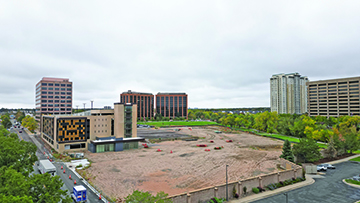
Promises Versus Reality: An aerial photograph shows the current condition of Glendale’s 10-acre Four-Mile District, where a six-story, 733-space parking garage stands alongside a large expanse of undeveloped land. Despite ambitious plans for a major entertainment and commercial destination, all work has ceased, the project is currently abandoned, and the $25 million garage remains the only building constructed by Salazar in the district.
Cities in Colorado are finding that entering into a seemingly binding contract with a developer to construct a critical downtown project does not mean it will ever, in fact, be done. The City and County of Broomfield entered into a $300 million agreement in 2019 with developers to construct a Broomfield Town Square on Main Street.
However, the September 12, 2026, deadline to pull the required building permits lapsed with no action taken. On October 13, the Broomfield City Council issued a notice to the developers to show cause why the Site Development Plan should not be revoked.
Even more frightening, the City of Glendale, in a court filing, accused Denver-based Central Street Capital (“CRC”), headed by Rob Salazar and his family, through a related entity, of inventing an excuse not to perform its obligations regarding the $150 million Four-Mile District along Cherry Creek on Virginia Avenue, down from Shotgun Willie’s. CRC then sued the city for $20 million in state court, the same amount a Salazar-related entity has sought from the City and County of Denver in an unrelated suit regarding property in Globeville.
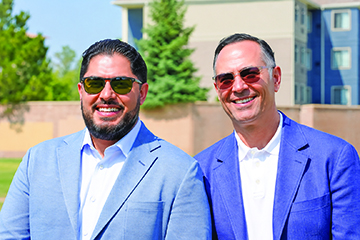
Litigious Father And Son: Rob Salazar (right) and Isiah Salazar (left) are pictured together at the groundbreaking of the Four-Mile District in Glendale on July 25, 2024. All work on the project has now ceased and through a related entity they are suing Glendale for $25 million which is just one of various lawsuits they have brought in the Denver area through entities they control against organizations (both private and governmental) they had been working with.
Glendale declared in its pleading: “Developer had no intention of completing the Project, so it manufactured a dispute to avoid closing on the purchase of Phase 1 Property.”
Litigious Family
The Glendale lawsuit is one of a long line of suits brought by Salazar-related entities regarding properties they are connected to in the Denver area.
Fox Street Investments LLC, a Salazar-controlled entity, acquired a small parcel of land (a 0.75-acre lot) in the Globeville area of Denver on which it wanted to squeeze a 20-story, 400-plus-unit apartment building. After the purchase, it sued the City and County of Denver, claiming its development rules were unconstitutional and caused the property to be worthless, while, absent the city rules, it would be worth $20 million.
Critics of the Salazars surmise that, instead of an entertainment district in Glendale, they wanted to acquire the 10-acre parcel, at least in part, to squeeze in high-density apartments, perhaps not dissimilar to what they are planning in Globeville.
A Salazar family holding company, SFF Reality Investors LLC, was a plaintiff in a 2019 lawsuit against Town and Country Motel, asserting that it was a public nuisance because of crime that interfered with its Fox Street properties.
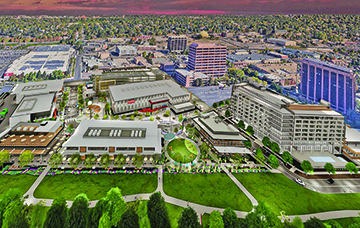
Grand Plans: An architectural rendering depicts the ambitious vision for Glendale’s Four-Mile District, including an Alamo Drafthouse Cinema, hotel, restaurants, retail establishments, and public gathering spaces.
Rob and his wife, Lola, brought a lawsuit as shareholders in Solaro National Bank, claiming that majority shareholder and chairman Michael Quagliano (known as “Red Pant Man” for wearing red pants while sitting courtside at Denver Nuggets home games) spent money on planes and helicopters for personal use, including trips to away Nuggets games.
Another Salazar-related case involved “Auraria Student Housing at the Regency” (formerly the Regency Hotel), which sued an entity called Campus Village, claiming its exclusive agreement with CU-Denver, requiring all new international students and incoming students to reside at Campus Village, was an unfair monopoly. A federal jury awarded the Salazar-related entity $3.26 million, which federal antitrust laws triple for injured parties.
In the LoHi area of Denver, CRC developed a 57-unit apartment building which it sold for $34 million to a third party but signed a lease to keep their office space in the building. CRC then turned around as tenant and successfully sued the new owner as landlord alleging it had created an “intolerable condition” through maintenance problems and a failure to maintain the building at the required standard.
Healthcare Litigation

Red Pant Man: Michael Quagliano nicknamed the “Red Pant Man” for his attire attending courtside Denver Nuggets games. He is the subject of a shareholder lawsuit filed by developer Salazar and his wife adding another chapter to the legal controversies surrounding the Four-Mile District’s former developer.
Rob Salazar was originally an accountant and, prior to becoming a real estate developer, was involved in the healthcare field, where he became embroiled in very serious litigation.
The United States government sued him personally, as well as other individuals and entities, including Solomon Health Management LLC, of which Rob Salazar was president and CEO, under the federal False Claims Act, alleging fraudulent Medicare and Medicaid billing. Salazar was able to get some of the claims dismissed, but not others. The public record does not reflect the final disposition of the remaining claims, although numerous lawsuits were filed by individuals relating to the matter, claiming negligent care.
Parking Garage To Nowhere
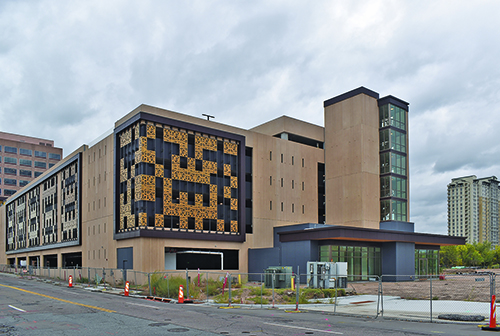
Four-Mile District Parking Garage: The only building constructed by developer Salazar in the currently abandoned Glendale’s Four-Mile District is this empty six-story, 733-space parking garage on Virginia Avenue. Built on a one-acre lot owned by a Salazar-related entity, the $25 million garage was financed entirely by bondholders, with Salazar bearing none of the construction costs.
The only building constructed by Salazar regarding Glendale’s Four-Mile District is a massive six-story, 733-space garage on Virginia Avenue, on a one-acre lot owned by a Salazar-related entity. The parking garage cost $25 million to build, all of which was borne by bondholders and not Salazar.
The money to repay the bonds was expected to come from sales tax and other funds generated by a functioning entertainment district, which is now not going to be built, at least not by Salazar. Critics of Salazar point out that the parking garage could serve a high-density apartment development that they surmise Salazar would want to build on the remaining acreage.
The attorney for CRC, Daniel Richard of the law firm Davis Graham & Stubbs, told The Denver Post/BusinessDen that Glendale’s claim that CRC didn’t plan to complete the project was “false, unsupported, and directly contradicted by the record.” The case is set for trial beginning January 4, 2027.
by Mark Smiley | Oct 19, 2026 | Main Articles
Denver Audit Questions City Oversight, Bidding, And Contract Practices During Massive Downtown Renovation
by Mark Smiley
Unexpected Discovery: A historic brick sewer discovered beneath Denver’s 16th Street contributed to construction delays and an $18 million settlement with PCL Construction Services. Denver auditors found the sewer had not been adequately considered during planning for the massive downtown renovation. Photo courtesy of PCL Construction.
A historic brick sewer buried beneath Denver’s 16th Street added $18 million in unexpected costs and nearly a year to the downtown corridor’s massive renovation project, according to a new audit that also raises questions about City Council oversight and the city’s handling of the construction contract.
Denver Auditor Timothy M. O’Brien’s office found that the discovery ultimately resulted in an $18 million settlement with contractor PCL Construction Services and extended the project schedule by 301 calendar days.
But the sewer itself was only part of the problem identified by auditors.
The audit found that contract changes involving millions of dollars took effect before the Denver City Council was notified. Auditors also raised concerns about the Department of Transportation & Infrastructure’s competitive bidding process, its oversight of subcontractors, and its enforcement of contract provisions.
Denver City Council initially approved $149 million in renovation costs for the 16th Street project in 2021.
What Was Under The Street?
The trouble began in 2022 when PCL crews encountered a brick sewer beneath 16th Street, bringing construction to a halt.
According to the audit, the city had con- ducted an environmental assessment as part of the federally funded project, but had not adequately investigated the sewer system during project planning.
Transportation & Infrastructure limited its investigation of underground utilities after consultants advised that a more extensive examination would require removing pavers and rerouting shuttle service.
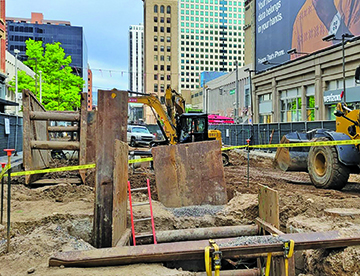
Long Road To Completion: Construction crews work along Denver’s 16th Street during the multi-year renovation of the downtown corridor. The discovery of an underground brick sewer extended the project schedule by 301 days, according to the Denver Auditor’s Office.
Complicating matters, Denver does not have a comprehensive map showing the location of all of the city’s historic brick sewers.
The potential for problems involving brick sewers was also not disclosed when the city solicited proposals from contractors, according to the audit.
PCL subsequently sought changes to its contract to cover the additional work and delays associated with the sewer. The city initially resisted, maintaining that the contractor had assumed those risks under the agreement.
The dispute eventually resulted in a settlement and an $18 million change order covering additional costs and schedule impacts.
“Because the city did not consider the sewer while planning the 16th Street Improvement Project, businesses on 16th Street had construction lingering outside their doors for nearly a year longer than expected,” O’Brien said.
The audit did not examine the economic impact of the prolonged construction on businesses along the corridor.
Council Left Out Of The Process
Auditors also questioned how such a significant financial change could occur without prior City Council approval.
According to the audit, council members were not notified about the increased costs and delays until after the changes between the city and PCL had already taken effect.
The City Attorney’s Office maintained that council approval was unnecessary because the agreement was handled as a “change order” rather than an amendment to the contract.
Transportation & Infrastructure said City Attorney guidance recommends change orders for changes involving scope, time, or budget unless the alteration represents a “cardinal change” to the original contract.
The department said the PCL agreement resulted from delays and a contractor dispute rather than a fundamental change in the project’s scope.
O’Brien warned that the distinction could create a loophole allowing expensive changes to major city contracts to escape council scrutiny.
“If there is no mechanism allowing change orders to become amendments, construction projects can continue circumventing City Council review for costly contract alterations,” O’Brien said. “When strong oversight is absent, budget transparency is reduced, and public trust in responsible city spending is lost.”
The Auditor’s Office recommended creating a process under which sufficiently significant change orders could become contract amendments and therefore receive additional review. Transportation & Infrastructure disagreed with the recommendation.
Questions About Bidding
The audit also found problems with the process Denver used to select a contractor.
Auditors said Transportation & Infrastructure did not maintain sufficient documentation to demonstrate a transparent competitive bidding process, making it unclear why PCL was selected over another company.
Three contractors initially participated, but one dropped out after becoming aware of potential utility issues, leaving two bidders.
The audit also criticized the city’s oversight of subcontractors. Transportation & Infrastructure took the position that because its agreement with PCL was a lump-sum contract — with a fixed scope and price — it had limited ability to obtain information about subcontractors.
As a result, auditors said the city has little documentation concerning companies that performed subcontracted work on the project.
$1 Million In Damages Waived
Another finding involved more than $1 million the city could have collected for missed completion deadlines.
According to the audit, Transportation & Infrastructure leaders chose to waive $1.03 million in damages associated with delays because they wanted to support the city’s relationship with PCL.
Auditors recommended stronger documentation of quality-control procedures and contract compliance. The department disagreed with that recommendation as well.
Transportation & Infrastructure did, however, accept several recommendations.
The department agreed to formalize what information about major projects should be provided to the City Council beyond what is legally required. It also agreed to maintain documentation of each step in the competitive bidding process for capital projects and develop a strategy for dealing with unexpected underground discoveries on future federally funded construction projects.
O’Brien said the findings do not mean the city’s overall project management system is ineffective, but they demonstrate areas where additional safeguards are needed.
“Our audit found that— while the city’s project management is generally effective — it can be strengthened,” O’Brien said. “I hope the Department of Transportation & Infrastructure implements our recommendations to make improvements. We will follow up in a later audit to see what they achieve.”
For a project intended to remake one of Denver’s most prominent public spaces, the audit provides a costly reminder that some of the biggest construction problems can be the ones no one sees until the street is torn open.
by Amber Wyatt | Oct 19, 2026 | Main Articles
by Amber Wyatt

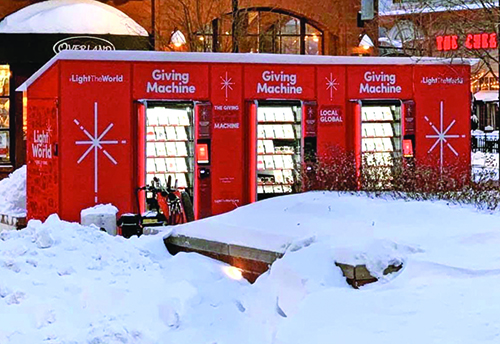
Some of the Giving Machine’s offers. Photograph by #LightTheWorld
A unique holiday tradition is returning to Cherry Creek North this November, offering Denver residents and visitors a memorable way to give back while enjoying the holiday season. The famous Giving Machines are set to open November 19, bringing a creative, interactive approach to charitable giving to the heart of one of Denver’s most popular holiday destinations.
Located at the entrance to the Cherry Creek Holiday Market on 2nd Avenue and Fillmore Plaza, the colorful, vending-machine-style displays will operate 24 hours a day, seven days a week, giving shoppers and passersby an opportunity to make a difference at any time.
Unlike traditional vending machines that dispense snacks or drinks, the Giving Machines allow visitors to purchase meaningful items for people and communities in need. Options may include warm meals, blankets, livestock, and other essential resources, with donations supporting participating local and global charitable organizations.
Popular Giving Machine location at 105 Fillmore St., Denver, CO 80206. Photograph by #LightTheWorld
The concept is simple: Choose an item displayed on the machine, make a payment and help provide that resource through a participating nonprofit. Rather than taking a physical product home, donors contribute toward providing the selected item to someone who needs it.
It is a straightforward way to turn an everyday holiday outing into an opportunity for generosity.
A Different Kind Of Holiday Shopping

Donor makes a donation to one of the offerings at the Giving Machine. Photograph by #LightTheWorld
The Giving Machines offer a visual and interactive experience that stands out among the seasonal decorations, storefronts, and festivities throughout C
herry Creek North. Their placement at the entrance to the Cherry Creek Holiday Market makes them a natural stop for visitors browsing holiday vendors, searching for gifts, or simply enjoying the neighborhood’s seasonal atmosphere.
For families, the machines can also provide a hands-on way to introduce children to charitable giving. Instead of donating money without seeing how it might help, visitors can select a specific need and connect their contribution to a tangible resource.
A warm meal can help someone facing food insecurity. A blanket can provide comfort during cold weather. Livestock can help support livelihoods and food security in communities where animals provide a source of income, nutrition, or agricultural support.
Each selection offers a reminder that even a small act of generosity can contribute to a larger effort to improve lives and visual aids on each option help children easily understand their impact.
The machines also offer a convenient option for people who want to support charitable organizations but may not have time to research individual causes or arrange donations themselves. With the displays available around the clock, visitors can stop by whenever it fits their schedule.
Giving Locally And Globally
The Giving Machines initiative is known for connecting donors with participating nonprofit organizations that address a variety of humanitarian needs. Depending on the participating charities and available selections, contributions can support assistance ranging from basic necessities to longer-term community development.
The initiative provides an alternative to traditional gift-giving, encouraging people to direct some of their holiday spending toward the
community. Visitors can choose a donation that benefits a family, individual, or neighborhood in addition to gifts purchased for their own. Those interested in participating should review the available selections and charitable organizations at the machines to learn which causes their contributions support.
As the holiday season approaches, the return of the Giving Machines adds another opportunity for the Cherry Creek community to embrace the spirit of generosity. Their prominent location makes charitable giving accessible to residents, tourists and holiday shoppers alike.
The Giving Machines are schedu
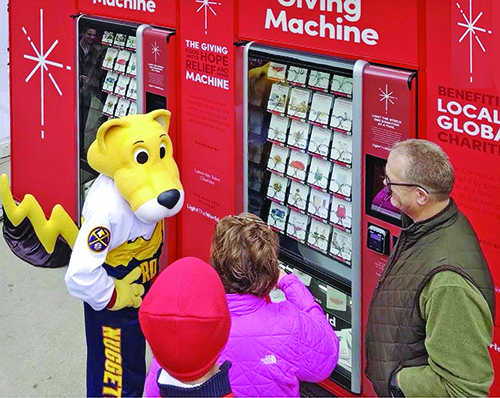
Denver Nugget’s Rocky attends Giving Machines opening in 2019. Photograph by #LightTheWorld
led to open November 19, 2026, at the entrance to the Cherry Creek Holiday Market on 2nd Avenue and Fillmore Plaza. Operating 24/7, they invite visitors to stop by, select a meaningful contribution, and help make the holidays brighter for someone else.
This season, consider adding a different kind of purchase to your holiday list: one that gives to your city, to your country, or your planet.
by Valley Gadfly | Sep 29, 2026 | Main Articles
One Man Killed In Parking Lot — Suspect Arrested In Mexico
by Glen Richardson
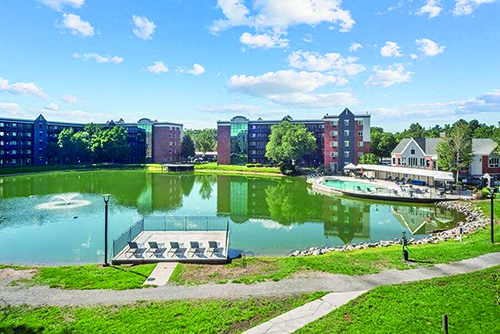
Apartment Battle: An extraordinary gun battle broke out at Esprit Cherry Creek Apartments that required the intervention not only of Glendale P.D. but also Denver, Sheridan, and Cherry Hills police departments. No individual has been charged yet but arrests are expected to be announced soon.
At 2:09 a.m. on August 31, 2026, the Glendale Police arrived at Esprit Cherry Creek Apartments where a wild gunfight broke out in the parking lot involving up to a dozen individuals who were believed to be predominately from Venezuela. One juvenile was badly wounded with a gunshot wound to the chest and was later pronounced dead.
Glendale would receive assistance from the Denver, Sheridan, and Cherry Hills police departments during the initial response and subsequent scene investigation. Because the gunfight is an active homicide investigation, the Glendale police are not releasing the identities of the individuals involved, information regarding potential suspects of interest, or specific investigative details at this time. Glendale detectives have identified several individuals connected to the investigation and are working closely with outside law enforcement and investigative partners. Various details of the information for this article has been obtained from third party sources outside of the Glendale police department.
The gunfight at Esprit was recorded on the apartment house’s residents. The videos allowed the Glendale police to track which apartments or automobiles the participants went into following the gunfight.
There were dozens of bullets lodged into the walls around Esprit as well as vehicles on the premises. Glendale police towed in four vehicles with bullet holes. Three individuals were taken into protective custody, but later released with no charges filed.
Crime Scene: Bullets were found sprayed throughout the complex as well as in vehicles in the parking lot.
One of the major participants in the gun battle was a Venezuela national identified by the Glendale police and traced down to Mexico, where he had been arrested in Mexico for violation of that country’s immigration laws. The suspect was likely in the United States illegally but not arrested in the United States for violation of this country’s immigration laws, and under Colorado law the Glendale police are prohibited from coordinating with ICE. The Glendale police department acquired an arrest warrant for the suspect and is coordinating for extradition with the Mexican government.
The individuals involved in the gun battle are believed to be rival factions of the Venezuelan transnational criminal organization know as “Tren de Aragua” (TdA). Members of that organization took over three apartment complexes in Aurora in 2024, and the subsequent criminal activity made national news.
In August of last year, the U.S. Department of Justice indicted 30 individuals associated with TdA in Colorado for drug trafficking, murder-for-hire, prostitution, and firearms crimes.
The enormous influx of Venezuela illegal immigrants to Denver including TdA members occurred under the Biden Administration. It had been estimated 40,000 illegal migrants reached Denver starting in 2022. The City of Denver placed in Aurora large numbers of illegal migrants bussed up from Texas to Denver. The transporting of those illegal immigrants to Aurora caused a major rift between the administrations of those two cities.
Glendale City Manager Chuck Line indicated that the Trump administration’s efforts to close the border have greatly reduced the influx into Glendale. However, a significant number of TdA members are still believed to be in the greater Denver area.
Glendale police anticipate additional arrests relating to the gunfight over the next several months.
by Mark Smiley | Sep 29, 2026 | Main Articles
Mill Levy Would Fund Employee Pay, Career Education, And Student Services As Voters Weigh Benefits Against Higher Property Taxes
by Mark Smiley
Tax Question: Denver Public Schools is asking Denver voters to approve an additional mill levy override in the November 2026 election. The measure would raise up to approximately $44 million annually, with much of the additional revenue directed toward employee compensation. DPS estimates the owner of a median valued Denver home would pay approximately $72 more per year.
Denver voters will decide this November whether to provide Denver Public Schools with an additional $43.9 million each year through a property tax increase, setting up a debate over employee compensation, student services, and how much more Denver property owners should be asked to contribute to the city’s public schools.
The Denver Public Schools Board of Education voted unanimously to place the mill levy override before voters. The proposal follows months of discussion about the district’s finances and recommendations from a citizen advisory committee assembled to consider both the need for additional revenue and how that money should be spent.
The largest share of the proposed revenue would go toward employee compensation. The advisory committee recommended approximately $25.8 million annually for salary increases for DPS employees. Another $4 million was recommended for career and technical education hubs, and $4.8 million for mental health and special education supports. Charter schools would receive approximately $9.3 million annually, reflecting requirements that charter schools receive an appropriate share of mill levy revenue.
For the owner of a median priced single-family home in Denver, DPS has estimated the measure would increase the school portion of the property tax bill by approximately $72 per year, or about $6 per month. Supporters argue that the relatively modest increase for an individual homeowner could collectively provide the district with meaningful resources to improve employee compensation, retain experienced teachers, and provide additional services for students.
Opponents and skeptical voters may view the question differently. Rather than focusing solely on the incremental cost of this particular measure, they are likely to consider the cumulative property tax burden Denver residents already face and ask whether a school district with a roughly $1.5 billion annual budget should find the money for its priorities within existing resources.
DPS officials have identified employee recruitment and retention as important reasons for seeking the additional revenue. The district has pointed to compensation gaps and difficulties filling certain positions, while educators have argued that competitive salaries are essential to keeping experienced teachers and other professionals in Denver schools. The issue also has roots in negotiations between DPS and the Denver Classroom Teachers Association. The teachers union and district previously reached an agreement to pursue additional compensation through a ballot measure after educators did not receive their full cost of living increase in 2024.

Students And Staff: Denver Public Schools Superintendent Alex Marrero visits a classroom. DPS says competitive employee compensation is necessary to retain staff, while voters will have to decide whether those needs justify another increase in property taxes.
From the supporters’ perspective, teacher compensation is not simply an employee benefit. They argue that it directly affects what happens in the classroom. Schools that struggle to recruit and retain experienced teachers may face greater turnover, more vacancies, and difficulty maintaining consistent instruction. Supporters contend that better compensation can help DPS compete with surrounding school districts and other employers for qualified workers.
There are similar arguments for spending additional money on mental health and special education. Educators have told the district that students have increasingly complex needs requiring additional support. The proposed mill levy would provide approximately $4.8 million for those services. Another $4 million would support career and technical education programs intended to provide students with pathways into skilled occupations, apprenticeships, and careers that may not require a traditional four year college degree.
District officials also point to broader financial pressures. DPS has experienced declining enrollment, which affects the amount of state funding it receives. Officials have warned that enrollment losses and uncertainty surrounding future state and federal funding could create increasingly difficult budget choices in coming years. DPS approved a balanced budget of approximately $1.5 billion for the coming school year, but district officials have said the longer term financial outlook presents challenges.
Supporters therefore see the mill levy as a way to provide a stable local source of recurring revenue. They argue that allowing salaries to become less competitive could ultimately cost the district experienced employees and make it more difficult to recruit replacements. They also contend that investments in mental health, special education, and career training can provide benefits that extend beyond traditional classroom instruction.
There are substantial arguments on the other side. Denver residents already pay significant property taxes to support DPS, and the district currently collects approximately $288.6 million annually through previously voter approved mill levy overrides. Denver voters have approved three such overrides since 2012, including a $32 million measure in 2020 that provided money for nurses, teacher compensation, and hourly employees such as bus drivers and custodians.
Critics may reasonably ask how often the district should return to voters for additional operating revenue. Each individual increase may appear relatively small when expressed as a monthly cost for the average homeowner, but taxpayers ultimately pay the combined cost of school district, city, county, and other taxing measures.
The timing of the proposal could also present a challenge for DPS. In 2024, Denver voters overwhelmingly approved a $975 million DPS bond, the largest in the district’s history. That money was designated for capital purposes including building maintenance, air conditioning, safety improvements, and technology rather than employee salaries or ongoing operations.
Bonds and mill levy overrides finance different types of expenses, making the current proposal substantially different from the 2024 bond. Nevertheless, some voters may look at the broader picture and question being asked to approve another significant school funding measure less than two years after authorizing nearly $1 billion in borrowing.
There is also a question of long-term sustainability. Employee raises represent recurring expenses. Once salaries increase, those higher costs generally remain in the district budget year after year. The mill levy would likewise produce recurring revenue, but critics may question whether increasing property taxes is the best long term method for financing employee compensation, particularly at a time when DPS enrollment has been declining.
The proposed $43.9 million represents only a relatively small portion of DPS’s approximately $1.5 billion annual budget, and that fact provides arguments for both sides. Supporters can contend that a comparatively small increase in overall district funding could produce meaningful improvements in compensation and student services. Critics can argue that a district with a budget of that size should be able to identify $43.9 million through reprioritizing existing spending.
The debate is further complicated by Colorado’s system for financing public education. Schools receive funding through a combination of local property taxes and state revenue, meaning decisions made at the state level can have significant effects on local school district budgets. DPS officials say the district has become increasingly dependent on local property taxpayers as the financial environment for public education has changed.
For voters, the November decision ultimately comes down to priorities and competing concerns. A yes vote would mean higher property taxes in exchange for approximately $43.9 million in additional annual school funding. The largest portion would be directed toward employee compensation, with additional money supporting career and technical education, mental health, special education, and charter schools.
Supporters will argue that approximately $6 per month for the owner of a median priced Denver home is a reasonable investment in attracting and retaining teachers, supporting students, and maintaining the quality of Denver’s public schools. They will also argue that failing to remain competitive on compensation could result in staffing shortages and greater turnover that ultimately affect students.
Opponents are likely to argue that Denver taxpayers have repeatedly supported DPS funding measures and that the district should demonstrate it can meet its priorities within the substantial resources it already receives. They may also point to the cumulative effect of property tax increases at a time when housing affordability and the overall cost of living remain concerns for many Denver residents.
The question does not offer voters an especially simple choice. Competitive teacher compensation and adequate student services are important to the quality of Denver’s schools. Property tax affordability, fiscal accountability, and careful use of public money are also legitimate concerns.
The November election will give Denver voters the final say on whether the benefits DPS says would come from an additional $43.9 million each year are worth the additional cost to property owners.
by Jessica Hughes | Sep 29, 2026 | Main Articles
by Jessica Hughes
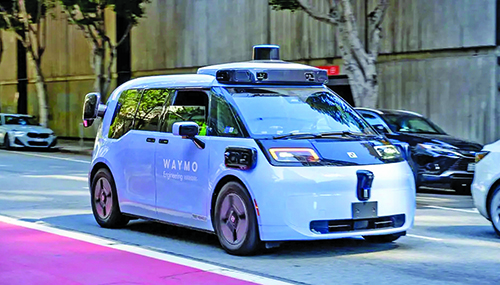
New Kid In Town: The distinct Waymo autonomous vehicles have been hitting the streets of Denver and Glendale since September 1.
While you may not be ready to hand over the keys quite yet, driverless cars have officially arrived in Denver. Waymo began welcoming its first public riders in Denver and Glendale on September 1, 2026, bringing fully autonomous ride-hailing service to the Mile High City and putting the Cherry Creek Valley at the forefront of a rapidly changing transportation industry.
The rollout places Denver and Glendale among a growing number of American cities where residents can hail a vehicle using a mobile app and travel across town without a human driver behind the wheel. Waymo launched public rides in Denver and Glendale simultaneously with San Diego and Tampa, and has continued expanding into additional markets.
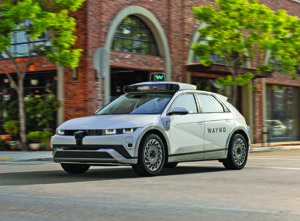 For some, the sight of a car navigating busy city streets with nobody sitting in the driver’s seat may still look like something out of a science-fiction movie. But Waymo’s arrival is the culmination of more than 15 years of research and development.
The technology began as Google’s self-driving car project in 2009. Waymo later became a separate company under Google’s parent company, Alphabet, and has spent years testing autonomous vehicles on public roads and gradually introducing commercial ride-hailing service.
The Cherry Creek Valley presents a particularly interesting challenge. Unlike many of Waymo’s earlier markets, the Mile High City experiences snow, ice, freezing temperatures, and rapidly changing weather conditions. Denver therefore offers an important proving ground for autonomous vehicles operating in a four-season climate.
Waymo announced its arrival to the area in September 2025, initially bringing a mixed fleet that included Jaguar I-PACE vehicles equipped with its fifth-generation autonomous driving technology and newer vehicles using its sixth-generation system. The company said its newer technology had benefited from previous winter-weather testing in Michigan, upstate New York, and the Sierra Nevada.
During the months leading up to the public launch, Waymo vehicles became an increasingly familiar sight on Denver-area streets as the company validated its technology under local driving conditions.
Rather than relying solely on GPS to determine where a vehicle is and where it needs to go, Waymo vehicles use a sophisticated combination of cameras, radar, and lidar sensors to continuously monitor their surroundings. The company’s autonomous driving system, known as the “Waymo Driver,” is designed to recognize other vehicles, pedestrians, cyclists, traffic signals, construction zones, and unexpected obstacles while making driving decisions in real time.

Ride At Your Fingertips: A rider uses the Waymo app to request an autonomous vehicle. Similar to other ride-hailing services, the app allows passengers to request a trip, locate their vehicle, and follow their ride — with one major difference: there is no human driver.
For passengers, however, the experience is designed to feel surprisingly ordinary. A rider requests a vehicle through the Waymo app much like requesting a ride through Uber or Lyft. When the vehicle arrives, there is no driver to greet the passenger. Riders can identify their assigned vehicle through the app and use features such as displaying their initials on the vehicle or remotely sounding its horn to help locate it.
Once inside, passengers buckle up, select their destination, and let the vehicle do the driving.
There is also no awkward question about how much to tip at the end of the trip. Because there is no human driver, tipping is not part of the Waymo experience.
The Appeal Of A Driverless Ride
Supporters of autonomous vehicles see considerable potential in the technology, with safety at the top of the list. Unlike human drivers, computers don’t get tired, distracted by text messages, angry at other motorists, or impaired by alcohol. Autonomous vehicles are also designed to monitor their surroundings continuously in every direction.
 Waymo says its safety data shows its autonomous driving system has been involved in substantially fewer serious crashes than comparable human drivers. The company reported at the Denver launch that its vehicles had experienced 94 percent fewer serious-injury-or-worse crashes compared with human drivers traveling comparable distances.
Those figures come from Waymo’s own analysis and will undoubtedly continue to receive scrutiny as autonomous vehicles accumulate more miles and expand into more cities. Another potential advantage is mobility.
Driverless transportation could eventually provide greater independence for people who cannot drive because of age, disability, or certain medical conditions. Older residents who have stopped driving, for example, could potentially maintain greater independence without relying entirely on family members, public transportation, or traditional ride-hailing services.
There are lifestyle benefits as well. Passengers don’t have to make small talk with a driver, worry about a driver canceling a trip, or wonder whether the person behind the wheel has been driving for too many hours. Some riders may simply prefer the privacy of having the vehicle to themselves.
Autonomous vehicles could also provide another option for people who have been drinking. A readily available driverless ride could give someone leaving a restaurant, bar, sporting event, or concert another alternative to getting behind the wheel.
Waymo’s vehicles are electric, adding another transportation option for cities attempting to reduce vehicle emissions.
Not Everyone Is Ready
For all of those potential advantages, there are also legitimate questions surrounding driverless cars. Perhaps the biggest is a simple one: What happens when something goes wrong?
A human driver can encounter a police officer directing traffic around an accident, a construction worker giving unusual hand signals, an unexpected road closure, or any number of situations that require judgment and communication. Autonomous vehicles must interpret those situations through software and sensors.
And the Denver area adds another variable: weather. A sunny September afternoon is considerably different from a January morning following eight inches of snow. Lane markings can disappear beneath snow and ice, visibility can deteriorate quickly, and residential streets may remain snowpacked long after major roads have been cleared.
The Denver area could therefore become an important real-world test of whether autonomous vehicles can operate as reliably in difficult winter conditions as they do in the warmer climates where much of the technology was initially deployed.
There are economic concerns, too.
Uber and Lyft created an enormous gig economy built around human drivers. If autonomous vehicles eventually capture a significant portion of the ride-hailing market, fewer human drivers could be needed. Taxi drivers, rideshare drivers, and eventually workers in other transportation industries could face increasing competition from vehicles that don’t collect wages, take breaks, or call in sick.
Privacy is another consideration. Autonomous vehicles necessarily rely on numerous cameras and sensors to understand their surroundings. Riders may reasonably want to know what information is collected during a trip, how long it is retained, and how it is used.
There is also the question of accountability. When a conventional vehicle crashes, responsibility typically rests with one or more human drivers. A crash involving a fully autonomous vehicle raises more complicated questions involving the vehicle operator, software developer, manufacturer, and insurance companies.
Those issues will likely become increasingly important for lawmakers and regulators as autonomous vehicles become more common.
Waymo Versus Uber And Lyft
Although Waymo, Uber, and Lyft can all get a passenger from Point A to Point B, the experience is fundamentally different.
The most obvious distinction is the empty driver’s seat.
Waymo’s vehicle is operated by an autonomous driving system rather than a rideshare driver using his or her personal vehicle. That means there is no driver to tip, no conversation unless the passengers are talking among themselves, and no individual driver deciding whether to accept a particular trip.
Pricing can vary depending on the trip and demand, much as it does with other ride-hailing services, so Waymo will not necessarily always be cheaper than Uber or Lyft.
The companies are not necessarily destined to be competitors everywhere, either. Waymo has already partnered with Uber in some markets, demonstrating that autonomous vehicles could eventually become another type of vehicle available through existing ride-hailing networks.
Denver And Glendale
Become A Testing Ground
Waymo’s arrival does not mean the Denver area’s streets will suddenly be filled with thousands of driverless vehicles. Access is being introduced gradually. When Waymo launched public rides in Denver, San Diego, and Tampa on September 1, the company said tens of thousands of people in each city had already expressed interest in riding. Waymo said it would steadily add riders as it worked toward opening service more broadly.
The company has also said it intends to expand its service areas over time as the technology and operations develop. That gradual approach means residents are likely to see more Waymo vehicles on local streets even if they haven’t yet taken a ride themselves.
And that may be the most significant part of Waymo’s arrival. For decades, the driverless car was one of those technologies that always seemed to be just around the corner. Engineers promised it, futurists predicted it, and automakers demonstrated prototypes, but most Americans continued to get into vehicles with a person sitting behind the wheel.
That is beginning to change. There are still important questions involving safety, employment, privacy, regulation, winter-weather performance, and public acceptance. Some residents will undoubtedly download the app at the first opportunity, while others may need considerably more convincing before they are comfortable climbing into a car with an empty driver’s seat.
Either way, the Cherry Creek Valley is now part of that experiment. The future of the driverless automobile isn’t simply coming anymore. It’s already navigating our streets.
High-Tech Driver: Waymo’s fifth-generation autonomous driving system sits atop an all-electric Jaguar I-PACE. Cameras, radar, and lidar sensors allow the Waymo Driver to continuously monitor its surroundings and navigate without a human behind the wheel.