Has Cherry Creek Become Denver’s New Downtown?
by Mark Smiley
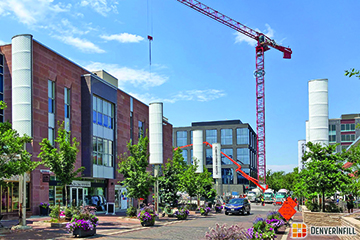
Changing Skyline: Construction cranes and road closures have become familiar sights in Cherry Creek North as new residential and commercial buildings transform the neighborhood. The development boom brings investment but also concerns about congestion, parking, and the area’s changing character.
For decades, downtown Denver was the undisputed center of the city’s business community. Its skyscrapers housed major corporations, its streets bustled with office workers, and its restaurants, hotels, and entertainment venues attracted visitors from across Colorado. Cherry Creek, meanwhile, offered something different: an upscale shopping district with fashionable boutiques, neighborhood restaurants, tree-lined streets, and a distinctly smaller-town atmosphere.
Today, that distinction is blurring. Construction cranes tower above Cherry Creek as older commercial buildings give way to luxury condominiums, modern offices, and high-end hotels. International hospitality brands are investing in the neighborhood, while businesses seeking prestigious addresses increasingly look beyond Denver’s traditional downtown.
The transformation raises a more fundamental point: Has Cherry Creek become Denver’s new downtown?
Cherry Creek may never rival the central business district in height or size. Yet it increasingly offers the hallmarks of a downtown: offices, high-density housing, hotels, restaurants, retail, and substantial economic activity, all within a relatively small area.
The economics help explain the possibility. Cherry Creek’s new residences frequently target affluent buyers, while many service and hospitality employees cannot afford to live in Cherry Creek. Downtown’s aging office towers, by contrast, present opportunities for residential conversion. Denver’s downtown revitalization strategy calls for reducing as much as 7 million square feet of vacant office space through reuse and other measures, and for adding affordable housing. The city has identified conversion support for the University Building (120 planned mixed-income units), Petroleum Building (178 units), and High Fidelity Plaza (more than 700 planned apartments).
The more likely possibility is that Cherry Creek is not merely becoming a second downtown; it is gradually replacing the old one as the address of choice for premium offices, investment, and high-end commerce. In that scenario, downtown Denver would take on a different assignment: housing more of the people who staff Cherry Creek’s offices, shops, hotels, and restaurants. The city center that once supplied the jobs could increasingly supply the workers for Cherry Creek.
The Cherry Creek alternative to Downtown Denver is comprised of two adjoining parcels of land separated by 1st Avenue. Cherry Creek North’s 16-block business improvement district represents only a portion of the larger commercial center rapidly emerging as an alternative to downtown Denver. The district encompasses approximately 27 acres, or 1.18 million square feet of land. Across First Avenue, the Cherry Creek Shopping Center occupies approximately 34 acres, excluding the adjoining 13-acre Cherry Creek West redevelopment site. Together, these areas represent roughly 74 acres, or 3.22 million square feet of land. By comparison, Denver’s historic Lower Downtown district, commonly known as LoDo, encompasses 23 blocks.
According to an April 2026 report by Engineering News-Record, 10 major redevelopment projects had been completed or were underway in Cherry Creek North since 2020, with five additional projects under review. Approximately 300,000 square feet of office space and hundreds of residential units had recently been added.
The latest indication of Cherry Creek’s growing prestige came October 29, when Four Seasons announced plans for its first standalone private residences in Colorado. The proposed eight-story development at 215 Detroit Street will feature 42 luxury condominiums ranging from approximately 1,260 to 6,000 square feet. Residents will have access to amenities associated with five-star hotels, including a rooftop pool, private dining facilities, spa services, housekeeping, and concierge assistance.
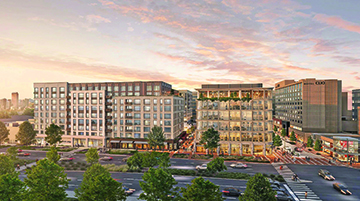
Cherry Creek’s Future Skyline: An architectural rendering illustrates the dramatic transformation underway in Cherry Creek North as luxury residential towers, office buildings, and mixed-use developments reshape the neighborhood.
The project, known as Cherry Creek, A Four Seasons Private Residence, is being developed by a consortium that includes Wexford Real Estate Investors, Stillwater Capital, Zabel Investment, and Brue Baukol. The announcement follows another major luxury residential project, Waldorf Astoria Residences, which is under construction in Cherry Creek North. The arrival of internationally recognized hospitality brands reflects developers’ confidence that affluent buyers will pay substantial premiums to live in the neighborhood.
Perhaps the strongest argument that Cherry Creek is emerging as a new downtown comes from its commercial office market. While downtown Denver has struggled with elevated office vacancies and changing workplace habits, Cherry Creek has continued attracting companies willing to invest in premium office space. Its newest commercial developments offer employers attractive, walkable locations surrounded by restaurants, retail establishments, and luxury residences.
Cherry Creek’s Southern Gateway Faces A Dramatic Transformation
Across 1st Avenue is the second portion of the new Cherry Creek downtown. As luxury condominiums and office towers reshape Cherry Creek, Cherry Creek South is poised to transform its western edge, replacing the Cherry Creek Shopping Center’s older retail buildings and parking lots with a denser mix of housing, offices, shops, and public spaces.
Cherry Creek South, sometimes referred to as Cherry Creek West is a 13-acre redevelopment project on the western side of the Cherry Creek Shopping Center near First Avenue and University Boulevard. Developer East West Partners plans to replace aging retail buildings and surface parking areas with an entirely new mixed-use neighborhood featuring seven buildings, approximately 840 residences, 600,000 square feet of office space, and 100,000 square feet of retail. Some buildings could rise as high as 13 stories, bringing a dramatically different skyline to an area historically known for shopping rather than high-density urban living.
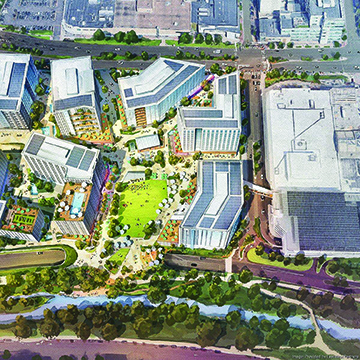
Cherry Creek West: Seven planned buildings, approximately 840 residences, 600,000 square feet of offices, and 100,000 square feet of retail. The tallest buildings could reach 13 stories. The first phase is targeted for 2029, with a second phase tentatively planned for 2033.
Demolition began in March 2026, and the first phase is expected to be completed in 2029, with additional construction potentially continuing into the next decade. Plans also include pedestrian-friendly streets, public gathering spaces, improvements to the Cherry Creek Trail, and underground parking. Developers envision a neighborhood where residents can live, work, shop and dine without relying on their automobiles for every trip.
The scale raises pressing questions. Can First Avenue, University Boulevard, and surrounding intersections accommodate the additional residents, employees, and shoppers? And will taller buildings and greater density preserve the neighborhood atmosphere that made Cherry Creek desirable?
South of First Avenue, the shopping center remains a major anchor rather than a bystander to the building boom. Cherry Creek South is being built on underused land at the mall’s western edge, not on the entire shopping center. The first phase is targeted for 2029, and the later phase has been projected for 2033. Alongside the Cherry Lane redevelopment across First Avenue, this expansion suggests that Cherry Creek’s future commercial center will extend well beyond the familiar boutique blocks north of First Avenue.
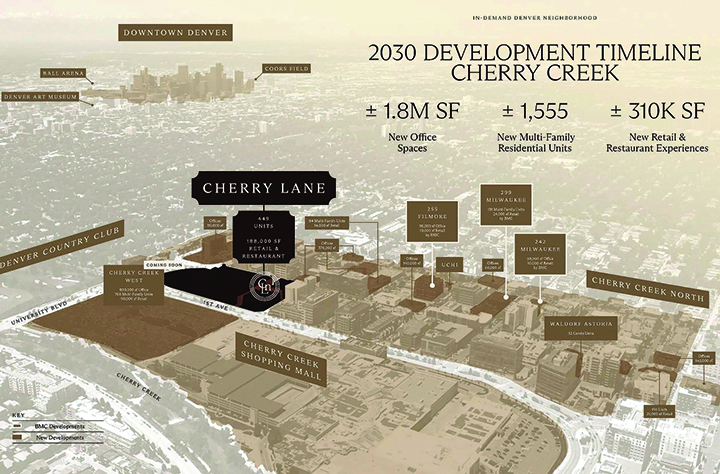 The 2025-26 State of Cherry Creek report offers additional evidence of the area’s economic strength. The broader Cherry Creek area generated approximately $119.3 million in tax revenue during 2025, including $62.1 million in retail sales taxes. The report also identified more than 16,800 jobs and nearly 1,700 businesses across the broader Cherry Creek area. Cherry Creek North’s office vacancy rate was reported at approximately 1.3%, illustrating the demand for commercial space.
By comparison, the downtown Denver area encompasses several times the size of these combined Cherry Creek area properties. Yet Cherry Creek’s relatively small geographic footprint makes its emergence as a competing commercial center all the more remarkable. While downtown Denver remains substantially larger, Cherry Creek is increasingly challenging its traditional role as the city’s premier destination for business, investment, and upscale urban living.
Downtown Denver’s Troubling Decline
While developers invest hundreds of millions of dollars in Cherry Creek, downtown Denver faces a different reality: vacant offices, falling commercial property values, and changing patterns of work and commerce.
Perhaps no building better symbolizes that decline than the iconic Wells Fargo Center, commonly known as Denver’s Cash Register Building. The 52-story skyscraper, one of the most recognizable landmarks on the Denver skyline, was appraised at approximately $85 million in May 2026, a staggering 82.1% decline from its 2019 valuation. A building that once represented Denver’s economic strength has instead become a striking example of the financial troubles confronting downtown office owners.
The Cash Register Building is not alone. Other downtown office properties have faced foreclosures, loan defaults, and steep valuation declines, with some selling for a fraction of earlier prices. Those losses affect more than owners and lenders: they raise questions about downtown’s ability to attract and retain businesses.
According to commercial real estate firm CBRE, downtown Denver’s office vacancy rate reached 40.1% in the third quarter of 2026, roughly four out of every 10 square feet. Cherry Creek North’s reported rate was approximately 1.3%. The figures cover different markets and reporting methods, but the contrast is striking.
For decades, downtown Denver’s economic vitality depended on thousands of workers filling office towers every weekday. Those employees supported restaurants, coffee shops, retailers, parking garages, and countless other businesses. But remote work, corporate downsizing, and changing office preferences have disrupted that economic model. Even buildings with tenants may have far fewer employees coming through their doors than they did before the pandemic.
The result is a downtown that can feel dramatically different from the bustling commercial center many longtime Denver residents remember. Empty storefronts and quiet office corridors have become familiar sights in portions of the central business district. Although LoDo, Union Station, sporting events, and entertainment venues continue attracting visitors, the traditional weekday office economy has suffered considerably.
As demand for traditional office space weakens, city leaders and developers are exploring residential conversions. The idea is appealing, but transforming aging towers into apartments can be costly, and the resulting housing may differ considerably from Cherry Creek’s luxury condominiums.
Some conversions could offer market-rate apartments; others may include income-restricted housing. Either could bring residents downtown, but housing alone cannot guarantee the return of busy sidewalks, thriving storefronts, or a robust weekday economy.
If these conversions succeed, downtown may become more residential and some experts surmise that it could become a source of housing for the large workforce that will be needed to service the new expanded Cherry Creek area which will not have room for such housing. Under such a scenario, the city’s homeless and drug addicted residents would remain in the old downtown and not migrate to the newer and more upscale Cherry Creek area.
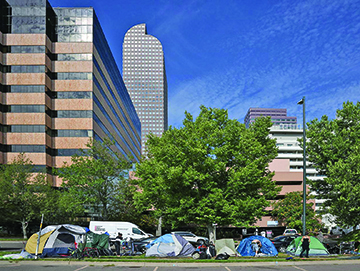
Downtown’s Uncertain Future: A homeless encampment sits beneath Denver’s iconic Cash Register Building, illustrating the challenges that have confronted the city’s traditional business district. While Cherry Creek North attracts luxury development and commercial investment, downtown Denver continues to grapple with office vacancies, declining property values, and homelessness.
Homelessness and perceptions of public safety also shape downtown’s future. Visible street conditions can influence whether employers, residents, and visitors spend time there. Affordable housing does not cause homelessness, and office conversions do not necessarily increase it. But residential growth will need to be accompanied by attention to safety, street maintenance, services, and active ground-floor businesses.
None of this means Cherry Creek has surpassed downtown as an employment or commercial center. Downtown still hosts major companies, government offices, cultural institutions, sports venues, and transportation connections that Cherry Creek cannot readily duplicate. LoDo, Union Station, and Coors Field continue to attract visitors.
Cherry Creek offers another model: walkable blocks combining upscale retail, restaurants, professional offices, and residences. Rather than competing on skyscraper height, it is emerging as an alternative urban center built around convenience and a concentrated mix of uses.
Denver could increasingly have two distinct economic centers: downtown as its civic, cultural, and transportation hub, and Cherry Creek as a destination for luxury housing, boutique offices, and high-end commerce. Whether that division strengthens the city or deepens economic separation remains to be seen.
For all the enthusiasm surrounding Cherry Creek’s development boom, the transformation has not come without consequences. Construction has disrupted streets and sidewalks, complicated parking, and created challenges for businesses attempting to remain accessible to customers. As additional residential units and office buildings open, increased traffic could place greater pressure on streets, parking facilities, and pedestrian infrastructure.
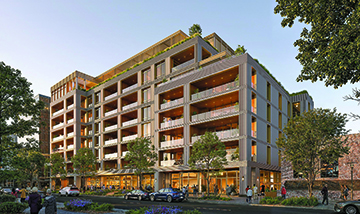
Luxury Living: An architectural rendering depicts the proposed Four Seasons Private Residences at 215 Detroit Street. The eight-story development would add 42 luxury condominiums to Cherry Creek North, raising questions about the neighborhood’s increasingly exclusive housing market.
New luxury condominiums may increase the overall housing supply, but developments designed for wealthy buyers do little directly to provide affordable options for teachers, service workers, younger professionals, and others employed in the neighborhood. This could be supplied by the revised former Downtown Denver. Cherry Creek has always been affluent, but there is a difference between a prosperous neighborhood that welcomes a range of residents and businesses and an exclusive district where participation increasingly depends on wealth.
Viewed together, the projects could change traffic patterns, population density, and infrastructure needs more than any single development suggests. City planners and neighborhood stakeholders will need to assess their cumulative effects.
Supporters point to investment, jobs, and tax revenue; critics worry about congestion, affordability and pressure on independent businesses.
As Cherry Creek’s skyline rises and downtown office towers lose value, the question is not simply how much Cherry Creek will grow. It is what downtown Denver will become if more businesses, workers, and investment choose to go elsewhere, and whether Cherry Creek can grow without losing the character that made it special.