by Mark Smiley | Mar 19, 2021 | Travel
New Lobby Referred To As The 16th Street Mall Living Room
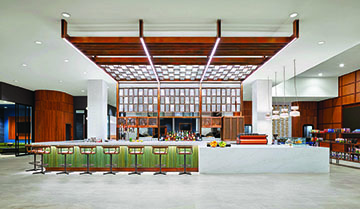
Bar Bar: The 16th Street Commons Coffee Bar Bar transitions guests from day (coffee) to night (cocktails) with food and beverage options that are locally sourced. It sits in the center of the redesigned lobby at the Sheraton Denver Downtown.
by Mark Smiley
The Sheraton Denver Downtown completed a full-scale renovation of its guest rooms, lobby, public and meeting spaces as part of Sheraton’s worldwide transformation of its guest experience vision. Only one other hotel in North America (Sheraton Phoenix) was commissioned for such a renovation. The conceptual phase started in 2013 and continued through 2016 when Marriott International purchased Starwood Hotels & Resorts Worldwide for $13 billion. The concept became a reality in February 2021.
“We are honored to be one of the first hotels to bring the new Sheraton brand to life in the heart of Denver,” said Tony Dunn, General Manager for the Sheraton Denver Downtown. “The renovation will serve to highlight what is already incredible about the local Denver community — and bring the best of the Sheraton brand to downtown. As travel starts to resume, these changes will strengthen Denver’s position as a global gathering place for groups, conventions, guests and locals alike, and will act as a public square for our growing, evolving city.”
The Sheraton was one of the first original town centers in the United States and one of the towers was built in 1959 and was a Hilton Hotel. It was designed by I. M. Pei who is most famous for designing the Louvre Pyramid which sits at the entrance of the Louvre Museum in Paris. In fact, the new fireplace in the lobby nods to Pei’s original tower design, featuring a plaster imprint of the historic ceiling tiles that remain on the tower’s second level.
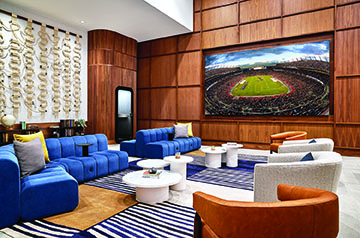
Media Wall: The 16th Street Commons Sitting Room provides a central gathering area in the lobby bringing the community together with soft seating and a media wall to catch all the big games.
Sheraton Denver Downtown includes Sheraton’s new signature key elements that aim to create an environment where guests can feel comfortable and at ease, whether working, meeting or relaxing. “We want locals to feel like guests and guests to feel like locals,” said Tracy Blair, Director of Sales and Marketing, Sheraton Denver Downtown. “The locals are definitely invited in and if you’re a guest, we want you to experience local flavors. We want you to know you are in Denver.”
The completion of this $80 million hotel renovation changed the face of the hotel and Denver’s iconic 16th Street Mall. Sheraton Denver Downtown has long been a familiar anchor in Downtown Denver, serving as the largest meetings/events hotel in the city. Today, this transformation is officially complete, with all aspects of the hotel updated and refreshed–including a new arrival experience, 133,000 square feet of renovated meeting space and 1,236 newly redesigned guest rooms and 138 suites as well as a new culinary and beverage experience.
“This is a pivotal moment for Sheraton as we see hotel owners embracing the new vision and bringing it to life,” said Amanda Nichols, Senior Director and Global Brand Leader of Sheraton Hotels. “Over the past 80 years, Sheraton has always offered guests the time-honored assurance of a welcoming community. We’re proud to have built on this legacy in the new concept, creating an environment where guests can enjoy all the familiar comforts of the Sheraton brand, but with fresh, contemporary updates. As travel resumes, we look forward to welcoming guests into this new chapter for Sheraton at Sheraton Denver Downtown.”
A Modern-Day “Public Square”
At the heart of the new experience at Sheraton Denver Downtown is the lobby. This has been re-imagined as the “Public Square” of the hotel called the 16th Street Commons; an open space that invites people to join together or be alone amongst others.
Sheraton Denver Downtown features all the signature elements of the new brand vision. This includes the Community Table, a purpose-built workspace that anchors the hotel’s lobby and allows guests to work, eat and drink. Following Sheraton’s philosophy to embrace both form and function, these tables are custom designed with amenities to keep guests productive, including built-in lighting, outlets and wireless charging stations.
The Studios, flexible gathering spaces available to book whenever a guest needs it, is in a less formal setting. Built on elevated platforms and enclosed with glass, the tech-enabled Studios allow guests privacy and focus for everything from small group meetings to private dining experiences. Soundproof booths are also placed around the lobby, ideal for a phone call to connect privately with friends, family or colleagues.
Sheraton Denver Downtown’s new food and beverage offering creates a focal point in the lobby experience. Part bar, part coffee bar, part market, the 16th Street Commons Coffee Bar Bar is a central pillar of the new Sheraton vision, transitioning guests from day to night with food and beverage options that are locally sourced. “It’s really the focal point now for the lobby,” said Blair. “The food and beverage is pulled out from the corners and walls and it is placed as a focal point of the community. We feel we are the living room of the 16th Street Mall.”
Guest Rooms
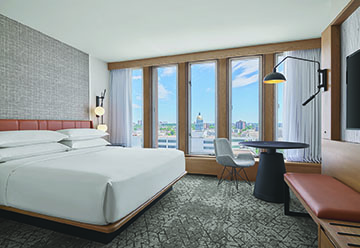
Remodeled Rooms: All of the guest rooms, including king accommodations (pictured) have been newly remodeled.
The new guest rooms, which were torn down to the studs during renovation, feature a bright, well-lit space with warm, residential appeal, comprised of soft finishes and light wood tones accentuated with black metal accents. The rooms have new tools for productivity, such as a height-adjustable worktable, integrated power and charging and layered lighting; while still retaining some of the classic Sheraton signature amenities, including the Sheraton Sleep Experience platform bed. The guest bathroom has also been completely redesigned with new and modern walk-in showers.
Sheraton Denver Downtown is following all of Marriott International’s Commitment to Clean protocols, created in partnership with leading experts in food and water safety, hygiene and infection prevention, and hotel operations. These protocols include mandated mask-wearing for all guests and associates within the hotel, and the use of electrostatic sprayers and disinfectants recommended by the Centers for Disease Control and Prevention and World Health Organization to sanitize surfaces throughout the hotel.
For more information on the Sheraton Denver Downtown, visit www.marriott.com/dends.
by Mark Smiley | Mar 19, 2021 | Main Articles
Wash Park Home Built In The 1890s Faces Wrecking Ball; ‘Park Won’t Be The Same If Home Is Razed,’ Residents Stress
by Glen Richardson
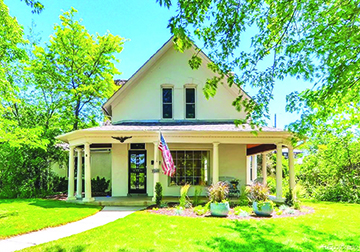
Stunning Site: Home, sweet historic home’s prominent location creates an established and familiar feature for both Wash Park and the Mile High City.
In a neighborhood where real estate is in high demand, demolition threatens a rare Wash Park Queen Anne home built no later than 1890. Neighbors were surprised and shocked when a demolition notice was posted at the 800 S. Franklin St. home by the City & County of Denver.
The oldest occupiable property from the 19th Century remaining in the neighborhood, it is located on a large corner lot across Franklin St. from Wash Park and across E. Ohio Ave. from St. John’s Church. The home is a rare remaining example of the Queen Anne Style in West Washington Park.
Representing the distinctive visible characteristics of a Queen Anne, it has the asymmetrical massing including projecting octagonal bays, steep gabled roofs, deep classical eaves and hooded windows. The porch features Tuscan order columns and classical entablature — an architectural section located above the columns on the building’s exterior. Largely developed 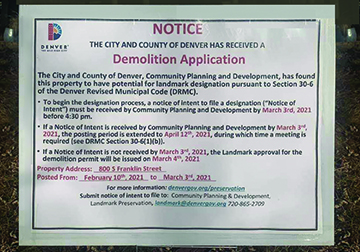 in the period between the world wars, many of the houses in the neighborhood were constructed in more revivalist or eclectic styles such as Tudor revival or Craftsman.
Saving Historic Site
Ironically the bid to bulldoze the $2,300,000 home was posted in March as Historic Denver began celebrating five-decades of saving and highlighting historic treasures under threat of annihilation. The non-profit got started by saving the Molly Brown House from demolition in 1970. The organization is hosting a 50th bash at the Molly Brown House Museum now through Sept. 19. The celebration includes a “50 Actions for 50 Places” campaign for sites worthy of preservation action.
Sixth generation Coloradan Drew Carder — who has spent nearly his entire life in Wash Park — is among the neighborhood admirers and supports nominating the Franklin St. home as a community mecca worthy of preservation protection. He says he doesn’t know much about the home other than it is one of the last remaining pieces of the neighborhood’s history. “I feel like this community should be given more of a chance to respond.”
Like Carder, Justin Moorland has spent most of his life in or around Wash Park. Today he lives on the 600 block of S. Gilpin, one block away from the Franklin St. house. “It has always been my favorite home at the park. I find it unique because of its obvious age, modesty and setting. It is truly from another era.” Admits Liz Schanker, “I guess that proximity gives me extra incentive to save the home.” She lives right next door to 800 S. Franklin and says she has lived in Wash Park long enough to be able to imagine the structure that would go up on the site and doesn’t want that to happen. “There is a plethora of new, urban mansions in the neighborhood but only one white farmhouse that predates the park.”
Stunning Setting
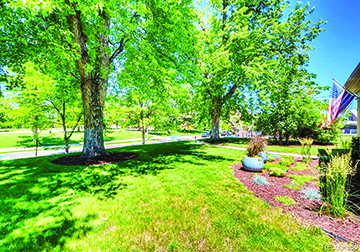
Stunning Site: Home, sweet historic home’s prominent location creates an established and familiar feature for both Wash Park and the Mile High City.
Set far back from Franklin St., the home has an unusually large front yard at the corner of E. Ohio. Because of the house’s large, open lot and prominent location, it creates an established and familiar feature for both Wash Park and the Mile High City. One of the neighborhood’s first buildings, it was constructed before the City of Denver became the City and County of Denver. Moreover, despite its age the house retains a high degree of integrity.
The original Queen Anne structure has experienced some alterations including the stuccoing of the masonry, the northern addition plus alterations to some window openings. Nonetheless, it still retains integrity of design, materials and workmanship to communicate its Queen Anne style. The home is in its original locations, and while the area around the house has been altered over time, the house retains its setting through its relationship to Washington Park and Smith Lake. The interior includes a breakfast nook, vaulted ceilings, walk-in closets and fireplace. The structure is encircled by a wrap-around front porch.
Bid To Bulldoze
Wash Park developer-builder Aaron Grant is the person seeking demolition of the historic home. He is owner-managing-broker of South Gaylord St.-based Grant Real Estate Co. Retailers and residents will recall it was his firm that bulldozed long-standing stores along Denver’s second oldest commercial block to build Park Coworking. The company website claims, “We maintain history and character in the Wash Park neighborhood through real estate design and development.”
In conversations with relatives of the owner who sold the house to Grant Real Estate, neighbors were purportedly told that Grant articulated to them “what they wanted to hear as a seller.”
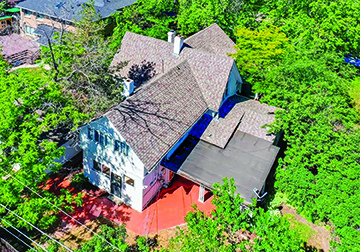
Treasure Threatened: Demolition threatens this rare Queen Ann home located across Franklin St. from Wash Park. The oldest occupiable property from the 19th Century remaining in the neighborhood, the house has retained a high degree of integrity despite its age.
At the time he was purchasing the property, Grant also allegedly indicated that he wanted to keep the shell of the home and remodel the interior. “We know now this was probably never his intent,” they say.
Noteworthy Owners
According to the Denver Assessor’s records, 800 S. Franklin St. was constructed in 1890. If the date is accurate, it would make the house one of the earliest remaining buildings in the West Wash Park neighborhood. Additionally, it confirms the house was built prior to the City of Denver becoming the City and County of Denver, which was not until 1902.
The earliest record of home ownership was by lumber tycoon Joseph Sterling who started Sterling Lumber & Investment Co. Records suggest, however, the house may be older that 1890 as a 1900 fire destroyed building records prior to 1890. The last prominent person to live in the Franklin home was William H. Burnett, a distinguished jurist who served on the Denver County Court for 17 years.
In 1964 Burnett served as President of the Judicial Research Foundation and became head of the American Bar Association’s Section of Judicial Administration. The judge lived at the Franklin St. address with his wife Margaret from 1963 until his death in 1973. He was at the height of his career when he lived at the address, therefore the property bears a strong association with him and his significance as a local judge and reformer.
by Mark Smiley | Feb 19, 2021 | Editorials
In the year 2000 I sat down to clarify my thoughts about the strange circumstances that seemed to be gathering momentum in our American culture. In light of our situation today, I think you will agree; if we would have cared to look, we would have seen this coming and acted sooner!
What will we do today to stop the accelerated loss of our personal liberty? If we do nothing; what will our “Liberty” look like in a few short years or for that matter months?
Today is Sunday January 24, 2021. Almost One year into a worldwide Pandemic and lockdown.
The world as I saw it in the year 2000 no longer exists — without the lessons learned from great past civilizations, will our Grandchildren have the ability to create a future?
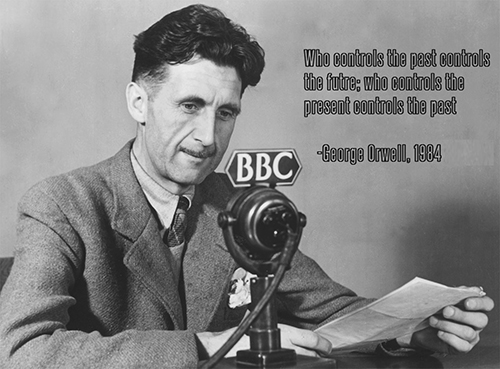
“Who controls the past controls the future. Who controls the present controls the past!”
— George Orwell
March 2000
Personal Liberty is under an assault from a counter culture bent on absolute control of our government and the American way of life. Have I lost my mind — probably, but not on this issue. This statement sounds like I am outside staring at the sky awaiting the arrival of black helicopters. If I had made this comment 20 years ago, around the table, over a few beers you would still be able to hear the laughter. In the same setting today, the reaction would be quite different — disbelief, fear, and discomfort would replace the laughter. Not because the audience disagreed with the statement, but because someone said “such a thing” in public. The insidious, unrelenting Thought Police tasked with destroying “intolerance” with an iron fist have stifled us. We now find ourselves on the outside barely able to look in.
“When I use a word,” Humpty Dumpty said, in a rather scornful tone, “it means just what I choose it to mean — neither more nor less.” “The question is,” said Alice, “whether you can make words mean so many different things.” “The question is,” said Humpty Dumpty, “which is to be the master — that’s all.”
— Lewis Carroll,
Through the Looking Glass
A general malaise infects our culture. The common person knows that a “misplaced” opinion or humorous comment about a “protected” group can destroy their lives. Equality of opportunity has given way to equality of outcome, personal rights to group rights. Personal rights bring personal wealth, personal success, and competition, and those who don’t make the grade are left behind. The counter culture believes in false equality predicated on the lowest common denominator.
To the counter culture, “social justice” has come to mean “protection” for certain groups from attacks by the “enemy” (principally white heterosexual males). It seems that everything we say, or do, can somehow exemplify our intolerance or downright hatred for a “protected” group. The great elixir of mankind, humor, should be avoided altogether. In fact, humor seems to be non-existent in the lexicon of the Thought Police. The ironical self-deprecating humor that was the hallmark of our nation’s immigrants is now considered to be hate speech on the part of the “enemy.” Even if you are the brunt of your own joke, the counter culture believes there exists an underlying “intolerance” that lurks dormant and insidiously hidden in your psyche that must be purged by the counter culture. Ultimately, it is not just our freedom of speech that is under attack, it is the freedom of thought.
“The price paid for intellectual pacification is the sacrifice of the entire moral courage of the human mind.”
— John Stuart Mill
To avoid falling into this “trap” we have developed a habit of self-censorship that has become so unconscious we fail to recognize the mind-numbing subliminal effort involved in maintaining the correct speech necessary to escape the wrath of the Thought Police. At some point it is easier to avoid thinking, and subsequently, disengage.
We are becoming a lobotomized society in which everyone believes that it’s every man for himself. A considerable number of Americans fail to recognize the counter culture’s agenda, and believe that the counter culture is interested in “inclusion” and constructive dialogue. They have become the unwitting foot soldiers that practice appeasement as a way to reconciliation. History shows us that the appeasers (after their usefulness expires) are the last to be executed.
Control The Debate
Frame the debate! Dehumanize your enemy! Call your adversary a sexist, racist or bigot, and you will no longer need to answer his arguments. He is now faced with defending his character. In the courts, there is a presumption of innocence until proven otherwise. However, in the court of public opinion if you are charged with sexism the burden of proof falls squarely on the shoulders of the accused. This is precisely how ideologues entrench themselves in a system; they exploit and ruin those on whose backs they rode to power. They begin by working in the establishment, and through insinuation and infiltration rather than through confrontation, they erode the system from within, all the while claiming that the root of the problem stems from the old guard, and its ideals. Thus, we find ourselves in a situation where the counter culture not only controls the answers but the questions asked. It is attempting to control how we understand the daily events of our lives.
Control History
“Who controls the past controls the future. Who controls the present controls the past!”
— George Orwell
“To destroy a people, you must first sever their roots.”
— Alexander Solzhenitsyn
When attempting to destroy your enemy, destroy the record of their past, and fill the void with a new history. Dishonor or disgrace his heroes, and you can demoralize his people. Besmirch, and degrade your adversary to the point that any and all outrageous comments will go unchallenged. Sit back and watch the crows devour what is left of the past and your future!
Yours in Hope, Etienne

by Mark Smiley | Feb 19, 2021 | Featured Stories & Advertisers

by Mark Smiley | Feb 19, 2021 | Featured Stories & Advertisers