
by Mark Smiley | Oct 19, 2026 | General Featured
by Mark Smiley
For TruSox owner Dave Banning, the idea seemed simple: donate socks and gloves his company could not sell to people who needed them. Instead, he says, Colorado tax rules made giving the merchandise away more expensive than throwing it in the trash. The experience became one example of the regulatory frustrations that eventually prompted him to move his company’s Colorado operations to Kentucky.
TruSox makes premium performance socks with proprietary grip technology designed to keep athletes’ feet stable inside their shoes. Its products are used by professional and other high-level athletes. The socks retail for about $55 a pair, or $70 for a wool version, and Banning insists that customers receive flawless merchandise.
During manufacturing, heat can reveal imperfections in the knitted socks. Banning estimates that 3% to 4% of merchandise becomes unsuitable for retail sale. The company also had excess ski gloves, including perfectly usable sizes retailers no longer wanted. Rather than discount those products and potentially undermine his brand, Banning wanted to donate them to homeless shelters.
That is where he encountered Colorado’s use-tax rules. TruSox purchases socks as inventory intended for resale, without paying sales tax at that stage. According to Banning, when the company removes merchandise from inventory to donate it, the state treats that as a taxable use. Discarding the same merchandise, he says, would not trigger the additional tax.
The distinction struck Banning as absurd. His company had already lost its investment in products it could not sell. Donating them could add a tax bill to that loss. “Why would I pay additional tax?” he asked. “I’m losing every penny I have in this product.”
Banning understands why rules prevent businesses from buying goods tax-free and then using them for their own benefit. But he questions applying the same treatment to unsellable goods handed to a nonprofit. “No one could explain what ‘use’ my business received for goods that we were wanting to donate,” he said in a follow-up email. “We were losing 100% of our investment to begin with, much less an additional ‘use’ tax levied by the state.”
He sought help from state Sens. Jeff Bridges and Lisa Cutter. Banning stresses that both lawmakers took his concerns seriously and worked diligently to find an answer. Over roughly a year and a half, he says, they communicated with the Colorado Department of Revenue, trying to clarify the rules and identify a practical solution.
“They were really good about trying to figure out what and why all this,” Banning said. He does not consider the dispute partisan and does not blame either senator for the outcome.
Instead, he says the experience raised a larger question about accountability in state government. “One of the central issues is elected officials not being able to get results from unelected bureaucrats that are writing and imposing regulations that were passed by the same elected officials,” Banning wrote. “It appears these bureaucrats have more power than the elected officials.”
Banning said he was told the state collected more than $1 million annually through this category of taxation and was reluctant to surrender that revenue. He also recalls Bridges recognizing the irony: public programs may spend money securing socks and gloves for shelters while a company offering similar goods for free faces a tax consequence.
One proposed workaround, Banning said, was to accumulate $10,000 worth of seconds before donating them. But storing that much unsellable merchandise would consume warehouse space. He wanted to deliver a box or two to a shelter as items accumulated, not stockpile pallets waiting to meet a threshold.
“I wanna drop a box once a week at the shelter when they need it,” he said. He wasn’t seeking a special financial benefit, he added, only a way to keep useful products out of landfills and get them to people who could use them.
The tax dispute was not the sole reason TruSox left Colorado. Banning cites an accumulation of regulations and employment costs that made competing with companies in other states increasingly difficult. He does not necessarily oppose measures such as paid family leave in principle, but says their costs matter to businesses competing nationally.
By Banning’s estimate, 99.9% of TruSox’s business was outside Colorado. He kept operations here largely because he grew up in the state. Ev
entually, that personal connection was not enough. About two years ago, he moved production to Kentucky. TruSox now has no Colorado employees.
The departure eliminated approximately 15 to 20 local jobs, many of them entry-level production and shipping positions. B
anning knows one small company’s move will not dramatically alter the state’s economy. His concern is what happens when many employers make the same calculation.
“The state’s not gonna miss my 15 or 20 dinky little jobs,” he said. “But if there’s enough people like me that say, ‘We’re done, we’re out,’ you’re gonna start seeing it.”
Unlike restaurants or repair shops that depend on local customers, manufacturers serving national markets can relocate production and shipping. Banning believes policymakers should consider the cumulative consequences of those decisions.
“It’ll be 20 here and 40 there and 10 here and five there,” he said. For TruSox, the decision is final. “I finally had enough.”
by Amber Wyatt | Sep 29, 2026 | General Featured
by Amber Wyatt
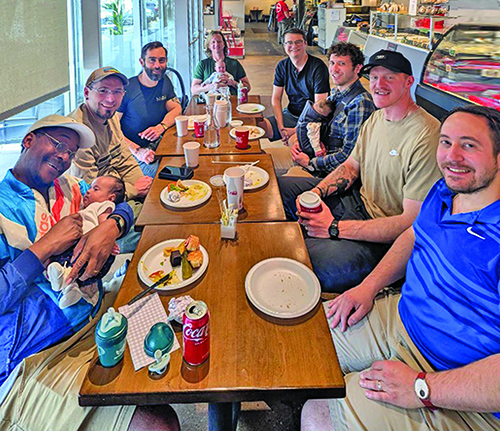
Abbas and Babbas participants meet on a Sunday at Zaidy’s Deli.
For many new parents, the first years of raising a child can be both joyful and isolating. While mothers often have access to a variety of support groups and parenting networks, fathers can find it more difficult to connect with others navigating the same stage of life. The Staenberg-Loup Jewish Community Center (JCC Denver), located at the intersection of Leetsdale Drive and South Dahlia Street, is working to change that with the launch of Abbas & Babbas, a free community program created specifically for dads of infants and toddlers.
The program is part of the JCC’s expanding First 36 initiative, which supports families from pregnancy through a child’s first three years. While many of the organization’s prenatal and postnatal offerings have traditionally focused on mothers and caregivers, Abbas & Babbas recognizes that fathers also benefit from dedicated spaces to build friendships, exchange advice, and navigate the challenges of early parenthood together.
The name combines the Hebrew word “Abba,” meaning father, with the familiar English word “Baba,” creating a welcoming title that reflects both Jewish tradition and the diverse families who make up the Denver community.
The program alternates between two types of gatherings every other week. Tuesday evening sessions feature facilitated conversations led by a licensed therapist, giving fathers an opportunity to discuss topics ranging from sleep deprivation and work-life balance to relationships and the emotional transition into parenthood. These conversations are designed to create a supportive, judgment-free environment where participants can openly share both successes and struggles.
On alternating Sundays, the group trades the meeting room for more casual outings. Fathers and their babies gather at parks, museums, restaurants, and other locations throughout the Denver metro area, providing opportunities to socialize while spending quality time with their children. Babies are welcome at all events, and no registration is required, although advanced sign-ups help organizers plan attendance.
The program reflects a growing understanding that fathers play an increasingly active role in raising young children and also benefit from meaningful peer support. Research has shown that strong social connections can improve parental well-being, reduce stress, and ultimately strengthen family relationships. By creating intentional spaces where fathers can connect with one another, the JCC hopes to foster lasting friendships that extend well beyond the early years of parenting.
Although rooted in Jewish values of community, kindness, and inclusion, Abbas & Babbas welcomes fathers of all backgrounds. The JCC has long positioned itself as a community resource serving the broader Denver population through educational, recreational, cultural, and wellness programming, regardless of religious affiliation.
The addition of Abbas & Babbas complements a growing lineup of family-focused offerings at the JCC, including prenatal education, breastfeeding support, caregiver-and-child classes, early childhood education, cultivating sleep routines, and the Community Baby Closet, which provides essential supplies to families without excluding fathers. Together, these programs aim to support parents through every stage of early childhood, from pregnancy through the toddler years.
As Denver continues to attract young families, initiatives like Abbas & Babbas demonstrate how community organizations are adapting to meet the evolving needs of modern parents. By recognizing that fathers also need connection, encouragement, and community, the JCC is helping ensure that no parent has to navigate the challenges of early childhood alone.
Abbas & Babbas meets every Tuesday evening at the JCC Denver, 350 S. Dahlia St., with alternating Sunday social gatherings held throughout the metro area. Participation is free, and fathers with babies or toddlers are encouraged to attend.

by Mark Smiley | Aug 20, 2026 | General Featured
 For the nineteenth year, Glendale fielded a team in the Government Relay category of the Colfax Marathon. This year’s team finished with its best time in eight years, placing 29th out of 72 teams. Representing Glendale (left to right) were Sergeant Shaun Farley, Community Development Administrator Hannah Forbes, Victim Services Coordinator Victoria Chavez, Mayor Pro Tem Storm Gloor, Essentrics instructor Jenny Bertrand, and Officer Anthony Donaldson.
by Amber Wyatt | Jul 23, 2026 | General Featured
by Amber Wyatt
The family’s latest location and a Virginia Village staple in Monaco Square, at 962 S. Monaco St. Pkwy., Denver, CO 80224.
Nestled in the heart of Virginia Village, Denver’s newest Italian standout, Pomodoro Pizza Pasta, isn’t just another neighborhood trattoria, it’s a warm and loving ode to family, from the owners to the tables they welcome.
The dream behind Pomodoro began in New York City, where the founding family, New York City immigrants in the early 1980s, worked in restaurants where they crafted an idea rooted in what they value most, teamwork and camaraderie. Their first restaurant, located in Aurora, aimed to serve a diverse range of quality Italian fare, catering to Coloradans of finer tastes.
Founders Luis and Gloria Enriquez, along with Gloria’s cousin, Jesus, combined decades of experience in both the front and back of house to create something truly special. Together, they form the restaurant’s heart and soul: Luis and Jesus crafting fresh dishes and signature sauces with remarkable precision, while Gloria welcomes guests with the warmth and hospitality that have become synonymous with the restaurant itself.
What makes this team exceptional goes beyond the food. Gloria is more than a founder, she is the face of the restaurant and the reason so many customers feel like family. She greets regulars with warm hugs, remembers names and favorite orders, and makes every guest feel seen. She never forgets a face, and it’s not uncommon for her to remember the smallest details about you, like serving my ice water with two lemons without ever being asked.
In the kitchen, Luis and Jesus move with the rhythm and confidence that comes only from years of experience. Every dish is prepared with care, consistency, and pride. Together, the Enriquez family has built more than a successful restaurant; they have cultivated a community. Their dedication to authentic Hispanic hospitality, hard work, and genuine human connection has helped redefine the dining experience in Southeast Denver, bringing warmth and heart to an area that was longing for both.

Shrimp Arrabiata (with a spice).
After the collapse of the Soviet Union in 1991, while the Enriquez family found stability in the glow of the New York City lights, Denver became home to growing communities of immigrants from Russia, Ukraine, Belarus, and other former Soviet republics. Many settled in southeast Denver and nearby Aurora because of affordable apartments and access to public transportation. As those communities grew, businesses followed and over time, Monaco Square, home to the latest Pomodoro location, became one of the area’s informal cultural hubs.
Its current identity developed organically as southeast Denver became one of the city’s largest centers of immigrant communities, which not only created demand for specialty eateries but a warm and inviting rustic culture of connection that still gives the area its distinctive character today. The reality of immigrant families landing here was never part of the mission but a beautiful, well fitting irony, especially for the owners of Pomodoro.
That mission: good food and real people, followed them west in 2024. Where they opened their second Italian joint in Virginia Village, at the infamous Monaco Square plaza, it instantly blew up. The 750 sq ft space could not contain all of the foodies flooding in to try their menu. When the opportunity arose to open a second Pomodoro in Denver, they seized it, as the Aurora location, loved for its intimate atmosphere, simply couldn’t contain all of the Colorado love it was receiving. What makes this new spot special isn’t just the red sauce or the freshly-made pastas though, it’s the family behind the stove.

Sebastian, Nicolas, and Angel – Pomodoro’s specialty pizzas.
Pomodoro is a family affair: from behind-the-scenes prep to front-of-house smiles, everyone shares an important role and a promise. A restaurant regular I caught on his way out, reflected on the origin story, recalling the family’s New York dream as driven by “an immigrant’s desire to make delicious and affordable Italian food for the working people of Denver.” That mindset didn’t fade and they’ve carried it into every corner of the Denver space.
Look around the dining room and you’ll catch genuine moments: the matriarch and owner Gloria checking each table’s satisfaction, the youngest member skipping between stations with a cheeky grin, and diners greeted not as customers, but as part of the weekly feast. Regulars already describe the scene as “like visiting an aunt’s house”, where hugs replace handshakes, and unfinished wine glasses are refilled before they have to ask.
The Menu:
Hearty, Homemade, Heartfelt
While the ambiance exudes familial comfort, the kitchen’s offerings shine with rustic simplicity and fresh quality ingredients. Expect all the classics done right:
- Cheese Tortellini Carbonara – A love letter to the restaurant’s ethos, this salt-cured pork belly in a creamy guanciale sauce envelops perfectly al dente rounds, with a sprinkle of parmigiano-reggiano.
- Penne Alla Vodka – From their custom menu, and my personal favorite, this creamy, with a hint of spice, dish reflects the “freshest and finest ingredients” philosophy that the family lives by.
- Famous Pizzas – A humble marriage of savory, each named in honor of the founding family’s grandchildren.
– Sebastian’s Pizza – Pizza with penne, vodka sauce, and sun-dried tomatoes
– Nicolas’ Pizza – Pizza with fresh chicken caesar salad topped with parmesan
– Angel’s Pizza – Pizza with an alfredo sauce base, topped with a medley of bacon, meatballs, and onions
Community, One Meal At A Time

The Virginia Village location hosts a full service bar in the warm and charming ambiance.
Pomodoro’s appeal lies in more than just delicious fare, it’s the simple but powerful way the owners forge connection. They greet newcomers like old friends and catch familiar faces by name. One Denver foodie remarked over their opening weekend, “This feels less like a dinner out and more like coming home.” That connection reminds us that food doesn’t just fill us; it roots us.
Under their roof, tables aren’t just seats, they’re places where conversations happen, stories are shared, and strangers leave feeling part of something warm. The founders remember replicating this vibe in Aurora, saying early on that “every customer gets to leave with memories curated in the pride of a homestyle atmosphere.” Now in Virginia Village, that signature consistency and haven of familiarity is fully intact.
Pomodoro nails the tactile, sensory markers of Italian comfort:
- Checkerboard tablecloths – a visual throwback to family-run pizzerie of the 1950s.
- Evening candlelight and soft jazz – just enough to lean in and laugh with your dining companion over the soothing flicker of natural light.
- Fresh floral centerpieces – echoing those old NYC trattorias full of calming aromas.
It’s here you’ll toast a “salute” to family.
Why It Matters
In a neighborhood rich with independent immigrant-owned eateries, Pomodoro stands out by rewriting what it means to treat customers like kin. You don’t just dine here, you belong. Their secret isn’t in an ingredient list either, it’s in the sum of all parts: heartfelt hospitality, traditions rooted in New York immigrant drive, and food cooked with open hands and open hearts.
For Denver diners craving authenticity, simplicity, and a sense of belonging, Pomodoro is more than another pasta stop, it’s your extended family’s kitchen away from home.
Stop in for a plate of rigatoni, leave carrying a food wallop and a memory. As the family behind Pomodoro would say: Everyone’s welcome, come as you are.

by Mark Smiley | May 19, 2026 | General Featured
by Mark Smiley
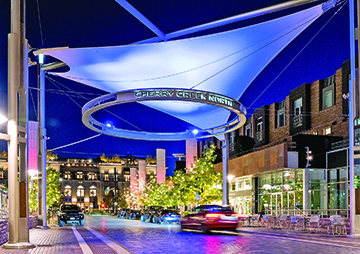 Cherry Creek continues to solidify its position as one of Denver’s strongest economic engines, according to a newly released State of Cherry Creek report highlighting continued growth in development, retail, tourism, office space, and small business activity throughout the district.
Released May 15 by the Cherry Creek Alliance, the report paints a picture of a thriving mixed-use neighborhood that continues to outperform many national and regional trends despite broader economic uncertainty in commercial real estate and retail sectors.
The report found that Cherry Creek welcomed more than 16.8 million visitors annually and currently supports 1,694 businesses and more than 16,800 workers, reinforcing its reputation as one of Denver’s premier destinations for shopping, dining, business, and tourism.
One of the most notable findings involved office space performance. While office vacancies remain a challenge nationwide, Cherry Creek’s office market continued to outperform many competing urban districts. Cherry Creek North’s office vacancy rate dropped to just 1.3% in 2025, while the broader Cherry Creek office market posted a 10.5% vacancy rate — figures significantly stronger than many major U.S. markets.
Retail performance also remained exceptionally strong. The report cited a retail vacancy rate of just 1.9% along with average lease rates of $36.05 per square foot triple net, demonstrating continued demand from retailers seeking a presence in the high-traffic district.
Development activity throughout Cherry Creek also continues at a rapid pace. According to the report, eight projects are currently under construction while another eight developments have been announced. Major projects include the highly anticipated Cherry Creek West development, the Waldorf Astoria Residences, and Cherry Lane, all of which are expected to further reshape the neighborhood in the coming years.
The district also generated more than $119.3 million in tax revenue for the City and County of Denver in 2025, including $62.1 million in retail sales tax revenue, $44.7 million in property taxes, $7 million in lodger’s tax revenue, and $4.9 million from parking revenue.
Small businesses remain a major component of Cherry Creek’s economic identity. The report found that the district supports more than 462 ground-level retail and service businesses, with 87% classified as small businesses and 60% qualifying as micro businesses with fewer than 10 employees. More than half of the area’s small businesses are locally owned.
Employment and wages also continued to rise in 2025, with Cherry Creek posting 1.7% employment growth and 3% wage growth. Professional and office sectors contributed significantly to the gains, while the average annual wage in the district reached $102,266.
Tourism and hospitality indicators also remained strong. Hotels within the Cherry Creek North Business Improvement District posted a 72.78% occupancy rate with an average daily room rate of $295.51 and revenue per available room reaching $216.61, outperforming citywide and statewide averages.
“Cherry Creek continues to prove that it is a vibrant, walkable mixed-use district and a powerful driver of economic growth and community vitality,” said Nick LeMasters, president of the Cherry Creek North Business Improvement District, in the report. “The momentum we’re seeing today reflects years of thoughtful collaboration between businesses, developers, residents, and community leaders.”
The Cherry Creek Alliance said the findings underscore the district’s continued role as a major contributor to Metro Denver’s economic growth and long-term development strategy.
Photos courtesy of Cherry Creek North

by Valley Gadfly | Apr 17, 2026 | General Featured
Electric Scooters Were Ridden Nearly 6.8 Million Miles Throughout Denver In 2025
by Glen Richardson
Coming To Town: The Department of Transportation & Infrastructure’s (DOTI) has selected Veo to take over the city’s scooter contract.
Following the Department of Transportation & Infrastructure’s (DOTI) selection of Veo to take over the city’s scooter operations at the end of 2025, Denver City Council — after postponing the vote twice — is expected to finally make a selection this month (May).
Lime and Bird — the two companies currently holding the city’s contract — expires on May 16. Though Veo operates in more than 50 cities, the Denver fleet would be its largest to date. Its biggest market is currently in Washington, D.C., where it has approximately 4,000 vehicles, compared to the 9,000 in Denver.
The city’s shared micro mobility program has grown into one of the largest in the nation since e-scooters arrived on Denver’s streets in 2018.
Ramifications

Reckless Riders: There’s little or no policing of careless and dangerous scooter rider behavior and improper scooter parking.
While the current companies have had success in expanding ridership and running a leading equity program, they’ve failed to address unintended side effects. Despite requests from both the city and residents, their scooters continue to block sidewalks, facilitate illegal riding, and lead to increasingly frequent injuries and deaths.
Lime lets low-income residents ride scooters for free if they receive city, state, or federal subsidies like SNAP and Medicaid. For them the free transportation has been pivotal, allowing them to get to work, school, and appointments without cost. They also bypass public transportation limitations, car traffic, and the maintenance requirements and fear of theft that come with owning personal scooters and bikes.
Lime argues that the smaller micro mobility company is incapable of taking over.
Hands Full Task
“Transitioning this program in May, the highest ridership season of the year, while Veo is engaging with a program here in Denver that is at least twice large as any program they’ve ever run before, they’re going to have their hands full no matter what,” suggests Zach Williams, Lime’s regional head of government relations.
“We just want to make sure that there is sufficient time between the transition to allow for as many people as humanly possible to get moved over.”`
Rentable electric scooters were ridden nearly 6.8 million miles throughout Denver in 2025. That’s the equivalent of scooting around the entire circumference of the Earth more than 270 times.
Lime’s Largest
Denver’s access program is Lime’s largest, according to the company, with around 30,000 people signed up.
Lime is seeking a contract extension of 12- to 18-months to serve as a transitional period, the company says.
“It has helped me get to the births of two of my granddaughters. It has helped me keep a job that I was working after the hours that public transportation, like RTD, is running,” Arenthian Bohannan, a Lime Access rider, testified during a March 18 committee hearing.
Outreach Upsurge
Despite Lime’s concerns that access riders will fall through the cracks, DOTI says the company has refused to assist in transitioning Lime users to Veo’s new access program until the contract is finalized.
“We have specifically asked that the current operators communicate information about the access program transition to their access program users. …Unfortunately, they have chosen not to,” Alaina McWhorter, DOTI’s legislative liaison, said at the April 1 committee meeting.
“DOTI, Veo, and the city can ramp up and expand our outreach and enrollment activities very quickly when this contract gets signed. We have the contingencies and mechanisms in place. …We are not going to rely on our current vendor to do it out of the goodness of their heart.”
Transition
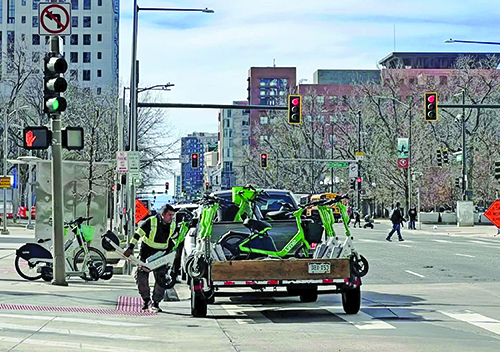
Last Load? Lime, one of the two companies currently holding the city’s contract, argues that the smaller micro mobility company is incapable of taking over.
Veo defends its ability to handle the transition. The current access program averages 7,000 to 8,000 active monthly users, according to the city; over 1,200 users have already pre-enrolled for Veo’s access program.
Residents can use their participation in the current Lime Access program as proof of eligibility to enroll, and Veo will allow a grace period for users to ride for free throughout May without providing proof of eligibility.
“They’re grasping at straws,” Alexander Keating, Veo’s vice president of policy and partnerships, says of Lime and Bird. “Both of those vendors have a track record of, if they feel they can intimidate a city with a lawsuit or a challenge, they will. …Having lost the procurement, they have a lot on the line. They’re going to do what they need to do to try to protect themselves. I’m not super surprised, but I think it’s unfortunate.”
Free Rides
Veo’s proposed access program offers more flexibility for riders, but fewer overall minutes. Currently, Lime Access provides three free rides per day, each lasting up to 30 minutes. That means users can’t make two round-trips.
Veo has agreed to continue providing free rides with its own access pips without paying, even if each trip is only a few minutes long. Veo will offer 60 minutes of free rides per day, with no limit on the number of rides taken; after the 60 minutes, riders will be charged $0.15 per minute, with no unlocking fee.
Lime Access used to provide unlimited free rides in Denver, but the company scaled back the program to just three rides per day in April 2025.
Council Concerns
The debate over the scooter providers has centered on the access program and panicked riders who fear losing an essential means of transportation. That fear has infiltrated Denver City Council, as well.
“I’ve been wrestling really hard with the equity program,” Councilmember Sarah Parady said during the April 1 meeting. “I’m just really, really worried that people are not going to find their way back into the program for a whole variety of reasons. I think Veo has done what can be done on their end; it’s just because of not having an overlap.”
City officials have long raised red flags about Lime and Bird’s operations here.
Denver prohibits riding scooters on sidewalks, riding with multiple passengers and parking scooters in ways that block sidewalks or streets, but all of those behaviors can be observed daily in the city. Despite this, Denver police issued only nine citations for improper scooter use between 2018 and 2024, compared with the over 18.3 million e-scooter trips taken in that timeframe. That has led officials to look to the companies to enforce proper behavior among their riders.
Policing Riders

Veo Benefit: Each vehicle has a QR code that reads “How’s my parking?” which passersby can use to report improperly parked vehicles.
“There’s little or no policing of careless and dangerous scooter rider behavior and improper scooter parking,” alleged David Kurth of the Upper Downtown Neighborhood Association during the March 18 committee meeting. Kurth expressed frustration over “the lip service that the current providers — especially Lime — have given to the safety of pedestrians in the downtown area.”
Reckless behavior by riders has dire consequences. Fifteen people have died while riding scooters in Denver since 2018, with over half of those deaths occurring just last year. Denver Health registered 1,868 patient encounters attributed to scooter injuries in 2025. That’s more than five patient encounters each day of the year. And Denver police received 199 reports of scooter-vehicle crashes in 2025.
Veo scooters are fitted with technology to detect unlawful behavior, such as riding on sidewalks or riding with multiple people on board, and the vehicle emits a voice warning if a rider does something wrong. Each vehicle has a QR code that reads “How’s my parking?”, which passersby can use to report improperly parked vehicles. Veo also offers a variety of vehicles with seats and larger wheels than those on standard standing scooters, improving stability for riders.