by Ashe in America | Feb 18, 2026 | Feature Story Bottom Left
ASHE IN AMERICA — OPINION
Election years bring out the worst in our community, as people show their true colors and drop the mask in the pursuit of the win. This year is particularly pronounced because the Executive is up for grabs, and the Colorado ruling junta is less popular than it’s ever been.
Despite that fact — that Democrats have turned Colorado into a national punchline and they should roundly lose — Republicans can’t get out of their own way. The biggest story in CO GOP politics right now is the campaign of Victor Marx who, despite outraising all other candidates, appears apprehensive to face voters directly.
Marx has a habit of avoiding — and even bailing — on local candidate forums in favor of allegedly elitist out-of-state events, and he recently made headlines for a few cancellations that indicate a low level of comfort among the people.
For example, Marx was scheduled to appear with other gubernatorial candidates in Elbert County on January 31st, but he bowed out at the last minute.
“We are not going to spend our time responding to provocation, participating in sideshows, or lending credibility to distractions designed to pull focus away from the real work ahead,” Marx said in a statement, adding, “That is why I will not be participating in events or forums that devolve into personal attacks or grievance-driven theatrics, including the recently scheduled forum on the 31st. Our time, energy, and resources are finite — and we choose to invest them where they matter: with the people of Colorado.”
Strange approach to insult and attack local grassroots groups on behalf of “the people of Colorado,” but Marx appears to only want to speak to low information voters — as a matter of strategy.
“The less certain people think they know about me right now, the stronger position we’re in when it matters most,” Marx stated in a separate post on Facebook.
On February 4th, Marx was supposed to attend a Parker Conservatives event, where many of his opponents in the race have already spoken and answered unvetted questions from that group’s highly engaged audience.
This event was weird from the outset. Mark Hampton, who leads the group with his wife, first announced that the questions for Marx had to be submitted in advance.
“During the evening, we will not be taking live questions from the audience,” Hampton wrote in his event email. “Instead, we will conduct a focused interview with Victor Marx. If you would like to submit a question for consideration, please use the link below to send it in advance.”
Hampton framed this development as his own idea, and he appeared to blame his highly engaged audience for needing to change the rules for Marx. “If people could reliably ask a clear, direct question, we wouldn’t need this format, but after five years of doing these events, hope has been replaced by experience,” Hampton said in the same email.
Notably, when I attended the Parker Conservatives event with Scott Bottoms earlier in this campaign, no one vetted my questions.
In the end, it doesn’t matter. The Parker Conservatives event was cancelled, and replaced by a Victor Marx campaign event at the same time and location. I called Hampton to ask what happened, and he told me that his organization had received a volume of threats that made them uncomfortable proceeding with the event, but that the Marx campaign was reluctant to cancel — so Hampton turned over his event space and audience to the campaign.
When I asked Hampton about the nature and volume of threats, he said it was “enough.”
Apparently, I’m not the only skeptic of the storytelling around this event. Hampton posted on Facebook on January 31st, “But when you make a decision rooted in your values and principles that doesn’t neatly align with others’ preferences. That’s when the masks come off.”
Yikes. The statement continued, “I have been working diligently to provide a venue for gubernatorial candidates, the most recent being Victor Marks [sic]. Not the first candidate. Not the only one. Just one more in a long line of candidates running for governor. You’d think this would be the least controversial thing in a conservative movement…”
He declined to share that the other candidates had different rules on Q&A.
Then he compared himself to Job, “The people most convinced of their own righteousness are often the quickest to condemn others. Job learned that from his friends, full of certainty, empty of wisdom.”
Two days later, on February 2, Hampton changed his Facebook banner photo to a Victor Marx 2026 campaign image.
Now the Marx campaign is in control of the attendees and the questions, and once again the “dangerous gentleman” avoids facing the people he claims to want to serve.
In summary, in his short time campaigning, Marx has alienated the Colorado voters that are most likely to knock doors and make phone calls and get out the vote.
Curious strategy…
Then again, if his target audience is low information voters, Marx can just buy a ground game with all that out of state donor money.
I bet Parker Conservatives will help.
Ashe in America is an independent writer, host, and activist in Colorado. Learn more at linktree.com/asheinamerica.
by Ashe in America | Jan 16, 2026 | Feature Story Bottom Left
ASHE IN AMERICA
OPINION
Colorado’s 2026 legislative session kicks off this month, and that usually means brace for impact.
But the legislature is operating under markedly different conditions than those of recent years — and you can only kick the can down the road for so long.
Colorado is in a rough spot, with slowing revenue growth, tightening budget constraints, and heightened federal-state friction. That friction resulted in devastating federal spending cuts for Colorado lawmakers, and they’re figuring out, in real time, that discretionary spending is… discretionary.
Under Colorado’s constitution and statutes, the General Assembly must balance its budget annually while operating within the constraints of the Taxpayer’s Bill of Rights (TABOR). Note that’s why DSA Democrats keep trying to end TABOR — they live outside their means and they don’t like that.
According to legislative previews circulated to legal practitioners and industry stakeholders, lawmakers are preparing for a session in which discretionary spending will be even more limited. That may mean that, for the first time in nearly a decade, policy ambitions will be shaped as much or more by fiscal guardrails as by political fever dreams.
The pandemic is over, and it’s time to true up the accounting.
As Democrats gear up to wield legislative power, dynamics in the state party read less like confident governors and mor5e like a mid-break up relationship status:
It’s complicated.
Ideological differences between the DSA bullies and the more traditional and pragmatic Democrats have become increasingly visible in recent months. These tensions are no longer confined to floor debates but now shape caucus strategy, party messaging, alliances, campaign strategies, and social media mudslinging. But wait, there’s more!
Piling on, legislators may face an unexpected barrier with Governor Polis. Colorado’s Chief Executive is expected to announce a Presidential run for 2028, and Polis plays libertarian when he’s running for office. With a compounding budget crisis, multiple federal investigations into weaponization, waste, fraud, and abuse, as well as close to 50 expensive lawsuits (a central feature of Phil Weiser’s gubernatorial campaign strategy), Polis may pretend to be his party’s adult in the room.
While Republicans have no real power in the legislature, they are well-positioned to be extremely antagonistic to the ruling party. That’s going to be fun to watch. Expect GOP leaders to focus on oversight, fiscal restraint, and public accountability as they seek to influence the electorate in the run up to the midterms.
So what’s on the agenda? Several issue areas are expected to dominate early committee exploration and debates.
Housing policy remains central, including affordability measures and tenant protections. Labor and employment policy, including wage standards, workplace regulations, and contractor classifications. Energy and environmental regulation is likely to command attention across stakeholder groups as the state attempts to reconcile their green new deal priorities with their unfortunate economic realities. Election administration and campaign-related legislation are also anticipated, as the DSA Democrats fight the federal government’s election integrity agenda while attempting to white knuckle their single-party electoral control.
This session is also likely to be shaped by the Colorado Democrats’ rabid Trump Derangement Syndrome, but unlike their earlier resistance politics in Trump 1.0, DSA Democrats no longer have the resources. We can expect symbolic legislation aimed at opposing federal actions, but practical change is unlikely. They have to stand on their record. And their record is incredibly unpopular.
Many of these priorities have been debated but unresolved in prior sessions, raising questions about whether the ruling party can get them done at all now that political will for Marxism is (finally) waning. While the DSA cheers for Mamdani’s NYC, moderate Democrats are bracing for public backlash and distancing themselves from the DSA.
(Note: These priorities may feel a bit Marxist, but take comfort knowing that’s only because Marxists currently run the Colorado government. Standby for Republicans to tell you that you voted for that.)
It’s all shaping up to be especially contentious in 2026. The bottom line is that the DSA Dems thrive on crisis and outrage, but when there’s already a crisis on every front, it’s hard to engage the public in new ones.
It’s much more likely the public will choose a reckoning.
Ashe in America is an independent writer, host, and activist in Colorado. Learn more at linktree.com/asheinamerica.
by Ashe in America | Dec 15, 2025 | Feature Story Bottom Left
ASHE IN AMERICA — OPINION
It is Christmastime in Colorado, and behind concrete walls and steel doors at the La Vista Correctional Facility, a medium-security women’s prison in Pueblo, sits Colorado’s most valuable political scalp.
Whether one agrees with Tina Peters’ politics, worldview, or actions, this much is undeniable: She is not a powerful figure.
Peters is an older woman, having just celebrated her 70th birthday in prison on September 11th. She is a Gold Star mother who buried her Navy Seal son, a cancer survivor who beat the odds, and a Western Slope clerk who dared to disbelieve Jena Griswold and Matt Crane.
Her name would never have reached the national stage if not for a single decision — a decision she says she made because the public entrusted her with their democracy.
That decision, and the avalanche that followed, made her a national symbol. To some, Peters is a villain … a threat to democracy … a criminal that got what she deserved. To others, she is a hero … a canary in the coal mine … a political prisoner … a victim of weaponized government and asymmetrical justice.
She’s something else, too: a sick, septuagenarian woman spending the holidays in prison because, as she tells it, she believed that her sworn duty mattered more than the personal consequences.
“I couldn’t unsee it.”
The official story condenses Tina Peters into a caricature: “rogue clerk,” “conspiracy theorist,” “election denier.” The courts claim she is a danger to our community because of what she might say. Her speech is a threat to democracy!
How very democratic.
A Colorado clerk’s job is not glamorous. It’s long hours, endless paperwork, and being a human complaint desk. It certainly doesn’t come with an instruction manual for what to do when half the country loses faith in the election system, and the other half refuses to discuss it.
When questions came in after the 2020 election, Peters didn’t dismiss them. She didn’t lecture the voters petitioning her office. When the state told her to simply trust the “trusted build,” she hesitated — because she didn’t. She knew inside that transparency mattered.
Peters undertook an unprecedented effort to retain two copies of Mesa County’s voting system — one before the system was allegedly wiped and one after. Four professional reports by cyber experts followed. Those reports were dismissed because Peters became the story.
“You are a charlatan.”
It was not a polite disagreement. It was not administrative discipline. It was the full weight of the state — in all its public-private partnerships — crushing their ideological opposition.
They made an example of her. The message to other clerks was clear: Stand down. To date, only one other county has dared to challenge the Colorado Department of State. (That county has also faced retaliation).
The state charged Peters with attempting to influence a public servant, conspiracy to commit criminal impersonation, identity theft, first degree official misconduct, violation of duty, and failure to comply with requirements of the Secretary of State.
Note that these charges are not about violating election statutes. Tina Peters was not convicted of voter fraud or meddling in elections or anything even resembling the oft-told narrative.
Peters made a single misrepresentation — that Conan Hayes was Jerry Woods — to three people. That and the conspiracy to make that misrepresentation comprise the four felonies of which she was convicted.
Peters was never allowed to explain her intent to the jury. The state’s key witness appeared to have lied on the stand at trial (without personal consequence, though Peters was acquitted on the related charges.) The judge showed open bias in front of the jury and, in his sentencing, cited facts not in evidence — because he prevented the jury from hearing them (though he relied on them himself).
It was a good show. In the end, the public believed the drama and bought the well-crafted and entirely controlled conclusion. Peters was a threat to democracy but democracy was just fine. Gold standard, even.
This storytelling is why otherwise kind and merciful Coloradans will jeer and cheer about a sick, old lady sitting in prison at Christmas.
“Truth will prevail.”
Peters prays for those who put her in prison. She rejoices in her suffering, and she maintains that the truth will out. It’s hard to believe she maintains that belief — until you remember her story.
She has buried a child. She beat cancer. She’s been through worse than prison, and she survived.
Her supporters call her indestructible.
Colorado officials want the public to forget about Tina Peters. Accept the sentence, move on, leave this chapter behind. Recently, the Attorney General, Mesa District Attorney, and Colorado County Clerks Association sent letters to Governor Polis, fearing he may commute her sentence and begging him to not.
They want her story to fade.
But it won’t fade.
Whether one believes Tina Peters is a heroine or a fool, brave or misguided, justified or reckless, what’s happening to her is not justice. It’s politics. Colorado holds her like a trophy, they apply an inequitable judicial standard, and it’s all undeniably political.
Of course, for a sick, 70 year old cancer survivor, it’s not just political. It’s also a likely death sentence.
That’s a fact year-round, but it hits differently at Christmas.
Ashe in America is an independent writer, host, and activist in Colorado. Learn more at linktree.com/asheinamerica.
by Ashe in America | Nov 17, 2025 | Feature Story Bottom Left
ASHE IN AMERICA
OPINION
Colorado’s schools are known nationwide for their “inclusion,” promising safe spaces and diversity, and respect for all. But while the Centennial State celebrates inclusivity as the highest civic virtue, a troubling paradox has emerged: Exclusion in the name of inclusion.
Conservative students across the state are learning that their ideas are often labeled “unsafe,” “harmful,” or “divisive” — and that their expected First Amendment protections may depend on whether the prevailing culture approves of what they have to say.
The First Amendment doesn’t promise comfort — it guarantees freedom of speech and assembly and religion and expression. Public institutions, from high schools to state universities, are legally bound to viewpoint neutrality. That means they cannot suppress expression because others dislike it or claim to feel unsafe.
But, that’s exactly what is happening to right-of-center students across our state.
In late October, the student government at Fort Lewis College in Durango voted to deny recognition of a new Turning Point USA (TPUSA) chapter. The Associated Students of Fort Lewis College justified the decision by citing “community safety” and the need to protect campus inclusivity. As the vote was announced, students in the gallery reportedly erupted in cheers.
For TPUSA students — who had followed all the procedural steps to become an official organization — the message was clear: Your ideas are not welcome here.
The College’s administration later released a statement reaffirming that Fort Lewis upholds free-speech rights consistent with the law; but it rings hollow for students whose peers, empowered by an institutional process, effectively vetoed their ability to organize.
Public colleges cannot delegate viewpoint discrimination to student governments. The mob does not get to decide whose ideas are protected — if the reason for denial rests on viewpoint, it crosses a constitutional line. Fort Lewis is a public college, and courts have repeatedly ruled that student governments exercising delegated authority act as state actors.
And this targeted suppression is not contained to universities.
In Eagle County, parents have circulated petitions opposing newly approved TPUSA clubs at Eagle Valley and Battle Mountain High Schools. The petition argues that TPUSA’s national reputation and past controversies make it unfit for public schools, claiming the organization “spreads hate.”
Despite the backlash, the school district allowed the clubs. Legally, they’re required to — the federal Equal Access Act bars public secondary schools from discriminating against student clubs based on viewpoint. Just like in Fort Lewis, the law is on TPUSA’s side. But the uproar has had a chilling effect.
Anecdotes from conservative students suggest that many students, who might otherwise have joined these clubs now won’t. Despite their constitutional protections, fear of retaliation — for their ideas — is preventing conservative students from organizing.
“This isn’t about speech, it’s about spreading hate!” Who decides what constitutes “hate?”
Perhaps the most egregious example of chilling student ideas comes from our state’s flagship land-grant university, Colorado State University (CSU). According to a 2025 report by the Foundation for Individual Rights and Expression (FIRE), 43 percent of CSU students say they self-censor on campus at least once or twice a month, and more than a quarter believe that violence is sometimes acceptable to stop a speaker. FIRE’s overall free-speech ranking gives CSU an “F” grade.
I wonder which quarter of the Rams want to use violence to stop ideas they disagree with. I’m quite confident it’s not the conservative students. And it’s not just that conservative students are quiet — it’s that they’re embracing silence for survival. When nearly half of a student body reports self-censoring, the marketplace of ideas is closing its doors.
Ironically, the campus most associated with liberal politics — the University of Colorado Boulder — has emerged as a relative model of free-speech protection. FIRE gives CU Boulder a “green light” rating, meaning its written policies fully respect First Amendment standards. Administrators there have repeatedly affirmed that all viewpoints, including controversial ones, are welcome.
The takeaway of that Rocky Mountain Showdown is that a campus can be both supportive and robustly open to dissenting ideas. Whether it will is another matter.
Conservative students are not asking for special treatment, only to participate in the same open dialogue promised to everyone else. Yet too often, their clubs are denied recognition, their peers cheer their exclusion, and their institutions justify violating their rights in the name of “safety.”
Safety is important — but safety cannot be defined as freedom from offense. The First Amendment was written precisely for moments like this, when Americans are divided, emotions are running high, and majorities are tempted to silence minority ideas.
The answer to speech that offends is not censorship, but more speech — reasoned, courageous, and unafraid. Free speech is not a gift bestowed by those in power; it is a right that limits their power. When inclusion is redefined to mean exclusion, education is properly defined as programming — and when the upcoming generations are programmed to devalue our most sacred American rights, the impacts are not contained to the campus.
Ashe in America is a writer and activist. Find all her work at linktree.com/asheinamerica.
by Ashe in America | Oct 20, 2025 | Feature Story Bottom Left
ASHE IN AMERICA — OPINION
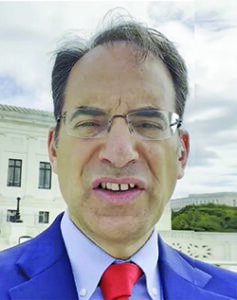
Paul Weiser
The 2026 Gubernatorial campaign is going to be wild, and a big part of that prediction is the Democrat front runner’s detachment from reality.
Earlier this month, Attorney General Phil Weiser posted to X, “In Colorado, we know what responsible governance looks like — and our leadership on the opioid crisis is a stellar example. As Governor, I will take our tradition of collaborative and innovative leadership to meet the range of challenges facing our state.”
In the post, he includes a link to an article that he wrote, in which we find his source for the “stellar” leadership:
“On his national TV broadcast, John Oliver had a lot of say about how other states have failed on their opioid response; he also called out Colorado an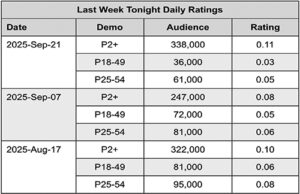 d North Carolina as setting the gold standard for how transparent we have been in how we’re spending these funds.”
Praise and affirmation of Weiser’s leadership is so low that he’s quoting a red-coated, failed comedian whose “national TV broadcast” is watched by 0.057% of the target demo, per September 2025 Nielson data.
Look at demographic breakdowns. P2+ in ratings refers to the total number of viewers aged 2 and older — it’s a broad demographic metric that captures the overall audience size, including adults, children, and anyone else (i.e., everyone in a Nielson house.)
Weiser cites this comedian(?) — the one reaching 61,000 people in a 107.5M person national demo — as an authority on Colorado leadership.
That’s enough for the AG. But should it be enough for Colorado voters? Setting aside what the foreign comedian says, what story does the data on lawfare, crime, and fentanyl say about Weiser’s performance?
As of mid-2025, the Attorney General of Colorado, Phil Weiser, has filed more than 20 lawsuits against President Trump and/or the federal government. He’s doing this in his official capacity, and using Taxpayer dollars, while citing the lawsuits as a campaign accomplishment.
While Weiser’s attention is focused on his campaign and portfolio of Trump-deranged lawfare (at your expense), his job performance — as the head of the justice department in the Centennial State — is stunning.
In 2022, the year of Weiser’s reelection, Colorado was ranked 4th highest nationally for overall crime (combining property and violent crime), according to FBI data, as reported by Common Sense Institute.
According to USAFacts, in 2024 Colorado’s violent crime rate was about 476 per 100,000 — placing it 7th highest among all states. That same source shows the state’s property crime rate at 2,593 per 100,000, ranking it 2nd highest among states in 2024.
In July, the Denver Gazette reported that Colorado was the “second most dangerous state” in the US, behind only New Mexico. But let’s get even more specific.
Weiser cites the state’s “stellar” leadership on the fentanyl crisis — but from 2018 (Weiser’s election) to 2023 (one year after Weiser’s reelection), fentanyl overdoses in Colorado increased by 900%, according to preliminary data from the Colorado Department of Public Health and Environment, as reported by KKCO 11 News. 900%!
In 2023, the DEA’s Rocky Mountain Field Division — a federal agency — seized a record 2.6 million fentanyl pills and an additional ~425.6 kilograms of fentanyl seized in 2023 in Colorado. In fact, Colorado is tied for second highest fentanyl seizures, according to Newsline’s assessment of the 2023 Colorado data. Despite these outcomes, the fentanyl crisis cost taxpayers an estimated $16 billion in 2023, about 3% of Colorado’s GDP, around $2,200 per taxpayer.
No wonder the campaign needs to rely on foreign storytellers to rebrand and spin Phil Weiser as a “stellar” leader and viable candidate.
Weiser is desperate for Colorado voters to imagine him expertly navigating the new, more powerful job of Governor while convincing them to forget his abysmal performance in the current AG spot.
But that strategy requires voters not believing their own eyes. And Colorado voters notice the examples of Phil’s stellar leadership all around them. Check out @dobetterDNVR on X for plentiful examples.
Alternatively, perhaps when Weiser claims “stellar leadership” in fentanyl, he means that Colorado is leading the nation in expanding illicit fentanyl access, use, and addiction. That’s certainly the story of leadership that the data tells.
Regardless of what he means by his words, electing Weiser for Governor will see Colorado continue the way things are right now. We’re living Weiser’s policies, positions, and politics right now. He’s literally bragging, right now, about almost nabbing the spot for worst performance in the nation on fentanyl. From his standpoint, it’s all “stellar.”
If you want Colorado to change, you must fire those making it stay the same.
Start with the guy who decriminalized crime.
Ashe in America is a writer and activist. Find all her work at linktree.com/asheinamerica.