
by Ashe in America | May 19, 2026 | Feature Story Bottom Left
ASHE IN AMERICA
— OPINION
Republicans in Colorado are trading representation for control — and calling it “conservatism.”
How we give our consent to be governed matters. But it’s worse than fake elections. The founding idea of representation itself has been abandoned (almost entirely) in favor of personality-based battles for the right to claim decision rights.
Explain to me how wielding a massive government apparatus for social change is a conservative value?
You can’t. It’s not.
In recent weeks, apportionment (redistricting) lawsuits have dominated the headlines as both national parties try to rig their way to 270 electoral votes.
Rearranging districts to protect incumbents or expand party-held seats to counter the “representation” of another state is, if we’re being intellectually honest, one of the purest forms of election manipulation. And it’s been normalized for so long that Americans don’t even question it.
Apportionment only happens in this way because representation was capped at 435 in the House of Representatives in 1929, so the constitutional ratio of representation has been continually diluted with population growth since the 20th century. As a result, we “require” the intervention of partisan-first legislatures to make the districts “fair.”
My Congresswoman, Representative Lauren Boebert (R, CO-04), “represents” around 756,000 Colorado residents. That’s a 25-fold dilution of representation per capita since America’s founding era.
Now, we’re hearing “kill the caucus” refrains from so-called “Republicans” — again — but if you ask them why they’re abandoning representation, you’re met with disdain-filled and puddle-deep talking points:
“It doesn’t work.”
“It favors the fringe.”
“It’s too volatile and unpredictable.”
If the process favors the fringes, it’s only because the more “mainstream” candidates can’t — or won’t — compete. So, they advocate for petition-only ballot access — centralizing access to the ballot in the hands of the Secretary of State.
Reminder: Centralization creates complexity, and complexity breeds and hides corruption.
Some on “the right” claim petitions are more representative than local, bottom-up organizing. Crazy — that’s a main policy position of progressive legal activists like Marc Elias and Norm Eisen: Centralize elections at the state level and remove the “pageantry of democracy” from the local jurisdictions.
Those guys are both conservatives, right?
The real answer to why Republicans are attempting to destroy the most accessible and representative process for ballot access that we have is simple: It’s too hard.
It’s not actually hard, but it is involved. It’s ground game and education and building networks — building party infrastructure for intentional change. Those raising the banner most highly point to dwindling party engagement and a devastating Republican brand problem.
Both of those data points are true. But they’re the natural and intended outcomes of open primaries, poor resource allocation, and sustained Republican infighting.
Republicans haven’t tried building party infrastructure — and Republicans with the backing of the donor class spend their time fighting those who do.
On the other side of that divide, largely self-organized groups inside the counties — the so-called “fringe” — have done the work. They recruited their neighbors and drove people to caucus and organized for their candidates and causes in advance of the Assembly. They built coalitions and worked phones and knocked doors and evangelized representation to unexpecting Colorado voters at bars and sporting events and grocery stores. Show up — make your voice heard.
They built relationships. They won hearts and minds. Again, it’s not hard. But it’s also not easy.
At this point, critics will shout about Unaffiliated voters — that the caucus process disenfranchises them. That’s nonsense.
Unaffiliated (UAF) voters — now more than 50% of Colorado’s electoral franchise — can vote in either party’s primary but not participate in caucuses. When one party lacks competitive primaries, UAFs can (and do) cross over and influence the other party’s nominee selection.
The caucus preserves internal party business for party members — and if we have open primaries (which I also, as a proud unaffiliated voter, oppose) UAFs can still vote in the actual primary. They shouldn’t. If parties have no control over their own candidate selection, they’re ideologically incoherent and have no real purpose. This is where we are now — with recent litigation and years long internal warring allowing UAFs to select Republican candidates.
If you’re going to have a party at all, it must be coherent. It arguably should be the people, in community, organizing for change (as opposed to dark money anointing the next “representative”).
But the caucus is unpredictable and messy — just like America — and requires that you earn legitimate power through your ideas and hard work to make those ideas heard. More importantly, it upends the centrally managed corporate structure where candidates line up before (bipartisan) donors for their chance to lose on purpose.
That’s terrifying for those next in line.
When ordinary Americans read the rule book, learn the bylaws, and decide they can play, too, the establishment demands their access be abolished. They change the bylaws or find loopholes and expend resources to enter court.
Welcome to the brand problem.
The 2022 assembly was the largest attended in a decade. The years that followed were marred by financial scandal and inter-party lawsuits and a shadow GOP and competing official meetings — and arguably irreparable fractures in any potential for unity.
The 2026 assembly was one of the least attended.
But rather than be honest about that journey…
“See! We told you it doesn’t work! Bring on rank choice voting!”
“Progress is man’s ability to complicate simplicity.” — Thor Heyerdahl
To recap, the ratio is diluted, the districts are rigged, and the party apparatus inverted power and is now advocating to abolish bottom-up representation in favor of central control.
“A Republic, if you can keep it.” — Benjamin Franklin
Ashe Epp is a local writer, host, and activist. Find all her work at linktree.com/asheinamerica.
by Ashe in America | Apr 17, 2026 | Feature Story Bottom Left
ASHE IN AMERICA — OPINION
The El Paso County Clerk & Recorder Speaks Out About External Influence In Colorado’s Democracy
El Paso County Clerk & Recorder Steve Schleiker quietly resigned as Vice President of the Colorado County Clerks Association (CCCA) in early March, and he also withdrew El Paso County from active membership in the non-governmental organization.
In late March, Schleiker released his reasons for leaving, and they are explosive.
“After careful consideration, I made the decision several weeks ago to resign as Vice President of the Colorado County Clerks Association and to withdraw El Paso County from active membership. This was not a decision I made lightly.” ‘
Schleiker says that his decision was “driven by concerns about independence, transparency, and the role of external influence within what is intended to be an independent association.”
After this news broke, I requested open records from several counties and received both his resignation letter as well as his notification letter to his clerk colleagues. Both letters are published in full on my Substack.
Schleiker named names.
“It has been difficult to watch what appears to be one individual in Denver, Martha Tierney, attorney for the Colorado Democratic Party, exert significant influence over election-related legislation, directing caucus positions and outcomes.”
He also alleged that CCCA Executive Director Matt Crane and CCCA President Carly Koppes prohibited him from attending certain meetings, even though he was the NGO’s elected Vice President. “I was not permitted to participate in certain executive-level meetings with the Secretary of State’s Office. I was informed this was due to a lack of trust from that office, and that participation would be delayed until others were more ‘comfortable.’”
But he believes those reasons were dishonest.
“After receiving that information, I reached out directly to the Secretary of State as well as multiple members of her staff. Each of them shared with me that these conversations had not occurred. That response raised additional concerns for me and led me to believe this situation was developed internally by the CCCA President and Executive Director.”
In response to Clerk Schleiker’s story going public, Clerk Koppes reportedly disputed his characterization, according to a summary from Complete Colorado:
“Koppes said Schleiker’s interpretation of the events are not accurate, saying the meetings Schleiker is referring to historically are held between the president of the organization, the executive director, and various stakeholder groups to discuss upcoming events, legislation, and other things pertinent to the organization. Koppes has the authority to expand those at the meetings to also include the president-elect and the vice president. Because this is her last year, Koppes says she was considering doing that so those two roles would be more informed as they took over the organization into the next year. However, some of the stakeholder groups’ members came to Koppes concerned about Schleiker’s views.”
Upon reading the characterization of Koppes’ position, I reached out to Clerk Schleiker. In his resignation letter, he said he wasn’t going to speak to the press about his resignation; but since the CCCA was disputing his story, I thought maybe he would change his mind.
He did, and he wrote me back — with even more allegations against the professional association. More on that below, but first some backstory.
The CCCA is run by Matt Crane, a former Arapahoe County clerk who has been the subject of great controversy since 2020. Crane is the mastermind of the recent CCCA statements demanding Tina Peters remain in prison. I wrote about that back in December when Elbert County Clerk Rhonda Braun bravely, publicly, rebuked the CCCA’s position as not representative of the clerks.
Crane is the main point of escalation for the clerks on all things election related. He also has the perception of a conflict of interest there. From Holly at Altitude back in 2021:
“It turns out Crane’s wife worked at Sequoia Voting Systems, which was acquired by Dominion Voting, for over 17 years… Matt Crane was working in influential election roles, bouncing between the public and private sector… Crane’s work included influencing, recommending, and distributing voting systems; shaping voter legislation, budgeting, designing and implementing voter registration, overseeing vendor contracts, and installing operating systems, the list goes on.”
Consider the investigation of Tina Peters’ Mesa County reports. The investigator called Matt Crane to craft the official narrative debunking those reports’ findings. That audio was released in February 2025. On the audio, you hear the investigator call and explicitly ask Mr. Crane how to debunk the findings.
Clerk Schleiker doesn’t stop with external influence. In response to my request for comments, the clerk makes additional allegations of retaliation and county interference by the CCCA principals:
“…an emergency meeting was convened by the Association’s leadership where my character and decision were discussed in a negative manner…Shortly thereafter, the Executive Director independently contacted several of El Paso County Clerk and Recorder’s vendors and spoke negatively about me and the situation…”
Why is the head of a professional association reaching out to county vendors and allegedly disparaging the elected clerk in that county while ostensibly discussing county business?
External influence, sure, but this is external interference. Matt Crane has not responded to multiple requests for comment.
Clerk Schleiker is raising red flags.
What is your clerk saying about this, and are they still paying dues to the CCCA?
You should ask.
Ashe Epp is a local writer, host, and activist. Find all her work at linktree.com/asheinamerica.
by Ashe in America | Apr 1, 2026 | Feature Story Bottom Left
ASHE IN AMERICA — OPINION
 Partisan outrage broke out earlier this month when former Democrat Senator Sonya Jaquez-Lewis was sentenced to probation for committing four felonies in an attempt to mislead an ethics panel. Her charges included one count of attempting to influence a public servant (C.R.S. 18-8-306), and three forgery counts.
That statute should sound familiar. C.R.S. 18-8-306 was the charging statute for three of former Mesa County Clerk and Recorder Tina Peters’ felonies — and she was sentenced to three and a half years in state custody for each of the counts.
Jaquez-Lewis attempted to influence the officials handling her ethics committee. Peters influenced three officials to bring an observer into her office. The difference in the cases comes down to prosecutorial discretion. That’s what caused the outrage.
Even Governor Polis got in on the drama.
“But it is not lost on me that [Jaquez-Lewis] was convicted of the exact same felony charge as Tina Peters — attempting to influence a public official,” the Governor posted on his personal account on X. “— and yet Tina Peters, as a non-violent first-time offender got a nine-year sentence.” He then talked about clemency calculus.
Predictably, the uniparty lost their minds at Polis’ suggestion that Peters might get out of prison. She represents the death rattle of a carefully created narrative about “election denialism” being dangerous to “democracy.”
They need that to be true (it isn’t), because they used that fake narrative to weaponize the government and undermine democracy themselves. If it’s not true, they violated their oaths of office and abused their power.
Clemency makes that inevitability go away for them. It’s an act of mercy for agreed upon guilt. It fortifies the state’s assertion that Tina Peters got due process, and that she was convicted by a jury of her peers after a fair trial. That’s not true.
The handling of Tina Peters’ case was so egregious that the three-judge panel that heard her appeal in February seemed poised to grant Peters at least some relief:
“The official misconduct charge was charged as with the intent to receive a benefit for herself,” Judge Tow said. “Why is it not relevant to the jury for her to say, ‘I didn’t intend to receive a benefit for myself. I intended to do what I thought was my job and protect the election process.’ Why was that evidence not relevant at least to that charge?”
Peters was prohibited by the trial court from defending against the state’s characterization of her intent before the jury.
The judge continued after an exchange with the solicitor arguing for the prosecution, “Why was that evidence not appropriately submitted to a jury?”
“When it comes to a defendant’s Constitutional Right to present a complete defense, does a trial court have the ability to curtail that in the interest of not letting the sideshow overcome the circus? Don’t they have a Constitutional Right to present a complete defense? …the Court can prevent cumulative or irrelevant evidence, but I cannot curtail the presentation of relevant evidence.”
This should be fatal to the prosecution.
The state and judge biased the jury — and not just on the misdemeanor. The only intent argument that was presented to the jury about Tina Peters — for any count — was the state’s characterization of her intent on the misdemeanor. That violation on one count arguably biases the jury on all counts. That’s not justice.
Earlier this month, I debated this point with District Attorney George Braucher (R-JD23) on Ryan Schuiling Live (630 KHOW) where I quoted Judge Tow’s statements above and posited, “Why she did what she did is relevant; and you could say it doesn’t matter, but then you have to throw out the misdemeanor for official misconduct because there’s an intent requirement. You cannot allow the state to…characterize her intent to the jury and refuse to allow her to present a defense for that.”
Brauchler’s response was chilling: “…we’re not talking about the intent like [Tina] had the intent to break the law [in] her conduct. She acted like a guilty person in the way that she did this. She didn’t act like an innocent person doing innocent things for a greater good.”
Is that the legal standard for whether the accused has access to due process and a trial by jury?
She acted guilty and, essentially, we knew she was guilty — so it’s fine that we violated her rights. She was guilty!
That’s grounds for reversal on appeal, which would expose due process violations and reinforce the rule of law; clemency keeps the conviction and the official narrative intact and allows the prosecutors to avoid inquiry on their violations of Tina Peters’ rights.
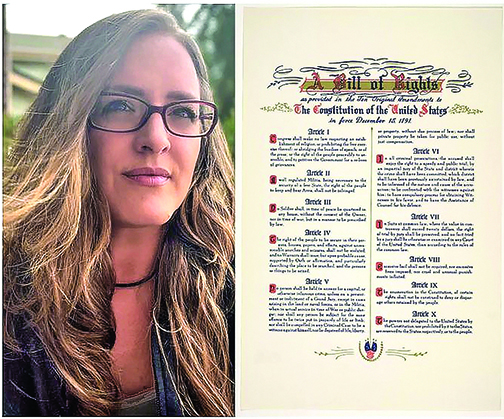
The Bill of Rights is always inconvenient for prosecutors. That’s its point. It’s non-negotiable in its demands that justice not be weaponized for politics…even if the government is certain the accused is guilty.
A 70-year-old woman, with no record, was charged with a nonviolent offense; the prosecutors decided her intent and characterized it to the jury; they prohibited her from disputing that characterization; and she was convicted.
Then they locked her up for almost nine years.
It’s hard to argue this is about the ethics of public officials and making examples when another official — Sonya Jaquez Lewis, who has the correct politics and positions on elections, gets probation under the same statute.
The facts, the evidence, and the law — not the stories told to the public — are what is supposed to matter in a court of law. In Tina Peters’ case — a political show trial bolstered by due process violations and false narratives about election crimes — only the story mattered.
Clemency locks that false story in — and it moots any further attempts to correct it. For due process, elections, and Tina Peters, that’s the worst possible outcome.
For those white knuckling the story, it’s the best.
That’s likely why Jared Polis is now talking about clemency in this case.
Ashe Epp is a local writer, host, and activist. Find all her work at linktree.com/asheinamerica.
by Ashe in America | Feb 18, 2026 | Feature Story Bottom Left
ASHE IN AMERICA — OPINION
Election years bring out the worst in our community, as people show their true colors and drop the mask in the pursuit of the win. This year is particularly pronounced because the Executive is up for grabs, and the Colorado ruling junta is less popular than it’s ever been.
Despite that fact — that Democrats have turned Colorado into a national punchline and they should roundly lose — Republicans can’t get out of their own way. The biggest story in CO GOP politics right now is the campaign of Victor Marx who, despite outraising all other candidates, appears apprehensive to face voters directly.
Marx has a habit of avoiding — and even bailing — on local candidate forums in favor of allegedly elitist out-of-state events, and he recently made headlines for a few cancellations that indicate a low level of comfort among the people.
For example, Marx was scheduled to appear with other gubernatorial candidates in Elbert County on January 31st, but he bowed out at the last minute.
“We are not going to spend our time responding to provocation, participating in sideshows, or lending credibility to distractions designed to pull focus away from the real work ahead,” Marx said in a statement, adding, “That is why I will not be participating in events or forums that devolve into personal attacks or grievance-driven theatrics, including the recently scheduled forum on the 31st. Our time, energy, and resources are finite — and we choose to invest them where they matter: with the people of Colorado.”
Strange approach to insult and attack local grassroots groups on behalf of “the people of Colorado,” but Marx appears to only want to speak to low information voters — as a matter of strategy.
“The less certain people think they know about me right now, the stronger position we’re in when it matters most,” Marx stated in a separate post on Facebook.
On February 4th, Marx was supposed to attend a Parker Conservatives event, where many of his opponents in the race have already spoken and answered unvetted questions from that group’s highly engaged audience.
This event was weird from the outset. Mark Hampton, who leads the group with his wife, first announced that the questions for Marx had to be submitted in advance.
“During the evening, we will not be taking live questions from the audience,” Hampton wrote in his event email. “Instead, we will conduct a focused interview with Victor Marx. If you would like to submit a question for consideration, please use the link below to send it in advance.”
Hampton framed this development as his own idea, and he appeared to blame his highly engaged audience for needing to change the rules for Marx. “If people could reliably ask a clear, direct question, we wouldn’t need this format, but after five years of doing these events, hope has been replaced by experience,” Hampton said in the same email.
Notably, when I attended the Parker Conservatives event with Scott Bottoms earlier in this campaign, no one vetted my questions.
In the end, it doesn’t matter. The Parker Conservatives event was cancelled, and replaced by a Victor Marx campaign event at the same time and location. I called Hampton to ask what happened, and he told me that his organization had received a volume of threats that made them uncomfortable proceeding with the event, but that the Marx campaign was reluctant to cancel — so Hampton turned over his event space and audience to the campaign.
When I asked Hampton about the nature and volume of threats, he said it was “enough.”
Apparently, I’m not the only skeptic of the storytelling around this event. Hampton posted on Facebook on January 31st, “But when you make a decision rooted in your values and principles that doesn’t neatly align with others’ preferences. That’s when the masks come off.”
Yikes. The statement continued, “I have been working diligently to provide a venue for gubernatorial candidates, the most recent being Victor Marks [sic]. Not the first candidate. Not the only one. Just one more in a long line of candidates running for governor. You’d think this would be the least controversial thing in a conservative movement…”
He declined to share that the other candidates had different rules on Q&A.
Then he compared himself to Job, “The people most convinced of their own righteousness are often the quickest to condemn others. Job learned that from his friends, full of certainty, empty of wisdom.”
Two days later, on February 2, Hampton changed his Facebook banner photo to a Victor Marx 2026 campaign image.
Now the Marx campaign is in control of the attendees and the questions, and once again the “dangerous gentleman” avoids facing the people he claims to want to serve.
In summary, in his short time campaigning, Marx has alienated the Colorado voters that are most likely to knock doors and make phone calls and get out the vote.
Curious strategy…
Then again, if his target audience is low information voters, Marx can just buy a ground game with all that out of state donor money.
I bet Parker Conservatives will help.
Ashe in America is an independent writer, host, and activist in Colorado. Learn more at linktree.com/asheinamerica.
by Ashe in America | Jan 16, 2026 | Feature Story Bottom Left
ASHE IN AMERICA
OPINION
Colorado’s 2026 legislative session kicks off this month, and that usually means brace for impact.
But the legislature is operating under markedly different conditions than those of recent years — and you can only kick the can down the road for so long.
Colorado is in a rough spot, with slowing revenue growth, tightening budget constraints, and heightened federal-state friction. That friction resulted in devastating federal spending cuts for Colorado lawmakers, and they’re figuring out, in real time, that discretionary spending is… discretionary.
Under Colorado’s constitution and statutes, the General Assembly must balance its budget annually while operating within the constraints of the Taxpayer’s Bill of Rights (TABOR). Note that’s why DSA Democrats keep trying to end TABOR — they live outside their means and they don’t like that.
According to legislative previews circulated to legal practitioners and industry stakeholders, lawmakers are preparing for a session in which discretionary spending will be even more limited. That may mean that, for the first time in nearly a decade, policy ambitions will be shaped as much or more by fiscal guardrails as by political fever dreams.
The pandemic is over, and it’s time to true up the accounting.
As Democrats gear up to wield legislative power, dynamics in the state party read less like confident governors and mor5e like a mid-break up relationship status:
It’s complicated.
Ideological differences between the DSA bullies and the more traditional and pragmatic Democrats have become increasingly visible in recent months. These tensions are no longer confined to floor debates but now shape caucus strategy, party messaging, alliances, campaign strategies, and social media mudslinging. But wait, there’s more!
Piling on, legislators may face an unexpected barrier with Governor Polis. Colorado’s Chief Executive is expected to announce a Presidential run for 2028, and Polis plays libertarian when he’s running for office. With a compounding budget crisis, multiple federal investigations into weaponization, waste, fraud, and abuse, as well as close to 50 expensive lawsuits (a central feature of Phil Weiser’s gubernatorial campaign strategy), Polis may pretend to be his party’s adult in the room.
While Republicans have no real power in the legislature, they are well-positioned to be extremely antagonistic to the ruling party. That’s going to be fun to watch. Expect GOP leaders to focus on oversight, fiscal restraint, and public accountability as they seek to influence the electorate in the run up to the midterms.
So what’s on the agenda? Several issue areas are expected to dominate early committee exploration and debates.
Housing policy remains central, including affordability measures and tenant protections. Labor and employment policy, including wage standards, workplace regulations, and contractor classifications. Energy and environmental regulation is likely to command attention across stakeholder groups as the state attempts to reconcile their green new deal priorities with their unfortunate economic realities. Election administration and campaign-related legislation are also anticipated, as the DSA Democrats fight the federal government’s election integrity agenda while attempting to white knuckle their single-party electoral control.
This session is also likely to be shaped by the Colorado Democrats’ rabid Trump Derangement Syndrome, but unlike their earlier resistance politics in Trump 1.0, DSA Democrats no longer have the resources. We can expect symbolic legislation aimed at opposing federal actions, but practical change is unlikely. They have to stand on their record. And their record is incredibly unpopular.
Many of these priorities have been debated but unresolved in prior sessions, raising questions about whether the ruling party can get them done at all now that political will for Marxism is (finally) waning. While the DSA cheers for Mamdani’s NYC, moderate Democrats are bracing for public backlash and distancing themselves from the DSA.
(Note: These priorities may feel a bit Marxist, but take comfort knowing that’s only because Marxists currently run the Colorado government. Standby for Republicans to tell you that you voted for that.)
It’s all shaping up to be especially contentious in 2026. The bottom line is that the DSA Dems thrive on crisis and outrage, but when there’s already a crisis on every front, it’s hard to engage the public in new ones.
It’s much more likely the public will choose a reckoning.
Ashe in America is an independent writer, host, and activist in Colorado. Learn more at linktree.com/asheinamerica.