by Ashe in America | Dec 15, 2025 | Feature Story Bottom Left
ASHE IN AMERICA — OPINION
It is Christmastime in Colorado, and behind concrete walls and steel doors at the La Vista Correctional Facility, a medium-security women’s prison in Pueblo, sits Colorado’s most valuable political scalp.
Whether one agrees with Tina Peters’ politics, worldview, or actions, this much is undeniable: She is not a powerful figure.
Peters is an older woman, having just celebrated her 70th birthday in prison on September 11th. She is a Gold Star mother who buried her Navy Seal son, a cancer survivor who beat the odds, and a Western Slope clerk who dared to disbelieve Jena Griswold and Matt Crane.
Her name would never have reached the national stage if not for a single decision — a decision she says she made because the public entrusted her with their democracy.
That decision, and the avalanche that followed, made her a national symbol. To some, Peters is a villain … a threat to democracy … a criminal that got what she deserved. To others, she is a hero … a canary in the coal mine … a political prisoner … a victim of weaponized government and asymmetrical justice.
She’s something else, too: a sick, septuagenarian woman spending the holidays in prison because, as she tells it, she believed that her sworn duty mattered more than the personal consequences.
“I couldn’t unsee it.”
The official story condenses Tina Peters into a caricature: “rogue clerk,” “conspiracy theorist,” “election denier.” The courts claim she is a danger to our community because of what she might say. Her speech is a threat to democracy!
How very democratic.
A Colorado clerk’s job is not glamorous. It’s long hours, endless paperwork, and being a human complaint desk. It certainly doesn’t come with an instruction manual for what to do when half the country loses faith in the election system, and the other half refuses to discuss it.
When questions came in after the 2020 election, Peters didn’t dismiss them. She didn’t lecture the voters petitioning her office. When the state told her to simply trust the “trusted build,” she hesitated — because she didn’t. She knew inside that transparency mattered.
Peters undertook an unprecedented effort to retain two copies of Mesa County’s voting system — one before the system was allegedly wiped and one after. Four professional reports by cyber experts followed. Those reports were dismissed because Peters became the story.
“You are a charlatan.”
It was not a polite disagreement. It was not administrative discipline. It was the full weight of the state — in all its public-private partnerships — crushing their ideological opposition.
They made an example of her. The message to other clerks was clear: Stand down. To date, only one other county has dared to challenge the Colorado Department of State. (That county has also faced retaliation).
The state charged Peters with attempting to influence a public servant, conspiracy to commit criminal impersonation, identity theft, first degree official misconduct, violation of duty, and failure to comply with requirements of the Secretary of State.
Note that these charges are not about violating election statutes. Tina Peters was not convicted of voter fraud or meddling in elections or anything even resembling the oft-told narrative.
Peters made a single misrepresentation — that Conan Hayes was Jerry Woods — to three people. That and the conspiracy to make that misrepresentation comprise the four felonies of which she was convicted.
Peters was never allowed to explain her intent to the jury. The state’s key witness appeared to have lied on the stand at trial (without personal consequence, though Peters was acquitted on the related charges.) The judge showed open bias in front of the jury and, in his sentencing, cited facts not in evidence — because he prevented the jury from hearing them (though he relied on them himself).
It was a good show. In the end, the public believed the drama and bought the well-crafted and entirely controlled conclusion. Peters was a threat to democracy but democracy was just fine. Gold standard, even.
This storytelling is why otherwise kind and merciful Coloradans will jeer and cheer about a sick, old lady sitting in prison at Christmas.
“Truth will prevail.”
Peters prays for those who put her in prison. She rejoices in her suffering, and she maintains that the truth will out. It’s hard to believe she maintains that belief — until you remember her story.
She has buried a child. She beat cancer. She’s been through worse than prison, and she survived.
Her supporters call her indestructible.
Colorado officials want the public to forget about Tina Peters. Accept the sentence, move on, leave this chapter behind. Recently, the Attorney General, Mesa District Attorney, and Colorado County Clerks Association sent letters to Governor Polis, fearing he may commute her sentence and begging him to not.
They want her story to fade.
But it won’t fade.
Whether one believes Tina Peters is a heroine or a fool, brave or misguided, justified or reckless, what’s happening to her is not justice. It’s politics. Colorado holds her like a trophy, they apply an inequitable judicial standard, and it’s all undeniably political.
Of course, for a sick, 70 year old cancer survivor, it’s not just political. It’s also a likely death sentence.
That’s a fact year-round, but it hits differently at Christmas.
Ashe in America is an independent writer, host, and activist in Colorado. Learn more at linktree.com/asheinamerica.
by Ashe in America | Nov 17, 2025 | Feature Story Bottom Left
ASHE IN AMERICA
OPINION
Colorado’s schools are known nationwide for their “inclusion,” promising safe spaces and diversity, and respect for all. But while the Centennial State celebrates inclusivity as the highest civic virtue, a troubling paradox has emerged: Exclusion in the name of inclusion.
Conservative students across the state are learning that their ideas are often labeled “unsafe,” “harmful,” or “divisive” — and that their expected First Amendment protections may depend on whether the prevailing culture approves of what they have to say.
The First Amendment doesn’t promise comfort — it guarantees freedom of speech and assembly and religion and expression. Public institutions, from high schools to state universities, are legally bound to viewpoint neutrality. That means they cannot suppress expression because others dislike it or claim to feel unsafe.
But, that’s exactly what is happening to right-of-center students across our state.
In late October, the student government at Fort Lewis College in Durango voted to deny recognition of a new Turning Point USA (TPUSA) chapter. The Associated Students of Fort Lewis College justified the decision by citing “community safety” and the need to protect campus inclusivity. As the vote was announced, students in the gallery reportedly erupted in cheers.
For TPUSA students — who had followed all the procedural steps to become an official organization — the message was clear: Your ideas are not welcome here.
The College’s administration later released a statement reaffirming that Fort Lewis upholds free-speech rights consistent with the law; but it rings hollow for students whose peers, empowered by an institutional process, effectively vetoed their ability to organize.
Public colleges cannot delegate viewpoint discrimination to student governments. The mob does not get to decide whose ideas are protected — if the reason for denial rests on viewpoint, it crosses a constitutional line. Fort Lewis is a public college, and courts have repeatedly ruled that student governments exercising delegated authority act as state actors.
And this targeted suppression is not contained to universities.
In Eagle County, parents have circulated petitions opposing newly approved TPUSA clubs at Eagle Valley and Battle Mountain High Schools. The petition argues that TPUSA’s national reputation and past controversies make it unfit for public schools, claiming the organization “spreads hate.”
Despite the backlash, the school district allowed the clubs. Legally, they’re required to — the federal Equal Access Act bars public secondary schools from discriminating against student clubs based on viewpoint. Just like in Fort Lewis, the law is on TPUSA’s side. But the uproar has had a chilling effect.
Anecdotes from conservative students suggest that many students, who might otherwise have joined these clubs now won’t. Despite their constitutional protections, fear of retaliation — for their ideas — is preventing conservative students from organizing.
“This isn’t about speech, it’s about spreading hate!” Who decides what constitutes “hate?”
Perhaps the most egregious example of chilling student ideas comes from our state’s flagship land-grant university, Colorado State University (CSU). According to a 2025 report by the Foundation for Individual Rights and Expression (FIRE), 43 percent of CSU students say they self-censor on campus at least once or twice a month, and more than a quarter believe that violence is sometimes acceptable to stop a speaker. FIRE’s overall free-speech ranking gives CSU an “F” grade.
I wonder which quarter of the Rams want to use violence to stop ideas they disagree with. I’m quite confident it’s not the conservative students. And it’s not just that conservative students are quiet — it’s that they’re embracing silence for survival. When nearly half of a student body reports self-censoring, the marketplace of ideas is closing its doors.
Ironically, the campus most associated with liberal politics — the University of Colorado Boulder — has emerged as a relative model of free-speech protection. FIRE gives CU Boulder a “green light” rating, meaning its written policies fully respect First Amendment standards. Administrators there have repeatedly affirmed that all viewpoints, including controversial ones, are welcome.
The takeaway of that Rocky Mountain Showdown is that a campus can be both supportive and robustly open to dissenting ideas. Whether it will is another matter.
Conservative students are not asking for special treatment, only to participate in the same open dialogue promised to everyone else. Yet too often, their clubs are denied recognition, their peers cheer their exclusion, and their institutions justify violating their rights in the name of “safety.”
Safety is important — but safety cannot be defined as freedom from offense. The First Amendment was written precisely for moments like this, when Americans are divided, emotions are running high, and majorities are tempted to silence minority ideas.
The answer to speech that offends is not censorship, but more speech — reasoned, courageous, and unafraid. Free speech is not a gift bestowed by those in power; it is a right that limits their power. When inclusion is redefined to mean exclusion, education is properly defined as programming — and when the upcoming generations are programmed to devalue our most sacred American rights, the impacts are not contained to the campus.
Ashe in America is a writer and activist. Find all her work at linktree.com/asheinamerica.
by Ashe in America | Oct 20, 2025 | Feature Story Bottom Left
ASHE IN AMERICA — OPINION
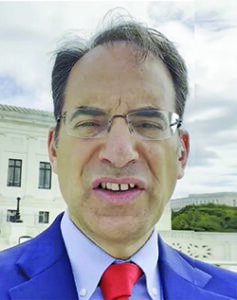
Paul Weiser
The 2026 Gubernatorial campaign is going to be wild, and a big part of that prediction is the Democrat front runner’s detachment from reality.
Earlier this month, Attorney General Phil Weiser posted to X, “In Colorado, we know what responsible governance looks like — and our leadership on the opioid crisis is a stellar example. As Governor, I will take our tradition of collaborative and innovative leadership to meet the range of challenges facing our state.”
In the post, he includes a link to an article that he wrote, in which we find his source for the “stellar” leadership:
“On his national TV broadcast, John Oliver had a lot of say about how other states have failed on their opioid response; he also called out Colorado an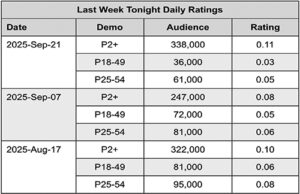 d North Carolina as setting the gold standard for how transparent we have been in how we’re spending these funds.”
Praise and affirmation of Weiser’s leadership is so low that he’s quoting a red-coated, failed comedian whose “national TV broadcast” is watched by 0.057% of the target demo, per September 2025 Nielson data.
Look at demographic breakdowns. P2+ in ratings refers to the total number of viewers aged 2 and older — it’s a broad demographic metric that captures the overall audience size, including adults, children, and anyone else (i.e., everyone in a Nielson house.)
Weiser cites this comedian(?) — the one reaching 61,000 people in a 107.5M person national demo — as an authority on Colorado leadership.
That’s enough for the AG. But should it be enough for Colorado voters? Setting aside what the foreign comedian says, what story does the data on lawfare, crime, and fentanyl say about Weiser’s performance?
As of mid-2025, the Attorney General of Colorado, Phil Weiser, has filed more than 20 lawsuits against President Trump and/or the federal government. He’s doing this in his official capacity, and using Taxpayer dollars, while citing the lawsuits as a campaign accomplishment.
While Weiser’s attention is focused on his campaign and portfolio of Trump-deranged lawfare (at your expense), his job performance — as the head of the justice department in the Centennial State — is stunning.
In 2022, the year of Weiser’s reelection, Colorado was ranked 4th highest nationally for overall crime (combining property and violent crime), according to FBI data, as reported by Common Sense Institute.
According to USAFacts, in 2024 Colorado’s violent crime rate was about 476 per 100,000 — placing it 7th highest among all states. That same source shows the state’s property crime rate at 2,593 per 100,000, ranking it 2nd highest among states in 2024.
In July, the Denver Gazette reported that Colorado was the “second most dangerous state” in the US, behind only New Mexico. But let’s get even more specific.
Weiser cites the state’s “stellar” leadership on the fentanyl crisis — but from 2018 (Weiser’s election) to 2023 (one year after Weiser’s reelection), fentanyl overdoses in Colorado increased by 900%, according to preliminary data from the Colorado Department of Public Health and Environment, as reported by KKCO 11 News. 900%!
In 2023, the DEA’s Rocky Mountain Field Division — a federal agency — seized a record 2.6 million fentanyl pills and an additional ~425.6 kilograms of fentanyl seized in 2023 in Colorado. In fact, Colorado is tied for second highest fentanyl seizures, according to Newsline’s assessment of the 2023 Colorado data. Despite these outcomes, the fentanyl crisis cost taxpayers an estimated $16 billion in 2023, about 3% of Colorado’s GDP, around $2,200 per taxpayer.
No wonder the campaign needs to rely on foreign storytellers to rebrand and spin Phil Weiser as a “stellar” leader and viable candidate.
Weiser is desperate for Colorado voters to imagine him expertly navigating the new, more powerful job of Governor while convincing them to forget his abysmal performance in the current AG spot.
But that strategy requires voters not believing their own eyes. And Colorado voters notice the examples of Phil’s stellar leadership all around them. Check out @dobetterDNVR on X for plentiful examples.
Alternatively, perhaps when Weiser claims “stellar leadership” in fentanyl, he means that Colorado is leading the nation in expanding illicit fentanyl access, use, and addiction. That’s certainly the story of leadership that the data tells.
Regardless of what he means by his words, electing Weiser for Governor will see Colorado continue the way things are right now. We’re living Weiser’s policies, positions, and politics right now. He’s literally bragging, right now, about almost nabbing the spot for worst performance in the nation on fentanyl. From his standpoint, it’s all “stellar.”
If you want Colorado to change, you must fire those making it stay the same.
Start with the guy who decriminalized crime.
Ashe in America is a writer and activist. Find all her work at linktree.com/asheinamerica.
by Ashe in America | Sep 19, 2025 | Feature Story Bottom Left
ASHE IN AMERICA — OPINION
Let’s go back to the beginning… to January 20, 2017.
 “What truly matters is not which party controls our government, but whether our government is controlled by the people. January 20th 2017, will be remembered as the day the people became the rulers of this nation again.”
I wasn’t die hard MAGA on that day, but I still get chills when I read or hear that speech. During his first term, President Trump very quickly earned my support for two reasons: (1) He was the first President in my lifetime to do the things he said he was going to do, and (2) he made all the right enemies.
The unprecedented attacks on President Trump, by every previously trusted institution, are not because President Trump is a terrible person or a predator or a super serious threat to democracy.
The attacks on President Trump are because he is giving the power back to the people.
But what does that mean?
Since the explosion of cable news, Americans have been slowly transferring their attention, and outrage, from their local communities to Washington, D.C. It’s been about 30 years, and the results are measurable.
People know their congressman, but they don’t know their state rep. Coinciding with this shift is strengthening of party tribalism — even as party membership has declined — for both parties over a decade in Colorado.
In many ways, party has replaced community. Parties rose as a way to organize and make change based on shared values, but parties today look more like each other than the communities and value systems they claim to represent.
You do not exercise your power by joining a party. You exercise your power by standing on your rights.
I learned this lesson intimately over the past several years fighting leftist lawfare from three leftist NGOs (and their pals in local, state, and federal government).
The claims were voter suppression, intimidation, coercion, and threats under the Voting Rights Act and the KKK Act. They claimed we were sending armed agents to people’s homes to intimidate and interrogate them about their votes. In reality, we simply canvassed the 2020 election, in a 100% volunteer effort, to check the government’s work. The real reason for the lawsuit, based on the evidence and arguments at trial, is that we were “election deniers” daring to exercise our First Amendment rights.
The case went to trial last July, I defended myself, and the judge entered judgement in our favor and awarded us costs. The plaintiffs appealed, and the case is docketed for November in the 10th Circuit. (24-1328)
Your rights are meaningless if you don’t hold the line on them.
There are many other examples of Colorado patriots standing on their rights in Colorado. Tina Peters is in prison for nine years. She was convicted, essentially for lying to public officials about a person who was in her office. The part of the story that you don’t hear is that Peters had the authority to have whomever she wanted in her office — until Secretary Griswold invented emergency rules for COVID.
Dallas Schroeder and Rhonda Braun in Elbert County also took images of voting equipment, and Griswold libeled and slandered the officials and imposed baseless and retaliatory sanctions on the county. No crime has ever been found in Elbert County. And no retractions or clarifications were ever issued by the Secretary.
Then there is Rebecca Lavrens, the praying grandmother of January 6th who prayed inside the capitol, and was dragged into DC court years later. During her sentencing, she was effectively told to deny her faith before the court. Lavrens refused, and she was stripped of her internet access and placed on house arrest.
At this point you might be thinking, “but, Ashe, everyone in your examples had horrible consequences for standing on their rights.”
That’s true.
I’m adapting this column on September 10th. Charlie Kirk was just assassinated. It is, right now to me, profoundly true that standing for American rights and values comes with consequences.
But that’s not just true of our current moment. It’s true of every patriot who has held the line of liberty in the face of tyranny — every patriot since the founding of our nation.
Americans are out of practice on Americanism. Over the past 30 years, our attention and focus have shifted away from our communities, and as we watched the soap opera in the nation’s capitol, murderous despots filled the vacuum.
Along the way, we decided to prioritize comfort over liberty. Our comfort keeps us in fear.
Do you want to be comfortable? Or do you want to be free?
Self governance is our birth right in America — we should never abandon American liberty in the face of fear. Our response should be to get louder.
Charlie Kirk’s assassination is a tragedy that is shaking the nation. Pray for his beautiful family, and for all the students that witnessed his horrific assassination. They will be forever changed, irreparably scarred by such a hateful, deliberate, and gruesome act of violence.
Then get off your knees and get loud.
This month’s column is adapted from Ashe in America’s remarks to Parker Conservatives on September 3, 2025. You can read the full remarks on asheinamerica.substack.com. Ashe in America is a writer and activist. Find all her work at linktree.com/asheinamerica.
by Ashe in America | Aug 22, 2025 | Feature Story Bottom Left
ASHE IN AMERICA — OPINION
For three months, Colorado voters breathed a little easier, safe to exhale after the Colorado General Assembly gavelled out on May 7, 2025. It was short lived.
“Today, Governor Jared Polis called the General Assembly back into session to address the significant impacts of H.R. 1 to Colorado’s budget,” an August 6, 2025, press release from the Governor’s office states.
The press release goes on to quote prominent democrats, Planned Parenthood, and other publicly-funded NGO leaders on how the $1.2B “loss of revenue” is devastating for “the state.”
It’s all in the framing.
To quote Representative Ken deGraaf (R-HD22) from an August 7 X post, “Subsidies are not ‘revenue.’ The federal government is not a source of it. Taxpayers are the source of revenue. Jared is just sad that his unsustainable spending spree cannot be sustained. Perhaps the second $5 billion on the train-to-nowhere-fast should pause until we see how California’s works out.”
He is obviously correct. Colorado taxpayers are also federal taxpayers, and the pork-filled-bridge-to-nowhere scam is coming to an end. This is going to be hard for Colorado. Colorado loves its virtue-signally, social change-promising NGOs.
In an article from April 2024 International Rescue Mission titled, “Nonprofits matter — Colorado Nonprofit Sector Supports $62 Billion in Economic Activity,” the nonprofit analyzes Polis’ “Colorado Nonprofit Economic Impact Report,” and how “the nonprofit sector directly employs 182,000 people, supporting an additional 54,000 jobs through business-to-business activity and 26,000 jobs via household spending.”
Wait, what?
“In total, this accounts for 10% of all jobs in Colorado.”
Honestly, the non-profit sector should be the priority for closing the gap. Colorado politicians are unlikely to take that approach — you can rather expect to see new taxes and fees.
Another barrier to solving this particular problem is the cost of new legislation — and the legislators were so busy earlier this year that new laws, and their related costs, are plentiful. Again from Rep deGraaf on X:
“Rubberstampapalooza: Because 700 new bills in 100 days is not enough new legislation for Democrats, they have engaged in the crisis-manufacture so they can pretend to crisis-manage. The sycophants of state want nothing more than for the trough to be open year-round. The timing and scope of the executive order/proclamation undoubtedly comes on the heels of this extra, ordinary session to figure out how to tax/fee you more. This governance-theater will cost the state around $50k per day to go through their choreographed ‘Dance of the Socialists.’”
Just in August, a portfolio of new laws went into effect. Highlights include allowing the government to price fix in an “emergency” (HB25-1010), gun violence education materials (HB25-1270), free tribal access to state parks (HB25-1163), new criminal statutes that protect transit workers (HB25-1290), and a simpler path to abandoning your children (HB25-1185).
Oh, they also created a process (inexplicably) so potential gun owners can voluntarily block themselves from buying a gun (SB25-034). That creates a new registry and list management and all associated costs of implementation — and it’s entirely unnecessary. Just don’t buy a gun if you don’t want one, right?
Republicans in Colorado are critical of the Governor’s special session, with several quoted in a House Republican press release from August 6:
“Families and small businesses across Colorado are being crushed under the weight of government overreach, rising costs, and reckless spending,” said Representative Anthony Hartsook (R-HD44). “Instead of working with us to rein in waste and protect the most vulnerable, the Governor is using this special session to defend a broken system. House Republicans are committed to responsible budgeting that puts Colorado families first.”
House Minority Leader Rose Pugliese piled on, “This is a waste of taxpayer dollars and state resources. The Governor is using a special session to stir fear about the Big Beautiful Bill when the truth is that the Big Beautiful Bill continues to cover the people it was designed to serve: seniors, single mothers, children, and people with disabilities.”
It’s unlikely that Colorado Republicans can do anything other than complain. In the House, they’re outnumbered 43 to 22, and in the Senate 23 to 12. The special session will proceed and the democrat majority will do what it wants.
As a result, Colorado is back to holding its breath, hoping against reason and history that the special session won’t further strip their rights and steal the fruit of their labor.
Ashe in America is a writer and activist. Find all her work at linktree.com/asheinamerica.