by Heather Brecl | Nov 17, 2025 | Main Articles
Cherry Creek North Residents Fight Government Overreach
by Heather Prochnow Brecl
Councilwoman Sawyer and GID Consultant Jamie Giellis present the proposed GID to CCN residents.
Cherry Creek North (CCN) residents successfully blocked the proposed General Improvement District (GID) for their neighborhood, keeping it from advancing toward the 2026 ballot. Their victory came after months of mounting opposition and culminated at a late-September meeting with consultant Jamie Giellis, representing Councilwoman Amanda Sawyer’s office, where residents made it clear they would not support the plan with the Cherry Creek North neighborhood in it. Their victory was reported in the Chronicle’s lead story last month, “Citizens Win! Neighbors Halt The Cherry Creek GID Takeover.”
But Giellis’ sudden and unexpected concession at the meeting without even the need to consult with the person who was purportedly heading the effort, Councilwoman Amanda Sawyer, left open many unanswered questions. What was the real genesis of this unwarranted and unwanted GID plan? What persons or entities were really behind the proposed Cherry Creek GID? Who were to be the real beneficiaries of the new GID?
The Official Story

CCN residents and activists Dana Busch, Wayne New, and Greg Jenkins battle to defeat the GID.
The story told to residents in Cherry Creek North by District 5 Councilwoman Amanda Sawyer was that numerous “constituents” had come to her requesting her aid in how to effectuate unspecified improvements in the Cherry Creek area. The story was spun that Swayer then consulted and engaged former Denver mayoral candidate and special district expert Jamie Giellis of Centro, Inc. to see what could be done to assist the constituents in their desire to improve the Cherry Creek area.
Councilwoman Sawyer went to Denver City Council and was awarded $15,000 to pay for a “feasibility study” regarding forming a General Improvement District for the entire Cherry Creek Statistical Area running from 6th Avenue to the North, Cherry Creek to the South, University Boulevard to the west, and Colorado Boulevard to the east. It is an unusually large GID with residential areas of Cherry Creek North and Cherry Creek East (containing 9,500 residents), the Cherry Creek Mall, and the Cherry Creek North Business Improvement District.
Neighborhood Disbelief
Sawyer’s initial problem was that no one believed her, or Giellis. The residents included in the Cherry Creek GID are many highly sophisticated individuals who know how government actually works and the feel-good cover stories, such as those being peddled by Sawyer and Giellis, are seldom the true motivations behind a project.
Cherry Creek resident Frank Ooms and other residents believe that the special districts like the Cherry Creek GID were examples of gross overstepping by the Denver City government and its complete lack of fiscal responsibility and policy. Ooms emphatically stated that the proposed GID was “a quick money grab for the City to raise funds for carrying out their own agenda for what they determine are needed improvements rather than actually representing the needs or wishes of Cherry Creek residents.”
By statute, a GID is supposed to be initiated by residents according to their needs as it is in essence an additional self-imposed expense on top of property/co mm
mm
ercial taxes they owe each year. Ooms, an architectural photographer for commercial projects and resident of Cherry Creek North, in tandem with other CCN residents, stood firmly in their position that the GID that Sawyer and the City were pushing did not represent the wishes of the majority of residents and was instead a front for picking the pockets of residents who live in well-established upper-class neighborhood.
Dana Busch, a vocal CCN resident and leader in the efforts to stop the GID, stated that “the residents of CCN are outraged that the City would try and impose these additional funds and that it is an excuse used to compensate for the City’s gross overstepping of government and complete mismanagement of funds.” She continued, saying that “the City of Denver so grossly mis prioritized and mismanaged their finances and policies that they attempted to use the residents of CCN to fix their budget problems and serve their own agenda further increasing the City’s debt and more problems, not to mention violating due process with a complete lack of transparency.”
The City Of Denver
 Tells A Different Narrative
Nick LeMasters, the respected and well-liked head of the Cherry Creek North Business Improvement District, appeared to be virtually the only business leader in the Cherry Creek area to admit what the GID was really about. When asked what the actual motivation of the City of Denver is for a GID in Cherry Creek, he described many critical areas of development that need to be addressed in Cherry Creek, such as public safety and mobility, including restoration of the Cherry Creek waterway, and an enhanced bikeway between University and Colorado which has become increasingly important for bikers. These are among the “shovel ready” proposed projects to maintain the elevated standard of living that residents of Cherry Creek expect and pay so dearly for.
Astro-Turf Survey
But, of course, residents were told nothing of the preplanned, “shovel ready” projects, that they were necessary since the city was bankrupting itself on the mayor’s homeless and “new comers” initiatives. The progressive City government was not going to spend money on what was viewed as the posh Cherry Creek area even if the area provided the second greatest amount of sales tax revenues to the City, surpassed only by downtown Denver.
Moreover, under the rubric of mobility (called “Denver Moves — Cherry Creek”), the City wanted to take out a driving lane for automobiles on Speer/1st and make it a bus lane which was not likely to be something that Cherry Creek residents wanted or were willing to pay for themselves. The businesses in Cherry Creek also did not want to pay for all of these shovel ready projects themselves. But the key to the project was to get residents to believe that they came up with the idea for more taxes to pay for vague and generalized improvements in Cherry Creek.
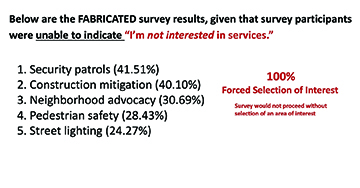
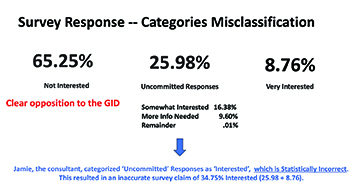
The gaslighting of the Cherry Creek residents was commenced with postcards sent out by Giellis last spring offering three improvement options — security, lighting, and beautification — and the results would later be presented as proof that residents supported forming a GID.
“The survey was designed to produce the answer the City wanted. It was a boondoggle, completely unscientific, and statistically meaningless,” says Dana Busch, CCN resident and entrepreneur.
Busch called the survey “a weaponized mechanism used to fabricate consent.” Residents note it failed to include a fourth option which was “no need for improvements,” creating a false narrative from the options that were included. Busch continued, saying that there was no credible demographic data, response rates, or cost transparency. Crucially, the City never disclosed how much a GID would cost homeowners, how assessments would be calculated, or that rates could increase over time without another vote. Furthermore, out of the almost 9,300 registered voters in the proposed GID area, only 200 votes are needed to get on the ballot. And, as is with other measures on the ballot, to pass the measure requires only a majority of those who actually end up voting.
“The City used bad statistics, omitted financial consequences, and spun the results as if residents were asking for services having no proof that they actually did,” Busch said. “That’s not just misleading, it’s manipulative.”
CCN resident Greg Jenkins, who has extensive experience with feasibility studies as an energy executive, pointed out that the survey that Geillis sent out falls far short of an actual feasibility study, noting that it is simply not possible to do a study when they do not even know what projects they are planning to do.
Denver’s Debt Habit
Continues with GIDs
As a whole, Denver has a lengthy track record for supporting bond measures, rapidly increasing the amount of debt that the City has in order to provide what they deem to be necessary services and what the people want. On the heels of defeating the proposed GID in CCN, Denver got the approval of a GID on Broadway and voted to pass the five “Vibrant Denver” Bonds in the amount $950M which will allow debt-funded construction.
Dana Busch expressed her disgust for the City’s overall irresponsible fiscal management. “They keep finding new ways to raise money instead of fixing the fiscal mess they already have. The City’s mismanagement is not our responsibility to underwrite. The CCN GID is a perfect example of going back into the pockets of residents to try and correct their gross misappropriation of funds to fix projects which are their responsibility to handle in the first place.”
How The CCN Neighborhood
Association Turned A Blind Eye
Initial discussions of the GID in CCN began with Councilwoman Amanda Sawyer and GID expert Jamie Geillis going first to sell developers like East West Partners and the Broe Group, and eventually the CCN Neighborhood Association (“CCNA”). Gradually CCN residents themselves were brought into forums. However, as discussion heated up and the City’s survey was sent out, the CCNA unexpectedly took a “neutral position” on the GID. CCN residents like Greg Jenkins became increasingly agitated by what they view as the unwillingness of their very own CCNA Board to protect the residents’ real interests.
Residents like Busch, Ooms, and Jenkins felt that their int erests were not represented by the City or their own neighborhood association that was once the vanguard of advocating for responsible development under the direction of Wayne New. Jenkins in particular felt that the CCNA was allowing the City to “pick their pockets” and slowly saw a pattern of change over the last year or so leading up to the GID battle. He noted that the neighborhood bylaws slowly allowed for more decision-making of the CCNA Board without participation of others. Furthermore, he recognized the involvement of individuals on the Board who he believes compromised the ability to represent CCN fully with their own agenda. “There are three things that motivate people to do things — they are power, prestige, and money. Falling short of demonstrating that money was the motivator, it is clear that power and prestige is causing certain Board members to wander away from their moral compass. Their naïveté and irresponsible behavior created great distrust with the Board.”
GIDs — Curse Or Saving Grace?
“GIDs are supposed to be put in place for emerging neighborhoods to solve specific problems that they deem are of necessity to their neighborhood — this does NOT apply to CCN,” noted Jenkins.
As downtown Denver continues to struggle to rebuild after decades of problems like safety, budgets, and failed businesses, there are a number of existing GIDs like in RiNo (Riverfront North) and Ballpark, including the formation of the Broadway GID, formed to raise additional funds for so-called necessary improvements. While on the surface, this appears to be a saving grace with increased funding for safety measures and development, Jenkins and other neighborhood colleagues are of the opinion that the GIDs are, in actuality, simply convenient tools for the City to patch holes in the tremendous mess that the City created over decades with no safety mechanisms in place to control what the GID can actually do with the funds they collect. Jenkins believes that the GIDs “are the proverbial nose under the camel’s tent and that once they are in there is no stopping them.”
In an attempt to get more clarity on the motivation of the City for forming a GID, residents of CCN opposed to the GID put in a formal request for public information through CORA to which the City refused to respond.
Jenkins pointed out that the future GID Board will not be people in the area but is the City Council itself and they in turn appoint an “advisory board” whose powers and authority can be taken away at any time. Since GID’s take on debt they are almost impossible to ever terminate.
“The GID Board may adjust the annual assessment rate or expand services as necessary… GIDs may issue debt to pay for capital projects.” — City and County of Denver, Guide to GID Creation.
That language confirmed residents’ fears that the Board could raise assessments, redirect funds, or incur debt with minimal resident oversight.
“Once the GID is in place, there’s nothing stopping the City from raising assessments or repurposing funds,” said Jenkins, energy consultant.
“It’s a blank check with no accountability.”
For example, in May of 2025, Denver City Council voted to renew the RiNo GID for another 10 years.
Wolf At The Doorstep
While the City of Denver claims that the GID is NOT another tax, but rather just an assessment intended for their own good, CCN residents see it as another tax adding onto what is already one of the highest property taxes in Denver. Jenkins said “if it looks, sounds, and smells like a tax” — it is. This is just another example of pulling the wool over people’s eyes and moving it along the road until it’s too late to stop it.”
Hidden Costs And Unchecked Authority
“The residents have no idea of the financial implications of imposing a GID with layers upon layers of costs to homeowners. City Hall has neglected to share that critical part of the dialogue and instead focuses on a warm and fuzzy narrative of improvements. The City has yet to actually tell anyone how they plan to fund the projects and what the real projects even are,” declared Dana Busch.
When the idea of the GID was first introduced in initial conversations between the City of Denver and residents, the City proposed that a mill levy would be used to assess the cost of the GID to each of the residents and that this levy would be based on property values at three price points $750,000, $1.5M, and $3M. Residents believe that the mill levy proposal did not actually align with the actual property values in CCN that are much higher than $1M nor was it a fair way to assess fees. Busch commented that homeowners will pay vastly different amounts for the GID to receive the same services.
The one person who would clearly benefit from the GID’s formation would be Jamie Giellis, who would earning up to $149,000 for working on the CC GID, one of many special districts she would oversee. As stated in the agreement between the City and Centro, Inc.
“4.4. Maximum Contract Amount
4.4.1. “the City’s maximum payment obligation will not exceed $149,000”
“CCN would simply be used as a piggy bank to fund the needs of the City, which are in actuality the inherent responsibility of the City. It is not the responsibility of CCN residents to carry those financial burdens simply because the City did not handle business and development responsibly.” — Dana Busch.
Busch goes on to say that the only possible way for the GID to be effective would be for a complete overhaul of the formation of the GID to happen with a new system of checks and balances.
Lessons In Accountability
The defeat of the proposed GID was more than a neighborhood win, it was a stand for civic accountability.
By exposing the misuse of data, the failure to disclose financial impacts, and the City’s attempt to bypass resident consent, CCN homeowners believe they forced transparency back into the process.
“Cherry Creek isn’t against improvement — it’s against being exploited,” Ooms said.
This neighborhood’s revolt the residents believe, ensures that for now, that City Hall’s playbook of quiet but endless tax hikes stops at least temporarily at the edge of the Cherry Creek area.
by Heather Brecl | Oct 20, 2025 | Main Articles
After months of grassroots pressure, Cherry Creek North neighbors stop Denver City Hall’s and Councilwoman Amanda Sawyer’s attempt to create a new tax district — and set a new standard for local government accountability.
by Heather Prochnow Brecl

Signage: Grassroots campaign signage became a unifying symbol across Cherry Creek North, as residents rallied under the “Stop the GID Tax in CCN” movement to oppose the proposed district.
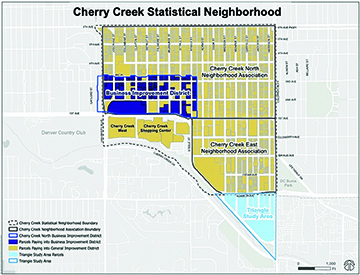
Map: A City of Denver map showing the Cherry Creek Statistical Neighborhood and proposed General Improvement District (GID) boundaries. The highlighted areas include the existing Business Improvement District (BID), Cherry Creek North and East Neighborhood Associations, and the “Triangle Study Area” south of 1st Avenue.
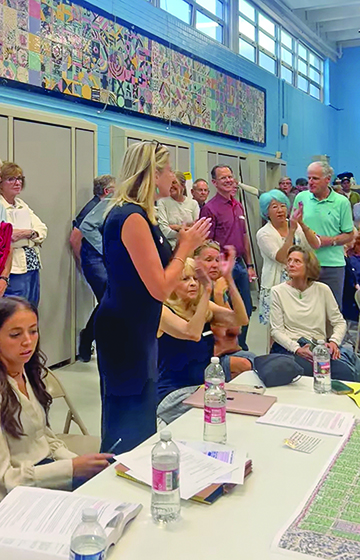
Enraged Citizens: Neighbors packed the Bromwell Elementary School meeting hall in September to demand answers about the proposed Cherry Creek North GID. Jamie Geillis responded to agitated attendees declaring that the City will no longer pursue the GID in Cherry Creek.

Bitter Defeat: Councilwoman Amanda Sawyer attacked her constituents following the defeat of the Cherry Creek North GID accusing them of “vitriol” and “intentional sharing of misinformation.”
Cherry Creek North residents have done what few neighborhoods manage to achieve — they held their local government accountable and won.
After months of organizing, petitioning, and pushing for answers, homeowners successfully defeated the City of Denver’s plan to form a General Improvement District (GID) — a proposal that would have imposed a new property tax on the neighborhood in the name of “enhancement projects.”
For now, the GID is officially off the table.
“Citizens will participate — but they expect honesty,” said Dana Busch, Cherry Creek North Resident.
Grassroots Unity Turned The Tide
What began as confusion over a postcard survey evolved into one of the most effective neighborhood movements Denver has seen in years.
After an initial article exposed flaws in the process, residents launched www.StopTheGIDinCCN.com to inform their community, share documents, track meetings, and mobilize volunteers.
Soon, yard signs lined every block, and door-to-door canvassing gathered more than 1,500 signatures opposing the tax. Standing-room-only meetings at Bromwell Elementary School drew hundreds of concerned neighbors demanding transparency.
Local media coverage followed, amplifying the message that the community was united, engaged, and watching closely.
September Showdown: Residents Demand Answers
The movement’s momentum peaked in two pivotal September meetings.
On September 9, residents dissected the GID’s legal structure, boundaries, and funding mechanisms — revealing that the City’s survey lacked residency verification and never disclosed that proposed projects would be funded through a permanent property tax.
At the September 16 meeting, Jamie Giellis, representing Councilwoman Amanda Sawyer’s office, addressed an agitated crowd and formally conceded that Cherry Creek North would be removed from consideration for the proposed GID. Giellis acknowledged the overwhelming opposition and confirmed that the City would not move forward with the plan in this area.
Councilwoman Sawyer’s
Formal Concession
The following day, September 17, 2025, Councilwoman Amanda Sawyer issued a formal statement confirming the decision:
“Last night officially ended the exploration and engagement effort to form a GID for the Cherry Creek North neighborhood,” Sawyer wrote.
“While we always welcome open dialogue and encourage all voices to be heard, it has been discouraging to see how misinformation and divisive rhetoric overshadowed what was intended to be a constructive community conversation.”
Her letter closed by noting that the City would continue to explore similar districts in other parts of the Cherry Creek study area — a tone that, to many residents, underscored the problem: City officials were still deflecting responsibility rather than acknowledging missteps in communication and transparency.
Why Residents Were Outraged
At the center of the conflict was what neighbors called a “weaponized survey.”
The City’s online questionnaire invited feedback on amenities such as lighting, landscaping, and safety patrols — but never asked the most basic question: Do you want a new tax to pay for these things?
Because anyone could take the survey — even those living outside the proposed district — residents questioned its legitimacy. Many felt it was designed to create a false narrative of support rather than
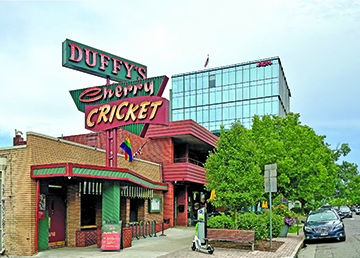
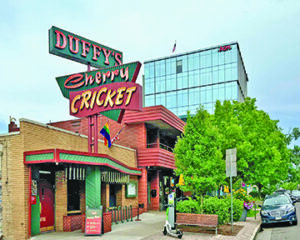
Cherry Cricket: The Cherry Cricket, a Cherry Creek North institution since 1945, sits near the heart of the area once targeted for the proposed GID — an emblem of the neighborhood’s mix of tradition, independence, and local pride.
collect meaningful feedback.
“This was about standing up when government oversteps,” added Busch.
Neighborhood Association:
“It’s Time To Heal”
Following the decision, the Cherry Creek North Neighborhood Association (CCNNA) issued a statement:
“The General Improvement District discussions are OVER; there will be no GID in the Cherry Creek area. A GID is simply a tool to address issues that residents want to fund. Currently, the majority of residents don’t feel that the scale of the problems warrants establishment of a GID in CCN.
The issues surrounding the GID formation discussions were complicated and led to deep wounds in our neighborhood that we would like to help heal.”
That healing, residents say, begins with rebuilding trust — not only within Cherry Creek North, but also between the neighborhood and City Hall.
A Broader Call For Reform
The defeat of the GID represents more than a neighborhood victory — it’s a lesson in civic accountability.
Residents are now calling for reforms in how Denver initiates and communicates potential improvement districts, including verified surveys, full financial transparency, and clear disclosures before any tax proposal moves forward.
The experience also raised broader questions about how public officials interpret “engagement.” For many in Cherry Creek North, the City’s version of outreach felt more like persuasion than participation.
“Government should never forget that it serves the people — not the other way around,” said Busch.
The Larger Lesson:
Power In Participation
The Cherry Creek North movement has become a model for how citizens can challenge opaque government processes through persistence and collaboration.
Their campaign — built on open dialogue, data gathering, and neighbor-to-neighbor engagement — proved that local democracy still works when residents get involved. The fight connected neighbors who had never met, empowered volunteers to learn city policy, and reminded everyone that complex bureaucratic actions can be stopped through collective action.
Now, neighbors are discussing next steps — how to stay engaged, promote transparency, and ensure future proposals begin with genuine community input.
The Legacy Of The Movement
What began as opposition to a single proposal has reshaped Cherry Creek North’s civic identity. The neighborhood discovered its collective strength and proved that engaged citizens can stop bad policy in its tracks. The newly bonded community of residents plans to stay engaged and stay strong in their resolve to protect the neighborhood they love.
While Denver leaders may revisit similar proposals elsewhere, residents of Cherry Creek North have established a precedent: informed, organized communities can — and will — demand accountability.
The GID is gone, but its legacy endures — a reminder that transparency, consent, and communication are the cornerstones of good governance.
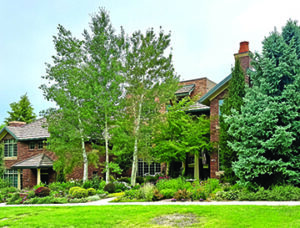
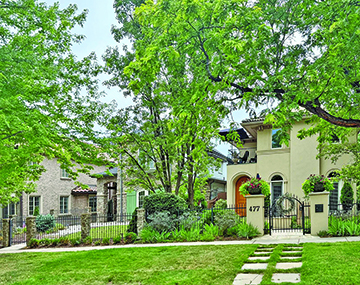
Tree-lined Street: Tree-lined streets and architecturally distinctive homes define Cherry Creek North — a neighborhood where residents take deep pride in preserving the character and quality of the place they call home.
by Heather Brecl | Jul 24, 2025 | Main Articles
by Heather Brecl
A growing group of residents in Cherry Creek North (CCN) is voicing strong opposition to a proposed General Improvement District (GID) that would impose a new mill levy on local homeowners. While the initiative is framed as a way to fund neighborhood enhancements, many residents argue it lacks transparency, introduces unnecessary financial risks, and does not reflect their needs or desires.
City’s Perspective vs. Community Reality
According to Councilwoman Amanda Sawyer — who represents Denver’s District 5, which includes Cherry Creek North:
“It is entirely up to the community if they would like to create a GID and, if so, what the cost structure of the GID would be, what the governance structure would look like, and what investments they would like to fund and implement.
A GID was first contemplated in the 2012 Cherry Creek Area Plan, which is a document born out of several years of community conversation. Over the past two years, Cherry Creek residents have expressed a desire for things that the City will not fund — such as security patrols, pedestrian-scale lighting, a neighborhood transit circulator, and beautification features. A GID is the best tool to achieve those goals, but only if residents want it. The Council Office is simply facilitating the conversation.”
However, many CCN homeowners say these statements do not reflect their experience with the process. Instead of inclusive, transparent community dialogue, they describe a rollout that has felt top-down, vague, and rushed.
Flawed Outreach And A Lack Of Transparency
The GID initiative first came to light for many residents through a postcard survey — one that numerous neighbors have described as deeply flawed. While the survey asked about preferences for amenities, it failed to clearly disclose that all improvements would be funded through a new residential property tax.
“There was no upfront question that said, ‘Do you want a permanent tax to pay for these things?’” said homeowner Dana Busch, one of more than 100 CCN residents voicing concerns. “It felt more like a marketing exercise than an effort to genuinely understand the community.”
The survey was also not restricted to verified voters or property owners within the proposed GID boundaries. It could be taken multiple times and shared broadly, with no identity verification. Councilmember Sawyer’s office promoted it via her District 5 platform — even though her district extends far beyond the proposed GID footprint. This has raised questions about the integrity of the data collected and who the survey responses actually represent.
Inclusion Without Consent
Residents were particularly surprised to learn that Cherry Creek North’s residential core — bounded roughly by University Boulevard to Colorado Boulevard, 6th Avenue to 1st Avenue, and between Adams and Steele from 3rd to 6th — was included in the GID proposal without prior input or notification. Many feel blindsided by the initiative and argue that the commercial and residential zones are fundamentally different in both needs and character.
“We were never asked if we wanted to be part of this,” said Busch. “Now we’re being told we may be taxed to support projects that don’t directly benefit our neighborhood.”
Opponents are also concerned that, under current rules, the GID could be approved by voters who don’t live in the residential blocks most affected. There was no verification system in the survey to confirm that respondents had a legal stake in the outcome, further eroding trust in the process.
Unclear Use Of Funds
Residents have repeatedly asked for clarity: What specific projects would be funded? What would the cost be per household? How would spending be allocated across zones? So far, there have been no detailed answers. Instead, responses have suggested that details would be worked out after the GID is formed.
“The answer we’re hearing is basically, ‘Pass it first, then we’ll figure it out,’” said one neighbor. “That’s not how responsible planning works.”
There’s also concern that the GID could be used to issue bonds or take on long-term debt. Given Denver’s current financial challenges, some residents believe this may be a workaround to shift infrastructure costs onto neighborhoods without broader public oversight.
Neighborhood Board Concerns And Leadership Conflict
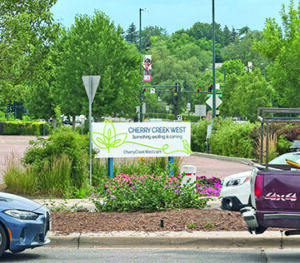
Why should long-established Cherry Creek North be taxed to support major developments like Cherry Creek West? Residents say: It’s not our responsibility and propose being excluded from the GID.
Efforts to raise concerns at the neighborhood level have also proven difficult. Residents say their requests for public forums have been declined or redirected to websites and Facebook pages. This limited access to real-time dialogue has left many feeling excluded from decisions that could impact their property taxes for decades.
Some residents have also pointed to potential conflicts of interest involving two members of the neighborhood association board — both of whom sit on the GID steering committee. In a recent meeting, one committee member reportedly acknowledged the limitations of the survey, noting it might not yield meaningful insights. Despite this, the process appears to be moving forward without pause.
Mismatch Between Neighborhood Needs And GID Goals
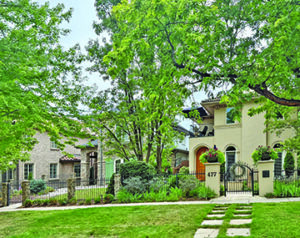
Well-established, well-loved, and well-maintained — Cherry Creek North residents are pushing back against a GID they didn’t ask for and don’t need.
Residents of CCN stress that their low-density, residential neighborhood is not comparable to the high-density, mixed-use commercial zones elsewhere in the GID boundary. Most say they do not require major capital improvements and could handle smaller projects — like sidewalk repairs, lighting upgrades, or landscaping — through existing mechanisms.
Wayne New, former Denver City Councilmember and past president of the Cherry Creek North Homeowners’ Association, shares these concerns:
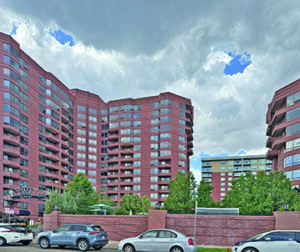
Imagine voting to raise someone else’s taxes — with no responsibility to pay them. That’s the concern CCN homeowners have with the proposed GID process. Under current rules, renters — who won’t pay the tax — can still vote on it. Homeowners are asking for a more equitable and transparent system.
“Without additional communication with all of our residents, this GID will not understand and represent the improvements needed in our neighborhood. To many the mandatory tax increase funding by residents will be pushed forward without clear communication. In addition, the life of the GID may extend for 10 or more years, creating mandatory additional tax revenue without indicating how the funds would be used. Residents paying for services that were previously funded by our City tax dollars is a major concern.”
Preliminary financial reviews suggest that residential tax contributions would significantly outpace any direct benefits returned to the neighborhood. Many believe their dollars would be used to subsidize larger commercial or infrastructure investments elsewhere in the district.
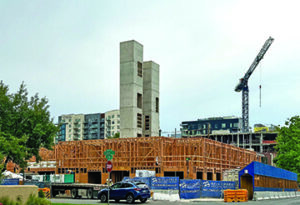
New development, vague plans, and a tax bill for homeowners. The City’s GID proposal raises more questions than answers — especially about where the money goes and who it really helps.
“We’re not against investing in our neighborhood,” added Busch. “We’re just against doing it through a process that lacks clarity and fairness.”
What Residents Are Asking For
The opposition group is not against improvement — but they are asking for a better process. Their main request is simple: remove the Cherry Creek North residential neighborhood from the proposed GID.
“We want to see thoughtful enhancements in our neighborhood too,” said Busch. “But not through a process where our voices are diluted, our questions are unanswered, and the financial implications are uncertain.”
 To stay informed, share concerns, and coordinate local outreach, residents have launched StopTheGIDinCCN.com. The site includes resources, updates, public records, and ways for neighbors to get involved in shaping the future of their community
by Heather Brecl | Feb 19, 2024 | Main Articles
by Heather Brecl
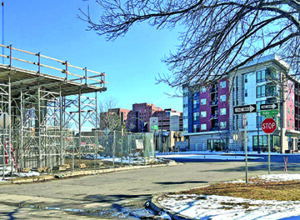
Overdevelopment: Neighbors argue that Hale neighborhood is already stressed by overdevelopment and apartments and does not need more ADUs.
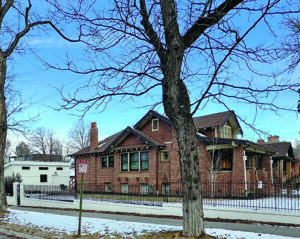
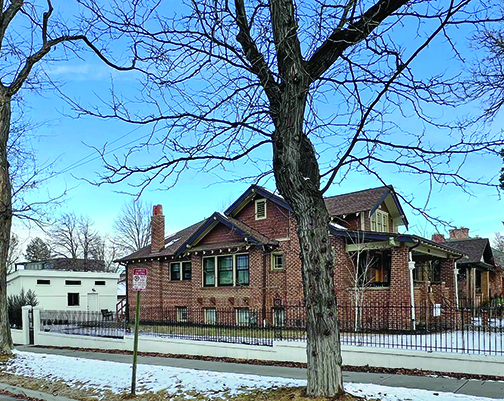
Back To The Future: Denver City Council eliminated Accessory Dwelling Units in 1954. They have raised their ugly head again as seen here at a home in Washington Park.
As the real estate market heats up this Spring, residents in Denver’s Hale neighborhood fear that new proposed rezoning laws regarding ADUs (Accessory Dwelling Units) will further accelerate unwelcome change in the neighborhood they love. And the concerns don’t stop with those residing in Hale — their neighbors in Mayfair, Hilltop, and Crestmoor Park see the impending loosening of regulations as the opening of floodgates for a myriad of problems that will devalue the historic neighborhoods that they hold near and dear to their hearts.
ADUs are a secondary structure or apartment that shares the lot with a larger primary home. They are built to provide additional and separate space for extended family members or to create income as a rental to offset mortgage costs. Often, they are apartments built above a garage, but can also include a finished basement used as separate living quarters. According to the City and County of Denver, Denver Zoning Code no longer has minimum lot size requirements for ADUs, though the size of the property does affect the size of a detached ADU and where on the property it can be.
Controversial District 5 Denver City Councilwoman Amanda Sawyer, a former California resident and CU Boulder grad, (serving Cherry Creek, Country Club, Hale, Hilltop, Lowry, Montclair, Washington-Virginia Vale, and Mayfair) is sponsoring the ADU rezoning efforts. Sawyer is already in hot water with her District 5 constituents over so-called traffic calming measures at 7th and Williams, and other locations which are causing traffic accidents (see Chronicle October 2023 edition’s front page “7th and Williams Fiasco”), and even a recent fatality. Sawyer believes that making ADUs easier to build in Hale will answer some of the affordability challenges that Denver buyers face.
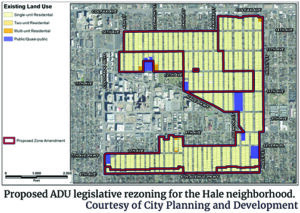
Proposed Rezoning: The areas highlighted in yellow and orange indicate lots subject to ADU redevelopment.
Members of the community in and around Hale see the addition of ADUs through a much different lens. According to residents in the surrounding neighborhoods, making ADUs a more accessible option for all homeowners in the area will destroy the character of their neighborhood and create irreparable damage in addition to the growing pains that are already facing. They fear that ADUs will be used as rentals to offset housing costs, creating a flood of trouble. With the slew of retail, restaurant, and entertainment venues that have been built in the Hale neighborhood near 8th and Colorado in the past few years, along with thousands of new residents that moved into the 9th+CO development, parking and congestion of traffic is already extremely formidable.
One Hale resident, who was granted anonymity to speak freely, has experienced first-hand the nightmare of having to find parking every night by her condo at 11th and Hale, even though she

In Hot Water Again: Councilwoman Amanda Sawyer has stirred controversy once again by pushing the development of ADUs in the Hale neighborhood. Residents of other neighborhoods fear this is just the beginning of pernicious overdevelopment.
owns her own spot. The resident’s designated parking space is rarely available for her own use — recently she parked three blocks away and was robbed at gunpoint returning home from her car. With the congestion and overdevelopment comes a new nine-acre development site with housing that is going in where the old VA Hospital is. Residents have pointed out that there are multiple empty lots where development has stalled, and they have witnessed growing numbers of homeless people.
Many residents believe that the rezoning in Hale isn’t even needed in the neighborhood as there are enough vacant rentals available already. Many feel that most residents probably can’t afford to get a permit for an ADU let alone build it, so there is no reason to change the existing law for the ones who can. They propose that the passing of the measure is simply intended to create a snowball effect for Mayfair and Hilltop next. Of the 16,401 occupied housing units in Hale, 56.81% are owner-occupied, while 43.19% have renters living in them. (Source: point2homes.com). Councilwoman Sawyer confirmed that of those homeowners who qualify to have an ADU on their property, statistically only 1.5% choose to do so. This leads residents to wonder why the money and resources were spent to pass such a measure which affects so few.
Long-time Denver Realtor Denice Reich of Re/Max and area resident voiced grave concerns that the historic integrity of these neighborhoods is in danger with the proposed rezoning that she believes will follow suit in Hilltop and Crestmoor Park once fully approved in Hale. She noted that while the lots in Hale may be too small to fit the guidelines and setbacks required to build an ADU, the larger lots in the neighboring areas are prime territory for ADUs. She fears that what happened in Capitol Hill to a once stately neighborhood with some historic homes being preserved and others scraped and replaced with unsightly multi-family units could happen elsewhere if the legislation continues down this path.
Reich shared that in her experience in residential real estate property, home values drop with the increase of rental units and an

Neighborhood Champion: Denice Reich, Re/Max realtor, is one of the many voices fighting the rezoning efforts of Councilwoman Amanda Sawyer.
increased transient population in the area. In addition, she cited her fear of increased traffic on 13th and 14th Avenues, decreased parking, increased population density, and clogging access for emergency services (especially fire). Furthermore, Reich proposes that there will be detrimental problems stemming from the construction of ADUs near property lines, especially because of the relaxed guidelines for setbacks such as loss of the tree canopy, more non-permeable land for water to flood off, and more noise and dust from construction.
While Councilwoman Sawyer’s Office stands by the results of their community survey in which 58% for expressed support the rezoning for ADUs, while neighbors argue that the number lacks transparency and that the actual sample of those wanting the zoning changes is too small to represent how the overall community truly feels. According to the numbers provided by the Councilwoman’s Office, only 382 responses (representing 4% of the population in Hale) were received and only 212 were considered valid with a margin of error of 6.5%.
It remains to be seen what the overall impact of rezoning will actually be. As the landscape and city continues to change at rapid pace with both the construction of new residential homes and unending commercial development, the conversation continues to escalate leaving all sides seeking long-term solutions that will provide affordable and dependable futures.
The Hale ADU rezoning was passed on January 17, 2024, in a meeting of the Denver Planning Board and then again on February 6, 2024, during the meeting of the LUTI (Land Use, Transportation and Infrastructure) Committee. It will be the subject of a final public hearing with the full City Council scheduled for March 26, 2024. The rezoning will apply to over 1,500 properties.
The public can follow the legislative process and view documents submitted for City Council review at denver.legistar.com or denvergov.org.
by Heather Brecl | Dec 15, 2023 | Main Articles
by Heather Brecl
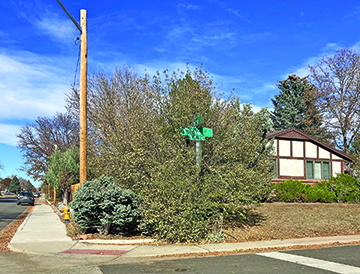
Homeowners on corner lots in Denver will pay up to $350 per year more than most.
In case 2023 didn’t have enough in store for everyone, 2024 is on the path to deliver more. In November 2022 Denver voters narrowly passed a new citizen-led ballot initiative called Ordinance 307 resulting in an annual fee for sidewalk construction that is coming due in the new year. Homeowners in the city of Denver will have to get ready to add one more bill to the list of things to deal with as a homeowner. On top of the tripled property tax and now the bill for trash removal, residents of Denver will be assessed a new fee that was designed to fund a complete overhaul of the sidewalk system throughout the city. This initiative was spearheaded by the nonprofit organization called Denver Streets Partnership.
Whether or not homeowners actually have a sidewalk, they will be paying a fee to the City for the project for at least the next 10 years.
How much is the fee and how can residents figure out what it will be? The city of Denver created a tool that provided an estimate for homeowners. On average the fee will be around $108/year per household, however if a home is positioned on a street corner, the fee will in some cases be as high as $450 per year. Since the fee is assessed according to the linear footage that a property has along a city street, the longer the property boundary, the higher the fee will be. Unfortunately for residents trying to forecast expenses for the upcoming year, the pricing tool has been taken down from the Denver County website and the following notice is in place: “The city’s sidewalk task force is reviewing the sidewalk ordinance and may refine the current fee structure to ensure it is applied in a way that is as fair and reasonable as possible. DOTI (Department of Transportation and Infrastructure) has removed the sidewalk fee lookup tool it previously offered on this webpage while that assessment is underway.” The task force is scheduled to complete their evaluation by
July and levy the fees.
Denver resident Erin F. (last name withheld at her request) is outraged by the new sidewalk fee which for her will be over $450 per year since her home has what is now seen by her as the misfortune of being on a corner lot. Prior to the sidewalk tax, Erin appreciated her large lot that she and her son have enjoyed for years. She also takes on the responsibility of making sure that the sidewalk is always shoveled, even shoveling her elderly neighbor’s sidewalk during snowstorms. Even though Denver residents do not own actually own the sidewalk, it has been their responsibility to make sure it is cleared of snow in the required amount of time and that repairs done as needed.
With the new fee structure, the responsibility for sidewalk repairs and improvements shifts to the City of Denver. While this seems to lessen the burden of homeowners having to do expensive repairs themselves, many homeowners will in effect just be paying a sometimes exorbitant fee for sidewalks that may not ever need any repairs in their lifetime. It also leaves to question what the actual process will be to have any needed repairs done with no reasonable sense for a timeline as the process will be new from start to finish and will encompass the entire sidewalk network.
To Erin F. and many other homeowners, the new sidewalk fee seems anything but fair. “The new fee is a huge burden to people, on top of everything else that we have on our plates with a big increase in property taxes and now having to pay for trash too,” said Erin F. “People are going to lose their homes over this. I have no control over who uses my sidewalk but now suddenly I’m responsible for paying more than any of my neighbors to maintain it even though it was recently repaired and is in perfect condition. I don’t understand how anything about this fee is fair and equitable as the Denver Streets Partnership claims it is.”
Erin wants to know how the city plans on dealing with situations in which the homeowner is unable to afford the fee and if there will be any relief. She said that she has issued multiple complaints with the Partnership but has not gotten specific answers to her questions, and that the current policy only offers relief to certain neighborhoods.
Executive Director Jill Locantore of the organization that spearheaded the sidewalk effort responded to questions and concerns about the inequities of the assessed fee stating that “fair is a matter of opinion and perspective.” She explained that Denver has had an ongoing conversation for the past 20 years since the Webb administration about improving the sidewalk situation and the residents of Denver have spoken by voting for the ordinance. Locantore emphasized that the majority of Denver’s citizens voted to have safe sidewalks and it is her organization’s commitment to fulfill that mission, making sure that people have a safe way to walk through their neighborhoods and move about their communities. The City’s stakeholder committee is currently reviewing ways to tighten up the differences between the average fees assessed and the “outliers” such as those who own properties on long sidewalks and corners. She stated that they cannot make everyone happy but are making concerted efforts to make as many people happy as possible.
Overall, the Partnership, in conjunction with the City of Denver, estimates that a complete overhaul of the sidewalk system will cost upwards of $1 billion and will take up to 10 years to complete. Annually the fees will total approximately $40 million which is how much DOTI believes to be the cost of yearly maintenance. The additional funds will be raised from bonds.
Erin F. remarked that she will most likely never see any immediate benefit to the thousands of dollars in sidewalk fees that she will pay over the coming years as her sidewalk was just recently redone. On average, homeowners sell their homes after seven years which means that most will be in the same situation as Erin and will contribute to the sidewalk fund without ever directly reaping the benefits.
Homeowners may think that they will avoid being assessed the fee if there is no sidewalk but they are mistaken. The fee applies to all properties bordering a city street — whether or not a sidewalk actually exists. As is stated on the denvergov.org website, “(T)he requirement to pay the sidewalk fee is not dependent upon having a sidewalk or whether or not a property owner has recently completed installation or repairs. The fee is a revenue source to fund maintenance and repair projects and new sidewalk installations to connect people to places and services citywide.”
Furthermore, homeowners who think they refuse to pay the fee or cannot pay, will have a lien placed on their properties and the city will not be issuing any refunds or exemptions. Locantore did point out that certain discounts will be offered in the amount of 20% for real estate property located in neighborhoods which have been historically underfunded and are considered area of risk under the city’s NEST (Neighborhood Equity and Stabilization) program.
As a single mom who struggles to make ends meet, Erin F. hopes that the efforts of the City’s stakeholder committee gives earnest consideration to the concerns she has and others in the same boat.
For more information on the impending sidewalk fees, go to denversidewalks.com and devergov.org and look for Sidewalk Construction, Reconstruction and Repair.