Although Storm Gloor is known around Glendale as a city councilman who enjoys running and spending time with his family, he is also an Associate Professor for the University of Colorado, Denver’s College of Arts & Media and a devoted music fan. He was involved in the music industry for 14 years and, more recently, has been conducting research and developing courses based on Music Cities topics. Unbeknownst to Gloor, Dr. Gigi Johnson, from UCLA’s Herb Alpert School of Music, was conducting similar research of her own.
Storm Gloor
“Five years ago I developed the first (from what I’ve been told) Music Cities course offered in higher education and Gigi developed Music Cities curricula more recently,” Gloor explains. “I led a Music Cities research project with my students for the city of Arvada and with Cheyenne, Wyoming. She led at least one with Los Angeles and has done some amazing things.”
Gloor and Johnson initially met at a Music Biz conference, became friends, and then realized that they were both doing related research at their respective schools.
“Our collaboration began with this project starting late last year,” says Gloor. “Gigi is awesome and when she suggested that we work together I jumped at the opportunity.”
When the two professors combined their efforts, they investigated 71 cities that had commissioned studies and analyzed each city’s music ecosystem. Their extensive research was accepted for presentation at this year’s South By Southwest — an annual gathering of film, interactive media, and music festivals and conferences in Austin — where they were slated to discuss connecting ideas between groups of organizations. As Gloor and Johnson planned their conference and strategized topics to cover, they realized that people and organizations all over the world were doing similar work. So they introduced those people to one another and put them on panels together. And then COVID-19 changed the world and everything was canceled.
Amplify Music Emerges
In an effort to ensure that their message was still heard, Gloor and Johnson organized a virtual gathering of stakeholders in the music economy who would focus on how communities and their ecosystems would endure the world shifting and discuss the short- and long-term effects on the music industry. The virtual gathering — now known as Amplify Music 2020 — became a 25-hour session that took place on April 23 and 24 with a new mission: bring together diverse music leaders and creators to learn and share from local artists, venues, creative communities, and support networks to address the challenges of COVID-19.
Featuring over 100 speakers and 11 central themes, the virtual event centered on the immediate future of music and how to prepare for the industry’s “new normal.”
“I think the most significant outcome is that we brought so many folks together so quickly to collaborate, share, and put the information out there to educate and provide a resource for anyone in need,” Gloor explains. “Hopefully we’ve contributed to getting through this as best we can.”
Major themes Gloor and Johnson highlighted were resilience, community, and recovery. Because the music business has historically been forced to repeatedly adapt due to disruptions caused by ever-changing technology, Gloor feels that the industry will survive the current disruption as well.
“Commercial radio did not stop people from going to see live music, home taping did not kill music, and post-Napster music consumers pay for music despite the prediction that they never would again,” he says. “In every case the industry was resilient, albeit with forced changes to the economic models. And it will be again. Music is too important to so many of us.”
Gloor continues, “That being said, all of those previous disruptions have generally been due to changing technology. We’re messing with a human virus now. Science, health and medicine, psychology, sociology, and even politics are now involved. The business will recover, though it will be painful. And the solutions, over at least the next 18 months, will now have to be sought through those lenses as well.”
What’s Next
While this unprecedented crisis is affecting most industries across the world, Gloor is confident in the resilience of the music business but acknowledges that the landscape will be different. That insight is why the conference’s format transformed from various sessions over the course of a month to 25 consecutive hours of discussion.
“There’s no doubt this has been catastrophic for the industry, particularly the live music industry,” Gloor says. “It’s tragic irony because that’s the sector that was perhaps thriving the most. For many artists it had become their main source of revenue, since sales of recordings had diminished so much and streaming has generated only a fraction of what recordings did. By the same token, live music venues were thriving. Attendance records were broken, shows were selling out more often, jobs were being created, and new venues were opening or upgrading. And then COVID.”
Though looking ahead is difficult, as the music business has already experienced significant blows with live music cancelations and venues closing indefinitely, Gloor is already seeing industry people coming up with ways to make do.
He adds, “Many folks, on both the business side and the artist side, are quickly getting creative just to stay afloat and are definitely working together. That was clear from the conversations during the conference.”
For more information on Amplify Music, and to see video recordings of all the sessions, visit www.amplifymusic.org.
Glendale City Councilman Storm Gloor is also an Associate Professor at UCD’s College of Arts & Media.
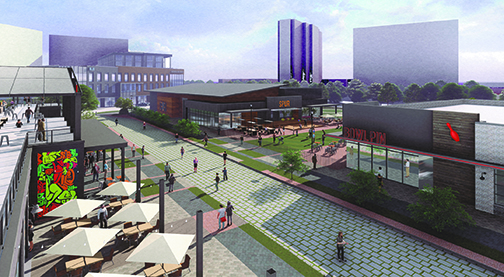
After several years of changes and setbacks, the Glendale 180 project is moving forward with a new real estate developer and a new timeline. Lincoln Property Company, a Dallas-based international real estate firm, is slated to break ground on the 268,000 square-foot mixed-used development in December 2020. An experiential retail, entertainment, hotel, and office destination, Glendale 180 will be the largest cohesive entertainment district in Colorado. It will also be among the first in the state to offer an open container law that allows for the common consumption of alcoholic beverages throughout the development. Further setting the project apart, Glendale 180 is expected to be the only entertainment district in Colorado where tenants have the ability to remain open until 4 a.m.
“The combination of Glendale’s central location and its reputation as a commercial-driven municipality makes Glendale 180 a desirable destination for the region’s growing population and businesses alike,” says Lincoln Property Company Vice President Hunter Brous. “We’re grateful to the City of Glendale for their partnership throughout this process and are eager to activate this new district with retail, dining, and entertainment experiences that are next to none.”
Founded in 1965, Lincoln Property Company is considered one of the most respected and diversified service firms in the United States. A key reason behind the City of Glendale’s decision to select the company for the Glendale 180 project was the firm’s experience with developing The Star, near Dallas, Texas, that is home to an entertainment district and the Dallas Cowboys’ headquarters and training facility.
“After visiting The Star, it was clear that Lincoln Property Company understood the sports/entertainment connection and would capitalize on the relationship between Infinity Park and Glendale 180,” says Glendale City Manager Linda Cassaday.
Experience Glendale
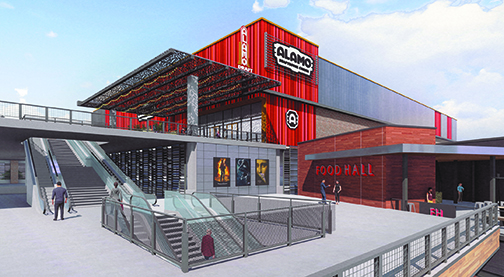
Featuring over 21,000 square feet of office space, over 134,000 square feet of restaurant and retail space, a 160-key hotel, and a 43,000-square-foot movie theater, Glendale 180 will also include free structured parking, an outdoor climbing wall, and a central outdoor plaza designed to support year-round programming.
“With Glendale 180 we are creating an experience and a gathering place,” Cassaday explains. “Major holidays will be celebrated there and people can look forward to food fairs, festivals, concerts, and fitness events. In short, we are creating a new downtown Glendale with this project.”
Bordered by Virginia Avenue to the north, Cherry Creek South Drive to the south, and Cherry Street to the east, Glendale 180’s dynamic, pedestrian-friendly design includes direct access to the Cherry Creek trail. Glendale Deputy City Manager Chuck Line says that a path will be developed to accommodate pedestrians and bicyclists, and that the green space will become an integral part of the project as a whole.
New Tenants
For those wondering why Glendale 180 has taken so long to come to fruition, Cassaday says that the City of Glendale was waiting for the right developer who really understood what the project was all about. Line adds, “The City could have sold the property to a big box store but we chose not to do that because it wasn’t going to serve Glendale well. Instead, we held out for an entertainment district and we are glad we did.”
As for the retail tenants, two have signed on so far: Alamo Drafthouse Cinema has leased 43,000 square feet and Food Hall by Hospitality Alliance has leased 25,000 square feet, including 10,000 square feet of patio space, for their first Colorado location.
Boasting the “best cinematic experience in the world,” Alamo Drafthouse celebrates cinema by pairing their movie-going experience with quality food and drinks. Each location is fitted with multiple types of projection equipment to accommodate both new and classic films. They show a variety of movies and the menu features burgers, pizzas, salads, snacks, and desserts prepared fresh from locally sourced ingredients. Additionally, every Alamo Drafthouse location highlights and promotes the best local craft breweries.
With offices in Las Vegas, New York, and Dallas, Hospitality Alliance is a consultancy and management group comprised of experts in different areas of the hotel and food and beverage industry. They are responsible for the Plaza Hotel Food Hall in New York City and the Discovery District redevelopment of AT&T’s new headquarters in downtown Dallas. The company also assists with concept development, leasing, construction project management, hiring, and training.
Vintage Glendale
While the experiential entertainment district is new in many ways, in other ways it’s bringing Glendale back to its roots. During the 1960s and 1970s, the city was home to a variety of now vintage establishments that attracted the masses. Colorado Mine Company (home of the “Fool’s Gold” which was Elvis’ favorite sandwich), Cork ‘N Cleaver, Celebrity Sports Center (owned by Disney), Cooper Theater, The Riviera (The Riv), Soda Straw, Sportspage, The Lift, and Tommy Wong’s Island are long gone but fondly remembered. Additionally, Andy’s Smorgasbord became Shotgun Willie’s Country Western Bar which is now Shotgun Willie’s Show Club and, almost five decades later, Bull and Bush Pub and Brewery is still a favorite.
“With this project, Glendale will regain its position as the premier entertainment hub of the metro area and we’re confident that we’ve found the right partner in Lincoln Property Company to turn that vision into a reality,” says Glendale Mayor Mike Dunafon. “From an exciting retail tenant mix and a central location to unprecedented trail access and more, Glendale 180 will usher in Colorado’s next generation of entertainment-based experiences.”
Every 10 years, United States citizens are
asked to respond to the Census which is a questionnaire designed to count the
number of people living in the country. According to the Constitution, the
results of the Census are used to determine the number of United States House
of Representatives each state is designated. Additionally, over $675 billion in
federal funds, grants, and support to states, counties, and communities is
allocated based on information gathered from the Census data. These funds are
then spent nationwide to support essential programs, roads, schools, hospitals,
and more.
State officials use Census results to
redraw the boundaries of their congressional and state legislative districts adapting
to population shifts. Exemplifying its historical significance, the first
Census was completed in 1790 — more than a year after the inauguration of
President Washington and soon before the second session of the first Congress
concluded. Because this data represents such an important part of Colorado’s
future, the United States Census Bureau is recruiting for a variety of
temporary jobs, including Census takers, to assist with the nationwide 2020
count.
“Applying to work as a Census taker is a
great way to make extra money and line up spring and summer employment ahead of
time,” says Laurie Cipriano, Media Specialist for the U.S. Department of
Commerce and U.S. Census Bureau. “Census taker positions offer flexible hours,
paid training, weekly compensation, and reimbursement for expenses such as
mileage for employees doing fieldwork.”
People of all backgrounds are encouraged to
apply, including college students and retirees who are looking for extra income
or a second job. While hourly pay rates vary by position and location, the
Arapahoe County rate is listed between $18.50 and $20.50 and Denver County is
listed as $20.50.
“Participating in the Census is extremely
important because these population changes determine the state’s representation
at the federal level and have a tremendous effect on how our state money is
allocated,” explains Greater Glendale Chamber of Commerce Chief Operating
Officer Jeff Allen. “Additionally, everyone’s responses are protected by law
and cannot be shared with a federal or state agency.”
Deemed the largest peacetime deployment of
civil servants across the country, the Census counts every person living in the
United States as of April 1, 2020, which is officially designated as Census
Day. By this date, most homes will receive an invitation to participate online,
by phone, or by mail. For households that do not self-respond, the national
door-to-door enumeration begins in May and ends in July. Additionally, for the
first time ever, citizens have the option to fill out the form online making
the process easy, safe, and secure.
For those interested in Census taker positions, the selection process is underway, with paid training occurring in March and April. Visit www.2020census.gov/jobs for more information.