
by Mark Smiley | Oct 19, 2026 | Glendale City News
Festival Moves Outdoors For The First Time As Colorado Breweries Bring Home National Honors
by Mark Smiley
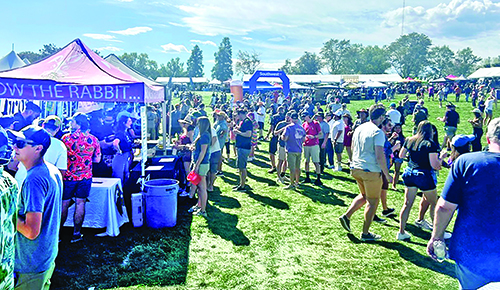
Beer Festival Under The Sun: Craft beer enthusiasts enjoy sunny skies while sampling beers from breweries across the country at the 2026 Great American Beer Festival.
The Great American Beer Festival traded convention center walls for Colorado sunshine this year, marking a dramatic change for one of the nation’s most celebrated craft beer events. Held October 10 and 11, 2026, at Denver’s Levitt Pavilion, the festival moved from its longtime home at the Colorado Convention Center to an outdoor setting featuring live music, craft beer, and a more relaxed atmosphere.
The change represented one of the most significant transformations in the festival’s history. Rather than navigating the enormous exhibit halls of the convention center, attendees experienced a festival designed around the outdoor venue, with an emphasis on connecting directly with the brewers behind their favorite beers.
A New Era For The Great American Beer Festival: The official artwork for the 2026 Great American Beer Festival celebrates the event’s move to Levitt Pavilion in Denver’s Ruby Hill Park. Held October 10–11, the festival embraced Colorado’s outdoor culture while showcasing award-winning craft beers from across the country.
The Brewers Association, which organizes the event, said the move was intended to create a fresh experience that better reflected Colorado’s outdoor culture. “Taking the festival outdoors lets us reimagine what’s possible,” said Ann Obenchain, vice president of marketing and communications for the Brewers Association, when the new location was announced.
Colorado Breweries Strike Gold
While the venue attracted considerable attention, Colorado breweries once again demonstrated why the state remains one of the country’s premier craft beer destinations. The competition attracted 7,267 beer and cider entries evaluated by 225 judges over three days. Nationally, 243 breweries and cideries earned a combined 336 medals.
Among the Colorado winners was Glendale’s own Bull & Bush Brewery, which captured a gold medal for its Pineapple 3 Way in the Belgian-Style Fruit Beer category. The recognition adds another prestigious national honor to the longstanding brewery’s accomplishments.
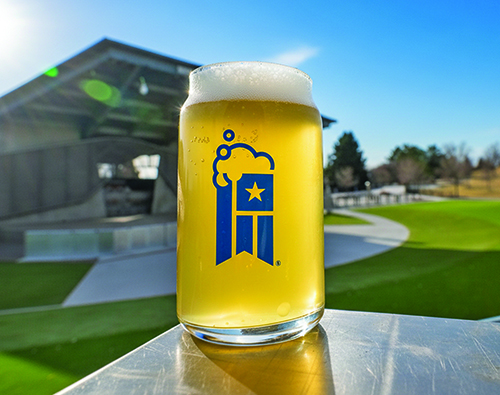
A New Home For Beer Lovers: A glass bearing the Great American Beer Festival logo overlooks Denver’s Levitt Pavilion, the festival’s new outdoor home at Ruby Hill Park. The 2026 event marked a major departure from its longtime location at the Colorado Convention Center.
Other Colorado gold medal winners included Los Dos Potrillos Cervecería in Parker for Agua Fresca in the American Fruit Beer category, Cannonball Creek Brewing Co. in Golden for Mindbender in the American-Style Strong Pale Ale category, and Verboten Brewing in Loveland for Grow Old With You in the Barley Wine or Wheat Wine category.
Denver’s Sandlot Brewery at Coors Field earned gold for Calamansi Wheat in the Fruit Wheat Beer category, while The Empourium Brewing Co. took gold for Honey Panda in the Specialty Beer category.
Bent Barley Brewing Company in Aurora also captured gold for its Dry Irish Stout, and Dostal Alley Brewpub & Casino in Central City won gold for Jacob Mack Mild Ale in the Craft Malt Beer category.
More Colorado Breweries
Earn Recognition
Colorado’s success extended beyond the gold medals. New Belgium Brewing in Fort Collins earned silver for Trippel, while Avery Brewing in Boulder took silver for White Rascal in the Belgian-Style Witbier category. River North Brewery in Denver received bronze for Quandary, and Golden’s Cannonball Creek added a bronze medal for Trump Hands in the Session India Pale Ale category.
Colorado cider producers also enjoyed success. Aurora’s Haykin Family Cider captured gold and silver in the Experimental, Barrel-Aged or Specialty Cider category, while Snow Capped Cider in Austin, Colorado, swept all three medals in the No/Low Tannin Cider category.
A New Chapter For A Denver Tradition
Founded in 1982, the Great American Beer Festival has grown into one of the country’s most prestigious beer competitions and tasting events. Its annual gathering has helped establish Denver’s reputation as a national center for craft brewing.
The 2026 festival also reflected changes in the industry, introducing competition categories for rice lager, hop water, and additional gluten-free beer styles.
Moving outdoors was a bold departure from the familiar convention center experience, but it also gave organizers an opportunity to rethink the event’s format and create a stronger connection between brewers and attendees.
by Amber Wyatt | Sep 29, 2026 | Glendale City News
by Amber Wyatt
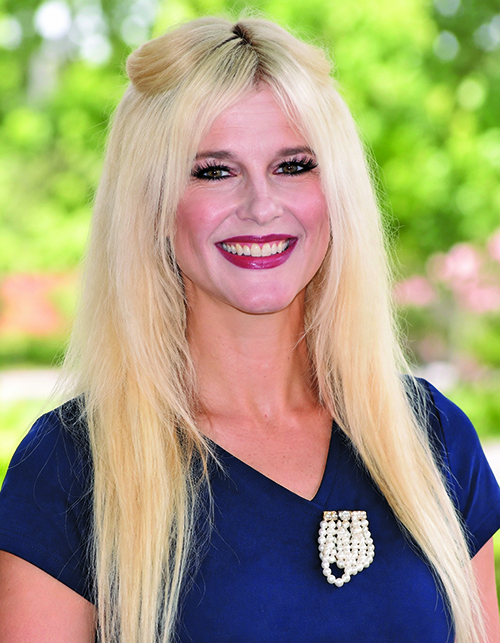
Republican Candidate for CD1: Christy Peterson
For the first time in nearly three decades, Denver voters will choose a new representative for Colorado’s 1st Congressional District this November. But the contest is about more than replacing longtime U.S. Rep. Diana DeGette.
It also raises a question that has dogged Republicans in overwhelmingly Democratic Denver for decades: Can Republicans, unaffiliated voters, and Democrats uncomfortable with their party’s nominee ever coalesce around a single alternative?
This year, they will not have only one alternative.
Democratic nominee Melat Kiros, Republican Christy Peterson, and unaffiliated candidate Dr. Shimon Blau headline a crowded November ballot that also includes Libertarian Chad Humphrey and Unity Party candidate Christopher “Critter” Milton. The multiple candidacies mean voters who do not support Kiros have several places to go — rather than a single challenger around whom they might consolidate.
That dynamic is particularly notable this year because Kiros is not a conventional establishment Democrat. The 29-year-old first-time candidate identifies as a democratic socialist and is a member of the Democratic Socialists of America. In June, she defeated DeGette, one of Colorado’s longest-serving elected officials, by more than 13 percentage points in the Democratic primary.
Kiros has said democratic socialism, to her, reflects a belief that government has a responsibility to meet people’s basic needs. Her platform includes Medicare for All, universal child and elder care, the Green New Deal, and making utilities publicly owned.
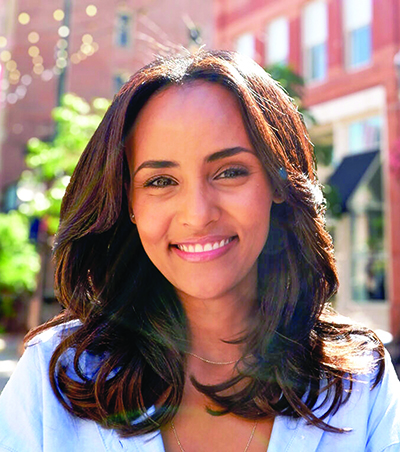
Democrat Candidate for CD1: Melat Kiros
International affairs have also become a significant part of the discussion surrounding her candidacy. Kiros has taken positions on Israel and Gaza that have drawn criticism, including from some Democrats. Axios reported in August that Democratic congressional nominees Dwayne Romero, Eileen Laubacher, and Jessica Killin said they would not endorse Kiros, while U.S. Rep. Jason Crow congratulated her on winning the primary but had not endorsed her campaign at the time of the report.
That makes the 2026 race an unusual test for Denver Republicans and political independents. A Democratic nominee well to the left of DeGette might appear to create an opening for voters looking for a more centrist alternative. Instead, those voters have multiple choices.
Peterson, 41, was the only Republican seeking her party’s nomination. The South Denver resident works in office management and accounting for a construction company and has centered much of her campaign on fiscal issues and public safety.
“I will work on reducing federal debt while helping our American farmers & ranchers sustain long-term production,” Peterson says.
“Supporting our local Police Departments with funding, training, and resources is my top priority,” Peterson says. She argues that improving public safety is important to Denver’s economic health and that a stronger business climate can create jobs and greater economic self-sufficiency. She also connects crime with some of the increasing costs confronting residents, including automobile and property insurance.
Her stated goal is “to make Denver a safer, more prosperous city for everyone.” But Peterson is not alone in trying to attract voters who want an alternative to Kiros.
The race changed significantly in July when Blau, a Denver physician specializing in pain management, qualified for the ballot as an unaffiliated candidate. Blau gathered more than 2,200 signatures in only a matter of days. State election officials determined that 1,918 were valid, comfortably exceeding the 1,500 required to qualify.
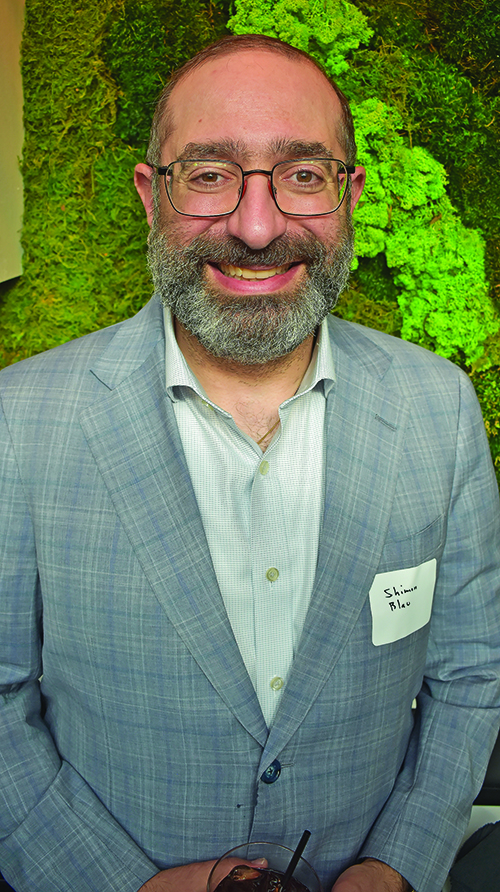
Independent Candidate for CD1: Shimon Blau
Born and raised near Sloan’s Lake, Blau is explicitly presenting himself as a more moderate alternative. He has described himself as leaning left on social issues and right on fiscal matters and has made affordability a central issue.
“Working families are being squeezed and having to make difficult choices between healthcare, housing, and food,” Blau told the Chronicle.
His platform also demonstrates why the contest does not break neatly along traditional partisan lines. According to Colorado Public Radio, Blau supports a long-term path toward universal health care, free childcare, and removing corporate money from politics, while saying he differs sharply with Kiros on other issues.
A Republican Drought Dating To Nixon
Perhaps the most striking historical fact about the race is just how long Democrats have controlled the 1st District.
A Republican has not represented Colorado’s 1st Congressional District since January 1973 — more than 53 years ago.
Republican Mike McKevitt won the seat in 1970 and served one term, from January 1971 until January 1973. Democrat Pat Schroeder defeated McKevitt in the 1972 election with 52% of the vote. She would go on to represent the district for 24 years.
When Schroeder retired, DeGette succeeded her. DeGette was first elected in 1996 and took office in January 1997. Thus, with the exception of McKevitt’s single two-year term, the district has been continuously represented by Democrats since 1951: Byron Rogers from 1951 through 1970, Schroeder beginning in 1973, and DeGette beginning in 1997.
That history helps explain the challenge facing anyone running without the Democratic nomination.
The district, which encompasses virtually all of Denver along with Glendale and portions of Arapahoe County, has become one of the most reliably Democratic congressional districts in Colorado. In 2024, for example, DeGette defeated Republican Valdamar Archuleta by 55 percentage points.
One Alternative, or Several?
That history also makes the presence of both Peterson and Blau particularly interesting.
Republicans seeking to compete in the district face a mathematical and political problem: Their traditional base alone has not been enough to win. Any serious challenge to Democratic control would therefore require support beyond registered Republicans, including unaffiliated voters and potentially Democrats dissatisfied with their nominee.
Yet the 2026 ballot provides those voters with several alternatives rather than one.
Peterson offers voters a traditional Republican candidacy emphasizing public safety, federal spending, and economic issues. Blau is trying to occupy a different lane, presenting himself as politically independent and more moderate while agreeing with Democrats on some social and economic policies. Libertarian and Unity Party candidates offer still more choices.
That leaves an unusual political picture: Kiros has critics to both her right and within the broader Democratic coalition, but those critics are not represented by a single opposing candidate.
Kiros, meanwhile, has demonstrated that her politics have substantial support among Democratic primary voters in Denver. Her victory was not merely the product of an incumbent stepping aside. She defeated DeGette, who had represented the district since 1997, after building a grassroots organization that her campaign said knocked on approximately 100,000 doors.
The primary also provided evidence of a broader progressive constituency in Denver. An analysis reported by Axios found significant support for progressive candidates across several Democratic primary contests, while candidates associated with the Democratic Socialists of America have increased their influence in the city’s politics.
So the general election presents competing political stories. One is the remarkable durability of Democratic control of Denver’s congressional seat. Another is Kiros’ successful challenge to Denver’s Democratic establishment and the ideological change her nomination represents. A third is whether voters who consider themselves somewhere between democratic socialism and traditional Republican politics see Blau’s independent candidacy as an alternative.
And hovering over all of it is 1972. Richard Nixon was president. The Watergate break-in had occurred only months earlier. “The Godfather” was in movie theaters. And Mike McKevitt was the Republican congressman representing Denver.
Pat Schroeder defeated him that November. No Republican has represented Colorado’s 1st Congressional District since.
More than half a century later, Denver voters will decide whether the district continues its long Democratic tradition under a very different kind of Democratic nominee, or whether one of the alternatives on a crowded ballot can break that streak.
Election Day is Nov. 3.

by Amber Wyatt | Aug 20, 2026 | Glendale City News
by Amber Wyatt
Large-scale intricately designed sculptures crafted by hand.

From the Houston Lanterns installation.
When Bright Nights illuminates Four Mile Historic Park, visitors enter a world of glowing color, towering forms, and intricate displays. Yet behind the spectacle is another story, one measured not only in lights, but in hundreds of hours of skilled human labor.
Produced by Tianyu Arts & Culture, the large-scale illuminated installations are the result of a painstaking process that combines a centuries-old Chinese lantern-making tradition with modern engineering and contemporary artistic design.
Long before the lights are switched on, artisans begin with hand-developed concepts that must ultimately work within a real landscape. Designs move from sketches into steel-frame construction, followed by electrical wiring, fabric application, detailed painting, and final assembly. According to Tianyu, a single display can require more than 200 hours of work and involve approximately 25 skilled artists.
The result is an art form that remains strikingly dependent on human hands at a time when automation and digital tools are transforming creative industries. Among the artists carrying that tradition forward is Jiang Guanghong, a Tianyu master artisan with more than two decades of experience in lantern design, fabrication, artistic direction, and international project leadership.
For Jiang, creating an illuminated installation involves far more than reproducing a drawing at a larger scale. Artists and fabricators must understand how a structure will appear from different angles, how fabric will behave when stretched across a steel framework, and how light will change the colors and details once the sun goes down. Those skills are only developed through years of hands-on practice.
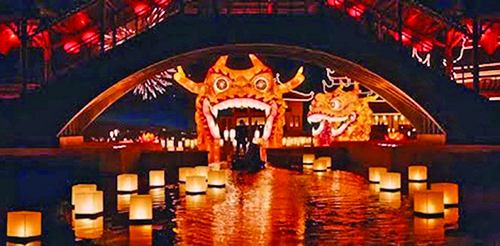
The casino scene in James Bond’s Skyfall featuring Jiang Guanghong’s work.
The tradition at the center of Tianyu’s work is closely associated with Zigong, China, a city internationally known for elaborate lantern-making. While the materials and technology used in modern installations have evolved, the process still draws heavily on skills passed from one generation of artisans to the next.
Today, those techniques are being applied to installations created for audiences far beyond China. Tianyu’s projects have appeared across the United States, Europe, and Asia, requiring artisans to consider not only artistic traditions but also the architecture, terrain, and character of each location. That means a display created for a historic Denver landscape may require different artistic and structural choices than one installed in a European garden or a modern urban setting.
Jiang’s career illustrates how far the tradition has traveled. His international work has included major installations on several continents, and one of his award-winning lantern creations was selected for use by the art department of the James Bond film “Skyfall.”
Despite that international reach, the underlying process remains intensely physical. Steel must be shaped into complex forms. Electrical components must be carefully integrated. Fabric must be fitted to perfectly engineered frames, and painted details must hold their visual impact before and after illumination. It is a balance of art and engineering, with technology supporting rather than replacing the craft of the artisan.
That balance may be part of what gives Bright Nights its appeal. Visitors experience the finished displays as immersive environments, but each glowing figure represents countless individual decisions made by designers, welders, electricians, fabric artists, and painters. At Four Mile Historic Park, the spectacle offers Denver audiences an opportunity to encounter a tradition that has crossed generations and continents while continuing to evolve.
Bright Nights may ultimately be remembered for what visitors see after dark. But behind every illuminated structure is something less visible: a network of skilled craftsmen keeping a living cultural tradition alive, one piece of steel, stitch of fabric, stroke of paint, and flash of light at a time.
by Mark Smiley | Jul 23, 2026 | Glendale City News
by Mark Smiley
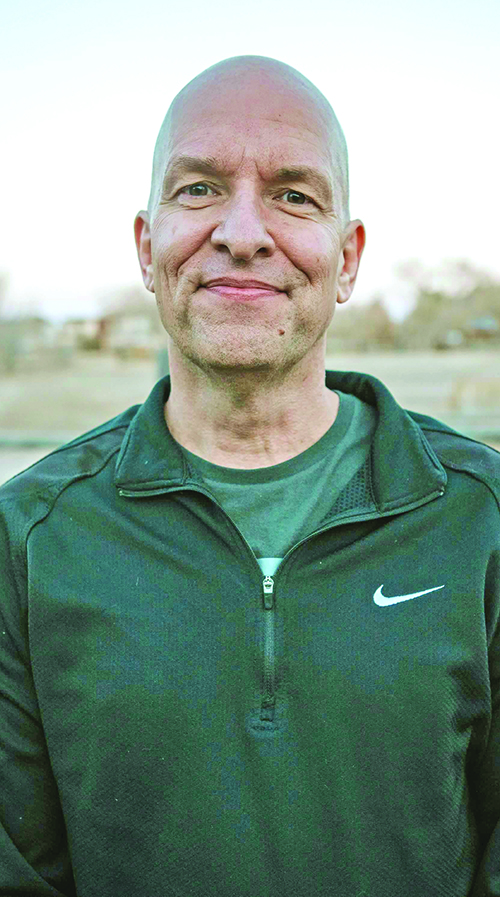
Storm Gloor
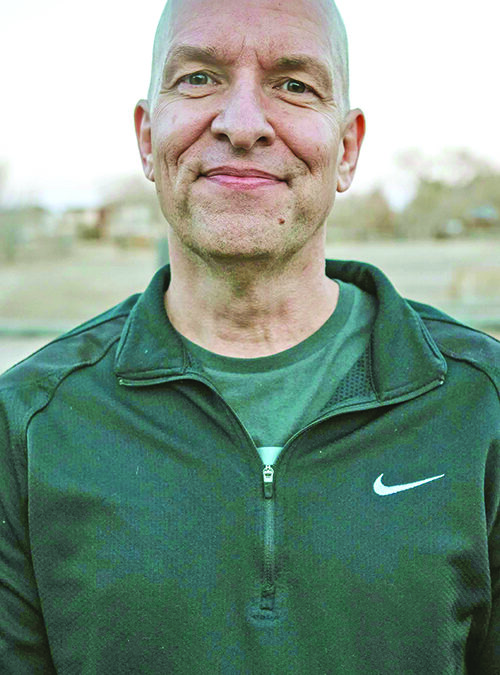
Glendale Mayor Pro Tem Storm Gloor has been elected to the Colorado Municipal League (CML) Executive Board, giving the city a stronger voice in statewide discussions on municipal policy and local government issues.
Gloor was elected during the Colorado Municipal League’s Annual Business Meeting on June 24, held as part of the organization’s 104th Annual Conference in Westminster. He joins a 21-member board responsible for overseeing the nonprofit organization’s finances, management, and policy direction while representing the interests of Colorado’s 270 member cities and towns.
His election places Glendale alongside leaders from communities across Colorado who help guide the League’s legislative priorities and advocacy efforts at the state Capitol.
The Colorado Municipal League plays a significant role in shaping legislation that affects local governments. According to the organization’s newly released 2025-2026 Annual Report, CML tracked 218 bills during the 2026 legislative session. The League successfully helped defeat 17 bills it opposed, secured amendments to 18 others, and saw 17 of the 30 bills it supported become law.
Gloor was one of five new members elected to the Executive Board. Others include Boulder Council Member Matthew Benjamin, Northglenn Mayor Pro Tem Shannon Lukeman-Hiromasa, Durango City Manager José Madrigal, and Centennial Mayor Pro Tem Amy Tharp.
Also elected to leadership positions for the 2026-2027 term were Golden Mayor Laura Weinberg as president, Breckenridge Council Member Carol Saade as vice president, and Parker Mayor Joshua Rivero as secretary-treasurer. Lone Tree City Manager Seth Hoffman will serve as immediate past president.
The Colorado Municipal League is a nonpartisan organization dedicated to serving and representing Colorado’s municipalities through advocacy, education, training, and legislative leadership. Gloor’s election gives Glendale direct representation on the organization’s governing board as it continues to address issues affecting cities and towns across the state.

by Mark Smiley | May 19, 2026 | Glendale City News
by Mark Smiley
 Denver families will have a chance to step into the worlds of Frozen, Encanto, Moana, and other Disney favorites later this year as Disney On Ice brings its newest production, Find Your Hero, to Ball Arena for a three-day run in November.
The traveling ice show will perform six shows from Nov. 13–15, offering a mix of classic Disney storytelling, figure skating, music, and large-scale stage production designed for family audiences.
The production features appearances from Mickey Mouse, Minnie Mouse, Donald Duck, and Goofy, who guide audiences through scenes inspired by some of Disney’s most recognizable films. This year’s show includes characters from newer hits such as Encanto and Moana, alongside longtime favorites including Beauty and the Beast, The Little Mermaid, Tangled, Frozen, and Lilo & Stitch.
Organizers say the show focuses on themes of courage, family, perseverance, and self-discovery. Audiences will follow Mirabel’s efforts to save her family’s magical home in Encanto, Moana’s ocean voyage with Maui, and Anna and Elsa’s journey to protect Arendelle in Frozen.
Disney On Ice productions have remained a longtime family attraction in Denver, regularly drawing large crowds to Ball Arena during holiday and winter entertainment seasons. The performances combine professional skating with theatrical lighting, digital effects, oversized set pieces, and elaborate costumes.
Showtimes are scheduled for 7 p.m. on Friday, Nov. 13; 11 a.m., 3 p.m., and 7 p.m. on Saturday, Nov. 14; and 10:30 a.m. and 2:30 p.m. on Sunday, Nov. 15.
Tickets go on sale to the general public May 19 through Ticketmaster, with presale opportunities already available for Disney On Ice subscribers and preferred customers.
In addition to standard admission, attendees can purchase a VIP Magical Pass package that includes premium seating, early venue access, a character meet-and-greet before the performance, and commemorative merchandise.
Ball Arena is located at 1000 Chopper Circle in downtown Denver.
For additional information and ticket availability, families can visit DisneyOnIce.com/find-your-hero/denver-co-ball-arena.
Feld Entertainment photos
by Valley Gadfly | Apr 17, 2026 | Glendale City News
by Glen Richardson
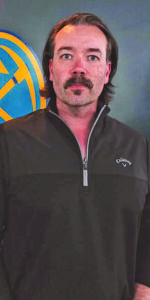
Ryan Tuchscherer
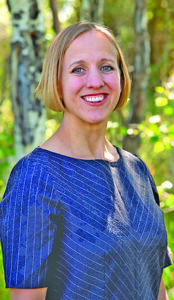
Kim Umbarger
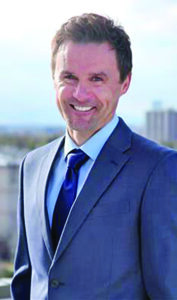
Dario Katardzic
Voters in Glendale have selected four candidates to serve on the City Council following a the April 7, 2026, municipal election that saw tight margins among the top finishers.
Ryan Tuchscherer led the field with 109 votes, followed closely by Kim Umbarger with 104 votes, and Mark Smiley with 102. Dario Katardzic secured the final winning seat with 97 votes.
Elizabeth Bonney, who received 28 votes, was not elected.
The results reflect a competitive race, with just 12 votes separating the top four candidates and underscoring the importance of every ballot in Glendale’s engaged electorate.
The newly elected council members will help guide city policy on key local issues, including development, public safety, and community services. Their terms come at a time when Glendale continues to navigate growth pressures and evolving priorities within the Denver metro area.
Voter turnout remained modest, consistent with past municipal elections in smaller cities, but the close margins highlighted strong community interest in local leadership.
With the election decided, attention now turns to how the incoming council will collaborate on shaping Glendale’s future and addressing the needs of residents and businesses alike.