by Jessica Hughes | Nov 17, 2025 | Editorials
by Jessica Hughes
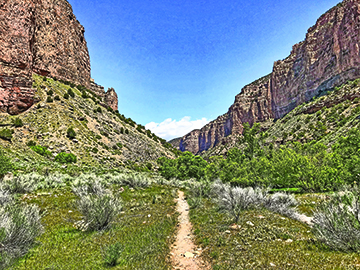
Dinosaur National Monument is one of many national parks experiencing severe budget cuts and staff shortages. Photo credit: Jessica Hughes
Often referred to as “America’s best idea,” our national parks are what many consider a national treasure, not only loved for their beauty and recreational access, but for their commitment to conservation, culture, and collective heritage.
Yet, now more than ever, our national parks are in crisis. Since the beginning of this year, they have become political pawns in a larger agenda that seems intent on undermining their mission. Behind the scenes, the foundational work of protecting landscapes and preserving cultural history is under attack.
National parks have struggled under a severe staffing crisis, losing roughly one quarter of their permanent workforce. This loss has made it increasingly hard to keep gates open, deliver basic visitor services, or carry out vital maintenance. It has also caused delays in research and critical maintenance, putting the long-term protection of America’s most iconic landscapes and cultural resources in jeopardy.
But the threats extend far beyond shrinking budgets and empty positions. Park leadership has been pressured to strip climate change information from official webpages and to remove references to slavery and LGBTQ+ history. Staff were also directed to inventory interpretive signage and museum content, and flag so-called “negative information” about past or living Americans via QR-code reporting and submit content for review. These requests are not isolated efforts, rather they reflect a sweeping effort to reshape our national park system and how American history is told.
All of this comes at a time of heightened pressure. Visitation has surged since the COVID era. Climate change is accelerating. And now, with cuts and mandates, national parks are being squeezed from every angle.
In Colorado, where more than one-third of the land is federally owned, roughly 24 million acres, parks were the busiest ever this year, with record-breaking visitation, all forced to operate with minimal staff. “The Administration ordered all NPs to remain open to maintain the appearance of a park visitor experience,” notes Tracy Coppola, the Colorado Program Manager at the National Parks Conservation Association. “It’s been tough this year.”
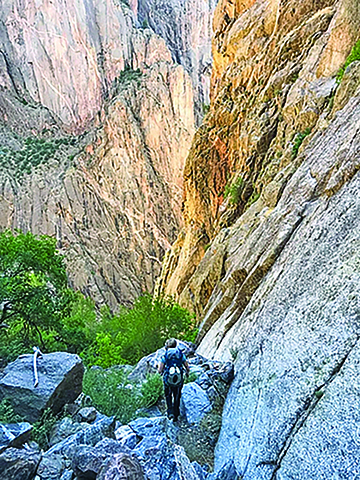
Black Canyon of the Gunnison National Park is currently operating with no maintenance crew and half its staff. Photo credit: Jessica Hughes
The Black Canyon of the Gunnison National Park was forced to operate with no maintenance crew and half of its staff. “That means Black Canyon of the Gunnison National Park is unable to fill 24 of the park’s 74 positions – a 1/3 reduction in staffing,” says Caitlyn Burford, the NPCA Senior Communications Manager. In other instances, this past summer, the park operated without rangers at the park’s North Rim, requiring signs to be posted telling visitors that search, and rescue would be slow or unavailable. And because all custodial staff had been terminated, higher-grade employees were being directed away from their regular duties to perform custodial functions.
Even amidst the government shutdown, most parks remain open with fewer amenities, and to the public, no real change is seen. But Coppola points out the front-facing staff shortages and closures aren’t the real issue.
“The challenge with the current narrative is that parks behind the scenes are scrambling. Visitors aren’t really seeing it out front; it is more behind the scenes,” explains Coppola. “It’s the scientists, conservationists, all those behind the scenes are where the parks are feeling it the most.”
Coppola refers to the staff who are hired to help protect the park’s natural and cultural resources. But with the recent cuts, places like Dinosaur National Monument, where its Cultural Resources person was fired, aren’t allowed to replace or rehire this position. And because administrative and maintenance staffing at the park is down 40%, those who remain behind the scenes, such as the park’s archeologist, are jumping in to help where they can, taking them away from what they were hired to do.
“We’re at a place where the parks are being put in an impossible situation,” says Coppola. “The future is uncertain. It is terrifying. We never thought the administration would come for the parks like they have; the parks are becoming politicized more, and we’re losing the reason why parks were created in the first place.”
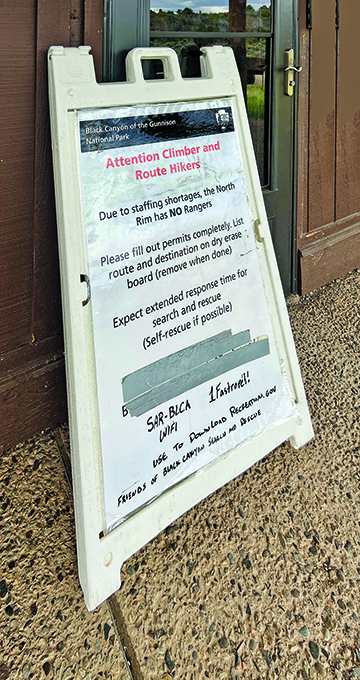
Staff shortages at national parks have led to visitors exploring at their own risk. Photo provided by National Park Conservation Association
The National Park Conservation Association is the only independent, nonpartisan organization dedicated to protecting and advocating for America’s National Park System. This year, Coppola has seen a huge pivot in the organization’s focus, most of which has been voicing how critically important park staff is, and how these cuts have put a huge strain on the park system.
“We estimate that at least 24% of park permanent staff is gone across the board,” says Coppola. “So, we’ve been using our voice to stand up for park staff.” Another big focus for the organization is the sweeping changes that could come with president’s most extreme proposed 2026 budget.
The harshest budget proposal asks Congress to cut more than $1 billion to the National Park Service, which includes a $900 million cut to the operations of our national parks. According to the NPCA’s calculations, “achieving a $900 million cut to operations would require eliminating funding and staffing for roughly 350 park sites from the smallest to some of the largest.”
The NPCA also goes on to list other Park Service-related budget cuts proposed in the President’s budget, including:
- $73 million cut to park construction funding
- $77 million cut to recreation and preservation funding
- $197 million cut to the Historic Preservation Fund
“This is the most extreme, unrealistic, and destructive National Park Service budget a president has ever proposed in the agency’s 109-year history,” according to a statement issued by National Parks Conservation Association chief executive Theresa Pierno. “It’s nothing less than an all-out assault on America’s national parks.”
It’s clear, no matter how you slice it, the future of America’s national parks is on the line.

by Mark Smiley | Nov 17, 2025 | Travel
by Mark Smiley

Ice Slides: Guests can take rides down the two-story-tall ice slides, traverse through ice tunnels and arches, and visit the carver showcase to watch artisans perform live carving demonstrations.

Ice Sculptures: Colorful ice sculptures recreate scenes from Dr. Seuss’ How the Grinch Stole Christmas! inside the ICE! exhibit at Gaylord Rockies Resort.
A team of 40 master ice artisans from Harbin, China, has arrived at Gaylord Rockies Resort in Aurora, to transform two million pounds of ice into a breathtaking winter wonderland. The group has spent more than 12,000 hours hand-carving intricate sculptures for this year’s ICE! experience, themed around Dr. Seuss’ How the Grinch Stole Christmas!
Hailing from Harbin — famously known as “Ice City” and home to the world’s largest ice and snow sculpting festival — the artisans have traveled more than 5,700 miles to Colorado. Since 2001, Gaylord Hotels has partnered with these highly skilled carvers to bring their centuries-old craft to life for American audiences.
Using tools such as chisels, tongs, hand saws, grinders, and chainsaws, the team begins with over 6,000 blocks of ice, each weighing about 300 pounds. Working from a 300-page design book, the artisans sculpt everything from coin-sized details to 30-foot-tall scenes inspired by Dr. Seuss’ beloved holiday tale.
Guests visiting ICE! at Gaylord Rockies will be transported through the classic story — journeying from the Grinch’s snowy mountaintop lair and his sneaky sleigh ride into Whoville, to the Whos’ joyful celebration and the Grinch’s heartwarming transformation. Brilliant colored ice, dazzling LED lights, and a precisely maintained 9-degree environment combine to create a mesmerizing display. Visitors can borrow signature blue parkas to stay cozy during the experience.
The attraction also includes two-story ice slides, sparkling tunnels, and live carving demonstrations in the Carver Showcase. ICE! concludes in a serene Nativity scene, sculpted entirely from crystal-clear ice. The display runs from November 24, 2025, through January 2, 2026.
While ICE! is the crown jewel of Christmas at Gaylord Rockies, the holiday spirit extends throughout the resort, which features millions of twinkling lights and more than 200 decorated trees. New this year is the Sugar Snow Station, a whimsical area featuring Candy Cane Mountain Indoor Snow Tubing, Gumdrop Gliders Ice Puck Challenge, and the Sugar N’ Spice Bar offering festive treats.
Ice!: Guests will embark on a journey through hand-carved ice sculptures depicting iconic scenes from Dr. Seuss’ How the Grinch Stole Christmas!
Other seasonal highlights include:
Feast with the Grinch, a family dining event where guests can meet the famously grouchy green guest of honor and his dog, Max.
Sippin’ Santa, a tropical tiki pop-up bar serving island-inspired holiday cocktails in collectible mugs.
Gingerbread Mountain Cabin, a life-sized (12 foot high) creation built from over 1,400 pounds of gingerbread, icing, and candy.
Festival of Trees, an annual fundraiser benefiting Lantern (formerly Bright by Text), supporting early childhood development.
Guests can also enjoy festive favorites like the Grinch’s Wonderful Awful Idea Scavenger Hunt, the Gingerbread Decorating Corner, Photos with Santa, the Elf Training Academy, Mrs. Claus’ Christmas Traditions, and the Yuletide Street Market in Mistletoe Village.
For those looking to extend the holiday magic, overnight guests receive special perks such as “Chill Pass” front-of-line access to ICE! and entry to the resort’s indoor Arapahoe Springs Waterpark.
Tickets for ICE! and other Christmas at Gaylord Rockies attractions must be purchased in advance, as peak weekends often sell out. For details, overnight packages, or reservations, visit ChristmasAtGaylord Rockies.com.

by Valley Gadfly | Nov 17, 2025 | Valley Gadfly
Valley Gadfly
December is the official start of winter, colder weather, holidays, family gatherings, and the last month of the year. Shorter days, the nights are colder, and most of the trees are bare.
Ho, ho, ho: ‘Tis the season of snowy peaks, mistletoe, wrapped gifts, hot chocolate, and holiday music. Households in the Mile High City begin putting up holiday decorations.
The peace and serenity of Denver’s mild weather helps us enjoy holiday festivities. Here are our Christmas time’s a-coming choices for shopping, dining, and entertainment:
The Nutcracker returns to the stage at the Ellie Caulkins Opera House for Colorado Ballet’s 65th season Dec. 1-28. There’s dancing mice, sugar plums, swirling snowflakes, and Tchaikovsky’s beloved score. Information: 720-865-4220.
Charlie, Snoopy, Linus, & Lucy do A Charlie Brown Christmas at Boettcher Dec. 6-7, 7:30 p.m., Sun. 2:30 p.m. Information: 303-623-7876.
Join Christy Wessler’s 21st annual Holiday Sing Along at Swallow Hill’s Daniels Hall Dec. 13, 7 p.m. Information: 303-777-1003.
Hungry for crepes before Christmas? Wash Park West’s Bon Ami Bistro & Creperie on the corner of Alameda Ave. & Pennsylvania St. has nearly 20 to choose from. Open for brunch all week long. Information: 303-862-4959.
See the newest — and perhaps the most unique — addition at Wings Over The Rockies, the AV-8B Harrier. It was the first vertical-short take-off and landing aircraft to enter service with the U.S. military. Information: 303-360-5360.
The Rock & Roll Playhouse plays the Music of Taylor Swift at the Bluebird Theatre Dec. 13, 11 a.m. Information: 303-777-1666.
Catch the musical tribute A John Denver Christmas playing in the Paramount Theatre Dec. 17, 7 p.m. Information: 720-577-6884.
End this year at A Night In Vienna listening to polkas, waltzes, and marches at Boettcher Concert Hall Dec. 31, 7 p.m. Information: 303-623-7876.
Party with a purpose this month by attending the 5th Annual Denver Winter Ball at The University Club December 13, 7 p.m. The Fire & Ice themed night of elegance, and dancing, raises money to help Denver children and families facing hunger. All profits go to the Food Bank of the Rockies. Information: 303-349-9262.
The final month of the year brings a unique blend of holiday cheer, winter wonder, and reflective moments. It’s the perfect backdrop as you anticipate opening all of those gifts.
Year’s end is neither an end nor a beginning but a going on, with all the wisdom that experience can instill in us. Cheers to a new year and another chance for us to get it right.
As the year comes to a close, it’s time to be jolly with the holiday spirit in the air and the atmosphere being a celebratory one. What’s the snow man’s favorite relative? Aunt Arctica.
— Glen Richardson
The Valley Gadfly can be reached at newspaper@glendalecherrycreek.com.

by Peter Boyles | Nov 17, 2025 | Blasting with Boyles
Blasting With Boyles
OPINION
 Once there was a shining spot which was Colorado in the 1970s — a type of Camelot. It’s worth noting that most historians believe in epochs or eras. The one that I’ve always been drawn to is what Jackie Kennedy dubbed Camelot. The very short presidency of John F. Kennedy. Also, again most historians see the sixties as not really beginning until Kennedy is assassinated in 1963, and the sixties don’t end until Richard Nixon resigns. I see a similarity that just occurred in the first week of November.
Dick Cheney dies but reappears in the speech by the newly-elected, Ugandan born, east Asian, democratic socialist Zohran Momdani. He’s the new face of the Democrat party as Cheney was a reflection of the past for Republicans.
Camelot, if you don’t know, was a legendary bright shining moment in Britain that the Kennedys attached themselves to. Jack Kennedy’s clearly King Arthur, Jackie fancied herself Guinevere, and Bobby was Lancelot.
I see Colorado in these terms. Many of us came here and came of age in what was once the bright shining spot, Colorado in the 1970s. It was a place for everyone whether Republican, Democrat, Libertarian, or anything else.
In Boulder you would find 1960s like hippies and Soldier of Fortune magazine. We had John Denver making music in the mountains with Coors beer as the real champagne of beers. Ski tickets were affordable. Plenty of young men and women came here seeking their fortunes like the young knights came to Camelot. We were all sitting at the Round Table.
Today, Colorado is little more than a progressive hell hole which will eventually sink into a primordial quagmire. In the British legend Camelot was ruined by the deception of Lancelot and Arthur’s wife, and the devious actions of Arthur’s illegitimate child Mordred, out of wedlock, with his half-sister.
If anyone was our Arthur in the 1970s in Colorado it was Democratic Governor Dick Lamb. Just like Arthur who fought off the invading Angles and Saxons, Lamb fought off the real estate developers who hoped to overrun the state with hordes of yuppies using the lure of the Winter Olympics. But the Democrat voting masses from New York, Illinois, and California still seeped in even though Lamb had slayed the Winter Olympics dragon.
The final death knell for Colorado Camelot was Republican Governor Bill Owens who, in 2005, supported Referendums C and D to give billions to the government rather than the citizens of Colorado. Referendum C passed and fueled the population boom and the growth of government. This in turn propelled Ted Trimpa’s Blueprint for Colorado and the eventual total Democrat takeover of the state with the crushing of any and all dissent.
Now the darkness has taken over the state. If you remember the Colorado Camelot that was Hal Moore in afternoon drive screaming, I love you Denver, the Phipps, and the Broncos. The Mile High Miracle Broncos season of ’76-’77.
I know we’re speaking in allegories and symbols about a Camelot that we all loved turning into a place where now we rank in some of the lowest economic measurements, highest crime, and horrible traffic. We seem to be the epicenter of shootings. The ridiculousness of the Denver Mayor’s policies on homelessness. The historians who study the Arthurian legend call it the Matter of Britain. Now we have the Matter of Colorado.
When Arthur throws the sword, it was caught by the Lady of the Lake symbolizing a waiting for the return of the king. Who are we waiting for? Do you see anyone on the horizon? Barbara Kirchmeyer? Victor Marx? Michael Bennet? If we’re waiting for Michael Bennet we’re waiting for Godot.
So, like the Britons in their darkness we wait now for the next king to pull the sword from the stone.
— Peter Boyles