by Mark Smiley | Nov 17, 2022 | Main Articles
by Mark Smiley
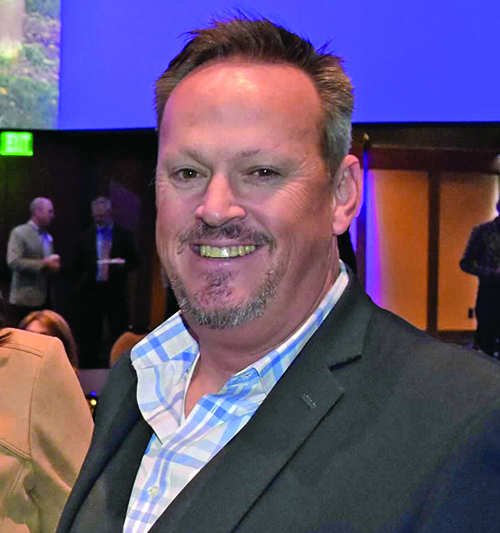
Long Career: Captain Mike Gross served under six Glendale city managers during his 28 years at the Glendale Police Department. He is pictured here in 2019 at the retirement party for then-City Manager Jerry Peters.
Captain Mike Gross of the Glendale Police Department has retired from the force he called home for 28 years and has started a new career. Gross, who began his law enforcement career as a reserve officer in Glendale, was part of the first class to come out of that program in 1994. And on January 12, 1995, he was hired on full time.
Since he was a teenager, Gross wanted to be a police officer. “When I graduated from high school, I wasn’t old enough to be a police officer,” said Mike Gross. “I asked the people at the Sheriff’s office what I should do. They said to go into the military. I asked them which one was the hardest. They said the Marine Corps, and so I went to the Marine Corps office and signed up. I was injured in the Marine Corps and received an honorable medical discharge and went into the academy and the rest is history.”
After eight years on the force, Gross was promoted to lieutenant in 2003 and he was a key part of the Glendale Police Department changing its culture after some incidents of excessive force in the 1990s. Under then Police Chief Victor Ross, Gross started to introduce new concepts that were cutting edge at the time. “We started to change the culture of the police department,” said Gross. “Specifically, with how we use force. We completely overhauled our training program and we changed our policy. This is something I am especially proud of, the changing of the culture, ushering in scenario-based training that was ahead of its time. It’s common now, but in 2003 we were cutting edge.”
Also under his watch, the Glendale Police created a Workplace Violence training course for the businesses. “With so few single family homes [in Glendale], it makes sense for us to focus on workplace violence,” said Gross. “Workplace violence is one of the greatest threats to our personal safety in our society.”

Marine: Mike Gross entered the Marine Corps out of high school because he was too young to join a police department.
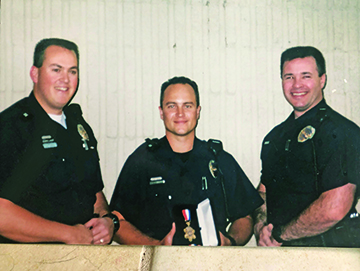
Rookie Cops: Mike Gross, left, Joe Silla, and Joe Haskins were young police officers coming up through the ranks in the mid-1990s.
Another notch in his long list of accomplishments was being an important voice on the development of Infinity Park, a multi-use complex built in 2007. “One of the things I love most about Glendale is that it is a small city and you have to wear a lot of hats,” said Gross. When the city started to build Infinity Park, it had a decision maker from each department meet every Wednesday, which Gross was a part of. “It was really neat to be part of that project and be able to have an opinion on things,” said Gross. “That was a unique experience to be part of and it was great to get to do that.”
In an interview with Glendale Mayor Mike Dunafon, the Mayor had many kind words to say about Gross, including calling him a “class act.” “We were fortunate to have Captain Gross as an integral part of our police force for 28 years,” said Mayor Dunafon. “He had an incredible ability to think through problems and juggle multiple projects that required a vast array of skill sets. His organizational skills were tremendous and I am confident he will utilize his many talents in his future endeavors.”
That future endeavor is already locked in, as Gross has accepted a position as Vice President of State, Local, and Education at NowVertical Group, a global technology firm. “We congratulate Mike for his well-deserved retirement from law enforcement,” said Dave Whitmire, President of NOW Solutions. “We are incredibly blessed to have Mike as an executive on our team. Mike brings decades of experience in law enforcement and smart policing to our team and will lead our technology-enabled services group to create critical tools for our first responders.”
Whitmire went on to address Gross’s leadership abilities. “Mike’s leadership has been, and will continue to be, instrumental in providing us valuable insights in protecting our nation’s critical infrastructure,” said Whitmire. “We are honored to have Mike and are humbled by his many years of service to his community. We look forward to his continued service to it in the commercial sector.”
Gross is one of the most highly decorated members of the Glendale Police Department. He was awarded the Medal of Valor and the Distinguished Service Medal. Gross speaks fondly of his nearly three decades of service in Glendale. “I am so thankful for the opportunities I was given in Glendale,” said Gross. “I was able to be a part of a bi
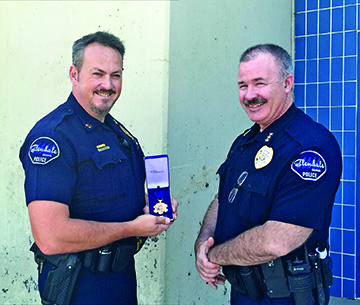
Highly Decorated: Mike Gross was one of the most decorated police officers in the history of the department. He is shown here receiving the Distinguished Service Medal from Glendale Police Chief Joe Haskins.
g project [Infinity Park] and see it be designed, built, and operated as a member of the police department.”
Although this highly decorated Police Captain was able to accomplish a lot in the Village of Glendale, he acknowledges that it is the support of his family that allowed him to be such an impactful contributor. “I would like to thank my wife Leslie and my daughters Maddie and Megan for always supporting me through all the holidays, birthdays, and special occasions that I missed,” said Gross. “All of the times that plans changed or were cancelled because I was called in to work.”
And it is this dedication to the Glendale Police Department and the citizens and businesses of Glendale that made Captain Mike Gross respected, honored, and valued. Gross can still be found at Infinity Park catching a rugby game from time to time. After all, it is a stadium he was a key member of creating 15 years ago. He enjoys coming back to enjoy the fruits of his labor.

by Ashe in America | Nov 17, 2022 | Feature Story Bottom Left
The 2022 midterm results defy logic and critical thinking. Despite the absolute state of the union this midterm was, by the numbers, “The Night of the Incumbent.”
In October, the NY Times was publicly stunned by their Siena College poll, revealing that most voters are most worried about government corruption: That the government is not working on behalf of the people.
They were stunned because the concern was paramount for 68% of voters and it was an open-ended question. To accept the 2022 midterm results, you must accept that those most concerned about government corruption voted to keep the government in place.
As I write this, Congresswoman Lauren Boebert is leading her race for Congressional District 3. It is unclear why the alleged “Gold Standard of Elections” cannot efficiently count votes on election night, especially since the holdup in this contest appears to be Pueblo County where Secretary of State Jena Griswold appointed an Election Supervisor. Per last month’s ruling against Elbert County Clerk & Recorder Dallas Schroeder, the Election Supervisor appointment puts Secretary Griswold in charge of the county’s elections. And so we wait for Secretary Griswold to give us the “results.”
In a pre-midterm press conference, White House Press Secretary Karine Jean-Pierre said of counting delays that, “This is how this is supposed to work.”
You would think that such White House confidence combined with Colorado State Department’s oversight would ensure smooth elections. Things aren’t going smoothly, and we’re being gaslit about it (again).
From the local NBC affiliate four days after election day, “‘Why is it taking so long to count the ballots?’ As Gilbert ‘Bo’ Ortiz, the Pueblo County Clerk and Recorder, said, ‘It could be because we’re American and we want instant gratification.’”
“This is how this is supposed to work.” Don’t question it, denier.
Keep in mind that the people telling us the delays, glitches, issues, and ambiguity are expected, are the same people that sold Americans electronic voting equipment in the name of efficiency and transparency. These are the same people that sold us mass mail-in voting with the single security control of signature verification which is, according to all honest experts, a Potemkin Village.
As I write this, there is still no official statement released from Secretary Griswold on the issues with CD3. Is it weird that the Colorado midterm’s only known issues happen to be in the race with the state’s sole MAGA candidate?
The political establishment, on both sides, want you to believe they are securing our elections; in reality, they innovated security out of U.S. elections a long time ago.
As the dust settles, establishment Republicans — both those known as establishment and those who are currently making their allegiance known — are taking a victory lap and claiming that the red wave’s failure to materialize is a “referendum on Trumpism” and “we need to move on from MAGA.”
This is silly, of course. The Colorado GOP manipulated or, at the very least influenced, the candidate selection, both at the assembly and during the primary. Party leadership openly mocks the politically active portion of their base while alienating the unaffiliated middle (46%) through authoritarian policy priorities that are irredeemably out of touch with the Colorado electorate.
With the current geo- and socio-political environment, Republicans should have been competitive in Colorado’s Governor and Senate races, even with electronic voting equipment. Unfortunately, Burton Brown picked up the playbook — unpopular candidates with no fight or fire — of her predecessor Ken Buck (CD4), and the party’s high-profile candidates lost by double digits and conceded immediately.
Intentional or incompetence, the Colorado Republican Party is terrible at winning elections.
I posit that this is because they are corrupt, unlikeable, and without political capital or credibility; but whatever the reason, they need to reflect on their failed 2022 midterm strategy, both the theory and the execution.
There is no “moving on from MAGA.” The people want America to be great again which means shaking up the power dynamics obstructing our desired change.
If the GOP hopes for a comeback in the Centennial State, Republicans must find a way to reconnect with voters and rebuild trust.
I’m not holding my breath. They seem quite content in the minority.
Ashe Epp is a writer and election integrity activist. Read her work at asheinamerica.com and follow her on Telegram and other socials @asheinamerica.

by Charles Bonniwell | Nov 17, 2022 | Editorials
 It took 20 years of hard work and persistence by a bi-partisan coalition of the Democrat Party and moderate establishment Republicans, headed by Colorado’s richest man, Phil Anschutz, to accomplish one goal. The election returns from the 2022 midterms are in and Colorado, at long last, has one-party Democrat rule. Incumbent Governor Jared Polis won by 20 plus points over Republican Heidi Ganahl. It’s not that Mr. Polis is so uniquely popular. Every Democrat candidate for statewide office in Colorado won close to double digits.
The State Senate went from 21 to 14 in Democrats favor to 24 to 11. In the State House it went from 41 to 24 in the Democrats favor to 48 to 17. In a terrible economy with high inflation and a Democrat President with low approval numbers how could this possibly be true? It’s easy. In over 20 years, as pointed out in last month’s editorial, we have gone from same day voting with 30-day registration requirements to same day registration, universal mail-in ballots with an almost month election period. Only the Democrats ballot harvest. They urge their members to cast their ballots immediately. That leaves Democrats three weeks to go house to house to harvest ballots and cure any faulty ballots.
Republicans are told by its leadership to all vote in person on election day and not to allow anyone to collect their ballots. Even without the enormous fraud that universal mail-in ballot and ballot harvesting encourages, there is no chance a Republican can win a statewide campaign under such circumstances.
Yet not a single prominent Republican has publicly protested this inherently unfair election process. In 20 years, they have not objected to any of more than a score of election process changes that have assured a one-party state from now to eternity. Former Republican state party chair and leading Republican Colorado Congressman Ken Buck has declared the process “the Gold Standard.” Former Republican Secretary of State Wayne Williams cut an advertisement with present Secretary of State Jena Griswold to the same effect, paid for with taxpayer dollars, which was continuously in the run up to the election.
Why would Phil Anschutz and the Republican establishment want to hand the state over permanently to the Democrats? Because it assures them, they will be permanently controlling the Republican party even if it is a permanent minority party. They can make deals with Polis for their own benefit. The Republican establishment cannot let the grassroots out of the bag because if they did, they could take over the state Republican party, and maybe even the state, which is exactly what has happened in Wyoming and Nebraska. All Anschutz has to do talk is talk to fellow billionaire Pete Ricketts, the two-term governor of Nebraska and president of the National Republican Governors Association, about what happens if everyday citizens get hold of a state party. It’s July 14, 1789, all over again.
Anschutz can also appreciate why Mitch McConnell withdrew money from the Republican senate candidates in Arizona and Nevada, so the Republicans lost by close margins and lost any chance of becoming the majority in the Senate. McConnell may have assured that Republicans are a minority in the U.S. Senate, but helped guarantee he would be the leader of that minority party.
So welcome to the one-party state of Colorado. Like all one-party states from North Korea to Cuba, the citizens will suffer greatly but the leaders of the uni-party will prosper extraordinarily.
Governor Polis celebrates one party rule in Colorado.
by Peter Boyles | Nov 17, 2022 | Blasting with Boyles
 In this past election the only thing that came to the surface about your children in school was the Furries. The allegations of litter boxes in classrooms and children who spoke to one another in snarls and barks. It actually sounded like the neighborhood I grew up in.
But in a recent headline in the city of Denver, the Archdiocese of Denver issued guidance to Catholic schools. Don’t enroll transgender children. The guidance on handling LBGTQ issues, including telling administrators not to enroll or re-enroll transgender or gender non-conforming students, and that gay parents should be treated differently than heterosexual couples. The document was titled “Guidance for Issues Concerning the Human Person and Sexual Identity” was obtained by The Denver Post. The spread of gender ideology presents a danger to the faith of Christians. Now which of us is going to be the first to laugh. The Catholic Church?
How many cases of sexual abuse of children by Catholic priests, nuns, cardinals, popes, and members of the religious life? Beginning in the 1990s the Catholic hierarchy has covered up sex abuse allegations by moving abusive priests to other parishes where their abuse continued. Kind of sounds like the Boy Scouts, doesn’t it? Remember the coverage of the Catholic Church scandal in the Archdiocese of Boston exposed by the Boston Globe in 2002? The abuse was in Europe, Australia, Chile, and certainly here in Denver, Colorado.
We saw how many times Roman Catholic priests were moved on to another diocese to do it again. Isn’t it a little hypocritical to now do this to people who are open about their sexuality, want to bring their children or grandchildren for a private education in Holy Mother Church?
If you do a bit of background work, in the French church 216,000 children, mostly boys, were sexually abused by the clergy of the French Catholic Church. 216,000. That study is 2,500 pages long. Start to tie into Jehovah’s Witnesses the number of cases of sex abuse. Pulling the same rabbit out of the same hat as the Catholic Church by covering it up.
The Boy Scouts also knew about Scout Masters who were molesting boys. And also moved them from state to state. Some horrible stories that you can read about where these one-time Boys Scouts, now grown men, talk about what the Scout Masters did to them. The manner of abuse and grooming the boys seems to follow suit with exactly how the Catholic priests did the same.
So now how does Jesus, who wants to speak and show compassion have these people turned away at the door? Is that unconditional love? Faithful to church teachings? In Michigan the Catholic Diocese says gay and trans people cannot be baptized or receive communion. They instruct priests on how to develop pastoral relationships with persons who have same sex attraction and lead them closer to Jesus Christ by being consistent with Church teachings on being gay.
I’m always told by my fanatical religious friends that being gay is a choice. So, I ask all of you reading this, when was your choice day? I didn’t have it. The first girl I ever kissed came to a ball game where I was playing baseball with some older guys and she was one of the girls when the sun went down you could kiss her. I didn’t want to kiss the shortstop, or the kid on second base, and I certainly didn’t want to kiss the kid who played catcher. But boy did the lights go on the first time I got to kiss (her name will be not be used to protect the innocent). But that was my magic moment. Sure, I loved the Pittsburgh Pirates and Bruno Sammartino, but I’ll be dammed if I had a choice in the matter.
I’d like to thank the Catholic Church for once again airing the hypocrisy in their sex abuse cases across the country. And why is it the deeper you go into your reading, the more you go into these horrific crimes, the more times it appears it’s religious organizations and institutions, and outfits like the Boy Scouts who are involved?
Peace on Earth good will toward men.
— Peter Boyles