
by Mark Smiley | Oct 19, 2026 | Editorials
Office Vacancies Approach 40 Percent Downtown As Cherry Creek North Attracts New Development And Commands Premium Rents
by Mark Smiley
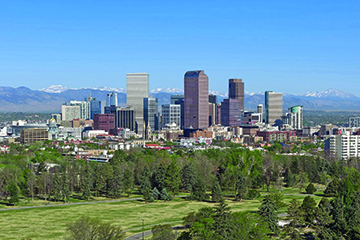
Downtown Challenges: Downtown Denver’s skyline remains impressive, but its office market faces significant challenges. Vacancies reached 38.6 percent during the second quarter of 2026, leaving property owners searching for tenants and alternative uses for aging buildings.
While downtown Denver struggles to fill empty office towers, Cherry Creek North is experiencing a building boom. Just a few miles southeast of downtown, developers are planning new office buildings, luxury residences, and retail projects in one of the region’s hottest commercial districts.
The contrast is striking. According to commercial real estate firm CBRE, downtown Denver’s office vacancy rate reached 38.6 percent during the second quarter of 2026. Meanwhile, figures presented by JLL in September placed vacancy in Cherry Creek’s most sought-after office market at just 2.2 percent, with asking rents approaching $94 per square foot. Although the figures reflect different market definitions, they illustrate the dramatic difference between the two areas.
A Building Boom Continues
One of Cherry Creek’s latest proposed developments is a five-story office and retail building at 2701 E. Third Avenue, near Clayton Street. Known as 3rd & Clayton, the project would include approximately 54,000 square feet of office space, ground-floor retail, and three levels of underground parking.
The proposal is one of several projects transforming Cherry Creek North from a boutique shopping district into a major employment, residential, and entertainment destination.
The approximately $500 million Cherry Lane development is expected to add hundreds of apartments, new retail space, and offices. Meanwhile, Oasis Apartments at 299 Milwaukee Street is expected to feature 177 apartments and approximately 26,000 square feet of retail space. Its retail space was reportedly fully leased ahead of the project’s anticipated 2027 opening.
Why Cherry Creek Is Winning
Building Boom: Construction cranes tower over Cherry Creek North as developers continue adding office buildings and luxury properties. The neighborhood’s thriving commercial real estate market stands in sharp contrast to downtown Denver’s struggling office sector.
The shift toward remote and hybrid work has fundamentally changed Denver’s office market. Businesses are seeking smaller, modern spaces surrounded by amenities that appeal to employees and clients.
Cherry Creek offers upscale restaurants, shopping, hotels, and convenient access to affluent residential neighborhoods. Its proximity to Glendale, Hilltop, and Belcaro makes it especially attractive to business owners and executives living nearby.
Investors are paying extraordinary prices for that convenience. CBRE reported that an office property at 255 Fillmore Street sold for approximately $941 per square foot, setting a record and highlighting the neighborhood’s appeal.
However, rapid growth comes with challenges. Increased traffic, limited parking, construction disruptions, and rising rents threaten the neighborhood character that helped make Cherry Creek successful. Smaller independent businesses may find it increasingly difficult to compete with national retailers and larger companies.
Downtown Faces An Uphill Battle
Downtown Denver’s office market is not without hope. CBRE reported 66,000 square feet of positive net absorption during the second quarter of 2026, along with the first quarterly decline in total vacancy since 2024.
Landlords are offering competitive rents and incentives, while some older office towers are being considered for conversion into residential buildings. Still, with nearly four out of every 10 office spaces vacant, downtown faces a difficult recovery. Lower rents alone may not be enough to persuade businesses to return.

by Editorial Board | Sep 29, 2026 | Editorials
Editorial —

Voter’s hand holding a YES vote ballot, inserting the vote card into the ballot box. Concept image of democracy and the election process for corporate election, board election, and governmental or business policy decisions. Voters making their selection and voting through a proxy ballot. Photographed in horizontal format.
The 2026 ballot will be arriving in registered voters’ mailboxes in a few weeks and a “beast” of a ballot it is. Voters will have many elective offices to fill from governor, attorney general, secretary of state, etc., to state house and state senate seats. Voters must also choose whether or not to retain various judges. In some jurisdictions there will be municipal and county offices to fill.
After completing the section on political and judicial offices the voter will have just begun his or her voting task. There are a record number (14) of ballot measures, 13 of which were proposed by citizen initiatives, as well as, one placed on the ballot by the state legislature.
The Colorado Blue Book is sent out to voters which is supposed to be an official, nonpartisan guide on ballot measures, purportedly to give voters neutral and clear information. But like all things involving humans, it has been corrupted over time, but what else is new?
The bilingual version (English/Spanish) of the Blue Book runs 260 pages. It looks more like a paperback version of the 19th century novel War and Peace than a concise voters’ guide.
We are not fans of ballot elections, but we feel sorry for any voter who goes to the polls to vote in person who isn’t already sure of how he or she is going to vote.
Partisan-oriented voters have, in the past, often simply voted all “Yes” if they are Democrats, as ballot measure in the past have tended to grow government and its revenues, while Republicans have voted “No” hoping for the opposite.
No such luck this year. Both liberals and conservatives have placed measures on the ballot including ones that are in effect mirror opposites.
Denver voters will be voting on a proposed mil levy increase for area schools, placed on the ballot by the dysfunctional Denver Board of Education, which tax is opposed even by The Denver Post. Both Denver and Glendale residents will vote whether to have a sales tax increase to support Colorado Front Range’s “train to nowhere” known as CoCo.
Who knows what mood voters will be in by the time they get to the energy measures (2K in Denver and 2B in Glendale) asking voters in those two municipalities to approve 20-year franchises with Xcel Energy to use municipal rights of way and streets for energy lines.
There is almost no opposition to either measure in either town. Glendale’s City Council voted unanimously to send the measure to its voters while Denver City Council passed theirs by an overwhelming 10-2 margin. Both city councils fought hard to extract concessions from Xcel on issues important to their citizens. Both cities will, over the terms of the agreements, receive millions of dollars they can use to underground power lines, upgrade parks and open space, and various other important city programs.
We suggest that once you get your ballot you turn to the municipal section and vote “Yes” on 2K in Denver and 2B in Glendale. You can then begin the long slough through the rest of the ballot.
Here’s hoping that the two measures that virtually everyone agrees should pass, do in fact pass.
— Editorial Board

by Mark Smiley | Jul 23, 2026 | Editorials

Best in the World: Bull & Bush Brewery team members celebrate their award-winning performance at the 2026 World Beer Cup in Philadelphia, along with David Lin, owner of Comrade Brewing (second from left). The Glendale brewery earned a gold medal for Ghoul Fuel: Rum Diaries Edition and a silver medal for Kauai Pie, adding two more international honors to Colorado’s rich brewing legacy.
Bull & Bush Brewery is celebrating 55 years of serving award-winning craft beer, classic pub fare, and unforgettable memories with a full day of festivities on Saturday, August 8. The anniversary celebration will feature exclusive beer releases, special whiskey selections, brunch with DJ High Deaf, an evening performance by Colorado favorite DeVotchKa, and commemorative merchandise honoring Glendale’s most beloved family-owned brewpubs.
Bull & Bush Brewery, one of Colorado’s most iconic family-owned brewpubs, is proud to celebrate its 55th Anniversary, marking more than five decades of serving exceptional handcrafted beer, classic pub fare, and elevated hospitality located in the heart of Glendale.
The 55th Anniversary celebration will take place on Saturday, August 8, 2026, featuring a full day of festivities, including an evening celebration with live music from Colorado’s very own DeVotchKa.
Guests attending the anniversary celebration can look forward to:
- Exclusive 55th Anniversary beer releases
- Special anniversary whiskey selections
- Brunch with DJ High Deaf
- Evening live music with DeVotchKa
- Commemorative merchandise
“For 55 years, Bull & Bush Brewery has been more than a restaurant or brewery hub where friendships are made, milestones are celebrated, and traditions are passed from one generation to the next,” said Erik Peterson, Minister of Progress at Bull & Bush Brewery. “We’re incredibly grateful to everyone who has supported us over the years, and we’re excited to celebrate this milestone with the community that has made it all possible.”
Since adding its brewery in 1996, Bull & Bush Brewery has earned numerous awards at prestigious competitions, most recently:
- Gold Medal, 2 Silver Medals, and 3 Bronze Medals 2026 US Open Beer Championship
- Gold Award and Silver Award 2026 World Beer Cup
- Gold Medal 2025 Great American Beer Festival
- 2025 Grand National Champion and Brewery of the Year at the US Open Beer Championship
Bull and Bush Brewery is located at 4700 Cherry Creek Drive South in Glendale. For more information, visit www.bullandbush.com.
by Editorial Board | Jun 29, 2026 | Editorials
Editorial —

New Colorado Republican Party Chairman Craig Steiner
As everyone is aware, Colorado is a one-party state (i.e., the Democratic Party), much like California and New York, but even more so. There are no Republicans holding any statewide office and there haven’t been since ballot harvesting was legalized in 2016. Democrats have overwhelming majorities in the State House and Senate. There is not a single judge at any level in the state who is not a Democrat.
But the state’s top Democrats recognize that for Colorado to be literally a single-party state like the Stalinist U.S.S.R. is not really a good look. Better for the Democrats to be like the old Harlem Globetrotters and the Republican Party to be like the plucky Washington Generals. The Generals almost never won a game, but it was, in theory, possible.
The Republican Party at the end of May elected a new chair, Craig Steiner of Douglas County. The position had become available due to the resignation of Brita Horn, the former Routt County Treasurer. She is almost universally recognized as the worst party chair in the 150 years since Colorado became a state in 1876.
The present Colorado Republican Party is split into two factions, and the essential battle is over how the party should pick its candidates for the general election. In 2016, the Democrats, with money from so-called independent Kent Thiry, put Proposition 108 on the ballot. It overturned past precedent and forced both parties to have semi-open primaries.
Under this scheme, unaffiliated voters were mailed primary ballots from both parties, and they could choose which party’s primary they wanted to vote in. It greatly weakened the rationale for a person to be affiliated with a party.
Today, approximately 54% of all registered voters are unaffiliated, swamping the Democrats at 24% and Republicans at 22%. Because Democrats, far more than Republicans, generally do not have contested primaries (with this year being an exception), many Democratic-leaning unaffiliated voters cast ballots in Republican primaries, choosing the more moderate or liberal candidate. As a result, many Republicans in the State House and Senate are little more than Democrat-lite politically.
For example, Cleave Simpson, the Republican leader in the Senate, has an “F” rating from the Liberty Scorecard, a leading conservative rating organization. His colleague in the State Senate and leading candidate for the Republican gubernatorial nomination, Barb Kirkmeyer, has a similarly dismal (from a conservative perspective) “F” rating. If you are a conservative Republican, there is often little reason to vote in a general election in Colorado.
Proposition 108 barely passed in Colorado, with a majority of Republicans believed to have voted against it. To pass constitutional muster, Proposition 108 provided that a party could opt out of the semi-open primary system only if an impossibly high percentage of its governing committee (75% of all members) approved. A federal district court judge recently ruled that the threshold was unconstitutionally high.
While the moderate/liberal wing of the party is in the minority, it does constitute more than 25% of the membership and has therefore been successful in keeping the Republican Party in the highly disadvantageous semi-open primary system that greatly favors moderate/liberal Republicans.
They have been able to do so by playing a deception game in which they pretend to support opting out while doing everything they can to prevent it. Every Republican chair since 2018 has played that game except one, Dave Williams (chair from 2023 to 2025), who is now in Washington, D.C.
The newest chair got elected by pretending he was for the opt-out, but since being elected has shown himself to be what they call a “DeceptiCon.”
The previous chair, Brita Horn, had to resign when it was discovered that she had allowed her attorney to loot the party of all its funds. Craig Steiner, since becoming chair, has done nothing to prevent all cash funds from being scooped up by the attorney, making it impossible to raise new funds.
Why in the world would Republican chairs like Horn and Steiner want to destroy the organization they head? It’s simple. The big donors to the Republican Party, who long propped up the moderate/liberal wing, no longer want a Republican Party to choose candidates at all. They and Kent Thiry want Colorado to move to jungle primaries, where candidates petition and/or pay to get on the ballot and the top two vote-getters, regardless of party affiliation or lack thereof, advance to the general election, just like California.
It is a system dominated by multi-millionaires and billionaires, and no one else need apply.
Perhaps it is all for the best. Instead of the present one-party state, we will become a no-party state where the very wealthy control all.
— Editorial Board

by Mark Smiley | May 19, 2026 | Editorials
by Mark Smiley
 The Denver Center Theatre Company (DCTC) has unveiled an expansive lineup for its 2026/27 season, featuring a mix of classic works, world premieres, and audience favorites that promise to deliver a dynamic year of live theatre.
Artistic Director Chris Coleman described the upcoming season as “a vibrant celebration of theatrical imagination,” highlighting a slate that blends reimagined classics with bold new storytelling.
The season opens September 11, 2026, and includes eight mainstage productions staged across the Denver Performing Arts Complex.
A Season Of Variety And Innovation
The lineup kicks off with Destiny of Desire, a lively telenovela-inspired play with music, running September 11 through October 4 at the Wolf Theatre. The comedic story follows two girls switched at birth, weaving melodrama, humor, and live music into a high-energy theatrical experience.
Shortly after, Shakespeare’s The Tempest takes the stage from October 2 to November 1. Directed by Coleman, the production explores themes of revenge, forgiveness, and identity through one of the Bard’s most magical works.
The new year brings fresh voices to the forefront with two world premieres. Bogfriends (January 15-February 21, 2027) delves into connections across time and memory, while How to Conquer America: A Mostly True History of Yogurt (February 5-28, 2027) offers a humorous yet heartfelt look at culture and identity through the lens of a 1970s marketing campaign.
Music, Memory, And Mystery
Spring programming includes the Tony Award-winning musical Once (April 2-May 2), known for its emotionally resonant folk-rock score and intimate storytelling.
Also featured is And So We Walked (April 16-May 23), a powerful solo performance by Cherokee artist DeLanna Studi chronicling a personal journey along the Trail of Tears.
Closing out the mainstage season is Dial M for Murder (April 30-May 30), a suspenseful adaptation of Alfred Hitchcock’s classic thriller, promising intrigue and unexpected twists.
Holiday Tradition And New Works
In addition to the subscription series, DCTC will present its annual holiday favorite, A Christmas Carol, running November 25 through December 27. The production remains a staple of Denver’s seasonal celebrations.
The 21st annual Colorado New Play Summit, scheduled for February 20-21, 2027, will once again offer audiences a behind-the-scenes look at new theatrical works in development.
Tickets And Subscriptions
Season subscriptions are now available through the Denver Center for the Performing Arts, offering benefits such as discounted pricing, priority seating, and flexible exchanges. Single tickets will be released at a later date.
With its blend of beloved classics, innovative premieres, and culturally resonant stories, the Denver Center Theatre Company’s 2026/27 season is poised to be one of its most compelling yet, inviting audiences across the region, including Glendale Cherry Creek residents, to experience the transformative power of live theatre.
by Editorial Board | Apr 17, 2026 | Editorials
Editorial —
Increasingly progressive Westword recently declared “good riddance” to Colorado’s largest company (based on market capitalization), Palantir Technologies, after announcing it was moving to Miami. The data-processing giant moved to Denver in 2020 from Silicon Valley in California.
With the company and its highly paid employees — including co-founder Alex Karp — leaving town for the Sunshine State, Westword informs us that “we” won’t miss them. Why? Apparently because the company does work for the federal “military-industrial complex,” including the hated ICE and Department of Homeland Security.
By similar logic, “we” are lucky that the relatively recently formed federal Space Force was moved by Trump from Colorado Springs to Huntsville, Alabama, with the loss of hundreds of jobs. In the same vein, hopefully any remaining mining and oil and gas operations in Colorado can be quashed in the name of saving the planet from climate change.
It is not clear whether or not Westword is equally happy about Trump shutting down and dismantling the National Center for Atmospheric Research (NCAR) in Boulder, with the likely loss of 800 well-paying jobs. NCAR is part of the now-hated federal government under Trump but is not, per se, part of the military-industrial complex.
Exactly what jobs in Colorado Westword does deem acceptable is also unclear, but it is no secret that Westword itself is up for sale, with titular head Patty Calhoun leaving a post she has occupied since 1978.
Westword has its share of challenges, like most print publications in Colorado. The staff, however, is being proactive in ensuring that the publication does not go to the wrong kind of person. It recently featured an article by Hanna Metzger with the headline “Racist, Abusive Son of Former Broncos Owner Offers to Buy Westword.”
It is assumed that John Bowlen was being facetious about an offer, but the publication went out of its way to delineate all of Bowlen’s many faults and failures, with the article’s writer declaring at the end that “Westword is not interested.”
Of course, that leaves open whether someone with the right pedigree is willing to buy the publication and keep the staff employed. Westword, like most publications, is largely dependent on advertising revenue. That revenue is, in turn, dependent on successful private businesses looking for customers they hope ads in the publication will bring them.
Westword’s staffers may be “happy” that various companies are leaving Denver but may find, to their chagrin, that some of the departing jobs may include their own. In case they are not aware, good jobs in journalism these days are very scarce. Perhaps Westword will one day find that Colorado’s largest company leaving Denver was not necessarily a cause for “celebration.”
— Editorial Board