
Bull & Bush

Here comes July and the outdoors are open for you to share. ’Tis the end of school and the death of cool. Sure the days feel hot and sultry because July’s sun-kissed season has begun. There are barbecues spent in the summer sun, parties with friends and family. Watermelon anyone? Did we mention red, white and blue everything?
July is a noisy time, when fireworks and new life are bursting forth and the birds return to chirp and sing. Rain’s pitter patter is followed by the roar of thunderstorms.
Here are our sweltering choices for shopping, dining and entertainment to rollick, romp and splash into the sights, sounds and smells to keep the fireworks bursting:
3 Blast off this month by watching the mega City of Glendale Fireworks as they light up the skies July 2nd at dusk (9-9:30 p.m.).The barrage of fireworks begins Valley’s July 4 celebrations. Information: 303-759-1513.
3 Mama Magnolia, Shakedown Street, Pint & A Half and Dakota Blonde play Shady Grove Wed. evenings July 3-24. Information: 303-777-3003.
3 Featuring a toe-tapping new score, don’t miss Charlie & The Chocolate Factory playing the Buell Theatre, July 9-28. Information: 303-893-4100.
3 Catch the swashbuckling tale of Billy Budd premiering at Central City Opera’s summer festival opening July 13. Information: 303-292-6700.
3 Get an A/C Tune Up or purchase a High Efficiency Cooling & Heating System to stay cool and comfortable this summer. The air conditioning experts at ARS are offering cool deals. Information: 303-418-6000.
3 For awesome summer eats, drinks and dessert, treat the family to Sam’s No. 3 with locations in Glendale, Aurora and downtown. Chill with a cold beer, cocktails and milkshakes. Information: 303-333-4403.
3 Help fund the Denver Dream Center by attending the 2nd annual Cowboy Luau at No. 38 July 13, 4-10 p.m. Information: lacomeevents.com.
3 View, buy beautiful art as you enjoy live music at the colorful outdoor Cheesman Park Art Festival July 27-28. Information: 505-273-7376.
3 Chill out at Sloan’s Lake Park to end the month attending the Colorado Dragon Boat Festival, July 28-29. A popular event for 17 years, it centers around a dragon boat competition. Teams of more than 50 boaters race across the lake. See 100 shows on five performing art stages. There’s an Asian Food Court plus a Marketplace. At Dragonland, kids try learning projects, watch shows on the kids’ stage. Information: cdbf.org.
July’s Cherry Creek Valley weather is the hottest of the year, bringing with it more thunderstorms. Nearly every day in July warms to over 70° F. The Valley averages 14 days this month with the thermometer reaching into the 90°s F. Temperatures above 100° F occur every couple of years. With the heat expect about 1-2-inches of rain.
Lest you think our worst wet weather is over, recall this folklore forecast: “If the first of July be rainy weather, It will rain more or less, for four weeks together.”
Yes, this is National Ice Cream Month. There’s also Chocolate Day and Moon Day. The month’s biggest blast is Independence Day on July 4th. Perfect days for splashing in the pool or relaxing on National Hammock Day. We close with this cool Sara Coleridge canto: “Hot July brings cooling showers, Apricots and gillyflowers.”
— Glen Richardson
The Valley Gadfly can be reached at newspaper@glendalecherrycreek.com.
by Parker Grissom
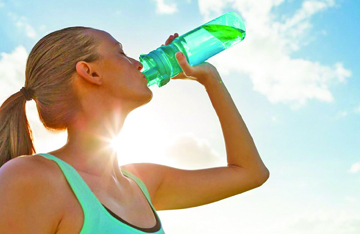
School is out and summer is here! The warm weather makes us all want to get outside, and when we do it’s important to stay safe. These tips can help!
Stay Hydrated
We can’t say it enough: The rule of summer is to hydrate. But it’s not always the best bet to aim for eight 8-ounce glasses a day. Runner’s World reports that recommended amounts are actually 91 ounces a day for women and 120 ounces for men. That said, people vary in their activity levels and “sweat rates,” so it is pretty safe to let thirst be your guide.
The following are other important things to know about hydrating.
Sometimes water isn’t enough. Water is necessary for every metabolic process of the body, as it transports nutrients and removes waste. However, if you go for a long run or are out in the heat all day, you may need a drink with enhanced electrolytes that can prevent your body from losing sodium.
Water won’t keep you cool. Speaking of heat, it’s also important to recognize that hydration alone cannot ward off the risk of heat stroke. While dehydration can make you more prone to it, factors like exercise intensity, humidity and air temperature can all contribute.
Don’t drink too much. Finally, while it is rare, it is possible to drink too much, which can result in a condition called hyponatremia. When this happens, the increased fluid intake combines with increased sweating, causing sodium levels in the blood to become dangerously low. To prevent this, again it’s best to let thirst be your guide and don’t overdo it.
Get The Right Gear
As you set out for Colorado’s playground, another tip to keep in mind is equipment and clothing. In addition to outfitting yourself for your favorite outdoor pastime, whether it is hiking, biking, running, or camping, you also have to factor in the season’s challenges surrounding altitude, wildlife and quick weather changes.
The best bet here is to get quality advice you trust. Do your research and talk to others who know the ropes. This is especially important when it comes to evaluating “trends” in fitness such as barefoot running. Some experts say that exercising without shoes makes it possible to absorb negative electrons from the earth through the soles of the feet, which can be an antioxidant and have an anti-inflammatory impact on the body. It also can improve foot position, balance and body awareness.
At the same time, other experts caution that barefoot walking and exercising can come with increased risk. Lack of strength in the foot can reveal poor walking mechanics, which can lead to injury. Barefoot exercisers are also susceptible to injury from rough or wet terrain, cold temperatures and sharp objects on the ground.
Bottom line: It’s important to seek wise advice and use your best judgment. Know what’s a trend in fitness and what makes sense for your lifestyle.
Remember The Sunscreen
A final way to stay safe — and another reason to use your best judgment — is in regard to sunscreen. Recent reports have made us second-guess ourselves and wonder whether all the sun protection could be doing more harm than good. Harvard Medical School addresses some common misperceptions: Does sunscreen cause skin cancer? (It doesn’t!) Does sunscreen prevent the three main types of skin cancer? (It does!). And is sunscreen actually poisonous to people? (It isn’t!)
The reality is that Colorado has more than 300 days of sunshine a year, and reports show risk of skin cancer goes up with altitude, so sunscreen is essential. Harvard Medical School also recommends avoiding sun exposure when possible, wearing sun-protective clothing, and reapplying sunscreen every two hours.
Parker’s purpose on earth is to make every person he meets happier and healthier. With a degree in Exercise Science from University of North Carolina at Wilmington, Parker achieves this purpose through group fitness, personal training, and motivational speaking.
Denver, Colorado, has been taught a great politically correct witch hunt lesson. All of the above, and many more who we will speak about in this column, took a nice, 41-year-old white woman from a farm in Iowa, who probably never even muttered any words or terms that could be construed by the witch hunters on the left to be remotely racist, homophobic, Islamophobic, or anti-global warming; who also, I believe, does not like Donald Trump; and these bastards were able to turn her, with the help of the Denver media, into David Duke.

You folks all remember David Duke? Remember when he ran against Edwin Edwards to be the governor of Louisiana, and the bumper stickers said vote for the crook because David Duke was such a horrible human.
Did you get the opportunity to witness the Hancock celebration party at Hancock election headquarters when the numbers came in early that he had taken this very decent woman and beaten her into the ground? Walking next to him, the one and only, former Governor Bill Ritter; cheering him on, former Mayor and presidential hopeful, Governor John Hickenlooper; the true master of the City, Wellington Webb; and, of course, the crown prince himself, Michael Hancock, doing the victory dance. (Conspicuously absent from the victory party was current Governor Jared Polis who did not endorse or do any fundraising for Hancock.)
To the man, these are philanderers. To the man, they understand the power and money in Denver. To the man, they knew they were taking this decent woman and turning her into George Wallace or the granddaughter of Lester Maddox.
Have the television outlets no shame as they covered and interviewed a cheerful Michael Hancock?
I can’t tell you how many times my sainted father would say to me and my brothers, “What the hell’s wrong with you?” To the City of Denver, in the words of my father, what the hell’s wrong with you?
This woman made some amateur mistakes, like not knowing what the initials of the NAACP meant, and taking the picture of an Asian man after they did a deep dumpster dive, and discovered she made some remark about Chinatown on social media that they lifted and implied it was some sort of racist anti-Asian remark. Maybe someone could ask the Brownstein Law Firm about that.
I’m told when she made the runoff her total war chest was $700 thousand and change. I’m also told, by reliable sources, that the minute it was announced, Hancock raised that amount of money and added it to his $2.7 million war chest.
As an amateur reader of history, it’s been noted that any time a candidate starts with negative advertising he or she is behind. Hancock came out of the box after promising Jamie Giellis they would not go negative. He went on the negative offensive turning her into a modern day KKK Night Rider.
That was despicable and we may never see the internal polling data, but you can bet your ass they knew he was in trouble.
There’s some smarmy character on the payroll and in the words of Al Davis, “Just win baby,” and they did. It’s sad that this cabal of wealthy men took this fine woman and dashed her on the rocks of hate. They brought in Hillary Clinton to endorse Michael Hancock. I suspect they did because Michael must remind her of her husband Bill. Keep an eye on this one folks. The only good news is that a Marxist beat Albus Brooks. Watch the skies.
— Peter Boyles