
by Regan Bervar | Mar 4, 2022 | Feature Story Bottom Left
“So, bye-bye, Miss American Pie / Drove my Chevy to the levee,but the levee was dry / And them good ol’ boys were drinkin’ whiskey and rye / Singin’, This’ll be the day that I die”— Don McLean
 by Luke Schmaltz
March 25, 2020, was the day the music died in Denver, Colorado. Governor Jared Polis ordered the closure of all nonessential businesses — which included music venues of all shapes and sizes, from the tiny Tooey’s, off Colfax, to Red Rocks Amphitheater.
The circumstances were devastating, not only for venues but for musicians as well — as the vast majority make their living on live performances and on-site merchandise sales.
As the long-term implications of lockdown life settled in, some Denver musicians vowed to forge forth with online performances while others relinquished themselves to spend the downtime writing new material. A slew of lifelong musicians found a way to persevere, and now that the music scene is back in full swing, they are seeing their circumstances with newfound determination.
Meanwhile, the city itself has lost a number of beloved venues. Those that found a way to hang on during the pandemic are back to hosting shows as Denver is quickly reclaiming its reputation as a thriving hub for live music.
The Legend
Erica Brown has been dubbed, “Denver’s Queen of the Blues” and deserves the title, hands down (or up). Image: Marilyn Stringer
Erica Brown is Denver Blues royalty and an internationally acclaimed singer, songwriter, and recording artist. Every local publication that covers music has praised her award-winning work and she has been featured internationally in Smithsonian Magazine, Blues Matters (UK), and Rootstime (Belgium). “When the pandemic hit,” she begins, “I was putting together a dream project of mine, called the Cast Iron Queens. We had just played our first sold-out show in December at Dazzle, then in January, I had gone to Memphis and emceed the National Women in Blues Event. We were the entertainment for the Womxn’s March, we did a live in-studio for KGNU Radio in early March, then everything went ‘poof!’”
Brown is thankful that she was able to work through the pandemic, explaining, “Nearly every musician has either a regular day job or a couple side hustles (smile) and since [my job] was in a sector deemed ‘essential’ I never quit going to work.”
Brown reflects on the unfortunate Covid-related loss of Denver music institution El Chapultepec along with resident musical legend Freddy Rodriguez Sr. — a dear friend. Yet, she is thankful that longtime venues such as the Rusty Bucket, Mercury Cafe, and Lincoln’s Roadhouse are still alive and kicking.
Moving forward, Brown’s future is looking bright, “In November 2021, I’m was thrilled to be singing America the Beautiful at Boettcher Concert Hall on Veterans Day. It was the World Premiere of a documentary by professional skier and filmmaker Chris Anthony, called “Mission Mt. Mangart” which tells the story of the 10th Mountain Division’s great ski race in 1945,” she explains. In 2022, Brown will be immersed in theater productions, tribute projects, and much more — stay tuned at erica brownentertainment.com.
The Hardworking Bard

Sputnik Slovenia didn’t miss a beat when the pandemic hit, and continues on Facebook Live every Friday. Image: Sputnik Slovenia
Sputnik Slovenia has been a fixture of the Denver music scene for well over 20 years. He currently sings in a Clash cover band called The Nuns of Brixton, fronts an original, punk rock band called The Pitch Invasion, and plays regularly as a solo acoustic act. The latter served as his sole outlet during the first several waves of the pandemic. “I started streaming live shows basically the week the pandemic started,” he begins. “I had been doing a Friday happy hour at the Larimer Lounge for the past few years, so I jumped online the very first week and continued with my happy hour via Facebook Live. The response has been great. I post the shows and they get hits all during the week. I can interact with my friends from across the country and across the world every Friday, and it lets other people connect via the web as well, so check in on Facebook live on Fridays at 6 p.m. Mountain standard time.”
Slovenia contends that among the best live venues in town is the fairly new EastFax Tap and the legendary Lions Lair — which he hails as “One of the best dive bars in the country.” While he laments the loss of staple venues such as Tooey’s and 3 Kings Tavern due to the pandemic, he credits the down time for kicking him into high gear to work on his record label, Rum Dummy Records, whose Bandcamp page offers recordings from most of Slovenia’s projects. “The pandemic really was one of my most prolific times,” he explains. “I even wrote a rap song called Covid was my chrysalis.”
The Virtuoso

Juaquina “Roqui” Lluma teaches music, hosts a radio show, and awaits her next post-pandemic, high-profile bass playing gig. Image: R2Shotz
Juaquina “Roqui” Lluma is a recently naturalized U.S. citizen — originally from Argentina — who came to Denver by way of Los Angeles. She is a lifelong, classically trained musician who, for years, ground it out in the City of Angels playing in club-circuit level bands. Yet, the “L.A. Bullshit Attitude” — as she and many other musicians refer to it — drove her to seek the more genuine climes of the Denver music scene back in the mid-2000s.
Just before the pandemic hit, Lluma was seemingly headed for the big time — juggling bass duties between blues rock powerhouse Hot Apostles and the country rock outfit Tracksuit Wedding. By late March of 2020, both acts were immobilized and a year later when things began to finally loosen up — both projects were no more.
Regardless, Lluma forges onward with music, currently teaching online lessons and co-hosting an Internet radio show dubbed El Crawlspace hosted by nucleorock.com. “I am doing this with a friend from Puerto Rico,” she begins, “The idea is to be a link between all the underground scenes. We focus on rock and underground music — anything that all the other Latin radio stations aren’t already doing. Our listeners are from all over the world: Europe, Mexico, Colombia, and more.” Lluma aspires to make this enterprise an international link between the underground scenes. “The show could be a contact point between bands overseas and bands over here,” she says.
Moving forward, Lluma keeps a keen ear to the grapevine in anticipation for the next high profile bass playing gig. She also pays particular respects to the folks at the Oriental Theater for “keeping shit real” by putting on their “Safe and Sound” music series during the waning months of the pandemic.
The Career Man

Jim Dalton (bottom left) plays solo, with The Railbenders and with Roger Clyne and the Peacemakers. Image: Jim Dalton
As the front man, guitarist, songwriter, and founding member of The Railbenders, Jim Dalton has done more than his share to bolster the Denver music scene by building a fiercely loyal following and inspiring hordes of other musicians. Dalton also holds down lead guitar duties for Arizona-based national touring sensation Roger Clyne and the Peacemakers. His position in the latter act took up the majority of his time until all tours were canceled in early spring of 2020.
Dalton decided to use his pandemic down time to flesh out and record a solo album titled “In My Head.” The 11-song opus includes an eclectic array of original tunes he’d been working on over the last couple of years. “The song, ‘In My Head,’ was the first tune I wrote after my father passed away from cancer in 2015,” he explains, “It has been around quite a while and I have always included it in my live solo shows. Same with the other songs on the record,” he continues, “the pandemic gave me the time to finish recording since all of our tours were canceled for over a year.” Of all the venues the pandemic claimed, Dalton laments the loss of 3 Kings Tavern. “Lotta good memories and emotional ones,” he says. “We held an Irish-style wake there for both my Uncle Terry and my father.
Moving onward, Dalton is set to soon get back out on the road with Roger Clyne. He is also looking forward to an upcoming two-night Railbenders run at Denver’s Globe Hall. He also cherishes the fact that some of his favorite long-standing Mile High venues are still in business. “Some of my favorites are Lincoln’s Roadhouse, Soiled Dove, Bluebird Theatre, and Herman’s Hideaway. But if I had to choose one,” he explains, “I’d say everyone needs to see a show at Red Rocks once in their life.”
The Wunderkind

Red Stinger are prolific in the creativity department, having released five studio albums in their 10-year tenure before the pandemic. Yet, 2020 shifted their productivity into overdrive. During the second, third and fourth quarters of 2020, the band’s singer, guitarist, and principal songwriter — Tim Merz aka Timmy Flips — conceived of a nine-part series of content releases and proceeded to embark on the most creative period of his life.
Merz, a ballroom dance instructor by day, explains, “During covid I wrote a full-length album titled Punk Rock Ballroom — a hip hop rock album available on Bandcamp. Then, I wrote The Stinger Scriptures — a nine-part rock album rewrite of the Bible. After that,” he continues, “I wrote Crooked Town — a ballroom ballet dance interpretation of the Battle of Armageddon.”
Merz’s Covid accomplishments also include a ballroom dance love story, a stage play about intergalactic alien enslavement, and much more. The singer cites his personal philosophy as the driving force behind his creative arc. “The current state of the world and the direction humanity has chosen is broken,” he says. “Humanity is constrained by our enslavement by money, religion, and weapons. Our political system has failed us, our religious leaders have failed us, our financial institutions have failed us. The only hope is a return to what is our truth and that requires a serious reshaping of what it means to exist — which is the true punk rock mentality. Punk is the refusal to accept that anyone has power over anyone else. A return to the physical human body and the realization that we are all the same and all equal in the eyes of death.”
Moving forward, Merz and his Red Stinger bandmates look forward to more recording work including a greatest hits album and a live album while keeping alive the hopes that, “Denver doesn’t become completely overrun by corporate music joints who only book bands with the appropriate amount of Facebook Likes.”

by Regan Bervar | Jan 21, 2022 | Feature Story Bottom Left
“Politicians wanted to mine the Grand Canyon for zinc and copper, and Theodore Roosevelt said, ‘No.’” – Douglas Brinkley
by Luke Schmaltz
For the last century, the internal combustion engine has been the driving force behind the industrialized world. But, just as landlines were (mostly) replaced by cell phones, the use of fossil fuels to transport people is being systematically eclipsed by electric vehicles (EVs).
Currently, most major auto manufacturers are offering an EV model, and nearly all have announced a plan to become carbon neutral within the next two-to-three decades. The EV revolution has introduced a new type of propulsion technology into the mainstream — the lithium ion battery. Additionally, the EV marketplace is abundant — practically saturated — with dozens of startup companies looking to carve out a niche in this booming industry.
Copper is the lynchpin of the EV revolution, as it is uniquely ideal for wiring electric vehicles due to its conductivity and compatibility with high temperatures. Aluminum is the closest alternative, but in terms of cost and efficiency — it doesn’t even come close.
Meet The New Boss
Electric vehicles are set to replace gas-powered internal combustion engines.
The role of copper wire is in EVs somewhat comparable to how a fuel line feeds an internal combustion engine (ICE). The wiring network carries an electric charge from the lithium ion batteries to the vehicle’s electric traction motor. Additionally, copper wire feeds power to the rest of the vehicle’s electric infrastructure and motorized functions such as windows, lights, thermal system, etc. This results in the use of a substantial amount of copper per EV — in the batteries, the charging port, busbars, motors, rotors, and much more. According to copper alliance.org, the average EV contains 83 kg of copper — compared to the average 23 kg found in most ICEs. Thus, large-scale adoption of EVs has placed a premium on the value of copper worldwide.
A recent report published by copper.org estimates that the known copper resources across the globe are somewhere around 5.8 trillion pounds. Currently, only about 12% of this ore has been mined, processed and put into circulation — most of which is still being utilized in some capacity today. While it is true that copper has been dubbed “the world’s most reusable resource,” as demand increases, so too will the need to extract more copper from subterranean deposits.
A Worldwide Resource

The Environmental Protection Agency can insist that vehicular transportation does not encounter copper potholes.
In terms of global consumption, copper is the third most popular metal next to aluminum and steel. It is pervasive in trace amounts in every ecosystem, partially due to human activity. According to a recent report by The Dartmouth Toxic Metals Superfund Research Program, the largest deposits of copper are in the Chilean Andes, Utah, New Mexico, and the upper peninsula of Michigan, with smaller claims being mined in places such as China, Poland, Canada, Zambia, the former Soviet Union, and more. Dartmouth’s research revealed that mining copper, especially using the sulfide-ore method, can be highly toxic to the environments in proximity to mines, smelters, refineries, and other production facilities — reducing air quality while polluting lakes, streams, forests, and farmlands. High levels of copper toxicity can adversely affect the human respiratory system and gastrointestinal tract as well as the circulatory, liver, and endocrine systems. Further, high levels of toxicity from copper sulfate have been known to cause psychological distress and death from nervous disorders and kidney failure.
Support Sustainability
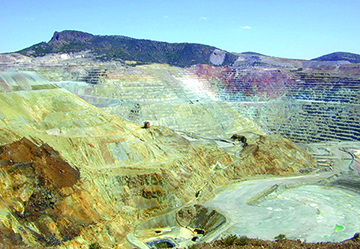
Copper mining can pollute the environment.
What this all boils down to is that, in an attempt to reduce pollution from burning fossil fuels, mining copper to power the cars which are supposed to deliver humanity from poisoning the earth could instead put civilization back in the slow lane. Thus, it is the onus of future consumers of EV transportation to insist that the companies who earn their business also provide transparency concerning their acquisition of the raw copper that makes EV mobility possible.
Otherwise, this 21st Century attempt at “progress” and “sustainable energy” may be nothing more than another spin on the ages old “two steps forward, one step back,” “robbing Peter to pay Paul” merry-go-round. Extracting copper from relatively accessible deposits in a responsible, regulated manner could result in less pollution, but the key to progress is to insist that car manufacturers establish a market protocol for recycling old EV batteries for the production of new ones. This standard can be further reinforced if regulatory agencies such as the EPA and the National Highway Traffic Safety Administration are pressured to establish eco-friendly regulations on copper acquisitions — primarily through recycling.
Thankfully, as “the world’s most reusable resource,” copper can be recycled fairly easily and put back into production as soon as the vehicles it helps power become inoperable. The difference between reusing copper from old batteries and purchasing newly-extracted copper is a slim margin on the profit ledger. While opting for the latter over the former will save a few pennies along the way, cutting that corner — as far as the environment is concerned — is hardly worth it.

by Mark Smiley | Dec 17, 2021 | Feature Story Bottom Left
So. Much. Christmas. Runs Through January 2, 2022
by Mark Smiley

Pinyons: A gathering spot for a cocktail or handcrafted drink in the Grand Lodge.
Gaylord Rockies Resort & Convention Center has once again launched its Christmas at Gaylord Rockies with plenty of activities for children of all ages. The Gaylord Resort has made minor adjustments to its popular setup that attracts families from all over.
Mistletoe Village on the convention center wing of the hotel features Build a Bear Workshop, cookies with Mrs. Claus, a gingerbread house decorating station, gift shop, and the brand-new, multi-sensory experience, Mission: Save Christmas, featuring Elf.
At the entrance to Mistletoe Village, enter Buddy the Elf’s world to help save the holiday. Team-up with Mr. Narwhal and friends in the candy cane forest, stay ahead of the toy quota at the North Pole, prepare for Santa’s arrival at the iconic department store, and take part in an epic virtual snowball fight in Central Park. These are just a few of the fun, interactive challenges you’ll experience inside the exhibit.
Christmas at Gaylord Rockies Resort also dazzles guests with Cirque Dreams Holidaze, an awe-inspiring, eye-popping family holiday spectacular, and loads of wondrous, wintry fun
Interactive Experience: From holiday cookie scents to hands-on interactive moments, indulge in surprises that will engage your senses from beginning to end in the multi-sensory experience, Mission: Save Christmas, featuring Elf.
at Glacier Point. In total, more than a dozen special events, attractions, original shows, interactive experiences, and more are in store for guests.
The west side of the hotel features acres of twinkling lights and decorations and holiday activities including mini golf, snow tubing, ice bumper boats, Merry-Go-Round, and ice skating.
Gaylord Rockies Resort & Convention Center offers a variety of restaurant options for you to enjoy during your stay. Choose from fine dining,  unique culinary experiences, and special restaurant events, or enjoy refined cuisine from the comfort of your own hotel room.
Toast family and friends with two local craft beers on tap, Pinyons Pale Ale and Grand Lodge Golden Ale, brewed by Dry Dock Brewing Company and exclusively available at the restaurants and bars in the resort.
Gaylord Rockies is near Denver International Airport and is a Marriott property that opened in December 2018. The 486,000 square feet of convention space makes it the largest combined resort and convention center in Colorado. It is the fifth Gaylord property to open, with the others located in Washington, D.C., Nashville, Orlando, and Dallas.
The Gaylord Rockies Resort & Convention Center is located at 6700 North Gaylord Rockies Boulevard. For more information about the resort or to make a reservation, visit www.gaylordrockies.com. Christmas at Gaylord Rockies runs until January 2, 2022. For more information or for tickets to the events, visit ChristmasatGaylordRockies.com.

by Mark Smiley | Nov 19, 2021 | Feature Story Bottom Left
Karl Honegger
by Karl Honegger
I recently paid $120 to fill up my SUV, bringing back memories of 2012 when I was a college student working two jobs to support my wife and newborn. It was difficult to balance the cost of rent, diapers, food, and gas. It felt like I’d been punched in the gut every time I left the gas station. Because I have a nine-year career under my belt, a master’s degree, and a professional certification, my income is higher. While it doesn’t hurt as much when I fill up my gas tank, I’m still reminded of how much the price of gas impacted my life. It still impacts me because my wife and I drive a full-size passenger van because of my eight-person family.
It is important to understand that it was a strange convergence of events that caused the price of gas to be so low the last decade. Why we used to enjoy low gas prices is because of three factors:
Senator Kevin Priola
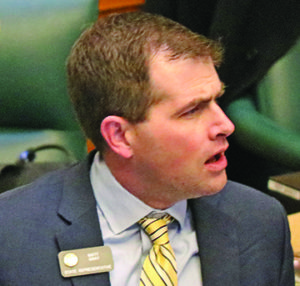
Representative Matt Gray
The first is that the United States is one of the few countries where individuals are allowed to own the minerals in the ground. They can then sign contracts with oil and gas companies to drill and sell those minerals. This free market causes oil companies to be fiercely competitive. March of 2011, NATO commenced a seven-month bombing campaign in Libya and the country was tossed into a brutal civil war. This took almost 1,500 barrels per day of oil off the international market and helped support the price of crude oil for the next few years. Here is how this impacted the United States — oil producers decided that they were going to invest billions in exploring and developing shale oil fields where the cost of drilling for a barrel of oil is much higher. The scientists and petroleum engineers working for those companies then figured out ways to drive down the cost of drilling for shale oil. The United States ended up producing a higher percentage of the world’s supply of oil. This innovation was great for the United States but gave Saudi Arabia a headache.
This brings us to the second factor, Saudi Arabia and OPEC decided they would stop working so hard to prop up the price of crude oil by constantly cutting their own production. Instead, they would flood the market. From mid-2014 to early 2016 the price of crude oil dropped 70% as Saudi Arabia entered a risky battle with US Shale oil companies for market share. The Saudi’s won. This led to over 100 oil and gas companies declaring bankruptcy in 2020, including Whiting Oil and Gas which I used to work for. The bright side was that this oil war was saving American’s $180 billion a year.
 The third factor that led to the low oil prices was that the world enjoyed some peace during the previous administration. The oil production of Libya came back on-line, and we managed to stay out of war with Iran. The combination of these three synergistic factors led to the low gas prices we used to enjoy. Those times will never return. Saudi Arabia is willing to keep oil prices high after winning their price war and demand for oil has recovered after last year’s government lockdowns. The cost of transporting our food to the grocery store, or driving to visit friends and family, or driving to work will remain expensive.
With this in mind, we must fight any new tax disguised as a fee on gas or transportation. The poor and middle class do not need to pay more at the pump as housing prices and out of control inflation continue to squeeze their budgets tighter and tighter.
The corporatists at Colorado Concern demonstrate how out of touch they are by giving Senator Kevin Priola their “In the Arena” award for his support of Senate Bill 260. This bill, sponsored in the State House by my Representative Matt Gray, creates an additional “fee” per gallon of gas. But the money doesn’t go to just roads, it’s also designed to funnel your money towards electrical vehicle “infrastructure” and to subsidize governments buying electric vehicles. Colorado Concern’s award is for the legislator whose “face is marred by dust and sweat and blood; who strives valiantly… who spends himself in a worthy cause…” If politicians like Priola did have any guts, they would have taken this bill to the voters as required by the Taxpayer Bill of Rights. Rather they chose the easy way out by calling a tax a “fee.” This form of sniveling cowardice is what big business interests at Colorado Concern want more of. Next time you are at the gas pump, give State Senator Priola or Representative Gray a call and let them know you don’t appreciate their “fee” on the gas you need to live your life. Colorado Concern may be funded by wealthy cronies who want politicians to do their bidding, but it’s time the voters let them know we’ve had enough.
Karl Honegger is on the Steamboat Institute’s Emerging Leaders Council and a board member of the Colorado Union of Taxpayers. He is a Certified Treasury Professional and works for a “tech-enabled” healthcare company as a Financial Reporting Accountant.
by Charles Bonniwell | Oct 22, 2021 | Feature Story Bottom Left
 Yes it was on Friday the 13th, a day steeped in mythology as a day of ill omens, in March of 2020, that President Donald J. Trump speaking in the White House Rose Garden, declared a national emergency that could free up $50 billion to help fight the pandemic and said that he was empowering the secretary of Health and Human Services to waive certain laws and regulations to ensure that the COVID-19 virus can be contained and patients treated.
“To unleash the full power of the federal government … I am officially declaring a national emergency,” Trump said.
“Two very big words,” he added.
Yes, they were and marked the beginning of the end to his presidency. The concept was to institute on a state-by-state basis lockdowns, mask mandates, and social distancing so that COVID-19 cases would be spread over a longer period so that ICU beds and ventilator machines would not be overwhelmed. All we had to do was go on a stay-at-home vacation for 15 days and all would be well. Approaching the two-year anniversary of that declaration we cannot be amazed at our overwhelming naiveté.
The result was a long-term worldwide recession, the loss of personal freedom, and liberty throughout the once called “Free World” from Italy to Australia, and the imposition of the “dictatorship of the public health bureaucracy.” If Karl Marx had only realized that the overthrow of democracy and capitalism did not require a bloody revolution but simply a public health mandate, we could have saved tens of millions of lives. In China, the apparent source of COVID-19, and the only remaining major country with a communist government, perhaps they did. They closed the city of Wuhan, China, from the rest of China but opened Wuhan up to the rest of the world. No COVID-19 recession for China but a recession for the rest of the world. Brilliant!
Of course, Trump was not the only politician to egregiously suffer due to that fateful Friday the 13th. Democrat New York Governor Andrew Cuomo initially rode the COVID-19 wave to great adulation, even garnering an International Emmy for his daily COVID briefings. In the end, however, he had to resign in disgrace in part from of the discovery that his dictates that nursing homes had to take in contiguous COVID-19 patients cost thousands of lives, which he fraudulently tried to hide. The coup de grâce came with the revelation that the so-called “LuvGov” was, in fact, a serial sexual harasser.
But what if Trump had ignored the advice from ever contradicting Dr. Anthony Fauci and the highly political Center for Disease Control and Prevention, and rode through the Ides of March doing nothing but shepherding through the development and distribution of vaccines for COVID-19. The one European country that ignored all of the lockdown mandates and impingements on civil liberties was surprisingly, Sweden, headed by the Swedish Social Democratic Party. From the beginning of the COVID-19 pandemic, the Public Health Agency, Folkhälsomyndigheten, embarked on a de-facto herd immunity approach, allowing community transmission to occur relatively unchecked. There were no mandatory measures taken to limit crowds on public transport, in shopping malls, or in other crowded venues, while recommending only a limit of 50 people for gatherings. Sweden’s mortality rates were lower than the European Union and the United States and its economy prospered.
In America, states like Nebraska, Wyoming, and Florida, which limited and quickly lifted COVID-19 restrictions appear to have weathered comparatively well when put up against highly restrictive states such as New York and California. Colorado, under Governor Polis, took a somewhat middle ground and at least did not go with the Draconian measures adopted by states such as Michigan, under the leadership of Governor Whitmer. In Denver we did get to see up close and personal the hypocrisy of the political elites when Mayor Hancock was at DIA texting to city employees not to travel over the Thanksgiving holidays, while he was heading to Texas and Mississippi to spend the holidays with family.
Was it all worth it? The autocrats and authoritarians and their admirers on the left and right will tell you it was. They certainly learned how easy it is to cower and control a populace. But at least for some the lesson learned is that next time they tell us the equivalent of it is just “15 days to flatten the curve” we know what they mean. It is time to again destroy liberty and freedom for as long as they can possibly get away with it.
— Editorial Board
by Charles Bonniwell | Sep 27, 2021 | Feature Story Bottom Left

Golden Rule: Phil Anschutz, Colorado’s wealthiest man.
The Colorado Republican Party met down in Pueblo for its fall meeting to consider whether to opt-out of the state run primary. The prominent Democrats had funded statewide referendums called Propositions 107 and 108 back in 2016, which made for Presidential primaries (107) and for open primaries for all others partisan elections (108) whereby unaffiliated voters would receive ballots from both parties and could choose one.
Similar measures had been passed in California and Utah, which mandated acceptance by the parties. Such mandates were found to be unconstitutional in federal courts so this time the provision was made where a political party could opt-out provided 75% of all its State Central Committee (the “SCC”) voted every two years in the fall to do so. Because of its extraordinary high percentage of all members, not just those voting, opting out is almost impossible.
Does this pass constitutional muster? Not according to virtually everyone from conservative legal scholar John Eastman to the liberal Legal Director of the Colorado ACLU Mark Silverstein. A group of grassroot Republicans who are members of the SCC (including the publisher of this paper) began touring the state to convince fellow members of the SCC to vote for opt-out of Proposition 108 at the fall meeting.
The merry band of grassroot activists did not do so because they thought they could achieve the nearly impossible task of getting 75% of all the SCC members to opt-out. In fact, 75% of all the members seldom even attend the fall meeting. The activists did so to get the leadership to act on the issue and bring suit in federal court to determine once all for all the unconstitutionality of Proposition 108.
Somewhat improbably the campaign caught fire and began to attract backers across the state. The Republican SCC is composed of 520 members which includes all state House and Senate legislators who are Republicans as well as the Republican Chair, Vice Chair, and Secretary of each of the 64 counties, as well as bonus members from the more populated counties.
Adherents for the opt-out included State Representatives Dave Williams, Matt Soper, Patrick Neville, Stephanie Luck, and Ron Hanks, former U.S. Congressman Tom Tancredo, Republican National Committeeman and radio host Randy Corporon, State Party Vice Chair Priscilla Rahm, and State Party Secretary Marilyn Harris.
But then came the counterattack from the Republican Party establishment who have controlled the Republican Party for over 20 years, and who dislike the grassroot Republicans more than the farthest left Democrats. The Colorado Republican Party has been, and is, controlled by one person, the state’s richest man, billionaire Phil Anschutz. Very few grassroots Republicans were ever actually aware of this fact.
Anschutz is the owner of the Broadmoor Resort in Colorado Springs, among many other business enterprises, including the NHL’s Los Angeles Kings and Anschutz Entertainment Group (AEG). He also controls the Colorado Springs Gazette newspaper and the blog sites Colorado Politics and the Denver Gazette. He is also rumored to be the biggest contributor to the Denver free market think tank, the Independence Institute, which in turn controls Complete Colorado a news aggregator.

The Discovery: Grassroots Republicans discover that Phil Anschutz is the man behind the curtain in Republican politics.
Anschutz never publicly expresses his political views and works behind the scenes through layers of intermediators. It is believed that he is not a Trump fan, and he is what was once called a “Rockefeller Republican.” His hires for editors and reporters at Colorado Politics and Denver Gazette are almost all left of center liberals and mostly laid off former Denver Post employees. His publications regularly attack grassroot politicians like former State House minority leader Patrick Neville while writing endless puff pieces on moderate Republicans like two-time failed gubernatorial candidate Bob “Both Ways” Beauprez.
The content of his publications tends to be almost no different than The Denver Post except for occasionally having moderate Republicans write opinion pieces. It is believed he has come to accept Democrat hegemony over the state governments of California and Colorado, where most of his business enterprises are located. He has figured out how to have his businesses thrive in such environments.
He clearly didn’t like the opt-out idea and all of a sudden, every one of his publications went on the attack and opposed the opt-out. Even though the Independence Institute’s Jon Caldera is not a Republican and now votes in Democrat primaries, he wrote an editorial condemning the opt-out and then emailed pleas to 520 members of the Republican SCC to vote no on the opt-out. The same for 710 KNUS host Jimmy Sengenberger who has been financially supported by Anschutz organizations. Anschutz even had the Colorado Gazette issue a scathing editorial on the eve of the Republican fall meeting condemning the opt-out vote.
In the end, the opt-out vote failed by a 60% to 40% margin of those attending the fall meeting. It was short of the required 75% of all members of the entire SCC. Ultimately, however, the grassroots won. They were able to get over 75% of the members to attend the fall meeting forcing the State Chair Kristi Burton Brown to even have a vote. Following that failed vote a motion and a resolution were passed almost unanimously demanding the party be a plaintiff to a federal lawsuit to overturn Proposition 108 and set up a separate fund to support such a lawsuit.
Anschutz won the opt-out battle but lost the war. Undoubtedly, Anschutz will try to scuttle the lawsuit too, but it is not clear he will be able to do so. Perhaps, more importantly grassroot Republicans have been able at long last to pull the curtain aside and see who their “Wizard of Oz” opponent really is.