by Mark Smiley | Mar 25, 2016 | Travel
Hundreds Flock To Collaboration Fest In Denver And Gear Up For Bacon And Beer Classic In April
by Phil Kummer
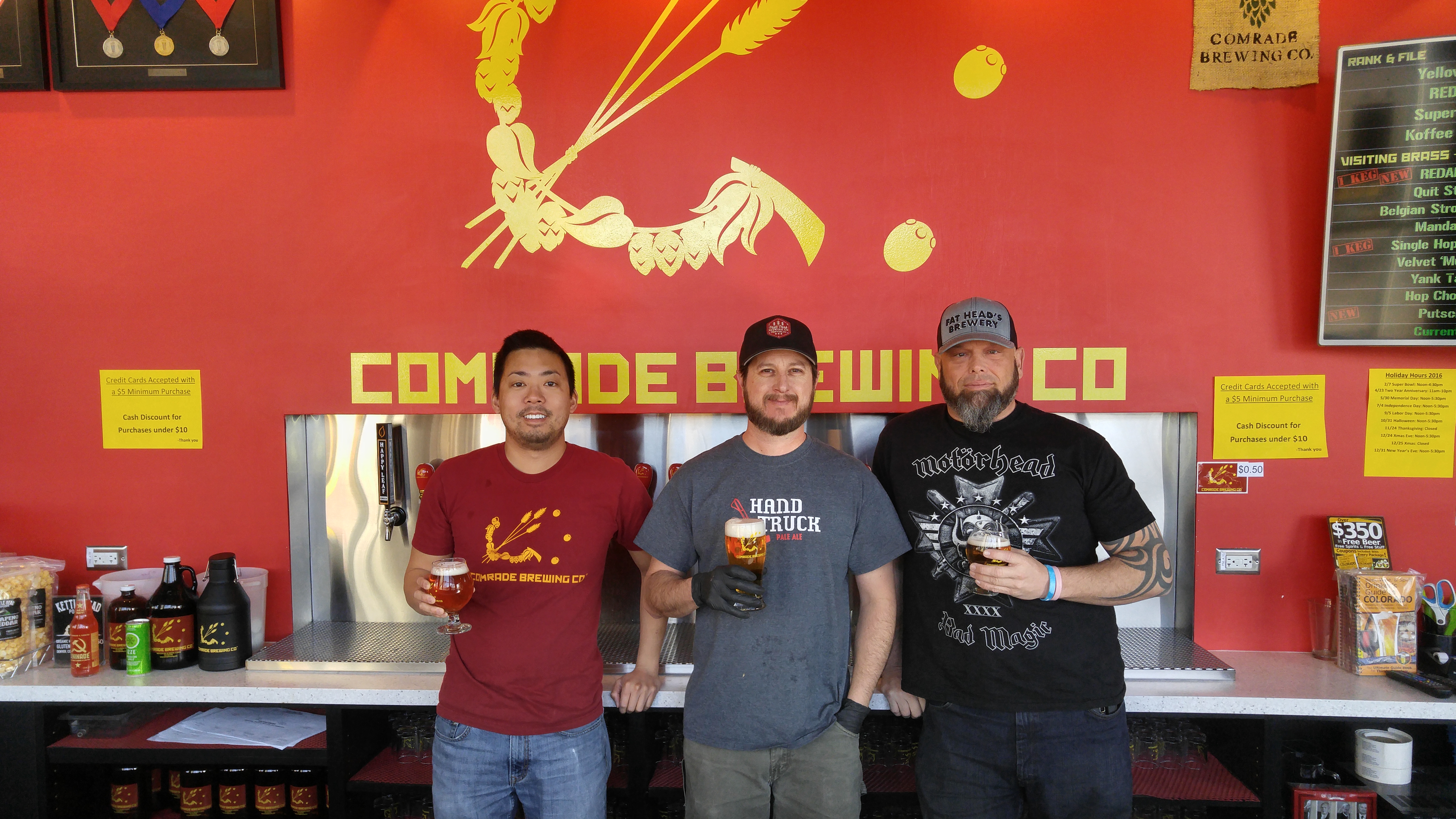
Special Blend: David Lin and Marks Lanham from Comrade Brewing collaborated with Mike H from Fat Head’s Brewery in Ohio to brew Lupulin Manifesto IPA.
Colorado has been at the heart of the craft beer explosion over the past decade and has over 235 craft breweries. Closer to home in the Cherry Creek/Southeast Denver area one can suck down some craft brewed suds at no fewer than 11 establishments, most of which are no more than a few years old.
Although craft beer is becoming increasingly popular, beer is actually one of the oldest prepared beverages and might have been made as early as 9500 BC, when cereal grains were first harvested. Archeologists have dated beer made from barley to about 3500-3000 BC in western Iran, and hops were first used in Europe around 800 AD by monks. Just about any grain, vegetable or fruit that contains sugar can undergo alcoholic fermentation and has thus been used somewhere around the world to make beer. By 2006 the global beer industry had revenues of about $295 billion, yes that is billion. It’s obvious that what ancient peoples discovered has turned out to be a pretty good idea.
This ancient beverage is now the rage and with all this new popularity comes new career opportunities, the most important being that of brewmaster. To understand this now popular occupation we consulted with David Lin, owner, and Marks Lanham, brewmaster, of the award-winning Comrade Brewing Company. They have a combined total of about 24 years in the craft beer business and most of that time has been on-the-job training. They have been running Comrade since April of 2014.
The passion for beer and beer drinking is fundamental to be a successful Brewmaster and can’t be taught. You can’t get it by going to school. It’s important to love your end product and be proud of it. It means enjoying the beer that you and other craft brewers make and sometimes having a beer for breakfast just because you feel like it.
Once you have harnessed the passion for beer there is still a long way to go to actually making a good tasting craft beer. “We make beer we enjoy drinking and what we drink, we sell,” said David Lin. Being a brewmaster is a unique combination of skills and attitudes that all play a role in one’s ability to make a highly drinkable brew. It’s like being an artist and scientist at the same time, like being left brained and right brained on demand. The brewmaster must have the creativity of a chef to develop new tastes in beer along with the skills and focus of operations director to make sure that the beer comes out just right.
The brewmaster must learn to manage his suppliers which means having good relationships with suppliers around the country to provide agricultural products. Depending on weather and harvest conditions this can be a challenge. It once took David two years of working with a supplier to get a specific kind of hops for his beer. One advantage of working in the craft brewery business is the sense of community among brewers. One brewer coming to the aid of another brewer with a needed ingredient is a common thing and helps foster a unique sense of community.
To highlight this fraternity of craft brewers, Denver recently held its 3rd Annual Collaboration Beer Fest on the club level of Sports Authority Field. Collaboration is all about sharing brewing experience and technique to join the perfect ingredients. Brewers come together to decide exactly what yeast to use with what fruit, what type of malt works best with what barrel, or what hops will contribute to the perfect aroma.
Comrade collaborated with Fat Head’ s Brewery from Portland, Oregon, as well as Cannonball Creek and Station 26 breweries. The Bull & Bush collaborated with Little Machine from Jefferson Park neighborhood in Denver. Recently crowned Best New Brewery in the United States, Weldwerks Brewing out of Greeley, collaborated with Snowbank Brewing Company from Fort Collins, to produce a barrel-aged mocha stout.
Attendees of the fest were able to sample more than 85 craft brews and some are now available in the respective tap rooms. All in all, 151 breweries from five countries and 20 states were on hand to share their rare creations.
Whether a collaboration or in a day’s work, once all of the ingredients are in hand, the brewmaster has to carefully control and monitor a biological process, fermentation, that usually takes a couple of weeks but can be much longer. This means spending a lot time at the brewery, usually 60 to 70 hours a week. This is a totally hands-on type job.
Last, but by no means least, the brewmaster has to be an absolute clean freak because he knows that contamination is the worst thing that can happen to a batch of beer. So the brewmaster spends the majority of his time cleaning tanks and equipment to ensure that everything is clean all the time. Marks 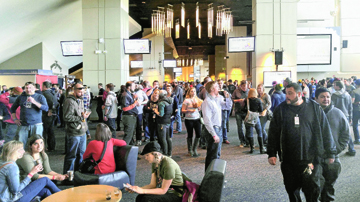 Lanham remarked, “Cleaning is 95% of the job.”
The craft brewing industry has grown so much that you can now get a degree or certificate at a few colleges here in Colorado and about dozen colleges throughout the U.S. At Metropolitan State University of Denver you can major in Brewery Operations or Brew Pub Operations. Colorado State University offers a BS in Fermentation Science and Technology and Regis University offers a certificate in Applied Craft Brewing. It appears that the art of craft brewing has come of age.
To highlight this art, after drawing sold-out crowds across the country, the Bacon and Beer Classic is coming to Denver on Saturday, April 16, for a unique gastronomic experience inside Sports Authority Field at Mile High.
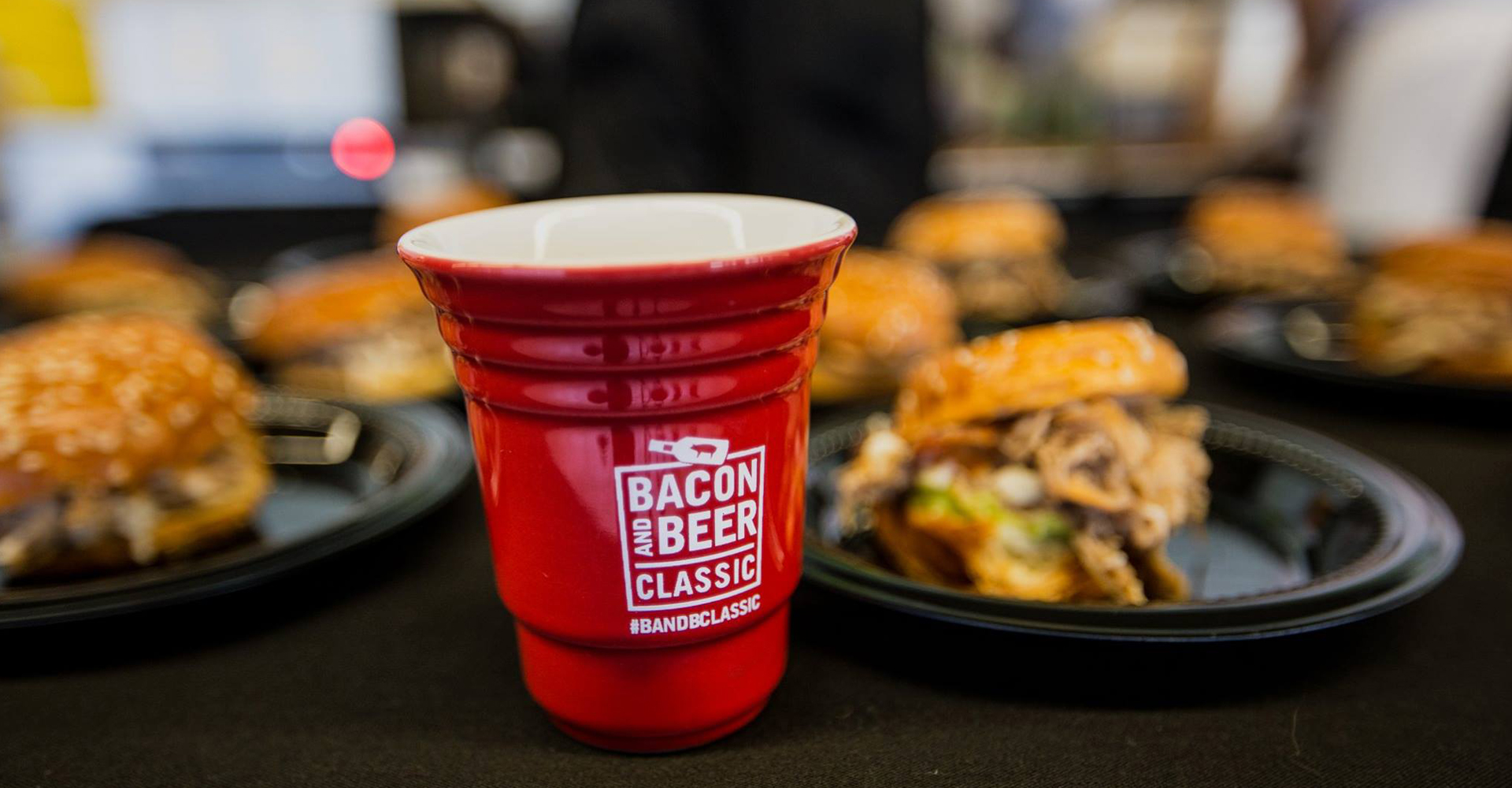
Bacon and Beer: Sports Authority Field will play host to the Bacon and Beer Classic on April 16, 2016 for the first time. Visit www.baconandbeerclassic.com for more information.
Over 30 local restaurants will provide bacon dishes and over 50 regional breweries will offer craft beer throughout the concourse. Kate Levenstien, founder of Cannonball Productions and the Bacon and Beer Classic, is looking forward to hosting the Classic at Sports Authority Field for the first time. “With some of the best craft breweries in the country, Denver is a dream city for this festival. It is easy to find an incredible selection of local brewers and restaurants. Pair that with die-hard Broncos fans and we’ve got everything all in one spot!”
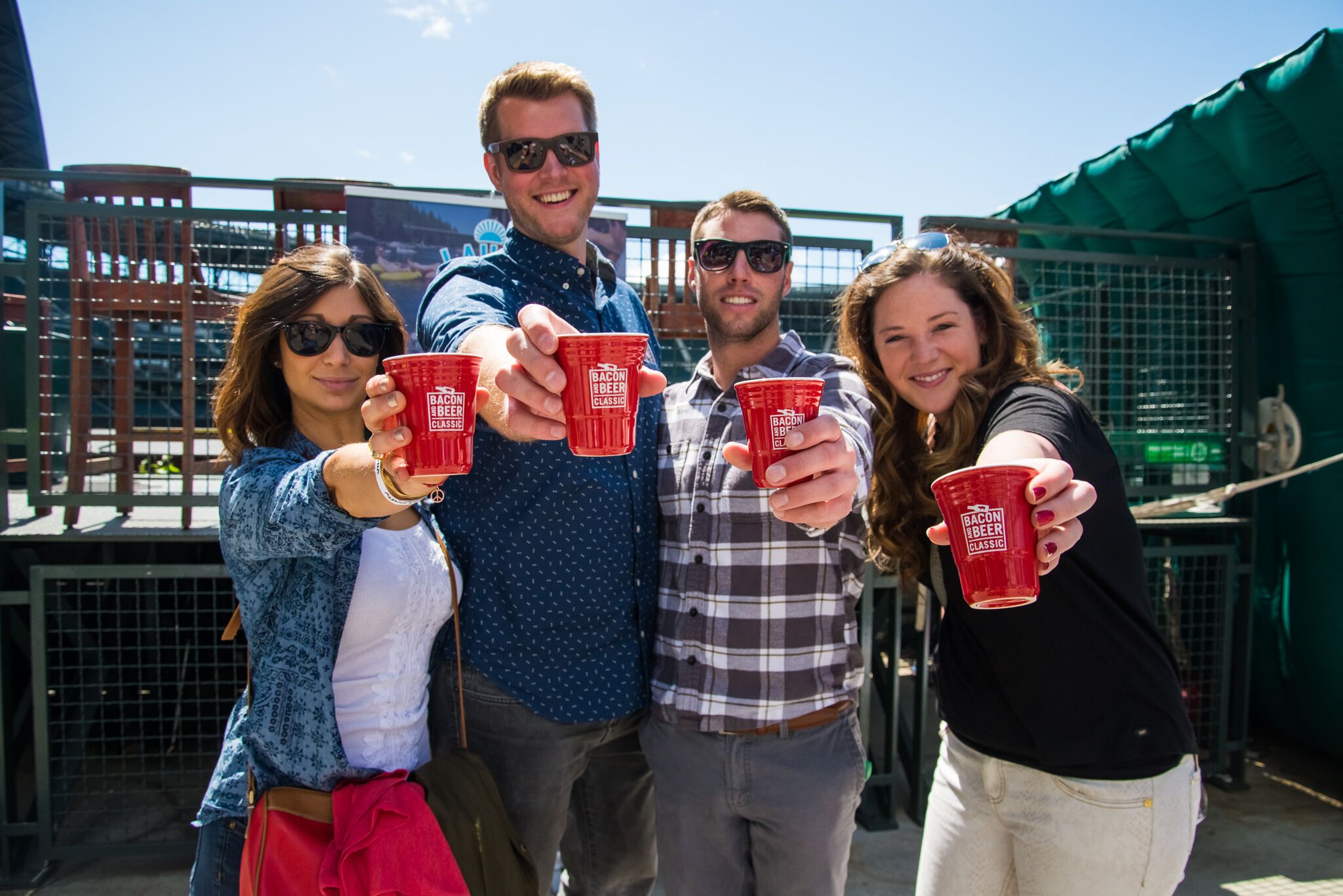
In addition to the all-star lineup of local breweries and restaurants, a panel of judges will be on site to rate the sips and tastes and award winners in select categories. The restaurant awarded the Best Overall Bacon Dish will go on to compete in the 2016 World Food Championships in Kissimmee, Florida.
So, after you’ve downed a couple of beers at your favorite craft brewery you might reflect on what it actually takes to make your favorite beverage and realize that the brewmaster could be the next rock star in your neighborhood.

by Mark Smiley | Feb 29, 2016 | Travel
by Megan Carthel
 According to the United Nations, one in three women will be beaten or raped in their lifetime, and for the past four years many of those women in Colorado showed up at One Billion Rising, a rally against violence toward women.
One Billion Rising is the largest mass action to end and bring awareness to violence against women. The name comes from the statistic of one-in-three. With the world’s population, that totals one billion women who will be beaten or victims of rape. One Billion Rising is leading the initiative to not only make victims survivors, but for violence to no longer be a threat to women.
Each year has had a theme, and this year was centered around the idea of revolution. This year’s rally focused on marginalized women, a call for people to rise for others and international issues such as human trafficking. Here in Colorado, Caitlin Brozna-Smith and her company Bella Diva Dance organized the event. For her, the initiative is personal. Three years ago, just as One Billion Rising was getting started, one of her dancers was almost fatally shot by her ex-fiancé.
“We’re going to rally for our dancer, and we’re going to come together and stand up saying this is not okay,” Brozna-Smith said.
On Valentine’s Day this year, over 200 women, men, girls and boys of all ages gathered to hear stories of survivors of rape and domestic abuse. They danced and marched around Denver to raise awareness. Dancing, Brozna-Smith said, is way of expressing unashamed emotion and reclaiming a sense of confidence. Activists and participants across the world dance the same dance on the same day to bring awareness. Brozna-Smith and Bella Diva Dance put a global spin on it, pulling dancing techniques from Bollywood, belly dancing and dance techniques from around the world.
“People are using their bodies because that’s what was violated.”
Bella Diva Dance has been a participant in One Billion Rising ever since one of their own was a victim of domestic violence, but this is Brozna-Smith’s first year heading the rally.
“It’s been very moving in terms of how many people who you actually get to discover this is happening to, and I think it’s something that needs to be talked about more,” Brozna-Smith said.
Tangi Lancaster and her husband Stephan w ere both victims of abuse and attended the One Billion Rising rally in Denver. As parents of boys, they feel a need to teach them about body awareness and the power of “no.”
“When they say no, no means no, and I think that starts at a very young age. And we need to engrain that,” Tangi said. “When they do get older and they are around other children who no doesn’t mean no, they can be an advocate, and that’s really why I like to bring them too. So that they know they have a voice, and that they know how to use it.”
For Stephan, he’s there to support his wife and the other billion women who’ve experienced abuse — their entire family wearing matching shirts.
“I know that having my wife at the end of the day having us all dancing together, supporting her, her making these shirts, us all wearing them and me proudly wearing it — I think that’s the part for me that makes me feel good,” Stephan said. “She knows that I’m there for her, and she knows that she’s protected for sure. I would never let anybody ever hurt her again.”
Brozna-Smith wants more men like Stephan to be involved. She said until more men get involved, domestic violence will continue to be a women’s issue. Katee Valverde attended the rally as a victim and survivor. Standing up against violence, toward either gender, is something she feels passionate about.
“I’m here because I’m one in three. I’ve been abused, victimized. I’ve been assaulted. And it’s time to not be quiet anymore,” Valverde said. “It’s too many victims. It doesn’t matter what gender. They’re victims.”
Domestic violence is a prevalent issue around the globe and in Colorado. According to the National Coalition against Domestic Violence, 16,700 people reported at least one domestic violence crime in 2014, and 25 Coloradans were killed by their current or former intimate partners. In a more staggering statistic, the NCADV found that 1,018 people were abducted by current or former intimate partners in 2014, and half of those were abducted by current or former dating partners.
by Mark Smiley | Jan 29, 2016 | Travel
56 Units And ‘ZERO PARKING’
by Glen Richardson
The City and County of Denver has become nationally known for approving apartment projects with extremely low parking requirements under the apparent theory that it will force its residents to walk, ride a bike, take public transportation or utilize taxi cabs/Uber vehicles. Families with kids are apparently not deemed likely to want to move to Denver anytime in the immediate future, just young single members of the millennium generation.
Denver is also believed to be the only major city planning department in the United States that as a matter of public policy refuses to consider the impact of increased traffic because of a development. Real estate developers are said to control both the office of the mayor of Denver, Michael Hancock, and the majority of the 13 member Denver City Council which must approve real estate projects according to the City Charter. Most developers want as little required parking as possible since it significantly increases the price of a project. Often the lack of parking becomes a major problem in the future for such projects, but the developer is usually long gone from the scene.
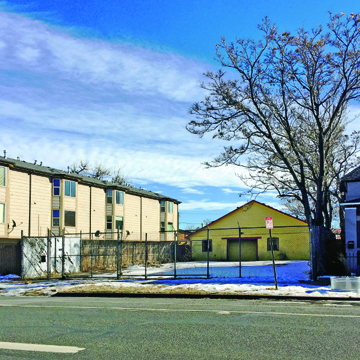
One of the newest projects in one of Denver’s oldest neighborhoods, Curtis Park, is slated to have 56 micro-units of 300 square feet each and no parking to the outrage of Curtis Park residents. The on-street parking in the area, according to neighborhood residents, is already extremely tight.
Apparently there is not a plan filed with the Denver City Planning and Development Department for the project. However, there have been numerous meetings between the developer, Gaddis Properties, and Councilman Albus Brooks who, according to insiders, has all but given a green light to the project.
The small property is located at 32nd and Stout Street and the residents indicate that a purported exemption for parking was intended for a small commercial business and not a 56 unit apartment house. City records indicate that the property was once used for an auto service garage. In fact residents also indicate that six more square feet and the exemption would not even apply to a small commercial business.
At a heated and angry meeting between Doug Gaddis and resident Andrew Kowalyshyn, reports are that Gaddis stated the residents were lucky he didn’t build a 70 unit building and that no parking was needed anyway as none of the future tenants or their visiting friends or family would ever use a car, a proposition met with incredulity with the people at the meeting. Summing up the feelings of the neighborhood Kowalyshyn stated of Gaddis, “This guy is just a complete bullshit artist.”
Councilman Albus Brooks told local television stations that neither he nor the city could force Gaddis to provide parking. City insiders indicate that virtually any development in Denver requires some variances and waivers by a city and the city could refuse to grant the same without Mr. Gaddis providing some parking, but is simply unlikely to do so.
Neighborhood activist David Johnson noted, “The fix is in, as always. The Planning Department does not plan and Denver councilmen like Albus Brooks don’t represent the residents. There is no part of the city that the epidemic of overdevelopment corruption is not affecting and destroying our neighborhoods. With Gaddis we are evolving from the ‘limited parking’ stage to the ‘absolutely no parking’ stage. How to change a beautiful city with wonderful neighborhoods to an overcrowded dump.”
by Mark Smiley | Dec 17, 2015 | Travel
 Residents Hate The Iconic Structure Designed To Gain Political Favor
With Bike Advocacy Groups
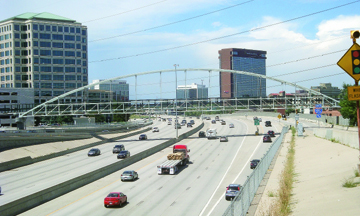
A pedestrian and bicycle bridge that crosses over I-25 at Colorado Blvd. linking the area to the light rail station opened 16 years and $8 million after Denver initially contemplated the project. Since opening in July 2015 many are asking if the bridge is a benefit or boondoggle to an area that grew up in the golden age of automobiles?
As the neighborhood and surrounding business community has matured many are unsure whether being retrofitted for pedestrians, bicycles and public transit is a blessing. Developed mostly during the 1950s and 1960s, this established neighborhood is an eclectic mix of single-family ranch homes, apartment buildings and townhomes, along with shopping centers and mid- to high-rise office buildings.
The initial reaction of many: They hate it! They are displeased and disturbed with the lack of parking spaces and believe the ramp is ugly. They are also unhappy with the increased noise and activity created by bicyclists and people going to and coming from work. Someone even wrote on the DownhomeDenver blog that there’s no reason for the bridge that was paid for with $4 million in City Capital Improvement Funds and $4 million in Federal Transportation Funds. Others, however, believe that the vast majority of residents other than the four or five buildings’ worth living at the base of the access ramp, approve of the bridge or have no opinion.
Taken For A Ride?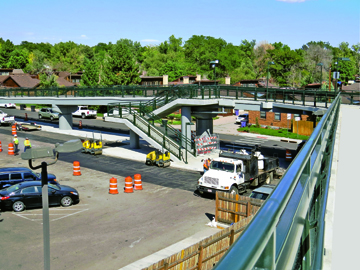
The north-south freeway previously separated inhabitants from the light rail link known as the Colorado Station. Now, however, the bridge connects the transit hub with Cherry St. and the Virginia Village neighborhood to the east. Access over I-25 is in the vicinity of Colorado Blvd. and East Evans Ave.
The bridge spans I-25, landing at Cherry St. to the north and RTD’s Colorado Station (light rail transit) to the south. The bridge was built to provide a safe way for bike riders and walkers to cross over I-25 without using Colorado Blvd., a street filled with rushing cars day and night. A biker named Bob stopped on the bridge by the Chronicle refused to give his last name but said he believes the bridge is worth every penny. He uses it fairly frequently now that he’s discovered it but can’t believe how few others do use it.
The bridge was theoretically built to increase connectivity to the Colorado Station, which boasted 5,600 arrivals and boarding per day prior to the bridge opening. That number hasn’t increased dramatically in the months since the opening. Only 2% of RTD’s ridership is by bike and at the Colorado Station that number hasn’t yet jumped appreciably. Most of those walking to the station don’t cross the bridge but are walking from the nearby parking lot.
Bicker With Bikers
For many the bridge also symbolizes the 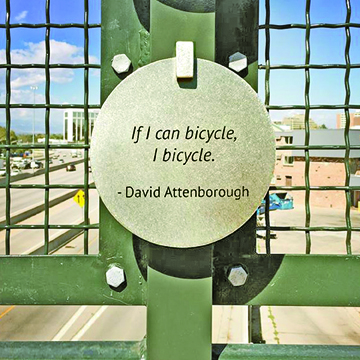 increasing squabble between motorists and bikers due to Denver’s policy of being hostile to automobile drivers and friendly to bikers. Denver drivers are constantly in a state of irritation due to the City’s implementing of Denver Moves Bicycles, a network plan of installing protected bike lanes, installing bicycle detection and signal upgrades that speed cyclists ahead while slowing down auto traffic.
Road Diets — a plan being advanced by Denver’s Planning Department — entails converting four-lane undivided roadways to two-lane roadways. Furthermore the plan provides for a two-way left turn lane by removing a travel lane in each direction. The remaining roadway width is converted to bike lanes. Staunch bicycle supporters argue that these road diets actually reduce overall traffic. Bicycling is growing beyond just being a part of Denver Public Work’s and Parks & Recreation programs. Denver added three full-time individuals to the bike program in 2014 to help implement bicycle projects and improvements.
Motorists complain that cyclists ride on their merry way oblivious to drivers, don’t obey traffic lights or anything or everyone else that get in their way. “They don’t look around, don’t care about their own safety or those of the people they are distracting,” says Cherry Creek resident Latasha Curry.
Engineering & Art
Work on the bridge began on March 17, 2014, with initial construction focusing on fabrication and installation of the steel pedestrian railing on the main span over I-25 and the approach spans on either side of I-25. The arch was successfully set into place on the night of Jan. 16, 2015. The installation of the railing on the main span started on the west side of the bridge and progressed to the east. Project lighting followed the progress of the steel railing.
The high point to completion of the bridge was construction of the concrete deck. The concrete was poured into a 309-foot long truss — a little longer than a football field — and weighed close to 200 tons. That’s equivalent to about 18,700 gallons of concrete and required 10 concrete trucks and two big “pumpers” to pour concrete into the truss. The work often required full overnight closure of I-25 from Colorado Blvd. to Evans Ave.
Artwork titled A Mindful Bridge by North Carolina artists Jim Hirschfield and Sonya Ishii was installed on the bridge during the week of Sept. 29-Oct. 3, 2015. They are an array of shimmering circular stainless steel disks attached to the interior of the bridge. The disks contain quotes about the experiences of people walking or cycling while crossing a bridge. A Denver ordinance enacted in 1991 directs that 1% of any capital improvement project over $1 million undertaken by the City be set aside for the inclusion of art in the design and construction of those projects.
Catalyst For Growth
Construction of the bridge has become a catalyst for new development within the area and more is anticipated. Lincoln Property Company and ASB Real Estate Investments are building a new mixed use development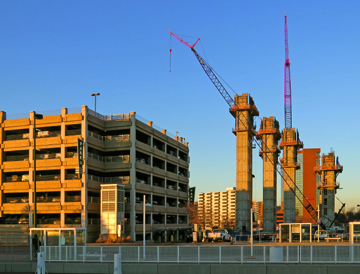 , adding more than 450,000 square feet of commercial and residential space to the nearby Colorado Center.
Real estate professionals suggest that the site has the potential to become Denver’s largest transit oriented development (TOD). Their point: With the light rail station plus the pedestrian-bicycle bridge, access to the site is unprecedented, creating a community center for the surrounding neighborhoods and I-25 corridor.
At the intersection of I-25 and Colorado Blvd. the additions will add 210,000 square-feet of office buildings plus a residential tower containing 189 apartments and 80 loft-style units. A 40,000 square foot Main Street retail section is also planned. The Center already features three office buildings plus the Dave & Busters-United Artists complex. New office space will add eight stories over five levels of parking. Retail space will be located within the residential development. Construction of the office space is expected to be complete in Dec. 2016 and the residential portion in mid-2017.

by Mark Smiley | Nov 23, 2015 | Travel
by Casey Bloyer
The holidays are a wonderful time to be a beer nerd. I revel in the opportunity to pair beer with a variety of celebratory meals and gatherings. Those congregations with family and friends can also provide a chance to become a beer evangelist to those less experienced with the variety of flavors local brews offer. Is the impending arrival of in-laws causing anxiety? A nice dose of Colorado craft beer can help ease the tension there, too. Of course the best part is the gifts. Whether giving or receiving, it’s all part of the communal nature of Colorado’s craft scene. Here are a few fun gift ideas for the drinker who has it all.
Personal Growler: ($35-$130) Yes, this is about as cliché as it gets. Yet, you also can’t really go wrong here, either. Brands such as FIFTY/FIFTY, Miir and Hydro Flask offer stainless steel, vacuum insulated carriers for your loved ones’ loved one: beer. They double as durable, insulated carriers for other liquids when the beer’s gone. Just about every local brewery sells and fills its own version as well. Traditionally a growler is 64 ounces but some companies now offer co2 pressurized versions with taps as large as 128 oz. Think of a mini keg in your fridge. Drink Tanks and ManCan are among the offerings in the pressurized growler market. But for looks alone, I prefer the uKeg from Portland’s Growler Werks. The uKeg looks great with copper, steel and brass options, but it is less versatile and more difficult to clean.
Local Brewery Gear: T-Shirts, hats, stickers, glassware. No, we can’t have too much. Some of brewski-reviewski’s favorite local brewery logos include Broken Compass (Breckenridge), Cerebral (Denver), Elevation (Poncha Springs), Liquid Mechanics (Lafayette), Mockery (RiNo), Ska (Durango), 3 Freaks (Highlands Ranch) and 38 State (Littleton), just to name a few.
Laws Whiskey: ($65-$70) Laws Whiskey House has been very good to the local craft brewing community, bucking my own notion that distillers didn’t often embrace the cooperative aspect of the craft brewing culture. Brewers both acknowledged and reciprocated that spirit for the distillery’s recent anniversary celebration, donating a number of free brews, which were available to fans throughout the celebration at no cost. The neighborhood distillery was started by Al Laws and includes some former staffers who left Stranahans, after Proximo Spirits (owner of Jose Cuervo) purchased the Stranahans distillery. Laws employs local family farms, where it sources its wheat, barley and rye. I sampled Laws latest rye batch whiskey at the distillery’s first anniversary party earlier this year. My take away? Smooth. Very, very smooth. Single barrel offerings are available for purchase at the Denver distillery (1420 S. Acoma Street) and at about 20 local liquor stores. A rye was also released by the distillery in mid-November. Find your closest carrier at the Laws website. www.lawswhiskey house.com/whiskey-locator/.
Whiskey Advent Calendar: ($190 -$320) Looking for a new twist on the annual advent calendar tradition? Master of Malt has the answer, offering advent calendars with various spirits including cognac, rum, whiskey and tequila. Behind each of the 24 windows lies a different 3cl “Drinks By The Dram” sample of whisky. Highlights among this year’s 24 drams include a rare 50-year-old Scotch, an award-winning Japanese whisky and the winner of the 2014 World Whiskies Awards. Each handmade, wax-sealed dram allows whisky fans to sample a new whisky, tasting everything from single grain whisky to rare Scotch. In my rudimentary and uncertain conversion, each bottle includes one ounce of whiskey. Purchase online at www.masterofmalt.com
Hops: ($6-$40) You are almost certain to get “unique” points for gifting hops to the beer fan in your circle. Michigan’s Black Creek Hops has you covered, offering everything from hops related ornaments to herbal hops tea and even pillows filled with hops designed to help ease of sleep. Black Creek Hops is a small scale hop farm run by a husband and wife team in Scottville, Michigan. They are also happy to send whole cone, noble hops if you’re shopping for a homebrewer. www.etsy.com/shop/ blackcreekhops.
Hopefully this gets you started on your gift search for the beer lover in your life. We both send you wishes for a healthy, happy and hoppy holiday season. Until next year, raise your glass!
Casey Bloyer is the Executive Producer of The Peter Boyles Show and The Dan Caplis Show. He is the co-host of Brewski-Reviewski with Connor Shreve who is the Sports Director at 710KNUS. Brewski-Reviewski is a bi-monthly podcast talking about all things craft beer in Colorado. Twitter @Breviewski; Facebook www. facebook.com/craftbeerradio; email brcraftbeer @gmail.com.
by Mark Smiley | Nov 2, 2015 | Travel
by Mark Smiley
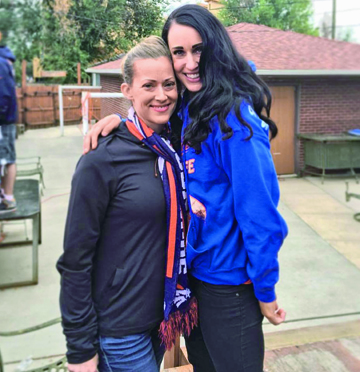
Cherry Creek Valley resident Elizabeth (Biz) Erickson, age 31, watched as her sister Emily, age 36, slowly wasted away and began to die from the liver disease Primary Sclerosing Cholangitis (PSC) as she waited for a transplanted liver from a cadaver. Football legend Walter Payton died from PSC at age 45 and now his football coach Mike Ditka has the very same disease.
Every year thousands die while waiting for a cadaver liver which never comes. Emily’s dilemma was made even more acute from the fact that she has a relatively rare blood type, AB+. Elizabeth could no longer watch her sister suffer and volunteered to help try to save her sister’s life by offering the gift of her own liver or more accurately, 65% of her liver. Luckily livers are one of the most regenerative portions of the human anatomy and if the operation is successful, both women will eventually have full livers. But the operation is not without serious risks for both the donee and the donor.
Out of every 100 people who receive a liver transplant using a living donor, 78 will live for five years or more and 22 will die from the transplant. The odds for the donor are better with approximately one in five hundred dying from the operation.
Transplant
On December 8, 2015, University of Colorado Hospital (UCH) surgeons will transplant a portion of Elizabeth’s liver in Emily’s body. The sisters will spend 5-10 days at UCH and once they are stable, they will be taken to a transplant recovery area to continue recuperating. It takes about 2-4 months of rest, rejuvenation, and regeneration at home. The liver will regenerate in Biz’s body within months and there is a chance that Emily may be close to feeling 100% in six weeks, a feeling that she has not had in over 13 years.
The sisters’ mother, Kathy Barrett, stated, “This is an unbelievable gift Elizabeth is giving to her sister. Elizabeth is my hero too. This is the kind of person she is. This is what she is supposed to do. I’m not even that scared.”
PSC is a chronic disorder of the liver in which the bile ducts outside the liver (the extrahepatic bile ducts) and often the bile ducts inside the liver become inflamed, thickened (sclerotic), narrowed, and finally obstructed. This is a progressive process that can in time destroy the bile ducts.
Thirteen years ago after Emily gave birth to her son she had severe itching which created painful scabs. Her liver enzymes were evaluated and she was initially diagnosed with hepatitis. But after a visit to the Mayo Clinic, her diagnosis was changed to PSC. Her mother Kathy remembers these days vividly. “For me, this has been such a long journey. In the beginning, I was mamma bear and I wanted to fight for the whole thing,” said Kathy. “The first time she got sick, I was off the charts crazy. But then a calm came over me and I said, ‘I can’t control this.’”
The symptoms that Emily currently deals with are extreme fatigue, itching, and a reversed sleep cycle. Her two children are now 13 and 9 years of age. They struggle to understand why their mom is always tired. This transplant is necessary to give her children the childhood she feels they deserve. “I feel like I am living someone else’s life,” said Emily. “I have a lot of guilt associated with it [being tired around her children]. I have no energy to do anything. But if this operation is successful my children will see for the first time the energetic and joyful person that their mother was before PSC struck.”
Support Group
Emily relies heavily on a support group based in Colorado. She attends regular conferences and gets advice from experts. PSC Partners Seeking a Cure, headquartered in Englewood, Colo., is a volunteer organization that was formed in 2005 to provide PSC patients and their caregivers education and support and to raise funds to research the origins of and a cure for the disease.
Donor Alliance
While Emily will be receiving a live transplant from her sister most individuals with PSC must depend upon a liver from a cadaver. Sixty-seven percent of adult Coloradans have registered to be an organ and tissue donor which is a much higher percent than most states.
The registration process is through an organization called Donor Alliance, headquartered in Glendale, Colo. Donor Alliance is an organization that facilitates the donation and recovery of transplantable organs and tissues; the mission is to save lives through organ and tissue donation and transplantation. Every 10 minutes, another person is added to the waiting list.
After waiting on the list, Emily grew increasingly more frustrated. “I made myself inactive because I was scared. I had gotten sicker and sicker. I was in the hospital in early September with fluid buildup.” That fluid buildup became infected which made Emily’s disease more life threatening and Biz’s donation all the more vital.
As children growing up, Emily and Elizabeth, along with their sister Kate (who will be flying into Denver to be with her mom during the operation), were normal, everyday sisters. “Emily was the boss as the older child,” said Kathy Barrett. For example, she would have them pay her to go into her room.”
Now, Elizabeth has the ability to give her sister Emily the greatest payment anyone could ask for. “You get to give the most beautiful gift that anyone can give, which is the gift of life,” said Elizabeth.
For more information about organ and tissue donation, visit DonorAlliance.org. To register to be an organ and tissue donor, visit DonateLifeColorado.org or call 303-329-4747 for more information. For help or support, visit the PSC Partners website at www.pscpartners.org.