Denver Audit Questions City Oversight, Bidding, And Contract Practices During Massive Downtown Renovation
by Mark Smiley
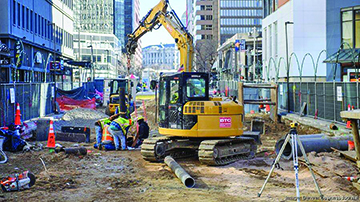
Unexpected Discovery: A historic brick sewer discovered beneath Denver’s 16th Street contributed to construction delays and an $18 million settlement with PCL Construction Services. Denver auditors found the sewer had not been adequately considered during planning for the massive downtown renovation. Photo courtesy of PCL Construction.
A historic brick sewer buried beneath Denver’s 16th Street added $18 million in unexpected costs and nearly a year to the downtown corridor’s massive renovation project, according to a new audit that also raises questions about City Council oversight and the city’s handling of the construction contract.
Denver Auditor Timothy M. O’Brien’s office found that the discovery ultimately resulted in an $18 million settlement with contractor PCL Construction Services and extended the project schedule by 301 calendar days.
But the sewer itself was only part of the problem identified by auditors.
The audit found that contract changes involving millions of dollars took effect before the Denver City Council was notified. Auditors also raised concerns about the Department of Transportation & Infrastructure’s competitive bidding process, its oversight of subcontractors, and its enforcement of contract provisions.
Denver City Council initially approved $149 million in renovation costs for the 16th Street project in 2021.
What Was Under The Street?
The trouble began in 2022 when PCL crews encountered a brick sewer beneath 16th Street, bringing construction to a halt.
According to the audit, the city had con- ducted an environmental assessment as part of the federally funded project, but had not adequately investigated the sewer system during project planning.
Transportation & Infrastructure limited its investigation of underground utilities after consultants advised that a more extensive examination would require removing pavers and rerouting shuttle service.
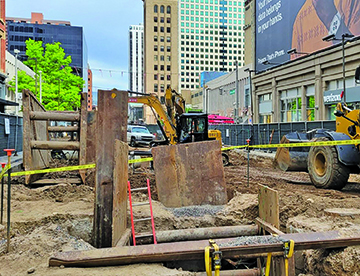
Long Road To Completion: Construction crews work along Denver’s 16th Street during the multi-year renovation of the downtown corridor. The discovery of an underground brick sewer extended the project schedule by 301 days, according to the Denver Auditor’s Office.
Complicating matters, Denver does not have a comprehensive map showing the location of all of the city’s historic brick sewers.
The potential for problems involving brick sewers was also not disclosed when the city solicited proposals from contractors, according to the audit.
PCL subsequently sought changes to its contract to cover the additional work and delays associated with the sewer. The city initially resisted, maintaining that the contractor had assumed those risks under the agreement.
The dispute eventually resulted in a settlement and an $18 million change order covering additional costs and schedule impacts.
“Because the city did not consider the sewer while planning the 16th Street Improvement Project, businesses on 16th Street had construction lingering outside their doors for nearly a year longer than expected,” O’Brien said.
The audit did not examine the economic impact of the prolonged construction on businesses along the corridor.
Council Left Out Of The Process
Auditors also questioned how such a significant financial change could occur without prior City Council approval.
According to the audit, council members were not notified about the increased costs and delays until after the changes between the city and PCL had already taken effect.
The City Attorney’s Office maintained that council approval was unnecessary because the agreement was handled as a “change order” rather than an amendment to the contract.
Transportation & Infrastructure said City Attorney guidance recommends change orders for changes involving scope, time, or budget unless the alteration represents a “cardinal change” to the original contract.
The department said the PCL agreement resulted from delays and a contractor dispute rather than a fundamental change in the project’s scope.
O’Brien warned that the distinction could create a loophole allowing expensive changes to major city contracts to escape council scrutiny.
“If there is no mechanism allowing change orders to become amendments, construction projects can continue circumventing City Council review for costly contract alterations,” O’Brien said. “When strong oversight is absent, budget transparency is reduced, and public trust in responsible city spending is lost.”
The Auditor’s Office recommended creating a process under which sufficiently significant change orders could become contract amendments and therefore receive additional review. Transportation & Infrastructure disagreed with the recommendation.
Questions About Bidding
The audit also found problems with the process Denver used to select a contractor.
Auditors said Transportation & Infrastructure did not maintain sufficient documentation to demonstrate a transparent competitive bidding process, making it unclear why PCL was selected over another company.
Three contractors initially participated, but one dropped out after becoming aware of potential utility issues, leaving two bidders.
The audit also criticized the city’s oversight of subcontractors. Transportation & Infrastructure took the position that because its agreement with PCL was a lump-sum contract — with a fixed scope and price — it had limited ability to obtain information about subcontractors.
As a result, auditors said the city has little documentation concerning companies that performed subcontracted work on the project.
$1 Million In Damages Waived
Another finding involved more than $1 million the city could have collected for missed completion deadlines.
According to the audit, Transportation & Infrastructure leaders chose to waive $1.03 million in damages associated with delays because they wanted to support the city’s relationship with PCL.
Auditors recommended stronger documentation of quality-control procedures and contract compliance. The department disagreed with that recommendation as well.
Transportation & Infrastructure did, however, accept several recommendations.
The department agreed to formalize what information about major projects should be provided to the City Council beyond what is legally required. It also agreed to maintain documentation of each step in the competitive bidding process for capital projects and develop a strategy for dealing with unexpected underground discoveries on future federally funded construction projects.
O’Brien said the findings do not mean the city’s overall project management system is ineffective, but they demonstrate areas where additional safeguards are needed.
“Our audit found that— while the city’s project management is generally effective — it can be strengthened,” O’Brien said. “I hope the Department of Transportation & Infrastructure implements our recommendations to make improvements. We will follow up in a later audit to see what they achieve.”
For a project intended to remake one of Denver’s most prominent public spaces, the audit provides a costly reminder that some of the biggest construction problems can be the ones no one sees until the street is torn open.