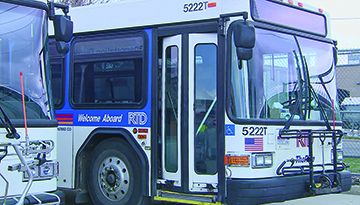
by Valley Gadfly | Aug 22, 2025 | Main Articles
Denver’s RTD Ranked 13th Transit Friendly City; Bus Ridership Booming As Rail Tries To Get On Track
by Glen Richardson
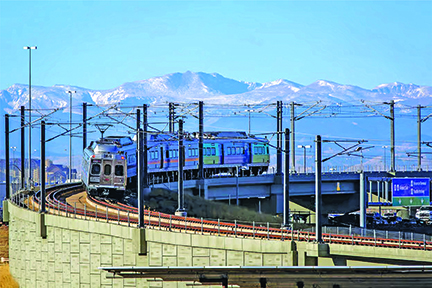
Airport A Line: RTD’s A Line, which opened in 2016, whisks travelers to and from downtown to DIA.
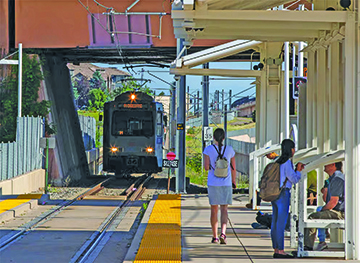
Decline In Rail Rider: A possible signal of waning public confidence in city’s rail system, light rail ridership has dropped 12%.
Denver’s public transportation by bus or rail known as RTD — expected to cost $1.2 billion in 2025 — claims to be “easy, inexpensive, and convenient,” but continues to report serious safety and security challenges.
Despite increased security, better reporting tools, and facility improvements, there were 112 “Criminal Incidents Reports” in May 2025, up from 56 in April.
In May, RTD received 3,058 security-related calls to the dispatch center. During that same month, RTD had approximately 5.4 million customer boardings, or approximately one-security-related call for every 1,800 boardings. That includes everything from graffiti and drug-activity, to noise complaints and unattended bags.
Risky Routes
There continues to be reports of drug use, fights, and threats of violence on RTD trains and buses, particularly on routes along major throughfares. Colfax Avenue, Broadway, and Federal Boulevard are among the highest.
Last year (2024), there were 177 physical assaults and 194 non-physical assaults of the system’s transit workers. Physical assaults were flat at 182. Non-physical assaults, however, jumped to 314. That’s an increase of about 62%, but likely relates to RTD’s efforts to encourage employees to make reports. New federal reporting standards also impacted the numbers.
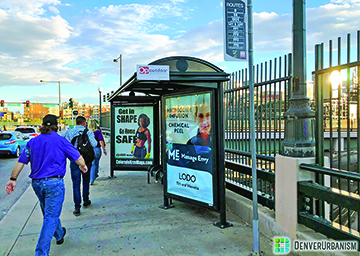
Bus Stop Coverup: Of RTD’s 9,700 public bus stops, less than half have a bench or any form of seating.
During a three-year period — 2022 to 2024 — riders contacted dispatchers for police help a whopping 130,280 times. The highest was in 2023 at 45,847 versus 41,327 in 2022. That figures out to 3,592 “help calls” per month. For security issues riders can contact RTD by phone at 303-299-2911. To text issues use the 303-434-9100 phone number. Better yet, acquire and use RTD’s Transit Watch app so you never ride alone. Those without a smart phone can use the emergency telephones located on “rail platforms” or at bus “Park-n-Rides.”
Bus Boom
RTD’s ridership in 2024 increased by just 1%, from 65.17 million in 2023 to 65.23 in 2024. That’s due to a huge 12% drop in light rail ridership, as customers increasingly relied on the bus system. The system’s bus boardings were 42,689,708 versus rail boardings of 19,493,133.
A key reason for the popularity of buses:
RTD’s bus system exceeded the national average in 16 of 16 comparative service categories. Furthermore, there are over 100 area bus routes, versus 10 rail lines providing 113 miles of rail service.
RTD, however, claims “customer satisfaction” for both bus and rail service. They assert rider satisfaction “with both bus and rail safety and security, cleanliness, on-time performance, plus frequency of service.”
Live-Look Cameras
One of the reasons for the popularity of buses is the “live-look” surveillance camera and response system installed on buses in 2024. Those systems let bus drivers push a silent alarm button to activate surveillance. As a result, RTD dispatchers can see inside and quickly r
Best By Bus: There are more than 100 bus routes in Denver, versus 10 rail lines. Bus system exceeds the national average in 16 categories.
etrieve images for police. State regulators want the system installed on trains by mid-2027.
There are currently 421 weekly bus service stops in Glendale. The closest bus stop to Cherry Creek North is 1st Ave. and Madison St., about a three-minute walk to-from the central district. There are also bus stops at Steele St. and Ellsworth Ave. and at Colorado Blvd. and 3rd Ave., about a 10 minute walk. In addition, the RTD bus fleet provides a slew of special rides. They include services for people with limited mobility, plus free rides for active-duty military.
As bus ridership grows, the system hopes to upgrade more than half of the region’s approximately 4,000 bus stops. Moreover, RTD wants to double the bus service in the city’s core areas. Another goal is to more than double the number of frequent bus routes that run every 15 minutes or less. That would jump the number of miles of frequent bus service from 490 miles to 1,139 miles.
Union Station U-Turn
Once known for crime and open drug use, Denver’s Union Station — the terminal had a $11 million restoration in 2024 — has made a dramatic turnaround. Overall, RTD says there has been a 52% drop in security calls between February 2024 and February of this year.
The about-face for the beaux arts-style transportation hub is good news for both travelers and the city of Denver. Union Station incorporates light rail and commuter rail lines, Amtrak rail service, plus regional buses, taxis, and shuttles. The site features an eight-track commuter rail station, plus a 22-bay underground bus facility.
Today Union Station is once again the city’s destination for LoDo events ranging from live music, and local festivals, to farmer’s markets. It also features cool places to eat and drink, including restaurants Ultreia, The Kitchen Next Door, Mercantile Dining & Provisios, and Snooze.
Budget Upswings
RTD’s budget is expected to jump 4.2% in 2025. Fares will only provide about 4% of RTD’s total budget. Sales and use tax revenue comprises 67% of the budget, with the remaining 29% coming from grants and other revenue sources.
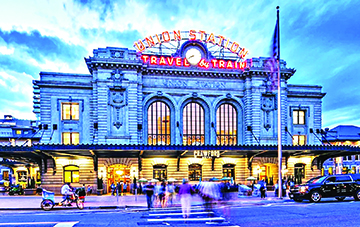
Hub & Great Hall: Denver’s rail and bus hub, Union Station features towering ceilings, elegant archways, and glittering chandeliers.
Grant revenue looks likely to be lower this year due to the $150 million pass-through grant received for the East Colfax Bus Rapid Transit Project in 2024.
Increase in the agency’s 2025 budget is due to year-over-year increases in salaries, wages and benefits, materials and supplies, and purchased transportation.
Rail Rebuild
This year (2025), RTD resumed its multi-phased “Downtown Rail Reconstruction Project,” while also adding to its Transit Police Department.
Between May and August, RTD completed the first phase of its downtown rail reconstruction. Workers restored the 30-year-old portion of the agency’s original light rail alignment to protect the network’s long-term integrity. Moreover, crews completed the work weeks ahead of schedule. Additional phases are planned through this fall-winter.
The system is also launching an updated operational analysis. That update is designed to create new standards for transit service.
by Mark Smiley | Aug 22, 2025 | Main Articles
by Mark Smiley

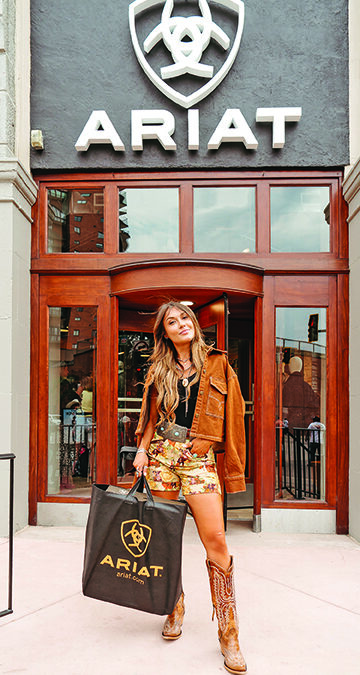
New Store: The new Ariat Brand Shop is located in Larimer Square in the heart of downtown Denver.
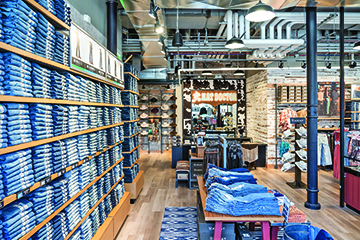
Jeans: The selection of jeans in store in extensive. Photo Credit: Meghan Develyn
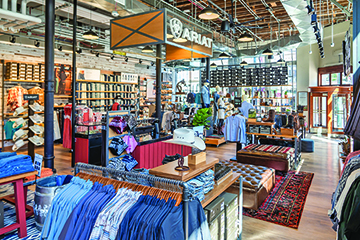
Western Wear: The Ariat Brand Shop features Ariat’s well-known performance western wear — boots, apparel, and accessories. Photo Credit: Meghan Develyn
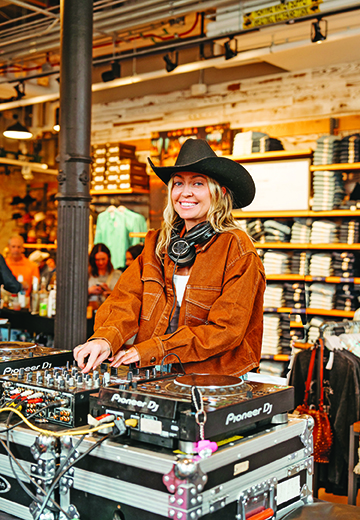
DJ: Brandi Cyrus was the DJ at the grand opening of the new Ariat store in Larimer Square on August 16, 2025. Cyrus is an American actor, singer, fashion blogger, DJ, and co-host of a television series and podcast.
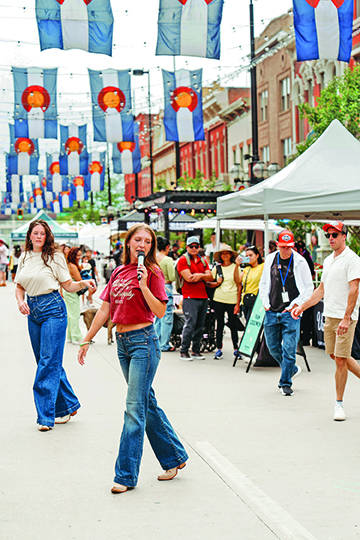
Line Dancing: Belles and Boots, located at 1930 Blake Street in Denver, conducted line dancing classes in Larimer Square during the grand opening of the new Ariat store. Belles & Boots is a high-energy country bar and restaurant with BBQ, line dancing, mechanical bull riding, bottle service, live bands, and a live DJ.
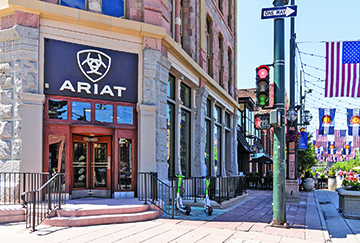 The Ariat Brand Shop, Ariat’s first standalone store in Colorado, opened at 1460 Larimer Street on June 30, nestled in the heart of historic Larimer Square in downtown Denver. The new store aligns with Ariat’s ongoing retail expansion strategy and taps into Denver’s unique intersection of Western culture and urban energy. The 3,945-square-foot space offers Ariat’s full Western lifestyle assortment and immersive services like expert boot fittings and custom hat shaping via its in-store Hat Doctor experience.
The store celebrated its grand opening on August 16, 2025, featuring cold drinks, DJ Brandi Cyrus, line dancing in Larimer Square, custom koozie branding, and free jeans for the first 50 guests. Ariat partnered with Belles and Boots, a local country bar and restaurant for line dancing lessons.
The store features Ariat’s well-known performance western wear — boots, apparel, and accessories. One standout feature of the new Denver store is the custom hat bar (“The Hat Doctor”), where you can craft your own cowboy hat with personalized shapes, trims, bands, and feathers.
Also of note, is the extensive selection of jeans to choose from in store. Ariat is renowned for combining Western heritage with modern performance. Their jeans are made for both rugged work scenarios and everyday wear, often incorporating advanced fabrics like DuraStretch for added comfort and mobility.
Hours of Operation for the Ariat Brand Shop are Monday–Thursday: 10 a.m. to 7 p.m., Friday–Saturday: 10 a.m. to 9 p.m., and Sunday: 11 a.m. to 6 p.m. For more information, visit www.ariat.com.
Photo Credit: Ariat International

by Jessica Hughes | Jul 24, 2025 | Main Articles
by Jessica Hughes
New gathering areas were added to the pedestrian corridor to encourage a social atmosphere.
The 16th Street Mall gets a revamp and rebrand as part of a $175 million project. But as the project nears its completion, will this much-needed makeover resurrect a once “ghost town” in the middle of the Mile High City?
Since roughly 2019, the 16th Street Mall has developed a reputation for crime, high rent prices, and dwindling crowds, becoming a shadow of its former self. What was once a bustling pedestrian promenade lined with packed restaurants and steady foot traffic had turned quiet — abandoned storefronts, growing concerns over safety, and a pandemic-era slowdown left locals and tourists alike steering clear.
Now, the Mile High City is betting big with a $175 million renovation and rebranding project to bring the street back to life. As the extensive renovation project nears completion this fall, the city isn’t just rebuilding a street — it’s rebranding it, hoping to shift perceptions, welcome back businesses, and offer Denverites a public space they can safely enjoy.
The project, which broke ground in April 2022, spans from Market Street to Broadway on 16th Street, with the full project set to complete this fall. The city’s hope is that the reimagined space will show off 16th Street as a hub for live music, outdoor recreation, sports culture, sidewalk sales, and more.
Britt Diehl, Senior Director of External Affairs and Marketing at the Downtown Denver Partnership (DDP), says it’s all about creating an experience. “Highlights of the renovations include an installation of new granite pavers in a similar rattlesnake design by renowned architect I.M. Pei to what was previously on the corridor, but with better drainage and greater surface friction to improve pedestrian safety,” says Diehl. “Plus, moving transit lanes to the center of 16th, eliminating the median that runs between the buses on some blocks and creating wider pedestrian walkways and new amenity zones for leisure, commerce, entertainment, and tourism. And expanding the number of trees on 16th from about 150 today to more than 200 at completion with a variety of species offering varying degrees of shade and color throughout the year.”
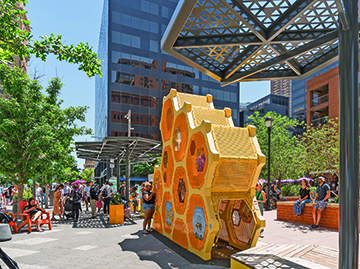
A beehive climbing structure, between Larimer and Lawrence, is just one of many new additions to 16th Street’s upgrade.
Other improvements meant to foster a sense of community and updated public gathering spaces also include more than 20 new patios installed near 16th Street businesses. Plus, new experiences and family-friendly amenities including the Howdy Trouty — three “climbable” trout, including one donning a western “troutfit!,” a beehive-themed children’s climbing structure, and many other interactive and artful installations.
“These are little moments of joy,” Diehl says — small but meaningful invitations for people to engage, linger, and play.
But 16th Street’s revival isn’t just about its looks. At its core is a full-scale identity reset, which includes a new name. “The Downtown Denver Partnership, in partnership with the City & County of Denver and the 16th Street Mall project team, announced last summer the appointment of DNCO, a renowned international place branding agency, to lead the repositioning of Denver’s iconic 16th Street Mall,” says Diehl. “The repositioning work introduces a new visual identity to usher the space into its next chapter. Part of the work to positively rebrand 16th Street involved creating a new message and visual identity to highlight 16th Street’s distinct sense of place.”
In a deliberate departure from its original “mall” branding when it opened in 1982, the city has now dropped the antiquated term and is now simply 16th Street or what Diehl says is now “The Denver Way.”
“With the concept, ‘The Denver Way,’ it’s about experiencing what our city has to offer and embracing openness, originality, and uniqueness,” says Diehl. “This repositioning work — from the mark honoring street signs and downtown murals to a color palette inspired by Colorado’s natural landscape, to icons illustrated by local artist YAMZ (Brayan Montes) — has been crafted to capture our city’s spirit and provide everyone a platform to experience this world-class public space, The Denver Way.” In the immediate term, windows of vacant retail spaces have come alive with three-dimensional installations inspired by “The Denver Way” designed by local creative agency Cultivator.
Yet even as new life returns to the corridor, it’s still easy to find empty offices and storefronts along the street as a result of increased rent prices, crime, and business closures during construction and the pandemic. Restaurateur Lon Symensma, chef and owner of ChoLon Restaurant Concepts, closed two of his restaurants along the street, including the short-lived Bistro LeRoux and most recently YumCha, which later reopened as the YumCha Beer Garden in Central Park. While other businesses, like Trompeau Bakery, whose second location on 16th Street struggled, hung on, and remain open for business. To help, Deihl says the Downtown Denver Partnership and Denver Economic Development (DEDO) have been co-leading a retail recruitment strategy to fill ground-floor vacancies, an effort that will continue in years to come.
But none of this really matters if these changes don’t translate to a safer street. So, in April this year Mayor Mike Johnston announced a new downtown safety plan. In conjunction with the DDP, the plan involves a newly formed 10-officer unit for downtown and a kiosk at the corner of 16th and Arapahoe Streets for Denver Police officers.
Will all these changes make a difference? Only time will tell.
Work on 10 of its 13 blocks has been completed, with plans to complete the remaining blocks this fall. And with nearly $2 million from the Denver City Council, the DDP will open additional play areas, fund public art, and schedule musical acts. And for the remainder of the summer, the Downtown Denver Partnership has planned 90+ days of activities and events along 16th Street that include live music, vendor markets, and hosting the Skyline Beer Garden at 16th and Arapahoe this summer and will continue to bring art, music, and other “surprises and delights” to the space year-round.
Crime Challenge
The corridor, of course, became known for public drug use, homelessness, and at times violence. Police now focus on keeping the street safe by using a 10-member team of bicycle and horse-mounted officers. They now parole the strip between 14th and 18th street, from Union Station to Broadway.
Stabbing along the strip in January — prior to reopening of 16th Street — made city officials and the Denver Partnership uneasy. Denver Police Chief Ron Thomas and Mayor Mike Johnston said they were committed to increasing the number of police patrols and police presence. Thomas said more officers were being added to the department’s District 6. He suggested the department had also added additional uncommitted resources that would be used to “provide an extra layer of safety.”
Between 2020 and 2024 the strip saw 464 aggravated assaults, five murders, and 203 robbery reports. Violent property and drug crimes on 16th Street, however, dipped in 2024, according to police records. Furthermore, it was the lowest number of property crimes in the last 10 years. For the balance of this year and into 2026, the best crime will be the crime that was prevented.
by Mark Smiley | Jul 24, 2025 | Main Articles
Glendale Brewery Wins 3 Gold Medals, 1 Silver Medal And 1 Bronze Medal
by Mark Smiley
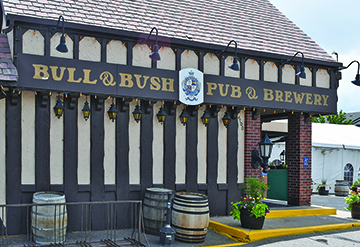
The Bull & Bush Brewery has been named the 2025 Grand National Champion at the U.S. Open Beer Championship.
The Bull & Bush Brewery, a Glendale landmark since 1971, has been named the 2025 Grand National Champion, taking home 3 gold medals, 1 silver medal, 1 bronze medal, and Brewery of the Year (1,001-2,000 Barrels), at this year’s prestigious national beer competition.
Gold medals were awarded to the brewery’s standout creations:
- Royal Oil
- Pimp My Rye
- Nappy Nap Time
 Two additional medals further cemented Bull & Bush Brewery’s reputation as one of America’s top craft breweries:
- Hucklesherry Hounds (Silver)
- Ghoul Fuel: Rum Diaries Edition (Bronze)
“This is an incredible honor for our team and a reflection of the passion we put into every pint,” said Erik Peterson, Minister of Progress at Bull & Bush Brewery. “Our mission has always been to create beers that are as memorable as the moments our guests share in our pub. Winning the Grand National Champion title reinforces our commitment to quality and innovation.”
Head Brewer Gabe Moline added:
“We love making beer and spreading cheer. Winning awards is the extra foam on top of a pint of beer. We’re lucky to do what we love every day.”
Founded in 1971, Bull & Bush Brewery is more than a brewery — it’s a family-owned English-style pub that has become a beloved part of Denver’s cultural fabric. Known for its award-winning, hand-crafted beers, Bull & Bush Brewery also offers a cozy, welcoming atmosphere that has drawn generations of locals and visitors alike.
by Heather Brecl | Jul 24, 2025 | Main Articles
by Heather Brecl
A growing group of residents in Cherry Creek North (CCN) is voicing strong opposition to a proposed General Improvement District (GID) that would impose a new mill levy on local homeowners. While the initiative is framed as a way to fund neighborhood enhancements, many residents argue it lacks transparency, introduces unnecessary financial risks, and does not reflect their needs or desires.
City’s Perspective vs. Community Reality
According to Councilwoman Amanda Sawyer — who represents Denver’s District 5, which includes Cherry Creek North:
“It is entirely up to the community if they would like to create a GID and, if so, what the cost structure of the GID would be, what the governance structure would look like, and what investments they would like to fund and implement.
A GID was first contemplated in the 2012 Cherry Creek Area Plan, which is a document born out of several years of community conversation. Over the past two years, Cherry Creek residents have expressed a desire for things that the City will not fund — such as security patrols, pedestrian-scale lighting, a neighborhood transit circulator, and beautification features. A GID is the best tool to achieve those goals, but only if residents want it. The Council Office is simply facilitating the conversation.”
However, many CCN homeowners say these statements do not reflect their experience with the process. Instead of inclusive, transparent community dialogue, they describe a rollout that has felt top-down, vague, and rushed.
Flawed Outreach And A Lack Of Transparency
The GID initiative first came to light for many residents through a postcard survey — one that numerous neighbors have described as deeply flawed. While the survey asked about preferences for amenities, it failed to clearly disclose that all improvements would be funded through a new residential property tax.
“There was no upfront question that said, ‘Do you want a permanent tax to pay for these things?’” said homeowner Dana Busch, one of more than 100 CCN residents voicing concerns. “It felt more like a marketing exercise than an effort to genuinely understand the community.”
The survey was also not restricted to verified voters or property owners within the proposed GID boundaries. It could be taken multiple times and shared broadly, with no identity verification. Councilmember Sawyer’s office promoted it via her District 5 platform — even though her district extends far beyond the proposed GID footprint. This has raised questions about the integrity of the data collected and who the survey responses actually represent.
Inclusion Without Consent
Residents were particularly surprised to learn that Cherry Creek North’s residential core — bounded roughly by University Boulevard to Colorado Boulevard, 6th Avenue to 1st Avenue, and between Adams and Steele from 3rd to 6th — was included in the GID proposal without prior input or notification. Many feel blindsided by the initiative and argue that the commercial and residential zones are fundamentally different in both needs and character.
“We were never asked if we wanted to be part of this,” said Busch. “Now we’re being told we may be taxed to support projects that don’t directly benefit our neighborhood.”
Opponents are also concerned that, under current rules, the GID could be approved by voters who don’t live in the residential blocks most affected. There was no verification system in the survey to confirm that respondents had a legal stake in the outcome, further eroding trust in the process.
Unclear Use Of Funds
Residents have repeatedly asked for clarity: What specific projects would be funded? What would the cost be per household? How would spending be allocated across zones? So far, there have been no detailed answers. Instead, responses have suggested that details would be worked out after the GID is formed.
“The answer we’re hearing is basically, ‘Pass it first, then we’ll figure it out,’” said one neighbor. “That’s not how responsible planning works.”
There’s also concern that the GID could be used to issue bonds or take on long-term debt. Given Denver’s current financial challenges, some residents believe this may be a workaround to shift infrastructure costs onto neighborhoods without broader public oversight.
Neighborhood Board Concerns And Leadership Conflict
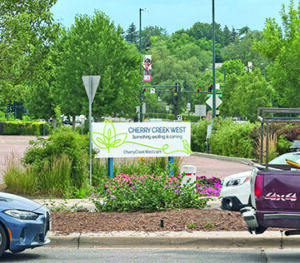
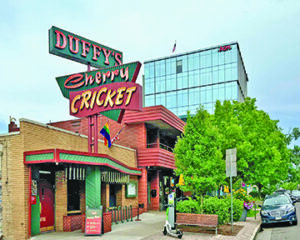
Why should long-established Cherry Creek North be taxed to support major developments like Cherry Creek West? Residents say: It’s not our responsibility and propose being excluded from the GID.
Efforts to raise concerns at the neighborhood level have also proven difficult. Residents say their requests for public forums have been declined or redirected to websites and Facebook pages. This limited access to real-time dialogue has left many feeling excluded from decisions that could impact their property taxes for decades.
Some residents have also pointed to potential conflicts of interest involving two members of the neighborhood association board — both of whom sit on the GID steering committee. In a recent meeting, one committee member reportedly acknowledged the limitations of the survey, noting it might not yield meaningful insights. Despite this, the process appears to be moving forward without pause.
Mismatch Between Neighborhood Needs And GID Goals
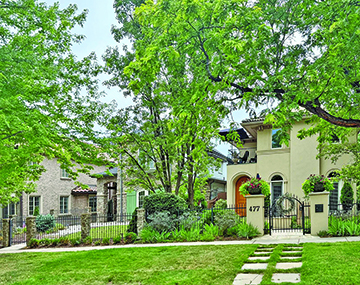
Well-established, well-loved, and well-maintained — Cherry Creek North residents are pushing back against a GID they didn’t ask for and don’t need.
Residents of CCN stress that their low-density, residential neighborhood is not comparable to the high-density, mixed-use commercial zones elsewhere in the GID boundary. Most say they do not require major capital improvements and could handle smaller projects — like sidewalk repairs, lighting upgrades, or landscaping — through existing mechanisms.
Wayne New, former Denver City Councilmember and past president of the Cherry Creek North Homeowners’ Association, shares these concerns:
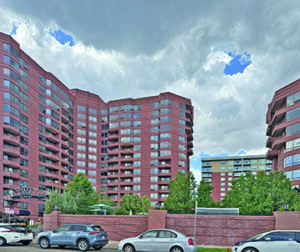
Imagine voting to raise someone else’s taxes — with no responsibility to pay them. That’s the concern CCN homeowners have with the proposed GID process. Under current rules, renters — who won’t pay the tax — can still vote on it. Homeowners are asking for a more equitable and transparent system.
“Without additional communication with all of our residents, this GID will not understand and represent the improvements needed in our neighborhood. To many the mandatory tax increase funding by residents will be pushed forward without clear communication. In addition, the life of the GID may extend for 10 or more years, creating mandatory additional tax revenue without indicating how the funds would be used. Residents paying for services that were previously funded by our City tax dollars is a major concern.”
Preliminary financial reviews suggest that residential tax contributions would significantly outpace any direct benefits returned to the neighborhood. Many believe their dollars would be used to subsidize larger commercial or infrastructure investments elsewhere in the district.
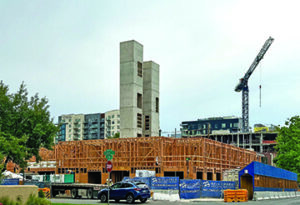
New development, vague plans, and a tax bill for homeowners. The City’s GID proposal raises more questions than answers — especially about where the money goes and who it really helps.
“We’re not against investing in our neighborhood,” added Busch. “We’re just against doing it through a process that lacks clarity and fairness.”
What Residents Are Asking For
The opposition group is not against improvement — but they are asking for a better process. Their main request is simple: remove the Cherry Creek North residential neighborhood from the proposed GID.
“We want to see thoughtful enhancements in our neighborhood too,” said Busch. “But not through a process where our voices are diluted, our questions are unanswered, and the financial implications are uncertain.”
 To stay informed, share concerns, and coordinate local outreach, residents have launched StopTheGIDinCCN.com. The site includes resources, updates, public records, and ways for neighbors to get involved in shaping the future of their community
by Mark Smiley | Jun 20, 2025 | Main Articles
Artists Stop Through Glendale To Promote The Show
by Mark Smiley
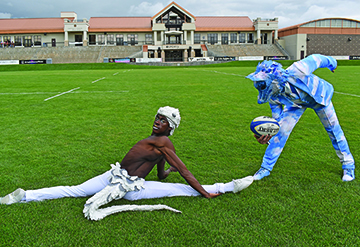
Cirque In Glendale: Henrik Veres (right) and Eddie John Browne visited Glendale’s Infinity Park to promote the upcoming Cirque du Solei show, ECHO. They had fun with a rugby ball on the field and enjoyed learning more about the Village during their visit.
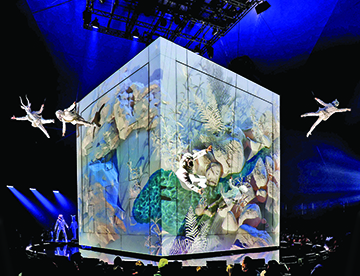 Cirque du Soleil returns to Denver with its latest show, ECHO, a story of connection, intention, and the symbiotic unions between humans and the animal kingdom. The show will be under the big top in the parking lot of Ball Arena from July 12 to August 17, 2025.
Fueled by the power of change, the hope of the youth, and the value of empathy, ECHO follows an inquisitive young woman named FUTURE as she wanders into a fantasy world that explores our sacred bond with animals and nature. When FUTURE and her best friend, the DOG, encounter a mysterious CUBE, they quickly learn how their actions have the power to shape this world, and if we come together, we can rebuild our planet to create the world we all want to live in.
Henrik Veres is a 6th generation circus performer from Hungary. He is performing the role of EWAI the aforementioned Dog in the show and has been with Cirque for seven years. This role is different for Veres as much of the show, he wears a mask. “Throughout this whole show having, my face covered with the mask, I really had to learn different ways of communicating, with the audience and communicating my emotions,” said Veres. “When I pull the mask off and reveal my face is when I feel like I can really just go full out and do what I’m the best at, my juggling number.”
Veres started juggling at the age of 12, and performed his very first show at age 14. He was been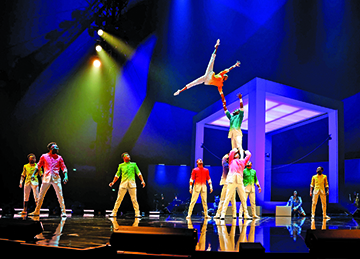 honing his craft and working in circus arts ever since, performing previously with Cirque du Soleil’s CRYSTAL and Cirque du Soleil at Sea. Over the past 15 years, he has performed in over 5,000 shows across the world. A seasoned circus performer, Veres joined ECHO a few months ago, as a juggling act and one of two artists, a principal role on the show.
Eddie John Browne’s path to the world-renowned Cirque du Soleil bega n in Sierra Leone, where he grew up and discovered a passion for movement and performance. Eddie was honing his flexibility and control from a young age.
Specializing in dislocation and contortion, Browne masters the art of bending and twisting the human body in extraordinary ways. These disciplines require not only physical prowess but also immense dedication and resilience.
Cirque du Soleil’s 20th Big Top show brings bold new visuals and a unique aesthetic on tour. Packed with vibrant characters, inspiring music, astounding lights and projections, and never-before-seen acrobatic feats, ECHO invites audiences on a journey through a universe of color, wonder, and infinite possibilities.
For more information or to purchase tickets, visit www.cirquedusoleil.com/echo.