by Jeff Shultz
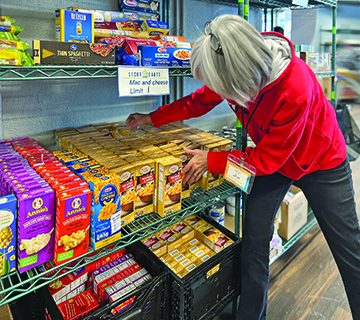
A volunteer at SECORCares works at restocking shelves at the food bank’s Free Food Market, located in Parker. The market serves approximately 450 families per week.
Depending on what side of the aisle you sit on, the bill known as “One Big Beautiful Bill” is either good for Colorado or will have a negative impact on the state. According to the House Ways and Means Office the bill will help families across the nation, including Colorado.
The typical family will get up to $10,900 in additional take-home pay and workers will see increased wages up to $7,200. According to the House and Ways Means Office, households earning less than $100,000 will benefit from a potential 12 percent tax cut.
However, rural Colorado families may not see all of the benefits of The BBB.
According to The Bell Policy Center, a non-profit group who monitors economic mobility in Colorado, the bill will have a devastating impact on Colorado’s rural communities.
According to BPC, rural areas in Colorado, especially those in southeast Colorado, are some of the poorest in Colorado.
“It’s important to recognize that income is not equally distributed across Colorado,” BPC said.
BPC reports that urban, suburban, and mountain resort communities have high concentrations of upper income families. To pay for the tax cuts in the BBB, according to Bell, the bill makes huge cuts to long-standing social safety net programs such as Medicaid and Supplemental Nutrition Assistance Program (SNAP).
SNAP is an important revenue source for one Douglas County area food bank.
SECORCares is a food bank service that reaches approximately 3,000 families per week through its three free food programs in Arapahoe, Douglas, and Elbert counties.
“At our brick-and-mortar Free Food Market, we currently serve about 450 families each week,” according to Brie Dilley, Executive Director of SECORCares.
“Beyond the Market, we extend our reach through two additional programs: our Mobile Market, which brings food directly into neighborhoods, and Food for Thought, our backpack program providing school-aged children with nutritious food to take home for the weekend,” she said.
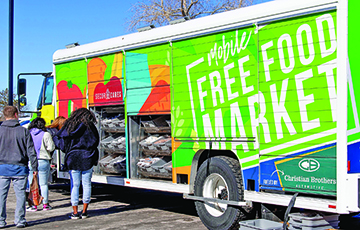
SECOR’s Mobile Market delivers food directly into neighborhoods. SECORCares is a food bank service that reaches approximately 3,000 families per week through its three free food programs in Arapahoe, Douglas, and Elbert counties.
The backpack program is a partnership with 35 schools in the three county region SECOR serves.
Dilley added the proposed changes to programs like SNAP may cause some families to push the panic button. “The greatest impact of these changes is felt by the people we serve. Reductions in social safety nets often push families from ‘barely scraping by’ into full-blown crisis.”
“Unfortunately, reducing and/or complicating SNAP benefits does not diminish food insecurity, it shifts the burden from the government to the nonprofit sector,” Dilley added.
Proposed changes to such programs are coming at a bad time for SECOR, as the demand for SECOR’s services has increased over the past three years.
Dilley said between 2022 and 2023 SECOR experienced a 200 percent increase in helping area families.
“We attribute this dramatic rise to the trifecta of inflation and economic instability, the Denver-area migrant crisis, and the end of COVID-19 emergency allotments,” she said
Dilley added that the demand has remained so high it has forced SECOR to place a cap on its services.
“While it’s difficult to project exactly how many more families we would serve if we expanded appointment slots, our best estimate is an increase to around 600 families each week in our Free Food Market — about 150 more than we currently serve,” she said.
Sadly, SECOR is seeing a troubling trend, Dilley added.
“We are also seeing a growing number of returning guests — families who had once relied on us, found stability for a few years, and are now back.”
Dilley said SECOR welcomes them back with “open arms” but their stories are heartbreaking.
“Many believed they had reached steady ground, only to find that stability wasn’t quite enough to withstand today’s economic challenges,” she said.
SECOR is primarily dependent on private donors and local grocers through SECOR’s grocery rescue program.
According to Dilley, both sources provided more than 1.2 million pounds of food for guests last year. “Sadly, we are now seeing a decline in both of these critical areas. Grocery rescue donations are down significantly, and we’re hearing from more and more donors who — because of the same economic pressures our guests face — must scale back their giving,” Dilley said.
“One of our favorite stories to share has always been about former guests becoming donors. Unfortunately, in this season, we are also seeing the reverse.”
For more information on SECOR visit www.secorcares.com.
Photos courtesy of SECORCares