After months of grassroots pressure, Cherry Creek North neighbors stop Denver City Hall’s and Councilwoman Amanda Sawyer’s attempt to create a new tax district — and set a new standard for local government accountability.
by Heather Prochnow Brecl
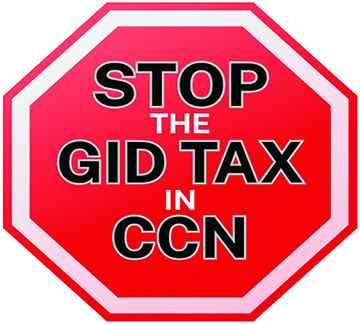
Signage: Grassroots campaign signage became a unifying symbol across Cherry Creek North, as residents rallied under the “Stop the GID Tax in CCN” movement to oppose the proposed district.
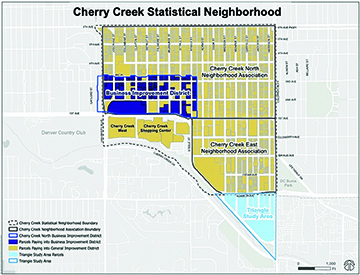
Map: A City of Denver map showing the Cherry Creek Statistical Neighborhood and proposed General Improvement District (GID) boundaries. The highlighted areas include the existing Business Improvement District (BID), Cherry Creek North and East Neighborhood Associations, and the “Triangle Study Area” south of 1st Avenue.
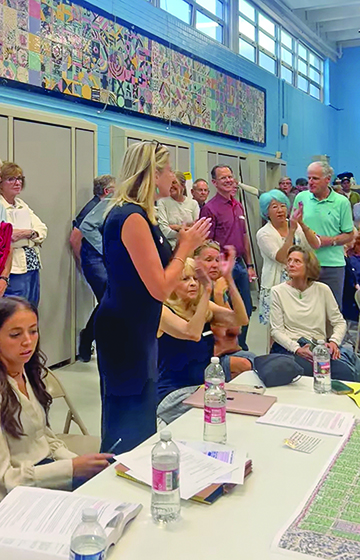
Enraged Citizens: Neighbors packed the Bromwell Elementary School meeting hall in September to demand answers about the proposed Cherry Creek North GID. Jamie Geillis responded to agitated attendees declaring that the City will no longer pursue the GID in Cherry Creek.

Bitter Defeat: Councilwoman Amanda Sawyer attacked her constituents following the defeat of the Cherry Creek North GID accusing them of “vitriol” and “intentional sharing of misinformation.”
Cherry Creek North residents have done what few neighborhoods manage to achieve — they held their local government accountable and won.
After months of organizing, petitioning, and pushing for answers, homeowners successfully defeated the City of Denver’s plan to form a General Improvement District (GID) — a proposal that would have imposed a new property tax on the neighborhood in the name of “enhancement projects.”
For now, the GID is officially off the table.
“Citizens will participate — but they expect honesty,” said Dana Busch, Cherry Creek North Resident.
Grassroots Unity Turned The Tide
What began as confusion over a postcard survey evolved into one of the most effective neighborhood movements Denver has seen in years.
After an initial article exposed flaws in the process, residents launched www.StopTheGIDinCCN.com to inform their community, share documents, track meetings, and mobilize volunteers.
Soon, yard signs lined every block, and door-to-door canvassing gathered more than 1,500 signatures opposing the tax. Standing-room-only meetings at Bromwell Elementary School drew hundreds of concerned neighbors demanding transparency.
Local media coverage followed, amplifying the message that the community was united, engaged, and watching closely.
September Showdown: Residents Demand Answers
The movement’s momentum peaked in two pivotal September meetings.
On September 9, residents dissected the GID’s legal structure, boundaries, and funding mechanisms — revealing that the City’s survey lacked residency verification and never disclosed that proposed projects would be funded through a permanent property tax.
At the September 16 meeting, Jamie Giellis, representing Councilwoman Amanda Sawyer’s office, addressed an agitated crowd and formally conceded that Cherry Creek North would be removed from consideration for the proposed GID. Giellis acknowledged the overwhelming opposition and confirmed that the City would not move forward with the plan in this area.
Councilwoman Sawyer’s
Formal Concession
The following day, September 17, 2025, Councilwoman Amanda Sawyer issued a formal statement confirming the decision:
“Last night officially ended the exploration and engagement effort to form a GID for the Cherry Creek North neighborhood,” Sawyer wrote.
“While we always welcome open dialogue and encourage all voices to be heard, it has been discouraging to see how misinformation and divisive rhetoric overshadowed what was intended to be a constructive community conversation.”
Her letter closed by noting that the City would continue to explore similar districts in other parts of the Cherry Creek study area — a tone that, to many residents, underscored the problem: City officials were still deflecting responsibility rather than acknowledging missteps in communication and transparency.
Why Residents Were Outraged
At the center of the conflict was what neighbors called a “weaponized survey.”
The City’s online questionnaire invited feedback on amenities such as lighting, landscaping, and safety patrols — but never asked the most basic question: Do you want a new tax to pay for these things?
Because anyone could take the survey — even those living outside the proposed district — residents questioned its legitimacy. Many felt it was designed to create a false narrative of support rather than
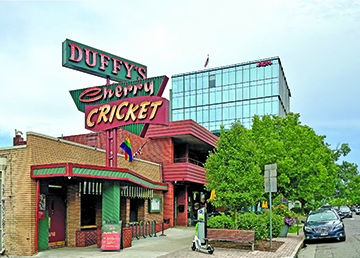
Cherry Cricket: The Cherry Cricket, a Cherry Creek North institution since 1945, sits near the heart of the area once targeted for the proposed GID — an emblem of the neighborhood’s mix of tradition, independence, and local pride.
collect meaningful feedback.
“This was about standing up when government oversteps,” added Busch.
Neighborhood Association:
“It’s Time To Heal”
Following the decision, the Cherry Creek North Neighborhood Association (CCNNA) issued a statement:
“The General Improvement District discussions are OVER; there will be no GID in the Cherry Creek area. A GID is simply a tool to address issues that residents want to fund. Currently, the majority of residents don’t feel that the scale of the problems warrants establishment of a GID in CCN.
The issues surrounding the GID formation discussions were complicated and led to deep wounds in our neighborhood that we would like to help heal.”
That healing, residents say, begins with rebuilding trust — not only within Cherry Creek North, but also between the neighborhood and City Hall.
A Broader Call For Reform
The defeat of the GID represents more than a neighborhood victory — it’s a lesson in civic accountability.
Residents are now calling for reforms in how Denver initiates and communicates potential improvement districts, including verified surveys, full financial transparency, and clear disclosures before any tax proposal moves forward.
The experience also raised broader questions about how public officials interpret “engagement.” For many in Cherry Creek North, the City’s version of outreach felt more like persuasion than participation.
“Government should never forget that it serves the people — not the other way around,” said Busch.
The Larger Lesson:
Power In Participation
The Cherry Creek North movement has become a model for how citizens can challenge opaque government processes through persistence and collaboration.
Their campaign — built on open dialogue, data gathering, and neighbor-to-neighbor engagement — proved that local democracy still works when residents get involved. The fight connected neighbors who had never met, empowered volunteers to learn city policy, and reminded everyone that complex bureaucratic actions can be stopped through collective action.
Now, neighbors are discussing next steps — how to stay engaged, promote transparency, and ensure future proposals begin with genuine community input.
The Legacy Of The Movement
What began as opposition to a single proposal has reshaped Cherry Creek North’s civic identity. The neighborhood discovered its collective strength and proved that engaged citizens can stop bad policy in its tracks. The newly bonded community of residents plans to stay engaged and stay strong in their resolve to protect the neighborhood they love.
While Denver leaders may revisit similar proposals elsewhere, residents of Cherry Creek North have established a precedent: informed, organized communities can — and will — demand accountability.
The GID is gone, but its legacy endures — a reminder that transparency, consent, and communication are the cornerstones of good governance.
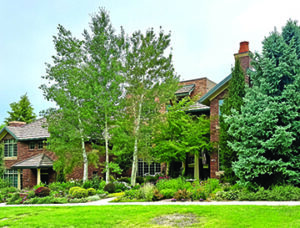
Tree-lined Street: Tree-lined streets and architecturally distinctive homes define Cherry Creek North — a neighborhood where residents take deep pride in preserving the character and quality of the place they call home.