by Charles C. Bonniwell

Ball Arena: The ownership of the Colorado Avalanche is taking 55 acres of surface parking and redeveloping it into a new urban neighborhood that would adjoin the River Mile project to its east.
The famous 18th-century French philosopher Voltaire is credited with saying: “Where states have an army, the Prussian Army has a state.” While many American cities have professional sports teams, Denver’s sports teams are the only ones to control the development of an entire city.
Virtually the only major development plans on the boards in the City and County of Denver relate to its various dominant professional sports teams — the Denver Broncos (football), the Denver Nuggets (basketball), and the Colorado Avalanche (hockey).
The Development Plans
Denver’s future growth comes from plans submitted by its sports teams:
- Burnham Yards. The Denver Broncos want a new $2 billion retractable-roof stadium that could host events year-round, including Super Bowls. The Broncos’ ownership acquired a 100-plus-acre former railroad site whose development will include massive high-rises that house five to seven million square feet of retail, office, and housing space. Construction is to start this year with a projected opening in 2031.
- The River Mile. The ownership of the Denver Nuggets purchased 62 acres of land along the South Platte River, which presently houses Elitch Gardens Amusement Park. The site will feature thin, very tall skyscrapers that will include: 47% office space (6.65M sq. ft.), 41% residential (5.85M sq. ft.), 5.5% hotel (790K sq. ft.), and 3.5% retail (520K sq. ft.).
- Ball Arena. The ownership of the Colorado Avalanche is taking 55 acres of surface parking and redeveloping it into a new urban neighborhood that would adjoin the River Mile project to its east. The plans call for 10 to 12 million gross square feet of mixed-use development that would include 6,000 housing units and a new concert venue. The first phase of the project is scheduled to be completed by 2033.
One Conglomerate Of Ownership

River Mile: The ownership of the Denver Nuggets purchased 62 acres of land along the South Platte River, which presently houses Elitch Gardens Amusement Park. The site will feature tall skyscrapers. Photo Courtesy of Revesco Properties
When discussing the ownership of professional sports teams in Denver, they are slowly morphing into a single massive conglomerate.
In 2022, the Denver Broncos football team was acquired for $4.65 billion by a syndicate headed by Rob Walton, his daughter Carrie Walton Penner, and her husband Craig Penner. Rob Walton is the son of Sam Walton, a co-founder of Walmart, the world’s largest retailer with corporate headquarters in Arkansas. Rob Walton was the chairman of Walmart, and Craig Penner is the present chairman.
Billionaire Stan Kroenke acquired both the Denver Nuggets and the Colorado Avalanche in 2000. In 1974, he married Ann Walton, the daughter of the other co-founder of Walmart, Bud Walton. The couple, through Kroenke Sports and Entertainment, owns a myriad of professional sports teams throughout the United States and internationally.
Until very recently, the piece of the Denver professional mosaic outside the control of the Walton/Kroenke extended family was the Colorado Rockies, owned by a syndicate headed by former beef processors and brothers Dick and Charlie Monfort. While the Monforts are relatively well off financially, they are not in the billionaire class of the Waltons and the Kroenkes. Apparently without offspring to marry into the Walton or Kroenke families, the Monfort brothers sold a 40% interest in the Rockies to the Broncos’ Walton group. While the Waltons do not presently have a majority share of the Rockies, they are expected to eventually obtain a controlling interest.
A major asset of the Rockies is the acres of surface parking in downtown Denver, which are now also ripe for redevelopment by the sports teams.
Crazy As A Fox?
It is fortunate that Denver’s sports teams seem willing to spend billions on real estate development in Denver, as most experts are not at all sanguine about future development prospects in the city. They wonder how Denver could possibly absorb tens of millions of square feet of new office space and housing in the form of apartments and condominiums.
Downtown Denver office buildings have economically disastrous vacancy rates. Various office buildings are selling for a fraction of what they cost to build. To construct millions of square feet of new office space for which there is no present market appears to be foolhardy.
Similarly, rental rates on apartment space in Denver are dropping precipitously, and there are many new apartment buildings in the development pipeline throughout the city. In addition, condominium sales in downtown and across the city are stagnant at best.
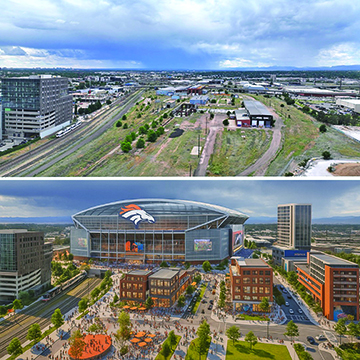
Burnham Yards: The Denver Broncos are proposing a new $2 billion retractable-roof stadium, on the site of the old Burnham Yards, that could host events year-round, including Super Bowls.
Denver’s population is no longer growing, and the business climate in the city and throughout the state is getting steadily worse as the state becomes ever more left-leaning and progressive.
People are fleeing the financial mismanagement of politically blue states such as California, Illinois, and New York, moving to states like Texas, Tennessee, and Florida — and no longer to politically deep-blue states like Colorado.
The Colorado Chamber of Commerce recently wrote to Colorado Governor Jared Polis that a hundred companies have left Colorado due to excessive regulation and other anti-business government practices.
For the Burnham Yards, River Mile, and Ball Arena projects to succeed, they depend on a growing, economically successful Denver and Colorado — unless they are planning to cannibalize from the rest of the city.
But the Walton and Kroenke families did not become billionaires by making poor business decisions. Denver residents can only hope that what they are envisioning happening in Denver in the next decade comes to fruition.