Electric Scooters Were Ridden Nearly 6.8 Million Miles Throughout Denver In 2025
by Glen Richardson
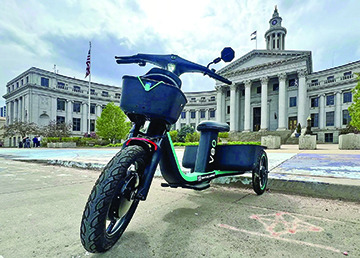
Coming To Town: The Department of Transportation & Infrastructure’s (DOTI) has selected Veo to take over the city’s scooter contract.
Following the Department of Transportation & Infrastructure’s (DOTI) selection of Veo to take over the city’s scooter operations at the end of 2025, Denver City Council — after postponing the vote twice — is expected to finally make a selection this month (May).
Lime and Bird — the two companies currently holding the city’s contract — expires on May 16. Though Veo operates in more than 50 cities, the Denver fleet would be its largest to date. Its biggest market is currently in Washington, D.C., where it has approximately 4,000 vehicles, compared to the 9,000 in Denver.
The city’s shared micro mobility program has grown into one of the largest in the nation since e-scooters arrived on Denver’s streets in 2018.
Ramifications

Reckless Riders: There’s little or no policing of careless and dangerous scooter rider behavior and improper scooter parking.
While the current companies have had success in expanding ridership and running a leading equity program, they’ve failed to address unintended side effects. Despite requests from both the city and residents, their scooters continue to block sidewalks, facilitate illegal riding, and lead to increasingly frequent injuries and deaths.
Lime lets low-income residents ride scooters for free if they receive city, state, or federal subsidies like SNAP and Medicaid. For them the free transportation has been pivotal, allowing them to get to work, school, and appointments without cost. They also bypass public transportation limitations, car traffic, and the maintenance requirements and fear of theft that come with owning personal scooters and bikes.
Lime argues that the smaller micro mobility company is incapable of taking over.
Hands Full Task
“Transitioning this program in May, the highest ridership season of the year, while Veo is engaging with a program here in Denver that is at least twice large as any program they’ve ever run before, they’re going to have their hands full no matter what,” suggests Zach Williams, Lime’s regional head of government relations.
“We just want to make sure that there is sufficient time between the transition to allow for as many people as humanly possible to get moved over.”`
Rentable electric scooters were ridden nearly 6.8 million miles throughout Denver in 2025. That’s the equivalent of scooting around the entire circumference of the Earth more than 270 times.
Lime’s Largest
Denver’s access program is Lime’s largest, according to the company, with around 30,000 people signed up.
Lime is seeking a contract extension of 12- to 18-months to serve as a transitional period, the company says.
“It has helped me get to the births of two of my granddaughters. It has helped me keep a job that I was working after the hours that public transportation, like RTD, is running,” Arenthian Bohannan, a Lime Access rider, testified during a March 18 committee hearing.
Outreach Upsurge
Despite Lime’s concerns that access riders will fall through the cracks, DOTI says the company has refused to assist in transitioning Lime users to Veo’s new access program until the contract is finalized.
“We have specifically asked that the current operators communicate information about the access program transition to their access program users. …Unfortunately, they have chosen not to,” Alaina McWhorter, DOTI’s legislative liaison, said at the April 1 committee meeting.
“DOTI, Veo, and the city can ramp up and expand our outreach and enrollment activities very quickly when this contract gets signed. We have the contingencies and mechanisms in place. …We are not going to rely on our current vendor to do it out of the goodness of their heart.”
Transition
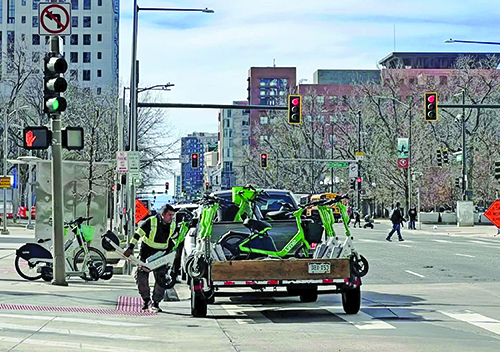
Last Load? Lime, one of the two companies currently holding the city’s contract, argues that the smaller micro mobility company is incapable of taking over.
Veo defends its ability to handle the transition. The current access program averages 7,000 to 8,000 active monthly users, according to the city; over 1,200 users have already pre-enrolled for Veo’s access program.
Residents can use their participation in the current Lime Access program as proof of eligibility to enroll, and Veo will allow a grace period for users to ride for free throughout May without providing proof of eligibility.
“They’re grasping at straws,” Alexander Keating, Veo’s vice president of policy and partnerships, says of Lime and Bird. “Both of those vendors have a track record of, if they feel they can intimidate a city with a lawsuit or a challenge, they will. …Having lost the procurement, they have a lot on the line. They’re going to do what they need to do to try to protect themselves. I’m not super surprised, but I think it’s unfortunate.”
Free Rides
Veo’s proposed access program offers more flexibility for riders, but fewer overall minutes. Currently, Lime Access provides three free rides per day, each lasting up to 30 minutes. That means users can’t make two round-trips.
Veo has agreed to continue providing free rides with its own access pips without paying, even if each trip is only a few minutes long. Veo will offer 60 minutes of free rides per day, with no limit on the number of rides taken; after the 60 minutes, riders will be charged $0.15 per minute, with no unlocking fee.
Lime Access used to provide unlimited free rides in Denver, but the company scaled back the program to just three rides per day in April 2025.
Council Concerns
The debate over the scooter providers has centered on the access program and panicked riders who fear losing an essential means of transportation. That fear has infiltrated Denver City Council, as well.
“I’ve been wrestling really hard with the equity program,” Councilmember Sarah Parady said during the April 1 meeting. “I’m just really, really worried that people are not going to find their way back into the program for a whole variety of reasons. I think Veo has done what can be done on their end; it’s just because of not having an overlap.”
City officials have long raised red flags about Lime and Bird’s operations here.
Denver prohibits riding scooters on sidewalks, riding with multiple passengers and parking scooters in ways that block sidewalks or streets, but all of those behaviors can be observed daily in the city. Despite this, Denver police issued only nine citations for improper scooter use between 2018 and 2024, compared with the over 18.3 million e-scooter trips taken in that timeframe. That has led officials to look to the companies to enforce proper behavior among their riders.
Policing Riders
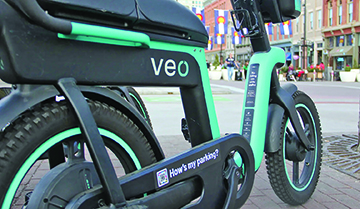
Veo Benefit: Each vehicle has a QR code that reads “How’s my parking?” which passersby can use to report improperly parked vehicles.
“There’s little or no policing of careless and dangerous scooter rider behavior and improper scooter parking,” alleged David Kurth of the Upper Downtown Neighborhood Association during the March 18 committee meeting. Kurth expressed frustration over “the lip service that the current providers — especially Lime — have given to the safety of pedestrians in the downtown area.”
Reckless behavior by riders has dire consequences. Fifteen people have died while riding scooters in Denver since 2018, with over half of those deaths occurring just last year. Denver Health registered 1,868 patient encounters attributed to scooter injuries in 2025. That’s more than five patient encounters each day of the year. And Denver police received 199 reports of scooter-vehicle crashes in 2025.
Veo scooters are fitted with technology to detect unlawful behavior, such as riding on sidewalks or riding with multiple people on board, and the vehicle emits a voice warning if a rider does something wrong. Each vehicle has a QR code that reads “How’s my parking?”, which passersby can use to report improperly parked vehicles. Veo also offers a variety of vehicles with seats and larger wheels than those on standard standing scooters, improving stability for riders.