They Can Capture Audio, Video Images; Denver Police To Use As First Responders
by Glen Richardson
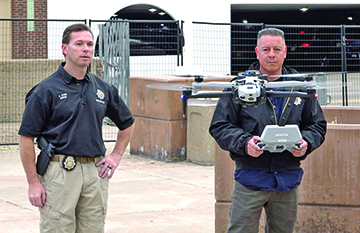
Drone Duo: Denver Police Sgt. Jeremy Cain (left) and Det. Jeremy Casias fly a drone outside of the Cherokee St. headquarters.
Already using Flock license plate cameras at intersections, the Denver Police Department appeared set to launch Flock’s “Aerodome” flying drones by December. Neither Denver nor Colorado regulates how police use drones.
The Denver Police Department has signed a free trial contract with Flock to use the company’s Aerodome flying drones — a “fully automated air support system” — that can reach crime scenes faster than police can often arrive. By deploying a drone to an incident scene ahead of ground units, it can provide real-time information.
Should you call 911, a drone would likely show up before an officer does. That’s especially true if the scene is being managed or secured by officers. Police drones are also used in specific scenarios, such as monitoring large events or providing aerial support in ongoing operations.
First Responders
The Denver Police Department has been exploring the utility of drones as a “First Responder” program. The department wants to improve its capacity to provide public safety services to the Mile High City.
“We saw benefit in these opportunities and have entered into a no-cost contract with Flock for a pilot package to evaluate its program,” according to a department spokesperson. The Denver Police Department is also in contract discussions with other venders to support a pilot program.”
The Flock drones are capable of capturing audio, video images, and other data that will be retained for 30 days. They look similar to consumer drones, with four propellers and a camera unit.
Dashboard Data
According to the contract, recorded images will be subject to Colorado Open Records Act requests. Once the police begin using the drones, the department plans to create a dashboard showing data about drone flights. Drones can be used to search for missing persons, respond to emergencies, document crime and crash scenes, and assist with bomb threats or “high-risk tactical situations,” among other uses. In some cases, they might be used to chase suspects.
In addition to surveillance, police can use drones for monitoring large crowds, assist in search and rescue operations, and gathering evidence. Federal and state laws govern the legality and extent of surveillance use. A warrant is often required for targeted surveillance, but permitting can be crucial in many circumstances, and state laws play a significant role in defining limits.
Thus far, about 65% of drone deployments are to assist in searches for suspects and during investigations. They have also been used in searches for missing people about 12% of the time.
Privacy Concerns
According to information obtained through an open records request by Denverite — Colorado Public Radio’s news website — the most recent contract with Flock will run through next August. If the city likes the product, it would begin to pay for Flock drones starting in 2026.
The company claims the technology makes policing more efficient and safer. However, advocacy groups argue the use of drone first responders — especially connected to a network of license plate readers — raises privacy concerns.
Moreover, the Electronic Frontier Foundation — a non-profit digital rights group based in San Francisco — argues that “integration of Flock’s ALPR technology with its Aerodome drone equipment is a police surveillance combo poised to elevate privacy threats to civilians.”
Sound, Lighting
Homeowners can often identify a police drone by its maneuverability, quieter, higher-pitched sound, and specific lighting. Police drones can make sudden, sharp movements, unlike planes and helicopters.
They often have a single, less-visible anti-collision light compared to the standard flashing lights on manned aircraft. In high-tech situations, police may also be using specialized equipment, and you might see them using a “Drone as First Responder” program, where the drone is deployed to a scene before officers arrive.
Police drones may be equipped with specialized payloads like thermal cameras or high-resolution zoom lenses for specific tasks like crime scene mapping. These programs deploy a drone to an incident scene ahead of ground units to provide real-time information.
Night Identity
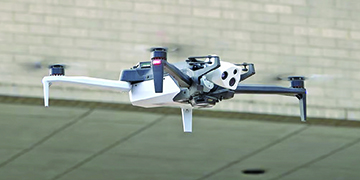
Unmanned Aircraft: Remotely piloted police drones can make sudden, sharp movements, unlike planes and helicopters. Photo: Denver Police Department
At night, surveillance drones can look like moving lights, sometimes with steady white lights or flashing red and green ones. They may also appear as a heat signature to thermal cameras, even in complete darkness.
Drones can be distinguished from stars and planes by their movement patterns. They may hover, move in strange ways, or follow specific, repetitive paths that aircraft cannot.
Some drones can hear conversations, especially through an open window or with specialized equipment, but most standard drones cannot eavesdrop through walls and have difficulty recording clear audio over their own rotor noise. Some commercial drones can record audio. Police or military drones may use advanced directional microphones to listen in, though these are not common.
Data Sharing?

Denver Police Drone: These small, unmanned, weapon-free aircraft support a variety of missions in Denver.
Earlier this year, Denver City Council refused to renew a contract with Flock after members raised concerns about the company’s data-sharing policies. Flock’s CEO came to Denver to lobby lawmakers about the technology.
However, Mayor Mike Johnston’s administration renewed the contract for less than the monetary amount that triggers a council vote, and the council may yet reconsider the larger contract.
Some groups — including the Party for Socialism & Liberation — have been rallying for the city to cut contracts with Flock, citing civil liberties concerns. Supporters, however, say they appreciate how police can use the technology to solve crimes. Arvada police officers recently used Flock cameras to track a stolen car after a carjacking and shooting.