Cherry Creek North Residents Fight Government Overreach
by Heather Prochnow Brecl

Councilwoman Sawyer and GID Consultant Jamie Giellis present the proposed GID to CCN residents.
Cherry Creek North (CCN) residents successfully blocked the proposed General Improvement District (GID) for their neighborhood, keeping it from advancing toward the 2026 ballot. Their victory came after months of mounting opposition and culminated at a late-September meeting with consultant Jamie Giellis, representing Councilwoman Amanda Sawyer’s office, where residents made it clear they would not support the plan with the Cherry Creek North neighborhood in it. Their victory was reported in the Chronicle’s lead story last month, “Citizens Win! Neighbors Halt The Cherry Creek GID Takeover.”
But Giellis’ sudden and unexpected concession at the meeting without even the need to consult with the person who was purportedly heading the effort, Councilwoman Amanda Sawyer, left open many unanswered questions. What was the real genesis of this unwarranted and unwanted GID plan? What persons or entities were really behind the proposed Cherry Creek GID? Who were to be the real beneficiaries of the new GID?
The Official Story

CCN residents and activists Dana Busch, Wayne New, and Greg Jenkins battle to defeat the GID.
The story told to residents in Cherry Creek North by District 5 Councilwoman Amanda Sawyer was that numerous “constituents” had come to her requesting her aid in how to effectuate unspecified improvements in the Cherry Creek area. The story was spun that Swayer then consulted and engaged former Denver mayoral candidate and special district expert Jamie Giellis of Centro, Inc. to see what could be done to assist the constituents in their desire to improve the Cherry Creek area.
Councilwoman Sawyer went to Denver City Council and was awarded $15,000 to pay for a “feasibility study” regarding forming a General Improvement District for the entire Cherry Creek Statistical Area running from 6th Avenue to the North, Cherry Creek to the South, University Boulevard to the west, and Colorado Boulevard to the east. It is an unusually large GID with residential areas of Cherry Creek North and Cherry Creek East (containing 9,500 residents), the Cherry Creek Mall, and the Cherry Creek North Business Improvement District.
Neighborhood Disbelief
Sawyer’s initial problem was that no one believed her, or Giellis. The residents included in the Cherry Creek GID are many highly sophisticated individuals who know how government actually works and the feel-good cover stories, such as those being peddled by Sawyer and Giellis, are seldom the true motivations behind a project.
Cherry Creek resident Frank Ooms and other residents believe that the special districts like the Cherry Creek GID were examples of gross overstepping by the Denver City government and its complete lack of fiscal responsibility and policy. Ooms emphatically stated that the proposed GID was “a quick money grab for the City to raise funds for carrying out their own agenda for what they determine are needed improvements rather than actually representing the needs or wishes of Cherry Creek residents.”
By statute, a GID is supposed to be initiated by residents according to their needs as it is in essence an additional self-imposed expense on top of property/co mm
mm
ercial taxes they owe each year. Ooms, an architectural photographer for commercial projects and resident of Cherry Creek North, in tandem with other CCN residents, stood firmly in their position that the GID that Sawyer and the City were pushing did not represent the wishes of the majority of residents and was instead a front for picking the pockets of residents who live in well-established upper-class neighborhood.
Dana Busch, a vocal CCN resident and leader in the efforts to stop the GID, stated that “the residents of CCN are outraged that the City would try and impose these additional funds and that it is an excuse used to compensate for the City’s gross overstepping of government and complete mismanagement of funds.” She continued, saying that “the City of Denver so grossly mis prioritized and mismanaged their finances and policies that they attempted to use the residents of CCN to fix their budget problems and serve their own agenda further increasing the City’s debt and more problems, not to mention violating due process with a complete lack of transparency.”
The City Of Denver
 Tells A Different Narrative
Nick LeMasters, the respected and well-liked head of the Cherry Creek North Business Improvement District, appeared to be virtually the only business leader in the Cherry Creek area to admit what the GID was really about. When asked what the actual motivation of the City of Denver is for a GID in Cherry Creek, he described many critical areas of development that need to be addressed in Cherry Creek, such as public safety and mobility, including restoration of the Cherry Creek waterway, and an enhanced bikeway between University and Colorado which has become increasingly important for bikers. These are among the “shovel ready” proposed projects to maintain the elevated standard of living that residents of Cherry Creek expect and pay so dearly for.
Astro-Turf Survey
But, of course, residents were told nothing of the preplanned, “shovel ready” projects, that they were necessary since the city was bankrupting itself on the mayor’s homeless and “new comers” initiatives. The progressive City government was not going to spend money on what was viewed as the posh Cherry Creek area even if the area provided the second greatest amount of sales tax revenues to the City, surpassed only by downtown Denver.
Moreover, under the rubric of mobility (called “Denver Moves — Cherry Creek”), the City wanted to take out a driving lane for automobiles on Speer/1st and make it a bus lane which was not likely to be something that Cherry Creek residents wanted or were willing to pay for themselves. The businesses in Cherry Creek also did not want to pay for all of these shovel ready projects themselves. But the key to the project was to get residents to believe that they came up with the idea for more taxes to pay for vague and generalized improvements in Cherry Creek.
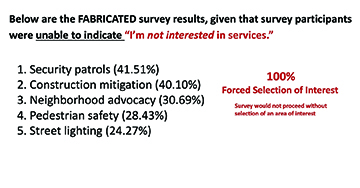
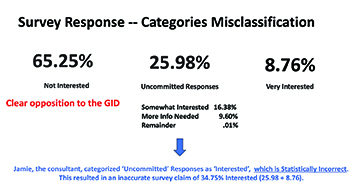
The gaslighting of the Cherry Creek residents was commenced with postcards sent out by Giellis last spring offering three improvement options — security, lighting, and beautification — and the results would later be presented as proof that residents supported forming a GID.
“The survey was designed to produce the answer the City wanted. It was a boondoggle, completely unscientific, and statistically meaningless,” says Dana Busch, CCN resident and entrepreneur.
Busch called the survey “a weaponized mechanism used to fabricate consent.” Residents note it failed to include a fourth option which was “no need for improvements,” creating a false narrative from the options that were included. Busch continued, saying that there was no credible demographic data, response rates, or cost transparency. Crucially, the City never disclosed how much a GID would cost homeowners, how assessments would be calculated, or that rates could increase over time without another vote. Furthermore, out of the almost 9,300 registered voters in the proposed GID area, only 200 votes are needed to get on the ballot. And, as is with other measures on the ballot, to pass the measure requires only a majority of those who actually end up voting.
“The City used bad statistics, omitted financial consequences, and spun the results as if residents were asking for services having no proof that they actually did,” Busch said. “That’s not just misleading, it’s manipulative.”
CCN resident Greg Jenkins, who has extensive experience with feasibility studies as an energy executive, pointed out that the survey that Geillis sent out falls far short of an actual feasibility study, noting that it is simply not possible to do a study when they do not even know what projects they are planning to do.
Denver’s Debt Habit
Continues with GIDs
As a whole, Denver has a lengthy track record for supporting bond measures, rapidly increasing the amount of debt that the City has in order to provide what they deem to be necessary services and what the people want. On the heels of defeating the proposed GID in CCN, Denver got the approval of a GID on Broadway and voted to pass the five “Vibrant Denver” Bonds in the amount $950M which will allow debt-funded construction.
Dana Busch expressed her disgust for the City’s overall irresponsible fiscal management. “They keep finding new ways to raise money instead of fixing the fiscal mess they already have. The City’s mismanagement is not our responsibility to underwrite. The CCN GID is a perfect example of going back into the pockets of residents to try and correct their gross misappropriation of funds to fix projects which are their responsibility to handle in the first place.”
How The CCN Neighborhood
Association Turned A Blind Eye
Initial discussions of the GID in CCN began with Councilwoman Amanda Sawyer and GID expert Jamie Geillis going first to sell developers like East West Partners and the Broe Group, and eventually the CCN Neighborhood Association (“CCNA”). Gradually CCN residents themselves were brought into forums. However, as discussion heated up and the City’s survey was sent out, the CCNA unexpectedly took a “neutral position” on the GID. CCN residents like Greg Jenkins became increasingly agitated by what they view as the unwillingness of their very own CCNA Board to protect the residents’ real interests.
Residents like Busch, Ooms, and Jenkins felt that their int erests were not represented by the City or their own neighborhood association that was once the vanguard of advocating for responsible development under the direction of Wayne New. Jenkins in particular felt that the CCNA was allowing the City to “pick their pockets” and slowly saw a pattern of change over the last year or so leading up to the GID battle. He noted that the neighborhood bylaws slowly allowed for more decision-making of the CCNA Board without participation of others. Furthermore, he recognized the involvement of individuals on the Board who he believes compromised the ability to represent CCN fully with their own agenda. “There are three things that motivate people to do things — they are power, prestige, and money. Falling short of demonstrating that money was the motivator, it is clear that power and prestige is causing certain Board members to wander away from their moral compass. Their naïveté and irresponsible behavior created great distrust with the Board.”
GIDs — Curse Or Saving Grace?
“GIDs are supposed to be put in place for emerging neighborhoods to solve specific problems that they deem are of necessity to their neighborhood — this does NOT apply to CCN,” noted Jenkins.
As downtown Denver continues to struggle to rebuild after decades of problems like safety, budgets, and failed businesses, there are a number of existing GIDs like in RiNo (Riverfront North) and Ballpark, including the formation of the Broadway GID, formed to raise additional funds for so-called necessary improvements. While on the surface, this appears to be a saving grace with increased funding for safety measures and development, Jenkins and other neighborhood colleagues are of the opinion that the GIDs are, in actuality, simply convenient tools for the City to patch holes in the tremendous mess that the City created over decades with no safety mechanisms in place to control what the GID can actually do with the funds they collect. Jenkins believes that the GIDs “are the proverbial nose under the camel’s tent and that once they are in there is no stopping them.”
In an attempt to get more clarity on the motivation of the City for forming a GID, residents of CCN opposed to the GID put in a formal request for public information through CORA to which the City refused to respond.
Jenkins pointed out that the future GID Board will not be people in the area but is the City Council itself and they in turn appoint an “advisory board” whose powers and authority can be taken away at any time. Since GID’s take on debt they are almost impossible to ever terminate.
“The GID Board may adjust the annual assessment rate or expand services as necessary… GIDs may issue debt to pay for capital projects.” — City and County of Denver, Guide to GID Creation.
That language confirmed residents’ fears that the Board could raise assessments, redirect funds, or incur debt with minimal resident oversight.
“Once the GID is in place, there’s nothing stopping the City from raising assessments or repurposing funds,” said Jenkins, energy consultant.
“It’s a blank check with no accountability.”
For example, in May of 2025, Denver City Council voted to renew the RiNo GID for another 10 years.
Wolf At The Doorstep
While the City of Denver claims that the GID is NOT another tax, but rather just an assessment intended for their own good, CCN residents see it as another tax adding onto what is already one of the highest property taxes in Denver. Jenkins said “if it looks, sounds, and smells like a tax” — it is. This is just another example of pulling the wool over people’s eyes and moving it along the road until it’s too late to stop it.”
Hidden Costs And Unchecked Authority
“The residents have no idea of the financial implications of imposing a GID with layers upon layers of costs to homeowners. City Hall has neglected to share that critical part of the dialogue and instead focuses on a warm and fuzzy narrative of improvements. The City has yet to actually tell anyone how they plan to fund the projects and what the real projects even are,” declared Dana Busch.
When the idea of the GID was first introduced in initial conversations between the City of Denver and residents, the City proposed that a mill levy would be used to assess the cost of the GID to each of the residents and that this levy would be based on property values at three price points $750,000, $1.5M, and $3M. Residents believe that the mill levy proposal did not actually align with the actual property values in CCN that are much higher than $1M nor was it a fair way to assess fees. Busch commented that homeowners will pay vastly different amounts for the GID to receive the same services.
The one person who would clearly benefit from the GID’s formation would be Jamie Giellis, who would earning up to $149,000 for working on the CC GID, one of many special districts she would oversee. As stated in the agreement between the City and Centro, Inc.
“4.4. Maximum Contract Amount
4.4.1. “the City’s maximum payment obligation will not exceed $149,000”
“CCN would simply be used as a piggy bank to fund the needs of the City, which are in actuality the inherent responsibility of the City. It is not the responsibility of CCN residents to carry those financial burdens simply because the City did not handle business and development responsibly.” — Dana Busch.
Busch goes on to say that the only possible way for the GID to be effective would be for a complete overhaul of the formation of the GID to happen with a new system of checks and balances.
Lessons In Accountability
The defeat of the proposed GID was more than a neighborhood win, it was a stand for civic accountability.
By exposing the misuse of data, the failure to disclose financial impacts, and the City’s attempt to bypass resident consent, CCN homeowners believe they forced transparency back into the process.
“Cherry Creek isn’t against improvement — it’s against being exploited,” Ooms said.
This neighborhood’s revolt the residents believe, ensures that for now, that City Hall’s playbook of quiet but endless tax hikes stops at least temporarily at the edge of the Cherry Creek area.