A Penny Saved Is Now More Than Just A Penny Earned, It’s Also A Relic Of History
by Mark Smiley
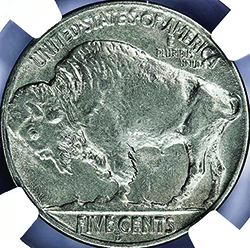
Three Step: A 1927-D three leg buffalo nickel sells from $1.50 in good condition, or up to $22,500 for uncirculated coins.
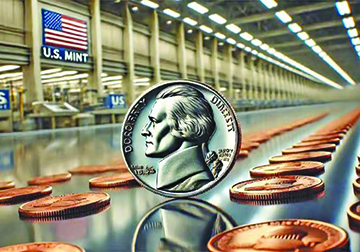
Nickel’s Worth: Costing 14 cents to mint, the nickel’s cost will potentially lead it to face the same fate as the penny.

Penny Pinched: The Denver Mint has stopped minting new pennies. It costs more to produce a penny than it is worth.
Among the first coins produced more than 230 years ago, the United States is ceasing to mint new pennies as 2026 gets underway. The decision was made because it costs more to produce a penny than it is worth.
Existing pennies will remain legal tender and can still be used. However, once lost or damaged, they will not be replaced, as the government will no longer be supplying them. There’s also likely little value to stockpiling pennies, even as production halts. Unless you have a rare penny, your one-cent coins are likely still only worth one cent.
This isn’t the first time the U.S. has done away with a coin. In 1857, Congress discontinued the half-cent coin. Canada stopped minting its penny in 2012. In 2024, it cost the U.S. Mint 3.7 cents to produce and distribute a penny. This means taxpayers were essentially subsidizing the production of a coin that had little purchasing power.
Costly To Make
When it was introduced in 1793, a penny could buy a biscuit, a candle, or a piece of candy. Now most of them are cast aside to sit in jars or junk drawers, and each one costs nearly 4 cents to make.
Penny shortages are expected in mid-to-late 2026 but could, of course, set in — sooner. That could leave everyone — state and federal governments, as well as businesses — scrambling to put together policies on how to handle cash transactions without pennies.
Many businesses say they may round change. They can do that by either rounding up the change (if you’re owed $19.24, you get $19.25) or rounding the transaction down (your $6.13 transaction becomes $6.10).
Cost Versus Value
Compared to other coins, pennies are not expensive to make. Compared to its own value, however, they are expensive.
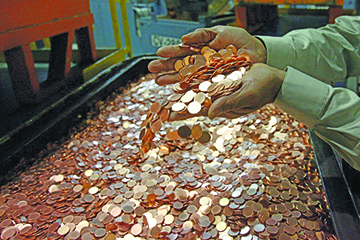
Penny Scoop: Denver Mint’s Guillermo Hernandez scoops a handful of “cents blanks” that will be stamped into pennies.
The average cost to make a single penny rose to 3.69 cents in 2024, marking the 19th consecutive year the coin has “remained above face value,” per the U.S. Mint report.
For comparison, it costs less than six cents to make a dime, about 15 cents to make a quarter, and nearly 34 cents for a half-dollar.
Pennies Per Person
That jar of pennies on your bookcase or dresser is not “skyrocketing in value.”
In 2024, about a quarter trillion pennies were estimated to be in circulation, or more than 700 pennies for each person in the United States.
A 5-gallon jug of pennies is worth approximately $350 to $450 in face value, depending on how densely they are packed. The total value could be significantly higher if the jug contains rare or old pennies.
You do not have to keep all your pennies, as they are still legal tender and can be spent or deposited into a bank. Hoarding them is generally not a good financial strategy because there are billions in circulation and they are not expected to become valuable collector’s items. It’s best to spend them, cash them in at a bank, or use a coin-counting machine, though be aware some machines charge a fee for cash payouts.
Penny Of Steel
During World War II’s critical years, the U.S. Mint made an unprecedented decision that would forever change American coinage. To conserve copper for military ammunition production, the traditional bronze penny was replaced with zinc-coated steel for 1943 only.
This wartime change created one of the most dramatic value contrasts in coin collecting. Most 1943 steel pennies remain affordable treasures. A fine condition example trades for just $0.69, while even “Mint State” specimens typically reach only $22.50 to $27.83, depending on the mint mark.
However, a few copper planchets accidentally remained in the presses, creating the legendary 1943 bronze pennies. A good condition bronze penny commands $43,067, while pristine Mint State examples soar to an astounding $723,350. This represents one of the most spectacular value jumps in numismatic history — from pocket change to potential retirement fund.
Pricy Pennies
A 1943 copper (bronze) penny is worth over a million dollars. They were created by an error when the U.S. Mint accidentally used leftover copper planchets instead of zinc-coated steel ones, which were needed for World War II.
The most valuable examples are those in the best condition, with specific coins selling for over $1 million, and the unique 1943-D bronze cent selling for $1.7 million in 2010.

Penny Wise: The Denver Mint is going to cease producing U.S. pennies due to their relative lack of value. There are exceptions as the above penny, the 1943-D Bronze Lincoln Wheat Cent, is estimated to be worth over $1.7 Million. When you go through your old pennies, be sure not to throw this one away.
To check if a 1943 penny might be rare, test it with a magnet. If it’s magnetic, it’s one of the common steel pennies worth only a few cents. However, if it’s not magnetic, it’s a valuable bronze error coin.
Is The Nickel Next?
It costs nearly 14 cents to make a nickel, significantly more than the 3.7 cents to make a penny. Thus, it faces a situation similar to the penny’s. Doing so, however, is more complicated than eliminating the penny. It would necessitate a new “rounding rule” for cash transactions ending in 5 cents, potentially increasing the “rounding tax” on consumers. Nevertheless, the nickel’s cost will potentially lead it to face the same fate as the penny.
The cost to mint a single nickel is significantly higher that its face value. It cost the U.S. Mint 13.78 cents to produce one nickel in 2024. That’s nearly nine cents per coin. The loss is even greater than that of the penny, which costs 3.69 cents to produce.
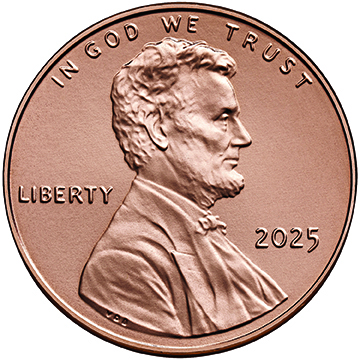
Coin Toss: After 230 years, the United States is ceasing to mint new pennies as 2026 gets underway.
Given the high cost of production and shifting consumer spending habits the nickel may eventually face the same fate as the penny. That’s particularly true if inflation continues to erode its purchasing power. Moreover, many other countries that have removed their smaller denomination coins later phased out the newest-lower coin.
A 1999 penny can be worth as much as $4,500 today because of a rare minting error called a “wide AM” variety, where the “A” and “M” in “AMERICA” are spaced further apart than normal. This error occurred when a reverse die intended for proof coins, which has a wide space, was mistakenly used on some business-strike pennies meant for circulation.