by Charles C. Bonniwell

Investigation: CBS News Colorado investigative reporter Brian Maass examined CDOT’s proposed Bus Rapid Transit (BRT) project along Colorado Boulevard in a May 11 segment highlighting concerns over lane reductions, increased congestion, and the potential impact on surrounding neighborhoods and businesses.
CBS News Colorado’s veteran investigative reporter Brian Maass led off the 10 o’clock news program on May 11 with a deep dive into the CDOT/RTD plans for Bus Rapid Transit (BRT) along a seven-mile stretch of Colorado Boulevard from I-70 to Hampden Boulevard.
He first interviewed Glendale City Manager Chuck Line, whose town’s main commercial tax base is along the relevant portion of Colorado Boulevard from Alameda Avenue to Mississippi Avenue and includes such leading sales tax generators as Target, Dick’s Sporting Goods, and Home Depot.
The Glendale City Council voted unanimously (5-0) to oppose BRT along Colorado Boulevard, rejecting all three of the so-called preferred alternatives along the road. Since Colorado Boulevard is a federal highway, the Colorado Department of Transportation (CDOT) apparently has the final say in consultation with the Federal Transit Administration, which oversees the federal environmental review process and provides potential funding avenues.

Star: Glendale City Manager, Chuck Line, was featured as the lead interviewee in CBS Colorado reporter Brian Maass’s segment covering CDOT’s proposed Bus Rapid Transit (BRT) project along Colorado Boulevard.
The Denver City Council has not, to date, taken a formal position on the project, but Amanda Sawyer, councilwoman for Denver District 5, which covers much of the Denver portion of the roadway, has expressed strong scepticism about the project, saying CDOT had failed to provide any data showing the “need for” the extremely expensive ($250 million) undertaking.
BRT Process
CDOT has undertaken, at enormous expense (three-quarters of a billion dollars), to turn three heavily traveled federal thoroughfares in Denver, Colfax Avenue, Federal Boulevard, and Colorado Boulevard, into BRT routes. The only specific reasons given are apparently to increase RTD bus
ridership at the expense of people riding in automobiles and a claim that it will increase public safety.
The Regional Transportation District (RTD) was formed in 1969 to act as the primary public transportation agency (initially buses) for Denver, Boulder, and parts of Weld County. It now covers eight counties, has a service area of 2,342 miles, and serves 3.08 million people. Its network encompasses 126 bus routes, six light rail lines, and four commuter train lines. RTD is run by a board of 15 elected representatives from 15 separate districts. From the start 57 years ago, RTD has struggled with the fact that revenue from ridership covers only 5% of the cost of service. To stay afloat, the operation is subsidized by a 1% sales and use tax imposed on the service area. Even with that additional funding source, RTD is chronically short of cash.
Bus Ridership Down
RTD’s ridership has been decreasing ever since the COVID pandemic in 2019-2020 and, even today, remains 39% below pre-pandemic levels. The RTD Board is looking to cut its bus routes by 20% to reduce expenses due to the lack of ridership in affected areas.
The fact that CDOT wants to spend three-quarters of a billion dollars on BRTs on three roads for a relatively small increase in bus ridership seems incomprehensible to critics of CDOT and RTD.
CDOT has estimated, for example, that after full implementation, Colorado Boulevard BRT bus ridership will increase by only 3,000 to 4,000 daily riders while causing the 70,000 cars (which often have multiple occupants) to double travel time from approximately 30 minutes to one hour for the seven-mile stretch.
Environmental Concerns
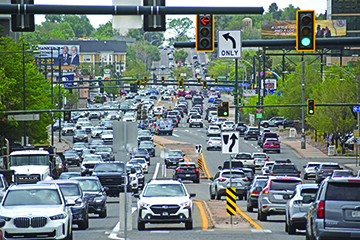
Traffic: Daily gridlock on Colorado Boulevard illustrates the corridor’s already severe congestion challenges. Critics of CDOT’s proposed Bus Rapid Transit (BRT) project, slated for construction around 2030, warn that eliminating two vehicle lanes could worsen traffic backups, increase idling times, and lead to higher vehicle emissions and air pollution along one of Denver’s busiest corridors.
Glendale’s deputy city manager has estimated that the exhaust fumes from the traffic congestion created by the BRT on Colorado Boulevard would be highly detrimental to the environment. He estimated that the BRT project would result in an extra 1,423,500 gallons of gasoline being used by car travelers on the congested road, producing 27,375,000 pounds of CO2 emissions and costing car travelers an aggregate of $3,285,000 to $8,760,000 annually.
Colfax Avenue BRT’s Many Problems
CDOT began construction on its first BRT project on a four-mile portion of East Colfax Avenue well over a year ago but still needs another year and a half for completion. The construction of the infrastructure for the BRT on Colfax Avenue has been a disaster for many businesses along the roadway, with no relief in sight.
If construction of the Colorado Boulevard BRT created similar problems to those on East Colfax, the sales tax losses would be catastrophic for the financial health of the City of Glendale.
Real Reason For The BRTs
With the enormous cost of a BRT and the many negative impacts once implementation occurs, it seems to many observers that the relatively small increase in RTD ridership is hardly worth it. Glendale’s Chuck Line, however, indicates that the key to understanding why CDOT is so aggressively pushing the BRTs is that the enormous auto congestion it would cause on the three roads is not a burden but the principal benefit for the political players involved.
Colorado Governor Jared Polis and Denver Mayor Michael Johnston and their administrations are profoundly anti-automobile. They want to get citizens out of cars and into far more egalitarian public transportation. To create a so-called “15-minute walkable city,” they want Denver to become, a large segment of the population must be convinced to abandon or be forced out of their automobiles.
The three BRT roadways are just part of a broad-ranging vision and plan to make Denver as automobile-free as humanly possible. The political powers, however, do not believe that, at this point, they can trust the public to concur with such an extreme plan, so the public reasons for the BRTs must be expressed in terms of road safety and increases in bus ridership.
Public Meeting
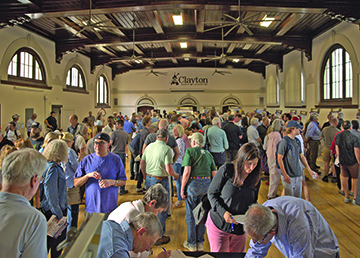
Packed House: The Colorado Department of Transportation hosted its second open house for the Colorado Boulevard Bus Rapid Transit (BRT) Project on Wednesday, May 13, to share project information, respond to questions and obtain feedback on potential options for improvements along the corridor. Photo by Miranda Tillinghast
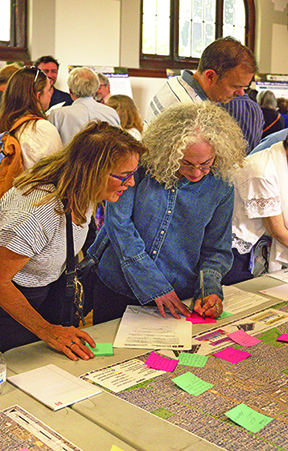
Input: Community members review maps, share feedback, and engage with CDOT staff during the open house on the proposed Colorado Boulevard BRT project at the Clayton Early Learning Center on May 13. Photo by Miranda Tillinghast
On the evening of May 13, from 5 p.m. to 7 p.m., CDOT held its second and final open house to purportedly gather community feedback on the only three potential design options that CDOT is willing to consider: center bus lanes, side bus lanes, and mixed-use bus lanes. Center bus lanes have an estimated cost of $350 million, while the latter two are estimated at $250 million each.
Having completed the public input portion of the process, CDOT will now determine what it calls the “Locally Preferred Alternative” (LPA). There are no criteria or guidelines explaining how CDOT will determine the LPA. CDOT, after the public relations disaster caused by construction work on the center bus lanes on Colfax Avenue, has indicated that it has no interest in the center bus lane option, asserting moreover that it does not have the extra $100 million required for that alternative.
Thus, CDOT is only considering whether the LPA should be the side bus lanes or the mixed-use bus lanes. Ostensibly, the side bus lanes would involve two dedicated bus lanes, thereby decreasing the number of lanes for cars from six to four and increasing automobile congestion. The mixed-use alternative would continue the present arrangement of buses sharing lanes with automobiles.
But Glendale officials point out that both alternatives would cost the exact same amount, which would go toward condemning land for rights-of-way along the roadway and building elevated bus stations along the route where none currently exist. CDOT has provided no explanation for why Colorado Boulevard suddenly needs multi-million-dollar bus stations where none previously existed. The only difference between the side bus lane alternative and mixed-use bus lanes would be the striping of the lanes. Mixed-use lanes could readily be converted to side bus lanes, which Glendale officials suspect CDOT will ultimately build regardless of what the community wants or needs.
As opposition to the BRT project along Colorado Boulevard has steadily grown, the nature of the May 13 open house appeared to have been altered. On May 13, there were no presentations given by officials or questions answered that could be heard by all attendees. The packed Clayton Learning Center simply had storyboards along one side of the room with the same information that appears on the CDOT website. There were tables in the center of the room where the public could fill out the so-called unscientific “survey,” but the same survey can also be completed online through the end of the month. Attendees could scribble thoughts on Post-it notes regarding the alternatives and stick them on the storyboards. While it appeared dubious that the large clutter of haphazard Post-it notes could be tabulated by CDOT in any meaningful way, attendees appeared happy to fill them out and place them on the storyboards. Critics of CDOT at the meeting postulated that the only purpose of the meeting was to fulfill a requirement set forth in the applicable federal environmental regulations for such a project.
“This project still has far too many unanswered questions for residents to support it responsibly,” said Audry Oxley, a Hilltop resident. “There has been no comprehensive analysis of air and water quality impacts, storm drainage costs, traffic diversion into nearby neighborhoods, or the effects on private property owners along Colorado Boulevard. At the same time, permanent station locations remain undecided, transit stops would be reduced, and there is no dedicated federal funding identified for the project. Residents and taxpayers deserve greater transparency and clearer answers before a project of this scale moves forward.”
“We’re being asked to support a massively expensive project without clear answers on cost, congestion, environmental impacts, property acquisition, or whether the community even wants it,” said Dana Busch, a Cherry Creek North resident. “Taxpayers deserve transparency and accountability before Colorado Boulevard loses lanes to a project tied to an RTD system many residents no longer trust.”
Choosing And Presenting The LPA
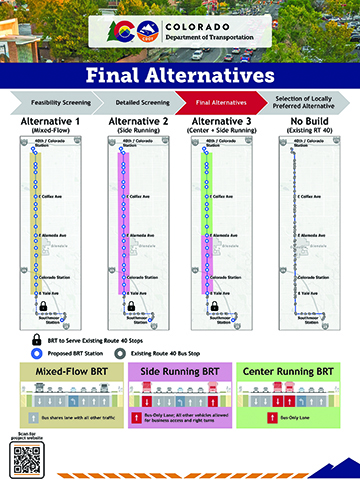
No Build: Glendale City Council voted to support a fourth alternative, the “No Build” option, opposing proposed lane reductions associated with CDOT’s Bus Rapid Transit (BRT) plans along Colorado Boulevard and favoring preservation of the corridor’s existing traffic lanes.
The next step will be for CDOT to choose the LPA in its sole discretion. CDOT has what it calls “partners” on the project, consisting of the City and County of Denver, the City of Glendale, Arapahoe County, and the Denver Regional Council of Governments. They will apparently have no say on what the LPA should be.
Instead, once CDOT determines its LPA, it will present it to a group of organizations it calls the “stakeholders,” but not to the public at large. The members of the “stakeholders” appear to be a myriad of highly progressive and/or pro-bicycle and anti-automobile organizations led by Denver Streets Partnership, an entity associated with Bicycle Colorado. Other organizations include the Colorado Cross-Disability Coalition, CoPRIG, Denver Regional Mobility & Access Council, Greater Denver Transit, Pedestrian Dignity, Servicios de la Raza, the Sierra Club, and YIMBY Denver.
Those “stakeholders” are among the most committed supporters of BRT on Colorado Boulevard. The “stakeholders” group does not appear to include any pro-business groups or retail establishments along Colorado Boulevard. It would appear that the “stakeholders” would likely enthusiastically support any LPA chosen by CDOT other than the no-build scenario.
After approval of the LPA by the stakeholders, CDOT would move into the preliminary design phase, followed by construction beginning in 2030.
Tension Between Residents
And Bicycle Advocates
There appears to be a growing rift between residents and the ever more radical bicycle lobby. At the April 29 Hilltop Neighborhood Homeowners Association meeting on the Colorado Boulevard BRT project, an apparent representative for the Denver Streets Partnership or an associated group, who wore his bicycle helmet throughout the entire meeting, opened his remarks with a declaration that he could not afford a car and did not give a “sh*t” what people with cars thought.
A group of members in the crowd of Hilltop residents reacted to his remarks by indicating that they, in turn, did not care what some “ANTIFA-adjacent bicycle nut” had to say. At the end of the meeting, an informal straw poll was taken in which all but eight people in a crowd of more than 100 individuals supported the no-build scenario.
The Road Ahead
As CDOT moves toward selecting its so-called “Locally Preferred Alternative,” opposition to the Colorado Boulevard BRT project appears to be intensifying among residents, business owners, and local officials who fear the project’s financial, environmental, and traffic impacts could permanently alter one of Denver’s most heavily traveled corridors. Whether CDOT ultimately listens to those concerns or proceeds with a plan many critics view as predetermined, may shape not only the future of Colorado Boulevard, but also the broader debate over transportation policy, public accountability, and automobile use throughout the Denver metro area.
For information about this project, visit www.codot.gov/projects/studies/denvermetrobrt/coloradoblvd. For information provided by sceptical citizens, visit www.keepdenvermoving.com.