It’s October, and that means the color pink will start
appearing everywhere — and for good reason. October is National Breast Cancer
Awareness Month, an international health campaign promoting prevention,
diagnosis, treatments and cures. Here are four ways to make the most of this
important month.
Be Aware. This month starts with just being informed.
According to the National Breast Cancer Foundation, about 1 in 8 women in
America will experience breast cancer during their lifetime.
While men can get breast cancer too, it is much more common
in women, with women over 50 being most at risk. That said, about 11% of all
new cases of breast cancer are found in women younger than 45.
Check your health. This month is also a good reminder for
women to check in with themselves, as there many uncontrollable genetic factors
that can put them at risk:
• Gender:
Women are 100 times more likely to develop breast cancer than men.
• Age: Two
out of three women are diagnosed after age 55.
• Genetics. A
family history of breast cancer can put individuals more at risk.
• Early
menstruation or late menopause. Breast cancer is also associated with early
menstruation (before age 12) and late menopause (after age 55).
Further, if they haven’t done so already, October is also a
good time to get in the habit of having regular breast exams. A mammogram — the
screening test for breast cancer — can help find breast cancer early when it’s
easier to treat. In addition, one of the first lines of defense against breast
cancer is being vigilant with self-exams. Experts recommend checking breasts
every month both visually and by touch, paying attention to any changes in how
the breast or nipple looks or feels.
Improve your lifestyle. During this month, another proactive
step is to make changes in your lifestyle that can both improve your health and
reduce your risk of cancer and other disease and health issues. This is called
lifestyle medicine, and it involves addressing nutrition, physical activity,
and chronic stress in order to live healthier.
To help prevent breast cancer:
• Maintain a
healthy weight. Being overweight or obese increases the risk of breast cancer,
especially after menopause.
• Stay
physically active. Breastcancer.org reports that exercising at a moderate or
intense level for four to seven hours per week can lower the risk of breast
cancer.
• Do not
smoke. Smoking is linked to a number of diseases, including breast cancer in
younger, premenopausal women.
• Watch your
diet. Eating too much saturated fat and not enough fruits and vegetables
increases risk.
• Cut back on
alcohol. Also according to Breastcancer.org, women who have three alcoholic
drinks per week have a 15% higher risk of breast cancer, compared to women who
don’t drink at all.
Spread the word. Lastly, an important thing to do during
Breast Cancer Awareness Month is simply raise awareness. Most people can
survive breast cancer if it’s found and treated early. Talk to others about
risk factors and lifestyle changes. Encourage your loved ones to get regular
exams. Reach out to a loved one who is experiencing breast cancer and lend your
support. And, join local events and races that raise money and create even more
awareness.
Breast cancer is one of the most common cancers found in
women. During October and every month, take steps to stay healthy. Everything
you do counts.
Justin is the Lifestyle Medicine Coordinator at the Glendale
Sports Center managed by the YMCA of Metro Denver. He has worked in the fitness
industry since 2015 and received his BS and MS in Exercise Physiology from
Western Kentucky University. He joined the Denver YMCA in 2019 after moving
from Bowling Green, KY.
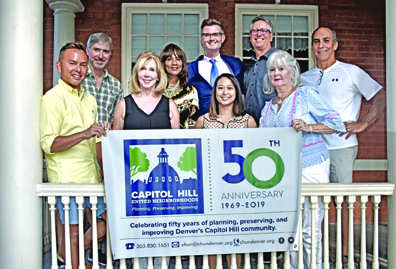
Capitol Hill United Neighborhoods (CHUN) has played a vital role in shaping neighborhoods by providing a unified voice to the City of Denver and Colorado state governments since 1969. Those who are not familiar with this organization need look no further than the trees that are planted along 13th and 14th Avenue. CHUN was instrumental IN having those planted.
Board Members: The Board of Delegates for Capitol Hill United Neighborhoods, Inc. is a group of 39 members representing 10 registered neighborhood organizations in Denver.
To commemorate 50 years in the community, CHUN will host a
fundraising event at Denver Botanic Gardens to celebrate its half century. The
50th Anniversary Celebration and Wine Tasting is open to the public and its
members and residents of the Capitol Hill community on Wednesday, September 18,
2019, 5:30-9 p.m.
In addition to an evening with Denver leaders and
neighborhood advocates, the event will feature a wine tasting, light hors
d’oeuvres from local restaurants, and a silent auction, showcasing goods and
services from local businesses. CHUN is seeking help from local businesses to
sponsor the event WITH silent auction donations, underwriting support, and
other in-kind goods or services.
Fifty years ago, CHUN was founded to take on the most
pressing issues facing Denver and its neighborhoods. Since then, the organization
has evolved into one of the Mile High City’s largest registered neighborhood
organizations (RNO) dedicated to strengthening and elevating the voices of
residents and neighbors.
The Board is comprised of members of 10 different RNOs,
including Congress Park, Cherry Creek North, Country Club, Cheesman Park and
Uptown. The boundaries of CHUN are 22nd Avenue to 1st Avenue, and Colorado
Blvd. to Broadway.
“I’ve served on a lot of boards,” said Bruce Caughey, CHUN
Board Member. “There is more commitment to this board than almost any board
I’ve ever been on in terms of participation and expressing opinions. It’s
really a great opportunity if you want to get involved in your neighborhood and
make a difference. That’s what CHUN represents.”
This board is rolling up its sleeves to come up with a plan
for the Tears-McFarlane House, a 120-year-old mansion that was gifted to CHUN
by the City of Denver a few years ago. The building requires some restoration
and ongoing upkeep,” said Travis Leiker, President, Board of Delegates for
Capitol Hill United Neighborhoods, Inc. “We tapped the experts in this work to
help us revitalize this property. We’ve done focus groups, surveys on the park,
and engaged the community to help us reconceptualize and visualize what can be
done with this space. We just released the results of that research which
indicates that most people want this to remain a community gathering space but
with additional amenities. The next phase of this will be how we revamp this
property to both fuel CHUN’s operations as a community group, but also activate
portions of the property for the betterment of the community.”
Renovation Plans: The Tears-McFarlane House is a historic house located at 12th and Williams in Denver, that was listed on the National Register of Historic Places on January 11, 1976. It was gifted to CHUN a few years ago and now is embarking on a revitalization project that will require approximately $2 million to complete.
CHUN advocates for smart zoning and land use, innovative
transportation systems, the protection of historic landmarks, promoting
community safety and championing city beautification. As Denver moves further
into the 21st century, this organization is committed to being collaborative
and solution oriented, by building strong relationships with community
stakeholders and serving as a go-to resource for Denver citizens.
Membership to CHUN is $75/year per household, $180/year per business, and $30/year for individuals. For a list of benefits, visit www.chundenver.org/membership. For more information on the 50th Anniversary event visit www.chundenver.org/chun50.