
by Mark Smiley | Mar 1, 2017 | Travel
by Mark Smiley

Eleanore Smiley on the patio of a preferred club guest room overlooking the ocean

An aerial view of Now Sapphire resort in Puerto Morelos, Mexico
My wife and I decided that we needed a family vacation and began to plan a trip to Mexico to have some fun in the sun and relaxation. When researching the different options of where to stay, there are a myriad choices. We decided to focus on resorts in Cancun that were family-friendly. The three websites we relied on most were Trip Advisor, Oyster, and Family Vacation Critic. These sites gave us a good idea, after sifting through hundreds of reviews, which resorts would suit our needs.
After careful consideration, we decided on Now Sapphire, a resort in Puerto Morelos, which is 15 minutes from the Cancun airport. Now Sapphire is part of AMResorts which also owns Dreams and Secrets resorts. Puerto Morelos is home to the second largest barrier reef in the world.
After booking roundtrip airfare on Southwest Airlines, we checked these two purchases and we quickly realized we should carefully select airport transfers, excursions, and anything else we wanted to do or the vacation could quickly escalate in price. Cancun Adventure Tours was the company we used for round trip airport transfers and an excursion to Xel-Ha Aquatic Park.
Upon arrival at the Now Sapphire resort, the staff was friendly and accommodating. We decided to pay the extra fee for Preferred Club and were not disappointed. This Club includes a private check-in and check-out ex

The Now Sapphire pool at sunrise
perience, free WiFi throughout the resort, an oceanfront room, the ability to reserve private bali beds near the pool, and more.
Now Sapphire, a former Paradisus hotel, was completely remodeled in 2010. The grounds are well maintained and the food in the seven restaurants was surprisingly good for an all-inclusive resort. The all-inclusive experience included all food, drinks, pool and beach wait service, 24-hour room service, and more.
The white sandy beach is private but does collect quite a bit of seaweed. The staff works by hand to try to clean it up each day but it does accumulate rapidly. Many reviews online mention this but we found it to be a beautiful beach with warm salt water and a tiki bar steps away to quench our thirst.

The oceanfront of now Sapphire Resort
Now Sapphire is also famed for hosting weddings. Beth Russell from Milwaukee, Wisconsin, was a guest at the resort for her son’s wedding. “The wedding was wonderful, the staff sure cares about the way things are put together, for a wedding,” said Russell. “Everything was spot on and we all had a good time.”
Excursions in Cancun are plentiful. Families must choose what fits their needs and decide how much of
Eleanore Smiley swimming with the dolphins through a company called Dolphin Discovery
their vacation they want to fill with excursions. We chose a dolphin experience with a company called Dolphin Discovery. Dolphin Discovery has multiple locations throughout Mexico. We chose to go to Dreams Puerto Aventuras which was approximately a one-hour ride from the resort. The 45-minute dolphin swim was an educational and a fun experience. The company added a manatee and sea lion experience at no additional cost. The guide and trainer were knowledgeable and friendly and the excursion included a lunch buffet.
There are resorts closer to the attractions so if you plan to do more than one or two, consider these venues as three hours in a van each day will eat into your vacation time.

The Smiley Family at Xel-Ha, a natural aquatic park
For our purposes, we did not want to fill each day with activities. We enjoyed swimming in the large pool complete with a swim up bar, relaxing on a bali bed, eating hamburgers and hot dogs at the Barefoot Grill by the pool, taking in a hydrotherapy treatment which is included with a Preferred Club upgrade.

The Hibachi meal at Lemongrass is very popular
Restaurants do not require reservations with the exception of Lemongrass Asian Cuisine’s hibachi meal. Most restaurants open for dinner at 6 p.m. but 24-hour room service is available. In addition, the Coco Café is open 24 hours featuring snacks and specialty coffees. This was especially helpful since tours departed from the resort at 7 a.m. which only allowed time for a coffee and muffin to go.
The combination of Southwest Airlines, Cancun Adventures, Dolphin Discovery, and Now Sapphire in Puerto Morelos provided an affordable and family friendly vacation. If considering this trip, temperat

The private white sandy beach at Now Sapphire
ures in Cancun tend to be best in the winter and spring. Summer temperatures soar into the 90s by August. Temperatures for this reporter’s trip remained in the mid-80s with very little rainfall.
by Mark Smiley | Mar 1, 2017 | Main Articles
by Glen Richardson
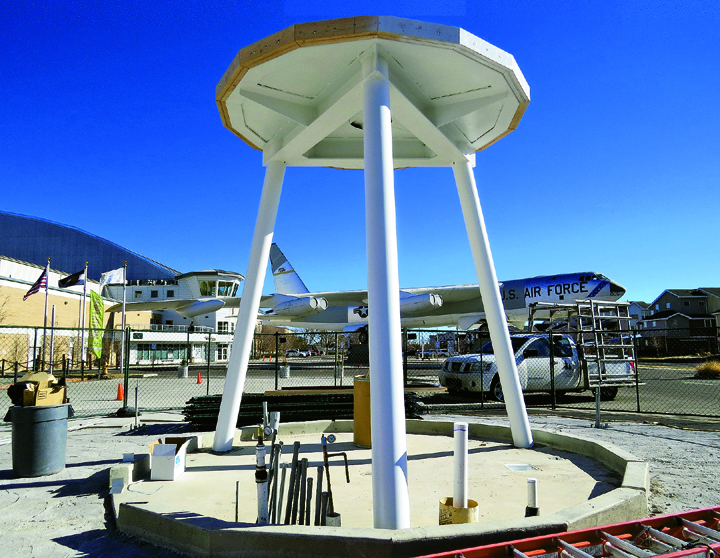
 The countdown is on: The 40-foot-tall Raygun Gothic Rocketship first revealed by the Chronicle last February is landing in Lowry this May. Ground zero is the parking lot directly in front of the Lowry Beer Garden at 7577 E. Academy Blvd.
Design and construction of a Spaceport — a structural and visual base — is currently underway in front of the Beer Garden and adjacent to the Wings Over the Rockies Air & Space Museum. Landing site for the rocket was moved from its original planned location in front of the Luce Condos at the corner of East Academy Blvd. and Rampart Way following last February’s Chronicle article.
The 40-foot tall art piece is a rococo-futuristic, highly stylized vision of space travel circa 1930s-1940s science fiction. First landing and inauguration took place at Burning Man 2009, and the sculpture subsequently appeared for Yuri’s Night at NASA Ames before going on display at the Embarcadero in San Francisco for more than two years.
Rocket Plaza Planned
The ambitious project to enliven the Hangar 2 development at Lowry is a project of Hartman Ely Investments in partnership with Larimer Associates. It remains uncertain if the project has overwhelming neighborhood support. Developers, however, are confident the compelling large-scale sculpture will engage people and enhance their experience at Lowry and Hangar 2. Without a doubt the rocket will make science fiction an everyday reality for thousands of Valley residents and visitors to Lowry. The Denver Landmark Preservation Commission has approved the project.
It was created by California artists Sean Orlando, Nathaniel Taylor, and David Shulman, along with Five Ton Crane (5TC), a group of artists and inventors from the San Francisco Bay Area.
The rocket’s voyage will end at Lowry where it will become a permanent display piece. Plans call for it to be mounted atop an ice cream shop, symbolizing a launch pad. Specifically, a retail structure to sell ice cream and other retail items will be the structural and visual base for the Raygun Gothic Rocketship. It will be the centerpiece of a pedestrian plaza being built in the existing parking lot in front of the Lowry Beer Garden.
Lowry officials have not announced if the installation will be illuminated for nighttime viewing as it was during its stay at the Embarcadero.
Stellar Destination
Although yet to be announced by developers, since the pedestrian plaza, rocket sculpture and kiosk will be located directly in front of the Lowry Beer Garden, it is likely the same staff will manage the two facilities.
Like other neighborhoods in the Cherry Creek Valley, Lowry has added several public art pieces. Unlike Lowry’s existing public art — many with a flight theme — this Gothic Rocket is so evocative of an old science fiction movie, viewers will half expect a crew clad in natty jumpsuits to disembark and explore Lowry. Others may imagine it is poised to board passengers for a run to nearby stellar destinations.
If the crowds for the new Star Wars Exhibit at the Denver Art Museum are any indication, it is likely that huge crowds will take the journey to Lowry for the opening and throughout the new year. In form and function the iconic rocket’s captivating structure is apt to equal or surpass the Power of Costumes to entertain and keep visitors amused.
Sculpture Site
Hartman Ely Investments has been involved in the redevelopment of Lowry since the approximately 1,800-acre community was created from the decommissioned Lowry Air Force Base. They are credited with re-energizing many old buildings and the creation of unique new places at Lowry. The firm has been involved in the planning and implementation of several Lowry developments. Among those projects are the Steam Plant Loft, Row and Patio Homes, Grand Lowry Lofts, Officers’ Row Loft Homes, Luce and Parkside.
Nestled in the heart of Lowry, the Lowry Beer Garden exists to bring people together. Celebrating Colorado’s craft beer culture, it has more than 4,500 sq. ft. of outdoor garden area with open-air seating plus a covered pavilion. Oktoberfest-style picnic tables can accommodate up to 350 guests. Being adjacent to the Wings Over the Rockies Air & Space Museum will make it a popular sightseeing diversion.
The Beer Garden offers a selection of draft and bottled beer with a focus on Colorado handcrafted brews. It also serves up casual food featuring locally made gourmet brats and sausages, freshly baked pretzels, house-ground burgers, hand-cut fries and chef-created salads.
by Mark Smiley | Mar 1, 2017 | Main Articles
Reform Or Wasted Opportunity?
by Ruthy Wexler
 On December 15 the Denver Public Schools (DPS) announced that it would close/restart three public elementary schools — Greenlee, John Amesse and Gilpin Montessori — pursuant to its new non-subjective School Performance Compact. The outcry was enormous with parents and teachers protesting vociferously. The dispute hit the news media with the local television stations and The Denver Post doing overview stories on the subject. One Denver School Board member called the decision “gut wrenching.”
As one of the targeted schools, Greenlee Elementary, is located in the Cherry Creek Valley, the Chronicle decided to drill down and find out exactly why DPS might be closing a school against the apparent, adamant opposition of a majority of its parents — and whether such a decision, in fact, made any sense.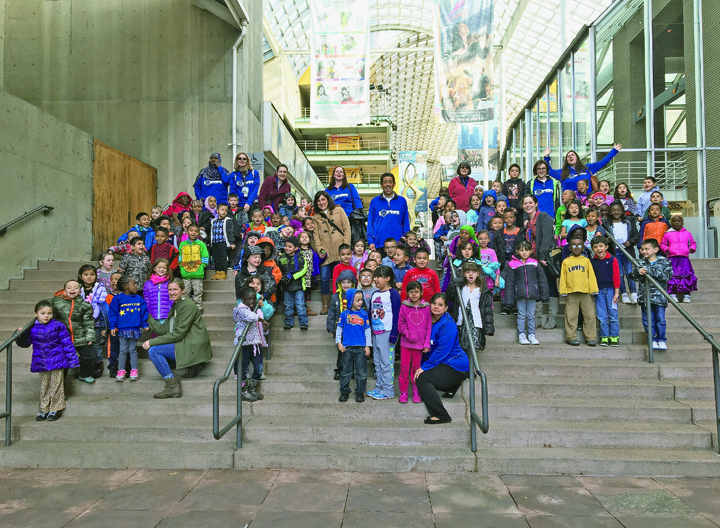
A (Measured) Work In Progress
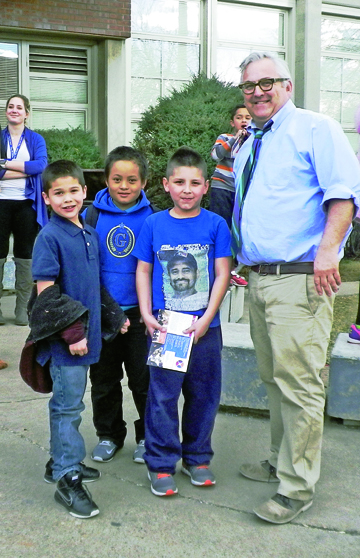
On a sunny day in late January, Sheldon Reynolds, current principal of Greenlee, discussed his school with a visitor. A former teacher herself, the visitor kept expecting knocks on the door, announcing various crises. But the school hummed quietly around them as the affa ble educator described practices he and his team had put in place in order to grow a “new culture” at Greenlee.
Sheldon — as he’s known in the community — has been principal for just a year and a half.
Occasionally, he allowed glimmers of pride to spark his eyes, telling of students who now believe they can succeed. At no time did he denounce standardized tests, the results of which have put his position in jeopardy.
Colorado students all take the CMAS PARCC state assessments every Ap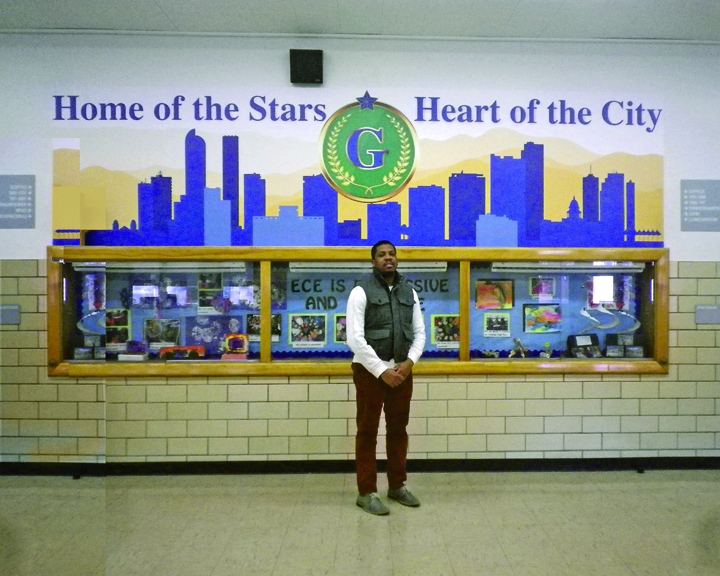 ril. These tests provide Median Growth Percentiles, a measure of how much a child has learned in a year. Results are combined into one “academic growth” score for the school.
Before Reynolds came, Greenlee’s academic growth was measured at 27 percent. He’d been there only seven months when students took those tests again in April 2016; results had bloomed to 48.8 percent.
“I’m not opposed to standards, not at all,” said Reynolds, whose youthful looks belie years of experience. “What I take issue with is the pass or fail, all or nothing decision. DPS’s benchmark is 50 percent. We were essentially only one point away in academic growth, the indicator DPS values most!”
Making Connections
Academic growth is indeed what DPS cares about most. “We don’t judge where a student starts,” Tom Boasberg emphasized. “We care how much they improve in a certain time period. This philosophy is especially important in low income neighborhoods.”
Greenlee definitely falls into the category of low income neighborhood. Almost 95 percent of its students qualify for free or reduced lunch. Many live in public housing. Seventy percent are “direct certified”; i.e., students experiencing homelessness or foster care. Located at 1150 Lipan Street, Greenlee is a stone’s throw from the colorful Santa Fe Arts District. Isolated by poverty, residents may as well live on the other side of a wall.
“We want to remove those invisible barriers,” Reynolds said. “So we’ve made many community connections … the La Alma-Linc oln Park Neighbors Association, the Art District, a local veterinarian, an architect … We have a Running Club now, led by a local businessman. Black and brown kids see black and brown males in leadership positions; that breaks down barriers, too.
“And we’re not afraid to try something new! The community helped us go see The Nutcracker. Yup, all 300 of us!”
Three hundred students at the Denver Performing Arts Center? Weren’t there, um, discipline problems?
Reynolds tried to make the visitor understand. “We don’t concentrate on what our kids do wrong. If they make a mistake … we remind them of our school standards, our culture. They get a chance to correct that mistake.”
He grins. “We had a great time at The Nutcracker.”
Change
Reynolds never intended to go into education. “My dad was a principal; I was going to do something else entirely.” Graduating from George Washington High, he chose a college in Las Vegas. But working one summer at his father’s school, Reynolds realized, “I want to work with kids.” He taught in Denver for a number of years, then took a job in North Carolina as assistant principal. After that, as principal, he built Lakewood Montessori into a high-performing, award-winning NC public school.
In August 2015, Reynolds came home to Denver: he’d been asked to take over Greenlee Elementary, a struggling school DPS had singled out for help back in 2010. Because he’d started Lakewood “from the ground up,” Reynolds felt he could do the same here.
“But you don’t just come in and start making changes,” he says. “You listen. You look around.
“What did I see? That the perception of the school wasn’t great. Things weren’t working. But I found some really strong pieces. The staff for one.”
Reynolds and his teachers created a five-year roadmap, a “Possibility Plan.” They adopted “HOME OF THE STARS, HEART OF THE CITY” as their slogan — and believed it. “We started building our culture through a talent dev elopment model,” Reynolds explained. “If we see students as talented and gifted, they see themselves like that. We found talents — not just academic, but artistic, athletic, leadership — and built on them.
“We did it with teachers, too. I identified the most qualified teachers, they became leaders, coaching the others. That leads to mutual respect and better teaching all around.”
“He’s given teachers the opportunity to take on leadership and it makes us more dedicated, in our classrooms and to each other,” says art teacher Jessica Plate. “I’m part of the Cultural Leadership Team. We want our students to be expressive, healthy and enlightened.”
Before, bad behavior stood out. Now, teachers rewarded good behavior with extra recess and awards. Academics took on a joyous note: students who met reading goals got to spray their principal with silly string. A blown up photo of that giggly event hangs in a hall, alongside images of Greenlee students laughing, hugging, quietly thinking.
“All that love and respect you feel?” said a teacher. “That’s Sheldon.”
Karen Dunn, Head Start teacher for 17 years, says that Reynolds is the best thing that’s ever happened to Greenlee. “His idea, that we teach to the gifted students and have faith our other students will rise to that level? It works!”
“Yes, things have improved,” Reynolds allowed. “But it takes time — years, really — to build and sustain a quality neighborhood school.”
Denver Plan 2020
The leadership of DPS also formed a plan in 2015 with a five-year goal. The Denver Plan 2020 aims to have “at least 80 percent of district students attending a high-performing school by 2020.” Since approximately half that number are still in schools DPS considers lower-performing, Boasberg feels an urgency to “increase the quality of schools.”
Denver schools are assigned a numerical rating based on test scores and other factors, within DPS’s School Performance Framework. “If a school’s SPF rating remains low for multiple years, and if academic growth is poor in the most recent year, then we mark a school — and we hope never to do this — as designated,” said Boasberg. “That’s when we put the last piece in place, a School Quality Review (SQR).”
This review is done by an independent third party.
If a school doesn’t do well on the review (SQR), it’s in danger of being closed or restarted. (“Restart” means that DPS closes the school and reopens it with a different program, chosen from submitted applications. The winning plan usually changes staff. It always — unless the current principal’s plan is chosen — replaces the principal.)
To make the process of closing/restarting schools more “consistent and transparent,” this past fall DPS put in place a new policy, the School Performance Compact (SPC), with strict cutoffs; e.g., if a school received a “1” in any SQR category, that would be a trigger for closure.
Reynolds had been at Greenlee for three months when they had their first SQR.
He’d been there just seven months when testing occurred. The almost-doubled results fell just short of DPS’s decreed mark.
“If a school has less than 50.5 percent of the growth points, they continue on to the next step of the SPC process,” Boasberg said. “Greenlee was below that mark …” Thus, another review (SQR).
How Children Learn
School Quality Reviews in Denver are conducted by a Massachusetts-based consulting firm called SchoolWorks. On November 2 and 3, 2016, their three-person team, plus two DPS staff trained by SchoolWorks, came to Greenlee.
“What we do,” says Kim Wechtenhiser, who was an advocate for charter schools before she became president of SchoolWorks, “is collect evidence in relation to the protocol’s pre-identified indicators.”
In other words, they observe how student s learn. But they look through a narrow lens. Greenlee’s excellent Spanish class or its third grade teacher who instills a love of books in his students were not mentioned in the report, which reads like a business quarterly review. To wit: “The partially effective promotion of cognitive engagement was evident in 80 percent of classrooms visited.” “The development of higher-order thinking skills was ineffective in 50 percent of classrooms visited.” “Site visit team members noted that some, but not all, students were seen answering and asking questions … however, many were observed … staring off into space …”
Asked about SchoolWorks’ report, Reynolds said equably, “Well, it’s a snapshot. Of that classroom, that day. For example, higher order thinking is very important. But you can’t just skip to it. The teacher might have just introduced the concept. [The report] did show things we want to work on. But SchoolWorks uses that snapshot as a diagnostic evaluation …”
Onwards And Upwards
By early December, the SchoolWorks reports were in. Greenlee received “1’s” in two categories.
“We received “1’s” on the exact same questions we received “2’s on the year before,” Reynolds commented wryly. “Our classroom ratings show improvement from 2015 to 2016 but our overall score was lower. We were told that SchoolWorks essentially re-normed or raised the expectations without informing anyone.”
In mid-December, Boasberg made his recommendation: Gilpin should be closed and Amesse and Greenlee should be restarted.
On December 15, crowds of parents and teachers pleaded with the Denver School Board to keep their schools open. Greenlee supporters, citing the Possibility Plan, said they’d begun their own restart. They begged the board to put the restart in Reynolds’s hands rather than someone with no knowledge of the neighborhood.
The Board refused all requests. They felt a responsibility, they said, to abide by their new policy.
On February 2, 2017, Tom Boasberg put out the call for applications to restart Amesse and Greenlee.
Reynolds was encouraged to submit an application.
Asked if he were angry, Reynolds paused. “We had reactions. But we move forward. I’m considering this an opportunity to make the school better than ever.”
Teachers and parents were not so sanguine.
“My child isn’t learning?” expostulated Gina Jones. “That’s B.S. My daughter hated math. Now she explains the concepts to me.”
“I’m very angry,” said parent Angie Huhman. “I love the vision Mr. Reynolds created for us.”
“People will feel betrayed if you get rid of this principal,” said Amanda Johns, with three children at Greenlee. “He turned the school around.”
“What are the kids supposed to think?” said another parent. “They see their teachers working so hard, their principal devoted to them, and then some strangers come in …”
If a new program is chosen, it would not begin until September 2018. “Imagine the tension of a year knowing you’re on the chopping block,” said Jessica Plate. “Already, fifth graders are stressed, they talk about it. This school will go down, not up, if Sheldon’s not part of the restart.”
There’s a large body of research about the harm done to low income communities when schools are closed. Space permits only one quote, the mildest. “Shutting down a school is hugely disruptive,” writes scholar Vontrose Deeds of Northwestern University. “It tears apart social ties … [often] undermining the very student outcomes policymakers are trying to improve.”
“If they change this school around now,” said an angry father, “they’re teaching my son something all right. They’re teaching him that we in this neighborhood don’t count.”
Two And Two Make …
Trying to make sense of it all, this reporter’s head spins.
DPS claims “parents deserve choice.” But Greenlee parents overwhelmingly choose the current principal.
Boasberg insists, “DPS restarts only persistently low performing schools.”
But Greenlee languished in the “low performing” category for years until Reynolds, in a year and a half, pushed its trajectory sharply upward.
Why not let the seeds he’s sown so skillfully bear fruit?
“DPS is up so high, they can’t see what’s on the ground,” said one Greenlee teacher, who, like many, declined to give her name. “They’re fixated on winning some sort of prize.”
At the recent confirmation hearings for Secretary of Education, Senator Michael Bennett bragged about the reform-minded Denver school system. On the DPS website, Tom Boasberg exclaims that Denver will educate low income children, “in a way that no other city in this country has done!”
In a letter dated Feb. 10, 2017 — the deadline for receiving restart applications — CEO’s of four charter school networks assure Boasberg they can help him reach his goal, if DPS opens more charter schools. “The deadline is rapidly approaching,” they warn, alluding to Plan Denver 2020.
By February 10, Reynolds had filed an application to lead a restart under a new name, the Greenlee Community School.
Two charter schools also filed applications to restart Greenlee.
In the end — SQR’s and SPC’s and “pre-identified indicators” pounding the brain — one image stands out: a support staff member, at Greenlee for years, coming over to say, “It’s all politics, nothing to do with us. We finally got a family goin’ on here. Why would they break up a family that’s working?”
For more information and to see more photos, visit www.glendalecherrycreek .com.

by Mark Smiley | Mar 1, 2017 | Editorials
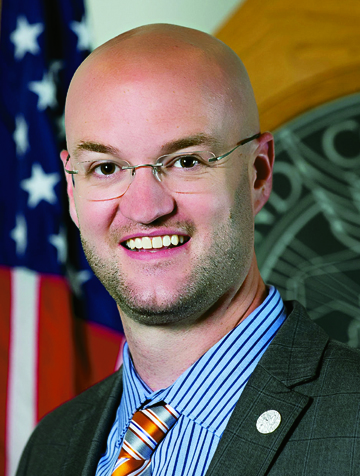 Old Abe Lincoln had sage advice for people like Denver City Council President Albus Brooks to wit:
“You can fool all people some of the time, and some of the people all the time, but you cannot fool all the people all the time.”
Brooks has aspirations to succeed the developer controlled Michael Hancock as mayor of Denver and he knows the best way to do so is to do the bidding of those exact same developers.
Of course, it is not smart to let your constituents know that you are bought and paid for so Brooks is always coming up with highly inventive ways of pretending to be a man of the people. Case in point is his incredibly duplicitous work on “Small Lot Parking Exemption” scam that former print company owner and now real estate developer Barry Hirschfield and others are unleashing on Denver’s neighborhoods. We highlighted this controversy in our lead story last October titled “Humboldt Neighbors And Allies Take On Barry Hirschfeld.”
Back in 2010 the Denver Zoning Code was revised to exempt lots of 6,250 square feet or less from parking requirements when redeveloped. As stated by Councilman Jolon Clark the exemption “was to catalyze business on small retail and commercial parcels along major arterials such as Colfax Avenue and Broadway, where there were empty store fronts and there was a real threat of a loss of neighborhood character by small lots being assembled.”
But the ever greedy Denver real estate developer community saw the exemption as another opportunity to stick it to the local neighborhoods. The exemption does not expressly limit itself to small retail and commercial uses and does not expressly prohibit assemblages for application of the exemption, but it would appear clear that such was the intent. Thus people like Hirschfeld came up with an idea of building coffin-like micro units on assembled lots and rent them to the ever ripped off millennials pouring into Denver, but with absolutely no parking provided. Of course, the majority of the millennials do in fact have at least modest cars. Thus in areas that these units are built, everyone in the neighborhood will find it difficult if not impossible to find any street parking at times.
The problem was that the developers’ incredibly strained interpretation of the exemption might not stand up in court even in Denver’s sad sack judicial system. The developers and their bought and paid for Denver Cit y Councilmembers needed time to amend the Zoning Code to remedy the problem, but they didn’t want to slow down any existing projects. And of course the citizens in various neighborhoods such as Cherry Creek North, Curtis Park and Humboldt Street were also screaming bloody murder about was being done to them.
That is when the evil genius of Albus Brooks took hold. He told the citizens that he would demand that the Council impose a moratorium on all such projects until a Steering Committee could be formed charged with coming up with a consensus solution. All interested parties would have a seat at the negotiating table. The citizens were thrilled when the City Council passed the moratorium unanimously.
They did notice that all actually existing plans including all of Hirschfeld’s projects were exempted. Also when a Denver city councilman says he wants to bring everyone to the table what he really means is that he will form a committee that is stacked in favor of the developers and their allies and citizens will be in a distinct minority. As a result, citizen representatives agree either to be browbeaten into submission or they will be simply outvoted by the developers and their allies. This is, of course, exactly what happened with Brooks’ Steering Committee which was chaired by the distinguished City Council President himself as an “honest broker” between the two sides.
The citizens quickly discovered that Mr. Brooks was being led around on a relatively short lease by Mr. Hirschfeld who was of course prominently placed on the committee. Brooks after listening to all sides proposed an amendment to the Zoning Code which specifically made clear that the Small Lot Parking Exemption did in fact apply to micro apartment units and as well as to assemblages like Hirschfeld’s. If approved by the City Council, the amendment would solve the developers’ greatest danger of a legal challenge to the City’s interpretation of the existing exemption. The amendment also allowed the full exemption for small lots for the first two floors of an apartment building and three floors within walking distance of rail stations and frequent transit corridors (whatever that phrase means). Even more importantly the City Council could waive any and all restrictions at any time for their favorite developers without specific notice to the affected neighborhoods. It was a compromise in which the Hirschfeld side gave up nothing and the neighborhoods gave up everything as was intended by Councilman Brooks from the very beginning.
But “surprise, surprise, surprise” as Gomer Pyle would exclaim, the neighborhoods were not taken in. Abe Lincoln’s admonition cited above in fact came true. In the Steering Committee all four neighborhood representatives voted “no” along with one real estate business representative. Of course, the developers and their allies had locked in eight votes so the “consensus compromise” passed eight to five. The neighborhoods groups had now caught on to the stacked voting trick and they also demanded parity in the voting rights between developers and the neighborhoods in all future deliberations, if any, of the Steering Committee.
Brooks tried another fast one by having representatives of the Orwellian named “Denver Community Planning and Development Department” try to con the Inter Neighborhood Cooperative (the umbrella group of neighborhood associations and others in Denver) into voting in favor of the “consensus compromise” but even they were shot down by a unanimous 32 to 0 vote.
With his con job falling apart along with his reputation, Brooks was even struggling at the City Council level with the honest city councilmembers led by Jolon Clark raising questions. Brooks had to postpone City Council approval of the scam and request an extension of the building moratorium.
Next time the neighborhood groups meet with Council President Brooks on matters such as parity in voting on the Steering Committee they quietly, but visibly, should have with them a pulled Recall Petition pertaining to Mr. Brooks. It will help to clarify the issues and the stakes for everyone involved.
— Editorial Board

by Mark Smiley | Jan 30, 2017 | Glendale City News
by John Arthur
Writer for and on behalf of the City of Glendale
Since the club’s founding more than a decade ago, the Glendale Raptors have been a pillar of community involvement, most notably through their extensive involvement with Glendale youth. Raptors team members and coaches spend time volunteering at Children’s Hospital every year, offer free and low-cost youth rugby clinics and programs, as well as a Rugby Academy where local youth can build rugby skills from kindergarten all the way to the professional level. The Raptors’ commitment to involvement with Glendale is an especially important aspect of the club’s overall mission, and not simply because it engages young people with positive mentors and promotes fun and fitness. Youth rugby programs have the added benefit of increasing awareness for the fastest growing sport in the United States, creating a new generation of players, coaches, and fans.
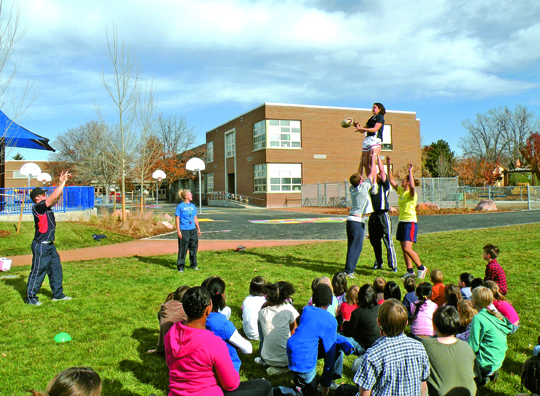 One of the most successful youth programs in 2016 was Rugby in the Schools, an offering spearheaded by Raptors Youth Programs Coordinator Jenna Anderson. Rugby in the Schools introduces the game through Rookie Rugby, a non-contact, educational format, specifically designed for presentations and instruction in school PE classes. Playing games and running drills, Anderson, alongside Raptors players and staff, introduces local schools to rugby’s inclusive nature, ensuring every child participates for the entire program period. Because rugby is often unfamiliar to local youth, everyone starts on an even playing field; as Anderson puts it: “We go in and it’s a clean slate. Everyone participates. Everyone is interested and every single child plays. Learning something new, as a group, is really important and really special.” Students experience the fun and excitement of rugby, as well as the importance of inclusion and good sportsmanship.
Anderson has led youth programming for the nine years since being brought into the Raptors club in 2008, but notes that 2016 was an especially busy year. The Raptors worked with 16 different local schools, and also held eight separate sessions elsewhere, including clinics at Glendale’s Infinity Park and for local nonprofits, as well as field days at local summer camps. According to Anderson, “2016 has really taken off. Teachers have shown a lot of interest in having rugby as part of their curriculum.” In addition to the host of benefits Rookie Rugby offers participating schools and students, the programming is and always has been entirely free of charge.
Rugby in the Schools is focused on communities surrounding Glendale, although dem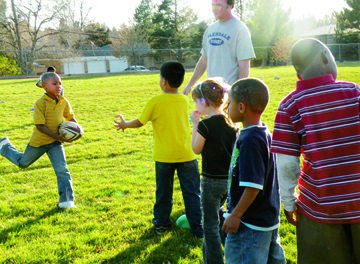 and exists all along the Front Range. In 2016, Anderson and the Raptors were a presence across metropolitan Denver, in both public and private institutions, though she admits the popularity of Rugby in the Schools has forced her to turn down requests from institutions located outside of the metro area. Working in physical education classrooms from kindergarten through 8th grade, she and players from the Raptors Men’s, Women’s, and Under-20 teams interacted with as many as 500 students per school. Engaging every interested student at each school, Anderson and her assistant volunteers spent between one and four days per location completing programming.
It’s difficult to point to any one reason why Raptors youth rugby programs blossomed in 2016. Clearly there are significant benefits for both the young participants and the schools they attend, but there is also something more. Rugby’s meteoric rise in popularity stateside in the last several years has been incredible, with Glendale at the epicenter of the sport in the United States. The reemergence of rugby in the 2016 Olympic games, combined with the Raptors’ successes on and off the pitch, have played a role as well. What is clear is that rugby is, in Glendale and the rest of the country, a sport that’s here to stay — and one that players and fans of all ages take great pride in.
Asked about her favorite part of Rugby in the Schools, Anderson says, “I love going and seeing kids who already play for the Raptors. They know we’re coming and they wear their Raptors shirts and it’s obvious that they’re really proud to be rugby players. It’s wonderful to see kids passionate about the sport.” The growth of rugby’s popularity in the United States shows no signs of slowing, and the work that Anderson and the Raptors are doing in community classrooms demonstrates that the next generation of players and fans is here to stay as well.