
by Editorial Board | Dec 15, 2025 | Editorials
Editorial —

Two adjacent skyscraper office buildings in downtown Denver located at 621 and 633 17th Street recently sold for $3.2 million. The buildings have nearly a million square feet of office space combined. Six years ago, the buildings were valued at $200 million – a 98% drop in value.
The purchase indicates the buildings were essentially worthless as office space. With a cost basis of $3.2 million, the buyer, Los Angeles developer Asher Luzzatto, could rent office space at extremely low rates and seemingly make a great deal of profit. But no, apparently there is almost no major market for rental offices downtown at virtually any price. Instead, the buyer is going to spend tens of millions to turn the buildings into 700 residences.
This developer is not the first one in Denver to come up with this idea. It was announced recently that the historic Petroleum Building will be converted from office space into residential units. The building was given its name as it was housing a myriad of businesses in the oil and gas business. No need to worry about such use as Governor Polis and the legislature have killed the oil and gas industry in Colorado in the name of preventing global climate change.
The problem is that there is no data out there indicating that people are dying to move to downtown Denver for residential purposes. In fact, Channel 7 in Denver recently ran a story entitled “Data shows people are actively avoiding moving to Denver” citing data from a MoveBuddha study. Moreover, as our front-page story indicates that apartment rental rates in Denver are going down reflecting lowering of demand.
At one time Denver could count on an influx of monied people from California but no longer. Why move from misgoverned Los Angeles and California to misgoverned Denver and Colorado. They are heading to red states such as Texas and Idaho.
So what in the world is the developer Asher Luzzatto thinking? Back in the Chronicle’s May 2024 edition we prognosticated in an editorial titled “No Mr. Mayor, the Woes Of Downtown Denver Will Not Be Saved By A Half Billion Dollar Retrofit Boondoggle” that proposed new Downtown Denver BID assessments would end up in the pockets of downtown office owners to help convert their buildings into residential properties. Rest assured that some of the bond proceeds from the just passed “Vibrant Denver” bonds will end up in the same pockets.
We assume that Asher Luzzatto is nobody’s fool. Most of the money to convert the two office buildings will come from governmental entities. If the project fails, the developer will lose very little money but if it succeeds the developer will very handsomely profit.
But what does the super bargain basement sale say about Denver’s economy? At a minimum the city’s budget will soon be in major trouble. Assessments for commercial property in downtown Denver will plummet, which will lead to a commiserate drop in property tax revenues.
Similarly, revenues from the head tax that Denver imposes on people who work in Denver will similarly drop.
Perhaps the proposed Burnham Yard redevelopment that includes a new Broncos Stadium will create some economic growth along with short-term boost from the newly approved Vibrant Denver bonds.
Ultimately reading the tea leaves, Mayor Johnston’s administration is betting on the farm downtown Denver becoming a residential hub through the conversion of office building into residences paid for by the government. If that bet fails hard times will likely await the Queen City of the Plains.
— Editorial Board
by Editorial Board | Oct 20, 2025 | Editorials
Editorial —

Comrade Polis
One of the keys to progressive left policies is to make sure people do not have any alternatives. When the Soviets imposed their form of communism on East Germany, it had to build the Berlin Wall to prevent the masses from escaping the workers’ paradise to West Germany. The progressives of North Korea attempted to prevent its citizens from escaping not only to South Korea but also to slightly less oppressive China.
Denver has decided it loves maximum density and a minimum number of cars. Afraid that not all Coloradans may want to live in Denver’s “affordability paradise,” the state legislature, as well as Governor Polis, have begun imposing Denver inspired restrictions and mandates on towns and counties across Colorado.
As a practical matter, progressives intensely dislike single family homes and, for that matter, nuclear families. The new law (HB 24-1152) prohibits local jurisdictions imposing mandatory owner occupancy laws and specific minimum square footage for residencies. No more single-family homes with those lots potentially becoming mini apartment buildings with streets jammed with cars. Since progressives can’t just say they hate nuclear families, they say what they are doing is make housing more “affordable” and fighting against “climate change.”
Housing will undoubtably become more affordable due to the legislature’s and the governor’s actions as fewer people will want to live in Colorado. The price of what were once called single family homes will plummet.
Next the state legislature adopted HB24-1313 which prohibits municipalities from adopting or enforcing parking requirements within a quarter mile of various transit stops. The legislature mandated that municipalities allow high density high rises near transit stops. The urbanization of Denver suburbs will, if successful, overwhelm infrastructure, strain schools, and destroy community character. In Polis’ mind what is there not to like?
Unfortunately, the proletariat outside of Denver have not been enamored by the Polis vision. Many communities refused to implement the necessary ADU regulations/ordinances. Moreover, six cities — Glendale, Greenwood Village, Arvada, Aurora, Lafayette, and Westminster — sued the state to stop the implementation of the legislation.
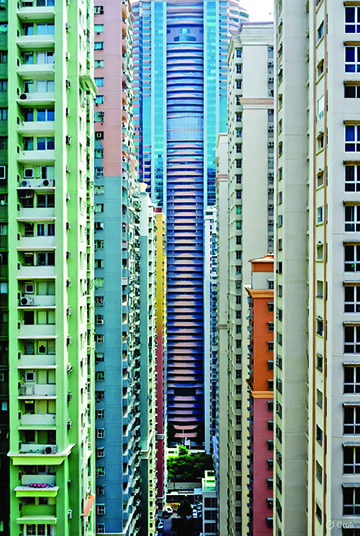
Polis’ vision of what suburbs in Colorado should look like.
Watching the peasant revolt, Governor Polis looked to President Trump’s authoritarian tactics for inspiration. Polis elected to issue an executive order that the rebel cities either comply or face losing out on $277 million in housing grants. Of course, there is nothing in the State Constitution or state statutes giving him the power to do so, but then again where does Trump get the authority for many of his executive orders.
The rebel cities in their lawsuit rely on the over century-old Article XX, Section 6, allowing home-ruled cities to operate free of state control on matters of local concern including zoning and land use. There are no exceptions for affordability and/or climate change. While on the surface the rebel cities appear to have a slam dunk case, Polis knows he has appointed many of the judges who will hear the case at the district court level and on appeal. Colorado courts have already largely gutted large parts of the citizen adopted constitutional amendment called the TABOR amendment. The Colorado Supreme Court was also happy to try to deny Republican voters the right to vote for Trump for President until the U.S. Supreme Court intervened. As a result, few people these days have any trust in the Colorado courts to fairly adjudicate the meaning of the state Constitution or Colorado laws.
It is well known that Polis is seriously looking at running for U.S. president in 2028. He would appear to be a worthy successor to the power-hungry Donald Trump.
— Editorial Board

by Editorial Board | Sep 29, 2025 | General Featured
Guest Editorial

Bianka Emerson
by Bianka Emerson
Bianka Emerson is President of Colorado Black Women for Political Action and is a gubernatorial appointee to the Environmental Justice Advisory Board for the Colorado Department of Public Health and Environment.
In America, turning on the kitchen faucet for a safe glass of water should be a given, not a gamble. Yet for far too many communities already burdened by environmental hazards, that simple act comes with fear and uncertainty
The tragedy of Flint, Michigan, is never far from mind, even here in Colorado. Every time I fill a glass, I want to trust that the water is safe. I want to trust that the taxes I pay, and the water bills I shoulder, are funding a system built to protect my health, not quietly threaten it. And I want my family, friends, neighbors, and people I fight for every day to share same trust.
But too many of us can’t.
One reason is simple: we don’t even know how many lead pipes still exist in our drinking water system. That uncertainty is the shadow of Flint, a reminder that what we don’t know can harm us.
And lead isn’t the only danger.
Polyvinyl chloride, or PVC, is one of the materials commonly used for pipes in drinking water systems today. PVC is promoted by the industry as a quick fix, but that convenience comes at the expense of long-term public health. Especially because there is an ugly truth that gets buried in the sales pitch by the plastics industry: PVC contains toxic chemicals that can leach into our drinking water. And as with lead, the communities most likely to bear the risks are the same ones already overburdened by environmental hazards.
This is a clear case of environmental inequity, with the heaviest burdens falling on communities already overexposed to pollution and under-protected by infrastructure.
PVC is made from vinyl chloride, a known human carcinogen. Its production releases dioxins and other dangerous byproducts into the air, often in or near neighborhoods with limited resources and political influence. From manufacturing to disposal, PVC leaves a toxic footprint. And when used in drinking water systems, the danger doesn’t stop at the factory gates as chemical additives can migrate into the water itself, especially as the pipes age, degrade, or are exposed to high temperatures.
The push for PVC fits right into this inequitable pattern. When city councils and utility boards opt for PVC, they’re making long-term decisions. And when those pipes begin to degrade, as all plastic inevitably does, it won’t be the contractors or suppliers who suffer the consequences: it will be us who are drinking water laced with endocrine-disrupting chemicals; it will be elders with compromised immune systems; and it will be pregnant women, children just starting their lives, and babies, all of whom are uniquely vulnerable.
What’s worse, PVC production itself is an environmental justice disaster. Look at Cancer Alley in Louisiana, an 85-mile stretch of the Mississippi River lined with more than 150 petrochemical plants. Many of those plants, including PVC manufacturers, operate in communities where residents face some of the nation’s highest cancer rates due to chronic industrial pollution. Residents there suffer some of the highest cancer rates in the nation. The same corporations making the PVC pipes pitched as “safe” for our water are also polluting the air these communities breathe.
Drinking water utilities in Colorado should adopt a precautionary principle: if a material poses a plausible risk to human health, it doesn’t belong in our drinking water systems. Safer alternatives exist, and they don’t come with the same long-term health liabilities.
Second, communities must have a seat at the table in infrastructure decisions. Too often, these choices are made behind closed doors, with little public notice or opportunity for input. Residents deserve transparency about the materials being used in our water systems and the health risks they carry.
Finally, we need national standards that address the environmental justice dimensions of water infrastructure. The U.S. Environmental Protection Agency should not only regulate chemicals leaching from drinking water pipes but also consider the life-cycle pollution of materials like PVC, especially in vulnerable communities. The EPA is already investigating the human health risks associated with vinyl chloride, which tells us just how dangerous that chemical is.
For generations, the health of marginalized communities has been the price of cheap infrastructure. PVC is just the latest chapter in that story. We have the knowledge, the resources, and the alternatives to write a different ending, and it’s one where safe water is a universal right, not a privilege reserved for some.
The pipes we choose today will carry water into our children’s bodies for generations. Let’s make sure those pipes carry life, not poison.
by Editorial Board | Sep 19, 2025 | Editorials

The Life in Saigon in the 1960s, by François Sully
Seldom, if ever, has Denver’s progressive Mayor and the majority of the City Council annunciated that the solution to a problem in the city is to let the “free market decide.” But now, all of the sudden, they have advocated that the solution to parking woes in Denver is henceforth to let the free market decide. For future developments or redevelopments there will be no city mandated parking minimums. Developers will be the ones to decide what, if any, parking is necessary or advisable for their projects.
What has caused this sudden change of philosophical outlook? The answer is obvious. The powers to be believe that many preternaturally greedy and short-sighted Denver developers will elect to provide the least amount of parking possible hoping to cannibalize off neighboring businesses or on-street parking. That will make automobile use in the city even more problematic.
But why do Denver’s planners and political class dislike cars? They believe, inter alia, automobiles are a major source of carbon dioxide contributing to climate change which will eventually destroy the planet. They also believe that automobile-oriented societies adversely affect the poor who can’t afford a car or drive cars that necessarily reflect their socio-economic status.
Cars also facilitate urban sprawl. Progressives correctly note the densely packed areas tend to be far more likely to lean left and favor increased governmental solutions to societal problems. Cars also provide a certain degree of personal freedom for people to travel where and when they wish. Individual freedom, however, is not a value prized by progressives.
An advantage to Denver’s approach to parking is that the city is looking to let an ever-increasing number of city employees go. Traffic engineers whose job it is to make car traffic flow more easily are now expendable as the city wants to make traffic more congested. As hard as that is to believe in some respects it is obviously exactly what is being planned. The number of traffic lanes on major thoroughfares in the city such as Colfax and Broadway are being reduced. On neighborhood streets, bollards and striping are intended to be “traffic calming devices” making traffic flow more difficult.
In turn dedicated bicycle lanes are expanding across the city. It appears the vision for urban transportation are buses, bicycles, and walking. For those old enough to remember, that was the transportation mode for Saigon, Vietnam, circa 1965.
Do most people want to live in or visit a city whose transportation plan reflects that of 1965 Saigon? Tax revenues for Denver have been steadily dropping but the city does not appear to care. The city depends on Coloradans coming to shop and recreate. By making the city less friendly for cars it makes it less likely people will come visit.
City planners indicate they would like to see Denver be a place where the concept of a “15-minute city” becomes a reality. In such a place daily necessities are all accessible by a 15-minute walk or bike ride from home. The peasants in Germany and the serfs in Russia in the 12th century lived in 15-minute communities. American coal miners were forced to live in company towns in the late 19th century.
Throughout history so-called utopian communities turned out to be lousy places to live. Denver’s city planners may be doing the same to Denver in their quest to make it a “15-minute city.” Only time will tell.
— Editorial Board

by Editorial Board | Jun 20, 2025 | Editorials
by Erik Clarke

 Denver voters approved the $937 million Elevate Denver Bond Program in 2017 to fund nearly 500 civic infrastructure projects across our city. Nearly a decade later, while many worthwhile improvements have been made, far too many projects remain unfinished, delayed, or over-budget. Now, city leaders are preparing to ask voters to approve another general obligation bond- the proposed “Vibrant Denver” bond package, which could target $800 million in new spending.
Before we issue another nearly-billion dollars in taxpayer-backed debt, Denver residents deserve accountability for how the last billion was spent.
Despite the size and complexity of the Elevate Denver bond program, and a smaller follow-up package, the Auditor’s Office has never conducted a dedicated performance audit of the program. That must change — immediately. We need an independent audit to assess which projects have been completed on time and on budget, which have fallen behind, and whether taxpayer dollars were spent effectively and efficiently. Denver residents deserve full transparency before we make another bond decision.
I am also deeply concerned by the possibility that this new Vibrant Denver bond might be used, either quietly or indirectly, to complete unfinished prior bond projects. If that is the case, the public has a right to know. No Vibrant Denver bond dollars should be used to backfill Elevate or Rise bond cost overruns unless it is explicitly stated, clearly labeled, and fully explained to voters prior to the bond being placed on the ballot. The City should also expand the existing bond dashboard to include a budget-to-actuals for each project, with supporting material, and an estimate of cost to complete.
As of June 2025, 13 projects are still being developed, but 105 projects have not even broken ground. Examples of projects that are not even in production, include transportation projects (62), parks improvements (34), and improvements to city-owned facilities. The unstarted projects even include public safety renovations, like improvements to police district 6 and fire station 40. There are roughly $171 million worth of projects in the in-design phase. This is a significant chunk this late in the game.
Bonds are essential tools for building city infrastructure. I’m far from being anti-bond. But bond projects require strong oversight and transparency. With global economic concerns, questions about public budgets, concerns about construction oversight, and more, the public needs to be able to trust that their taxpayer dollars are being safeguarded.
If Denver voters approve the Vibrant Denver bond, we need more, earlier oversight of these construction projects. That means that targeted project-based audits in the first few years of the bond cycle should be prioritized. If there are delays or cost-overruns early in the bond cycle, then folks should be aware of it. Oversight shouldn’t be an afterthought that comes near the end, once taxpayer dollars are already spent. Construction oversight should be a part of the foundation of good management.
If we want to make Denver a well-run, opportunity city, then we need to invest in Denver’s future. We also need to be sure that our investment is getting results. We need to do our due diligence prior to making voting decisions. The time is now for greater transparency and accountability. You, as taxpayers, deserve it.
Erik Clarke is an Executive Controller in the private sector and was in leadership roles at major accounting firms, specializing in internal audit and financial advisory. He has managed performance, construction, cybersecurity, and financial audits at nearly two dozen organizations.