
by Mark Smiley | Jan 21, 2022 | Travel
by Mark Smiley
 Wynkoop Brewing and Head Brewer Todd Bellmyer have brewed a new West Coast IPA beer, Much Needed Moisture IPA, to help those impacted by the Boulder wildfire. All proceeds from sales of this beer will be donated to the Boulder County Wildfire Fund. This beer launched on Friday, January 14, at Wynkoop Brewing Company, Ale House Denver, and both Cherry Cricket locations. Wynkoop’s parent company will make a 1:1 matching donation.
The golden hued brew features copious amounts of six different hop varieties and an ABV of 6.7%. The aroma is slightly tropical with a light bitterness and that classic West Coast IPA flavor.
Wynkoop Brewing opened in 1988 in Lower Downtown Denver and is Colorado’s first brewpub. For nearly 35 years, they have been brewing handcrafted beer in the basement brewery underneath Denver’s largest pool hall. Over the years the neighborhood has transformed and Colorado’s craft beer industry has exploded.

Fundraiser: All proceeds of the sale of Much Needed Moisture IPA benefits the Boulder County Wildfire Fund. The beer is available at Wynkoop Brewing Company, Ale House Denver, and both Cherry Cricket locations.
In addition to craft beer, Wynkoop offers an extensive menu complete with items such as nachos, mussels, a variety of salads, burgers, short ribs, pasta, and more. Executive Chef Chris Collins takes pride in the menu that he has put together. Collins is no stranger to Denver as he was the head chef at the Inn at Cherry Creek, a now closed popular spot in Cherry Creek North.
Wynkoop Brewing is located at 1634 18th Street in Denver. Visit wynkoop.com for more information or follow them on Instagram @wynkoopbrew.
by Laura Lieff | Jan 21, 2022 | Glendale City News
by Laura Lieff
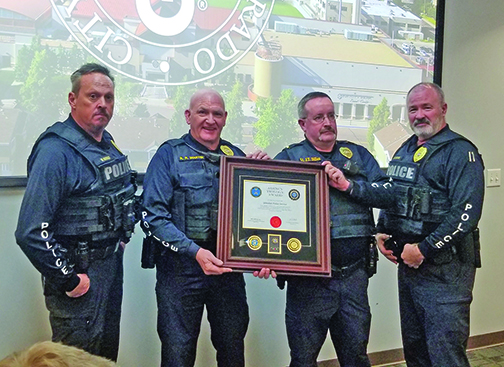
The Glendale Police Department started 2022 off with high honors. At the January 4 Glendale City Council meeting, officers from multiple divisions — including dispatchers, patrol officers, detectives, victims advocates, evidence technicians, and records technicians — were awarded a Unit Citation for their outstanding performance in two complex cases from 2017 and 2019.
“Everyone worked extremely hard on these complicated cases and that thoroughness resulted in identifying suspects and getting confessions,” says Chief William Haskins.
High Honors: The Glendale PD command staff earned the coveted Trilogy Award for completing all three FBI Law Enforcement Executive Development Association courses.
In October 2017, the manager was shot at Shotgun Willie’s when a small group was denied entry. As soon as the Glendale PD dispatchers received the call, they began collecting information which allowed officers to get to the club quickly and restore order in a chaotic situation. Haskins says the officers collected statements from people who were on scene and then detectives began digging through the information.
“Unfortunately, situations happen when there just isn’t enough information to show prosecutors,” Haskins explains. “But in this case, everyone continued pursuing every lead available until they were finally able to identify the suspect who was already in custody in federal prison on unrelated charges. Our detectives got a confession, and the suspect took a plea bargain for 18 years.”
Diligence And Hard Work
In November 2019, the Glendale PD received several calls at 3 a.m. about shots fired in the area. Officers arrived on scene and found a car, riddled with bullet holes, that had driven off the side of the road. The driver had also been shot to death. Although Haskins describes the amount of evidence as minuscule, Glendale detectives eventually figured out that the shooting was part of a much larger series of incidents involving the MS-13 crime gang operating in Colorado.
“We worked with other jurisdictions, the violent crimes task force, and ATF because the criminal subculture around MS-13 is that they don’t talk,” says Haskins. “By coordinating with these other agencies — and through good old-fashioned policework — they were able to identify the suspects and bring forth charges.”
As a result of the Glendale PD’s hard work and persistence, the District Attorney’s office felt they had enough evidence to prosecute. Although the MS-13 case is still ongoing, and hasn’t gone to trial yet, the Glendale team was able to put the pieces of the large, complex puzzle together and identify suspects.
FBI Training
In addition to the effort put into the 2017 and 2019 cases, the Glendale PD’s Command Staff — including Chief Haskins, one captain, and two lieutenants — took time to sharpen and update their skills by completing FBI Law Enforcement Executive Development Association (LEEDA) courses. According to the website, the FBI LEEDA provides executive law enforcement continuing education for police leaders across the United States.
LEEDA’s core training curriculum is comprised of three classes: Supervisor Institute, Command Institute, and Executive Institute. The Supervisor Institute covers personality diagnostics, leadership case studies, mentoring, performance and risk management, and credibility. The Command Institute discusses discipline and liability, dealing with problem employees, and leading change within an organization. The Executive Institute teaches trends in law enforcement, implications of the 21st Century Policing Report, bias and diversity, employee wellness, and transformational leadership.
According to Haskins, successfully completing just one of the three FBI LEEDA courses is a huge accomplishment for an individual. Completing all three — also known as the Trilogy Award — is extremely impressive. When an entire command staff takes law enforcement education even further by achieving all three, that is another level of excellence.
“When I took over as chief, I wanted Glendale to be the best police force in the nation, and that includes ongoing training at various levels,” Haskins explains. “This is a huge achievement for our department because it enables everyone to use the same tools to move the agency forward.”
Adds Mayor Mike Dunafon, “It’s an honor to work alongside the men and women of the Glendale Police Department. They work tirelessly to keep the citizens and businesses of Glendale safe and truly embody the spirit of the motto ‘to protect and serve.’”
by Regan Bervar | Jan 21, 2022 | Main Articles
“The smallest of actions is always better than the noblest of intentions.” — Robin Sharma
 by Luke Schmaltz
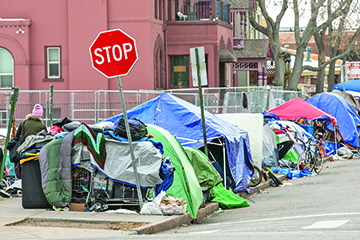
Tent-lined streets, debris-strewn sidewalks, and people languishing amidst it all — either injecting illicit drugs, relieving themselves, or walking around naked — have become unfortunate characteristics of central Denver.
According to an August 2021 report published by the Metro Denver Homeless Initiative (MDHI), 5530 individuals were unhoused or experiencing homelessness in Denver. These numbers reflect a February 2021 Point-in-Time (PIT) count, which may have fallen short of the actual numbers due to the safety issues of collecting in-person data due to Covid-19.
Of this populace, some turn to one of the numerous shelters across the greater downtown area. Others choose to “live on the street” in one of the many unsanctioned encampments in and around the city center and beyond. Yet others — perhaps the more fortunate of the destitute — have found temporary shelter in a Safe Outdoor

CVC: Colorado Village Collective is the purveyor of Safe Outdoor Spaces.
Space (SOS). The latter is a relatively novel form of addressing homelessness, and in Denver the primary administrator of such sites is known as the Colorado Village Collective (CVC).
The CVC is a Denver-based nonprofit led by ordained minister Cole Chandler, a Baylor University graduate with a Master of Divinity (M.Div.) degree. This NGO’s (non-governmental organization) boilerplate states, “Colorado Village Collaborative (CVC) exists to bridge the gap between the streets and stable housing. CVC is working to advance dignified solutions that significantly reduce Denver’s unsheltered homelessness population. Since its founding in 2017, CVC has launched five transformational housing projects, including two tiny home villages and three Safe Outdoor Spaces that have provided more than 54,815 nights of safe, dignified shelter in partnership with people coming from homelessness.”
An Honorable Pursuit
Currently, CVC maintains three Safe Outdoor Spaces. One is located on the Regis University campus in Northwest Denver, another at the Denver County Department of Human Services, 3815 Steele St., and a third, more recent site at 780 Elati in the Lincoln/ La Alma community on Denver Health and Medical Center property. This installment was pursued, in part to replace the Park Hill SOS (previously located at the United Methodist Church), and in part to offset removal of the large, unsanctioned encampment at the Four Winds American Indian Council at 5th and Bannock St. in the Baker District.
Jennifer Forker, M.Div., is the organization’s Development and Communications Director. She agrees that her organization had a busy 2021, stating, “We served nearly 300 people [last] year, a 300 percent increase over [the previous] year. We aim to serve more than 400 people in 2022. Our outcomes for 2021 include assisting 17 tiny home village residents and 47 SOS residents into more stable, permanent housing.” Forker also maintains that, “The city and the mayor have supported our emergency, temporary housing model, and we have a new contract to operate Safe Outdoor Spaces going before the City Council this month. We hope to have their support so we can carry on with our mission.”
Trouble In Paradise
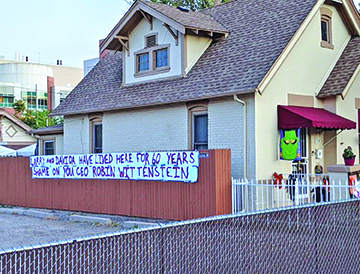
Opposed: Neighbors of the Safe Outdoor Spaces site at 780 Elati do not approve of Denver Health’s new installment.
At first glance, the CVC’s mission statement, their accomplishments, and the Denver city government’s endorsements are impressive. Yet, the SOS model is drawing scrutiny and outright criticism from residents and community leaders alike — particularly the most recent installment at 780 Elati St. The standout issues arising from the SOS model include concerns about neighborhood safety, the presence of undisclosed sexual predators, sanctioned use of illicit drugs, and inadequate solutions for citizens — people with addiction issues and mental health conditions — who require long-term comprehensive care.
Blame for the perpetuation of these concerns is aimed not only at the CVC, but even more so at Denver’s city government at large. Concerned local resident and native Coloradan Marc Spritzer sums it up succinctly, stating, “The city is, in my estimation, derelict in its duty to govern. They only enforce the laws they want to, not all the laws equally. They are not protecting citizens, including the unhoused. I would say what they are allowing them to do is even more cruel in the long run than sweeps. This is all really poor leadership — the Mayor, the City Attorney, the DA, the Judges, the city council, the State Legislators, and the Governor all have a hand in this.”
Despite this viewpoint, Britta Fisher, executive director of Denver’s Department of Housing Stability states, “Denver’s Safe Outdoor Spaces are making a difference in fostering stability, serving as a refuge to help move people from homelessness to housing. With 24-hour staffing, sanitation, support, and a myriad of services, temporary managed campsites are clearly transforming lives in our community. We are fortunate to have the Colorado Village Collaborative leading this innovative model, and the Department of Housing Stability is working to provide more support for safe outdoor spaces.”
Battlefield: Baker
Meanwhile, Dawn McNulty is a married mother of two, a longtime Baker district resident and an outspoken leader in the effort to expose and counteract the oversights of Safe Outdoor Spaces. “I personally do not see the proposed Safe Outdoor Spaces [to be] the compassionate, humane solution to Denver’s homeless problem,” she says. “In my humble opinion, it’s an interim solution that takes the pressure off the public officials.”
McNulty lives near the site of a previous unsanctioned camp at the Four Winds Tribal Council Church at 5th and Bannock. She was vocal, vigilant, and relentless in her efforts to draw attention to the hazards therein. “There was a woman with children living in a tent, and several people in the encampment openly doing illicit drugs on a daily basis,” she states. “There was vomit, human feces, urine, and needles in and around the camp, and when school at DCIS Baker (Denver Center for International Studies) started back up, I personally contacted Jolon Clark (Denver City Council) and then the Mayor’s office,” she explains. Once the camp was set to be “swept” the 780 Elati space was offered up by Denver Health to assuage the pleas for options from the Four Winds Tribal Council.
According to McNulty and other prominent community figures, the site was chosen, approved by city leaders, and the SOS build initiated with little to no engagement with the surrounding community, in spite of the fact that nearly 50 residents filed a joint appeal opposing the site. “This is when my good friend that lives in the Lincoln/La Alma community swiftly filed the appeal,” McNulty explains. “There was very little community engagement and a significant lack of transparency in the speedy process of placing the SOS site.”
Refutation Abounds
Details of this appeal are outlined in a December 6th article published by Business Den.com. In it, author Eric Heinz writes, “The 46 nearby residents claim the permit was approved outside of the authority of the zoning administrator and that the site was approved without accounting for ways to control various nuisances, such as its proximity to single-family homes, secondhand smoke, noise, outdoor lighting, littering, and pet control. They [permanent-housing residents] also have concerns about odors emitting from the portable toilets, and say that a potential homebuyer decided not to purchase in the neighborhood because of the encampment.”
Further, the La Alma/Lincoln Park RNA (Registered Neighborhood Association) released a statement on November 22, 2021, providing an in-depth expose titled “CVC Refuses to Provide Assurances to Low-Income, High-Minority Neighborhood Residents.” Here, the RNA states, “The 780 Elati site is operationally unprecedented for CVC. CVC will be operating the TSOS (Temporary Safe Outdoor Space) for the longest period of any TSOS to date. It will have the highest number of shelters. It will have the highest population of any previous site. Despite these factors and the unique characteristics of the neighborhood, CVC is unwilling to provide meaningful assurances to the neighborhood, something it has done with other neighborhoods. Therefore, the RNA reports that CVC has failed to negotiate a meaningful Good Neighbor Agreement.”
Safety Last
Homeless Camps: Encampments across the city are expanding.
Meanwhile, McNulty is quick to illustrate her growing concerns about the new SOS site in the La Alma/Lincoln Park neighborhood. “81 % of Denver voters opposed camping,” she begins. “How are Safe Outdoor Spaces any different when they allow use of illicit drugs on site?” Contrary to this, The CVC’s Jennifer Forker plainly states, “We do not allow violence or drug use in our Safe Outdoor Spaces.”
McNulty, however, provides an outright rebuttal to this, stating, “CVC Section III(O) of the Drug and Alcohol Policy in the Operational Plan for the 780 Elati encampment acknowledges there will be drug use at the site, which specifically provides for harm reduction materials available throughout the site, biohazard containers [for needles], Narcan/Naloxone, and safe use literature,” she says. “CVC allows and enables the use of illicit drugs in law abiding, tax paying, Denver citizen communities. With the certainty of mental health issues amongst this population, there is extreme opportunity for erratic, unpredictable behavior and Denver City officials are in support of this?” An exasperated McNulty continues, “Unlike prior SOS sites, CVC was unwilling to agree to Felony/Child/Violent Sex Offender resident background checks for 780 Elati Street, the Lincoln/La Alma SOS Site. Per the Colorado Sex Offender Registration Act, CVC should be required to disclose this information.”
Among McNulty’s concerns, another glaring oversight is the possibility that untrained, unqualified CVC personnel may be staffing Safe Outdoor Spaces which are occupied by people with addiction and mental health issues — since CVC claims to have personnel on site at all times. “CVC self-manages their SOS environments with 24/7 support staff, minimizing the need for police intervention,” McNulty explains. “Yet, they are unwilling to disclose incident reports to the communities [in which] they reside. This is important health and safety information for communities where the SOS sites are located, as the [SOS] residents are free to roam these communities.”
Diagnostic Prognosis

Stepping In: CVC is doing the civic duty of the Denver city government.
Currently, what it all seems to add up to is a non-governmental organization doing important civic work for the homeless which an existing and capable city government is unable or unwilling to do themselves. In the process, taxpaying, law-abiding citizens are becoming deeply concerned for the sanctity of their communities while the SOS initiative — although worthwhile — is putting but a tiny dent in the overall issue of homelessness. Ironically, it appears that just about everyone involved has, more or less, the same interest in mind: to mitigate homelessness and curtail the inhumane conditions experienced by the unhoused. The issue is pervasive and has been a forefront concern for decades. Yet, the concerns have become nuanced — and groups from one neighborhood to the next want solutions that resonate with their specific concerns. This is an instance where solidarity between HOAs, neighborhood watch groups, the Denver Police Department, SOS providers, mental health experts, and — most importantly — homeless people — could create a sustainable solution for a long-term problem.
Not to be outdone, however, the Denver Department of Housing Stability (HOST) has alas, announced their own initiative. The “Five-Year Strategic Planning Efforts” addresses all of these issues and more. The 14-point plan includes goals to “Reduce unsheltered homelessness by 50%,” “Measurably end veteran homelessness,” “Reduce the average length of time residents experience homelessness to 90 days,” and much more. Whether they can achieve these aims after grossly underperforming in this arena for decades is a subject for deep speculation. But, if you’re a betting person, it’s best to anticipate a strikeout rather than a home run.
by Jessica Hughes | Jan 21, 2022 | Main Articles
by Jessica Hughes
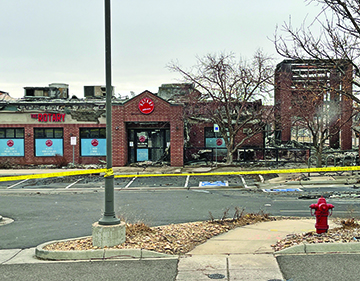
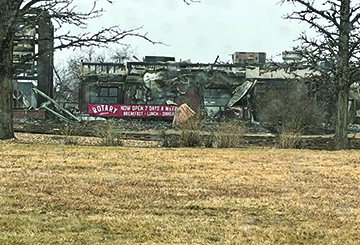
Out front, the day after the fire. Photo provided by Scott Boyd
Local Denver restaurant, The Rotary, first opened its doors in January 2021, at the corner of Holly Street and Cedar in the Hilltop neighborhood. They opened during the pandemic, and now, almost exactly a year later, are recovering from the Marshall Fire that recently scorched parts of Boulder County.
The Rotary’s second location in Louisville opened on December 15, 2021. But two weeks after opening, the wind-fueled Marshall Fire ignited on December 30, quickly ripped through the towns of Louisville and Superior, destroying nearly 900 homes in the short time of six hours.
Scott Boyd, a Louisville resident and co-owner of The Rotary, remembers that day looking out the window of his home as he headed to work at the restaurant. The first thing he noticed was a bunch of smoke and wind. When he arrived at work, there was even more smoke and the same wind intensity, plus ash inside the restaurant. Soon, the smoke and wind became bad enough that he decided to close for the day and sent everyone home.
As he was shutting down the restaurant, Scott peered across the parking lot in amazement as nearby bushes rose in flames
Fire damage seen from the backside of the restaurant. Photo provided by Scott Boyd
and watched as the fire quickly advanced toward his restaurant. Locking the door behind him, he fled and went home to grab his wife, kids, and pets.
Boyd and his family evacuated to a friend’s house in nearby Niwot, where they watched the destruction of the restaurant through the surveillance cameras. “It was so surreal,” says Boyd. “To watch in real-time as the flames tore through the restaurant.” But as he watched with his wife, kids, and friends, he knew he wasn’t alone in this. “It was nice to know I had support.”
Fortunately, Scott’s home was not one of the ones destroyed. He says he feels fortunate to only have lost a business and not his family’s home and belongings.
“Now begins the challenge of rebuilding,” Boyd says as he describes the mess that was left after the fire. Between the fire sprinklers that soaked everything and then the snowstorm that followed the next day, freezing almost everything, including pipes, there are many factors to consider in terms of the damage. The process to rebuild will take some time with COVID and current supply chain issues, but nonetheless, they do plan to rebuild in Louisville.
Boyd says so many people have reached out to see how they can help, but he says, “Find a family that lost everything and give them the help. We’ll be fine.”
The Rotary was started by Scott, his

Inside The Rotary before the Marshall Fire. Photo provided by Scott Boyd
brother Brian, and their life-long friend Don Gragg, a celebrated chef. What began with a space inside the Avanti Food and Beverage in Denver, quickly required its own space as the COVID pandemic made it hard to sustain a seat at the table inside a food hall.
Eventually opening a standalone establishment in Denver’s Hilltop Neighborhood, the three owners saw their life-long dream of owning and operating a restaurant realized, all in the middle of a pandemic. What was a real hustle to stay afloat during 2021, they knew they had something special and forged on. “We’re like the little restaurant that could,” Boyd chuckles.
“We’ll come out stronger on the other side of this,” says Boyd, who feels the community has done an excellent job of coming together with donations and volunteering to help clean up the affected areas.
You can help Boyd and others affected by the Marshall Fire by donating at:www.commfound.org/grants/get-grant/Boulder-County-Wildfire-Fund.