Polis Declares End Of COVID Emergencies And Mask Mandates
So Why Are We Still Wearing Masks? Mask Mandates Cause End Of Tri-County Health
by Charles Bonniwell
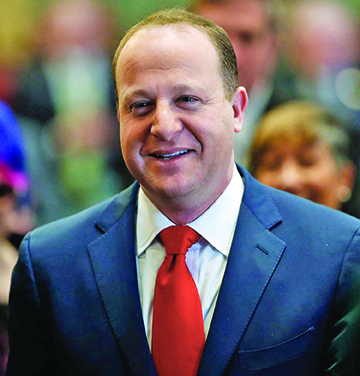
Canny Politician: Colorado Governor Jared Polis has gone on a national media tour receiving praise for declaring the COVID-19 medical emergency over and the lack of any need for mask mandates while 75% of the state’s population still remain under local mask mandates.
Colorado Governor Jared Polis made national news by appearing on Colorado Public Radio and declaring that after 16 months since he issued a medical emergency, the emergency was “over” and that there would be no statewide or vaccine requirements. He opined that:
“You don’t tell people to wear a jacket when they go out in winter and force them to (wear it). If they get frostbite, it’s their own darn fault. If you haven’t been vaccinated, that’s your choice. I respect that. But it’s your fault when you’re in the hospital with COVID.”
It was quite a reversal from just a few weeks earlier when he halted elective or cosmetic procedures to try to save hospital beds for COVID patients.
So why then are people in Metro Denver still wearing masks? Polis had stated that, “Public health [officials] don’t get to tell people what to wear; that’s not their job.” That is apparently not what some local health officials in Colorado believe.
On November 23, 2021, Denver Mayor Michael Hancock reinstated mask mandates requiring all indoor Denver businesses and venues “mask up” unless they choose to require proof of vaccination. Hancock followed the lead of Jefferson, Adams, and Arapahoe counties.
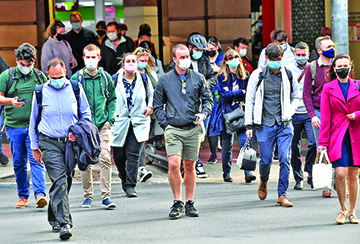
Still Under The Mask: Notwithstanding Colorado Governor Jared Polis declaring the COVID-19 pandemic emergency over and there being no need for statewide mask mandates, 75% of the population of the state are under some form of a mask mandate.
Tri-County Health Acts
Tri-County Health Department had preceded Hancock after waiting in vain for Polis to impose new statewide mask mandates. “If the state is unwilling to act, metro-wide action to implement mask mandates can provide some benefit given the size of our population and number of hospitalizations,” said Dr. John Douglas, executive director for the Tri-County Health Department, which covers Adams, and Arapahoe counties.
Other counties in Colorado that also presently have mask mandates are Boulder County, Larimer County, Pitkin County, and San Miguel County. In fact, notwithstanding the lifting of the state emergency by Polis, over 75% of the population of the state still live under mask or vaccine mandates.
Polis was not going, however, full Governor Ron DeSantis, who banned all local mask mandates in Florida.
While Polis received generally positive press nationally on his declaration that the COVID-19 emergency is over, not everyone in Colorado was thrilled. The editorial board of the Aurora Sentinel criticized Polis saying his action was “a grave disservice” to the state and that “the pandemic emergency in Colorado and across the nation is not over. It is far from over.”
The Destruction Of Tri-County Health
Local mask mandates are also not popular in Colorado in some circles. The Tri-County Health Department was until recent ly considered the premier and most respected health department in the state covering 1.3 million people (25% of the state population) in Adams, Arapahoe, and Douglas counties with 431 employees. Founded in 1948, it will be totally dismantled in just over one year due almost solely to mask mandates. Many blame Dr. John Douglas, the 69-year-old executive director of the department, and his insistence on mask mandates.
The Tri-County Health mask mandates, first ordered in July of 2020, allowed municipalities and counties to opt out. Those mask mandates preceded those that Polis issued statewide. At the time, Polis announced: “Wearing a mask is not a political statement. I don’t know how, in anybody’s mind, this became a political football.”
Douglas County, all of whose county commissioners are Republicans, balked and threatened to leave Tri-County Health when Tri-County decided to prevent counties from opting out from its mask mandates. Douglas County formalized its withdrawal in September of 2021. At the time, Tri-County also imposed the mandate for all people above the age of two in all schools and childcare facilities.
Adams County, all of whose county commissioners are Democrats, had also opted out of the Tri-County Health mask mandates. When that option disappeared, on October 19, 2021, the commissioners elected to leave subject to the mandatory one year notice.
That only left Arapahoe County whose county commissioners are split between Republicans and Democrats. On December 14, 2021, Arapahoe County, after over 60 minutes of public testimony demanding that the county get out of and remove the mask mandates and other COVID-19 restrictions, the commissioners voted to say goodbye to Dr. Douglas and his Tri-County Board.
Douglas Views The Wreckage
When interviewed by The Denver Post on the dissolution of a 74-year-old institution like Tri-County Health over mask mandates, Dr. Douglas stated:

Clueless: The executive director of the Tri-County Health Department, Dr. John Douglas, is blamed for the demise of the 74-year-old institution with mask mandates of dubious value. If the 400 plus workers of Tri-County’s Health Department who are losing their jobs are looking for a mea culpa from him they will be disappointed as he doesn’t appear to see what he might have done differently.
“If you had asked me to take a multiple-choice test three years ago about what would be the most controversial issues if we were to have a pandemic, and mask-wearing was one of my options, it would have been last on whatever list you gave me. I could just not have imagined that this would have become so.”
Given that the efficacy of non-surgical masks in preventing COVID-19 is a matter of dispute particularly as it applies to children, it does not appear to occur to Dr. Douglas that perhaps he should have given some credence himself to listening to all of the people who went before the various county commissioners demanding to leave Tri-County Health over mask mandates.
The question remains, given all that has happened, why most Coloradans are still required to wear masks. As a practical matter, the mandates of Tri-County Health are still law until the end of 2022 when the entity dissolves. Of course, people want to wear masks for health or political reasons. Enforcement of mask mandates, however, won’t be a law enforcement priority so many who do not enjoy wearing masks will flout the applicable law and that will certainly not help the moral authority of future local health directives.