
by Charles Bonniwell | Mar 19, 2021 | Editorials
When Amanda Sandoval and Amanda Sawyer were elected to the Denver City Council, from District 1 and District 5 respectively, this Editorial Board could not have been more thrilled. We strongly endorsed both candidates as women who would take strong stands against Mayor Hancock when appropriate. Sawyer upset incumbent Mary Beth Susman, who had decided to become little more than a shill for Hancock and his developer buddies. Sandoval, on the other hand, had been the aide to former Councilmember Rafael Espinoza, arguably the best councilman in the previous Council term. But he decided he could be more effective on the outside rather than in government and would be there to help, and assist Sandoval, when needed.
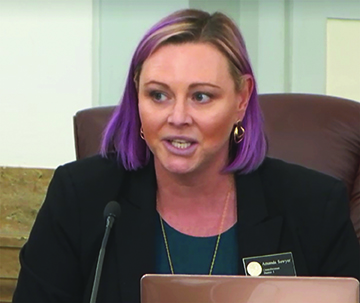
District 5 Denver City Councilwoman Amanda Sawyer
As far as opposing Hancock when needed each has done an outstanding job. But as for being decent human beings each has been an abysmal failure. Lord Acton the famous 19th century historian said: “All power tends to corrupt, and absolute power corrupts absolutely.” He noted that such people are not innately evil. They begin as decent human beings but soon evolve.
We have watched Denver City Council members come and go for decades now. It is an interesting process to observe. Many were relatively powerless prior to coming to office and that certainly was the case with the Amandas. Sandoval came from a highly political family but was known for her kindness and appreciation for others. Sawyer had lots of degrees, both a JD and an MBA. She had moved to Hilltop with her husband to raise their five children and had no political background. With the help of the EMERGE program, which trains Democratic women for political office, she prevailed.
It didn’t take either one very long to begin attacking and denigrating anyone who got in their way. For both, they always asserted that they were being “bullied” when they were, in fact, the biggest bullies. Sawyer claims any opposition to her is “sexist,” and Sandoval quickly claims everything is “racist.”
At times Sandoval appears to represent only the Latinx community. When Sandoval spearheaded the change of the name of Columbus Park to La Raza Park (which means The Race Park) she seemed clueless on why African Americans seemed to wonder whether they were welcome at the park. Her relations with the black community took a deep dive when she was booed at a City Council meeting after stating: “I support a lot of things that are going on. But it’s the same violence that is happening in our community. It’s Black on Black. It’s brown on brown.”

District 1 Denver City Councilwoman Amanda Sandoval
The black community began a “Recall Sandoval” campaign. She claimed she and her entire family were being threatened by something called the Afro Liberation Front and she went tribal. She asserted the Chicanos who had gone before her had been afraid, at times, but always showed up. She asked her supporters to take over the streets of North Denver. While everything eventually calmed down, starting race wars in District 1 was not previously thought to be one of the functions of a Denver City Councilmember.
If anything, Amanda Sawyer has been worse. She decided to try to destroy the career of an employee at the Denver Department of Transportation and Infrastructure (DOTI). She threatened to block every DOTI bill and grind the department into the ground unless she was given her way. When the employee responded in his defense, she declared it was sexist and claimed people were trying to smear her. She and her attorney wrote extremely unprofessional letters, claiming false and sexist attacks and threatening to file legal actions. A spokesperson for Hancock responded: “As far as I know there is no precedent for a member of city council, or any public servant, to communicate with the Mayor’s office this way.” Leave it to Amanda Sawyer to accomplish the impossible of making Mayor Hancock look sympathetic.
The Chronicle’s reporter Robert Davis recently had a chance to experience the full Amandas treatment. In a story on page 15 of the March 2021 edition of the Chronicle, he incorrectly indicated that Amanda Sandoval voted against the Group Living Amendment when it was, in fact, Amanda Sawyer. No apologies were enough for the Amandas. When alerted on Sunday morning, February 28, 2021, The Chronicle’s Executive Editor immediately changed the online version and updated the photo used in the story. This was also not sufficient. Nor was the declaration that a correction would be placed in this month’s printed edition (see Correction below).
If you believe them, Mr. Davis was clearly a misogynist. Amanda Sawyer immediately posted on Twitter where she joined Denver School Board Director Tay Anderson in attacking the paper. Separately, she has claimed that the Chronicle is out to get her, even though she has received overwhelmingly positive coverage from this paper since assuming office.
As a practical matter, newspapers from the Chronicle to The New York Times make inadvertent errors, and all papers can do is acknowledge the mistakes and move forward. As for the Amandas, we have had it with them. We will continue to report on them fairly. But like many people and businesses in Districts 1 and 5, Amanda Sandoval and Amanda Sawyer have lost all goodwill and this newspaper will not hesitate to defend and protect those people they unfairly and viciously attack. You can oppose Mayor Hancock without being total jerks, notwithstanding what Amanda Sandoval and Amanda Sawyer think.
Correction
In the March 2021 edition, on page 15, the Glendale Cherry Creek Chronicle printed a story titled “Denver Approves Controversial Group Living Amendment.” Within the story, we mistakenly identified Councilmember Amanda Sandoval voting against the amendment when in fact it was Councilmember Amanda Sawyer who voted against it. We regret the error.
by Valley Gadfly | Mar 19, 2021 | Valley Gadfly
Springtime bliss: April skies, showers and love! Days are longer, brighter and warmer this month creating joyous feelings. All seemingly stimulated by April Fool’s Day. References to the day go back to medieval times in literature. Ages ago when it all apparently got started some of those tricks, pranks and foolishness lasted up to a week.
No joke: The song “April Fools” was included in an album by folk singer Loudon Wainwright III that was released in 1998. However it was never released as a single.
Though April showers may come your way, here are our choices for shopping, dining and entertaining so life holds a goodly share of bliss when the sun goes away:
3 Enjoy the bluegrass tunes of Colorado musical powerhouse Turkeyfoot playing Globe Hall April 2. Group shares momentous instrumental and songwriting talents. Shows are at 7 and 9 p.m. Information: 303-296-1003.
3 Watch as JAAMM Fest live-streams a three-course springtime meal cook-along April 7 by restaurateur Admony, 7 p.m. Information: 303-399-3660.
3 View rarely seen Salvador Dali lithographs at the Denver Botanic Gardens show titled Gardens of the Mind, April 10-Aug. 22. Information: 720-865-3500.
3 Join the virtual Homeowners Townhall fraud prevention session sponsored by Paul López April 13, 6 p.m. Information: denverclerkandrecorder.com.
3 For food, fun and relaxation drive to S. Holly’s Esters Neighborhood Pub ranked as one of Yelp’s Top 100 Places to Eat in 2021! Reviewers love the neighborhood atmosphere, food and booze. Information: 303-955-4904.
3 Planning a wedding? Infinity Park Event Center is there to support you with flexible catering, 360 degree video screening plus outdoor wedding options and free parking. Information: infinityparkeventcenter.com.
3 Catch William Black whose EP climbed to #1 on the iTunes Dance charts playing the Bluebird Theatre April 24, 9 p.m. Information: 303-377-1666.
3 See the One Club Paper Fashion Show of outfits made entirely of paper at the Fillmore Auditorium April 29, 5:30 p.m. Information: 720-838-3797.
3 For a night beyond your wildest dreams plan to attend Central City Opera’s Theatre of Dreams Gala, April 23, 6:30 p.m. This year’s gala at the Denver Museum of Nature & Science will be a hybrid event, featuring Central City’s apprentice artists in a virtual setting. Gala will feature two operas, a new song cycle plus an operatic illustrated audiobook. Proceeds benefit the up-and-coming-composers. Information: 303-292-6700.
“Sometimes an April day will suddenly bring showers, rain to grow the flowers for her first bouquet.” April Love was the fifth of Pat Boone’s six No. 1 hits, topping the charts for six weeks in 1957. The movie by the same name starred Boone and Shirley Jones. Boone’s song is the only tune with April in the title to reach No. 1 on the charts.
“April in Paris, chestnuts in blossom. Holiday tables under the trees.” While many artists recorded the tune, Count Basie’s 1955 classic brought the song to the forefront.
Denver isn’t precisely Paris: The City of Love’s relative humidity is 41.3% higher with 1275 fewer hours of sunlight per year. Still the Mile High City gets that “feeling, no one can reprise.” A teasing, lighthearted month: April laughs, plays, and, of course, April fools. Will Denver’s Covid-19 color dial turn green by April 30? Will, it May!
— Glen Richardson
The Valley Gadfly can be reached at newspaper@glendalecherrycreek.com.
by Peter Boyles | Mar 19, 2021 | Blasting with Boyles

Conservative talk radio host Rush Limbaugh was awarded the Presidential Medal of Freedom during Trump’s State of the Union address.
In previous award-winning columns, I’ve written about the profile of the kind of person who really understands what I do for a living and what other people try to do. “It” being what I call a radio guy.
Rush Limbaugh passed away. In the non-radio world that seems to be now dominated by “talk show hosts” it was akin to the death of Julius Caesar, Winston Churchill, George Washington, and Babe Ruth.
Limbaugh was lionized, put on the shields of fellow warriors and carried through the streets of Rome. You saw it, I saw it, we all heard it. The truth always throws a curve ball and it deals from the bottom of the deck.
Rush Limbaugh was born in a small town in Missouri. His father was a banker and WWII fighter pilot. His grandfather was U.S. Ambassador to India, and his uncle was a federal judge. Limbaugh was a failure. When he was eight-years-old his father and mother bought a system so that he could be up in his room playing records and they could be downstairs listening on what was called a transistor radio. I think the record player needle, like a junkie shooting heroin, went right in the boy’s arm. His father, as an investor, owned part of a radio station in the town. Limbaugh got his first gig.
Now there are earmarks on how a radio guy operates in life. Let me list them for you. Number one, Rush Limbaugh used three different names on the air: Jeff Christie, Rusty Sharp and, of course, Rush Limbaugh. And in true DJ fashion, number two, Rush was married four times.
He went to rehab, another earmark to present someone as a radio guy, and most insiders believe that those drugs caused his hearing loss. As someone in recovery myself, it’s highly probable. He was fired seven times. A longtime friend of mine, Cliff Powers, worked with Limbaugh in Pittsburgh, when he used the air name of Jeff Christie, and told the stories of Limbaugh being blown out in Pittsburgh, not once wrestling fans, but twice.
He had less than a year of college, another benchmark since now this business is dominated by people who address each other as “Doctor.” And what I always thought was the whammo show-stopper, was for all the money, and what’s behind the curtain, when he finally settles in Sacramento, he replaces Morton Downey Junior.
His brother made most of his business deals. He used callers as records like good disc jockeys do. He did parody tunes as most great DJs. He did voices on air and was, in fact, what used to be dubbed a shock jock. He was brilliant, apparently very shy, and a lot of people around him never could explain whether a lot of what he did was an act or whether he truly believed it. I think its probably somewhere in the middle.
He got it! He understood it. He was a radio guy. He wasn’t leading Christianity although at the end of his life he became religious. I think he definitely loved the country. He loved the legacy. Yet with all the foibles, and all the problems, and all the good that he did, he changed what we do for a living, he changed the AM radio band and made us all better.
His voice will be missed, there is no replacement. Rest in peace, the best radio guy I ever heard, Rush Limbaugh.
— Peter Boyles
by Mark Smiley | Feb 19, 2021 | Editorials
In the year 2000 I sat down to clarify my thoughts about the strange circumstances that seemed to be gathering momentum in our American culture. In light of our situation today, I think you will agree; if we would have cared to look, we would have seen this coming and acted sooner!
What will we do today to stop the accelerated loss of our personal liberty? If we do nothing; what will our “Liberty” look like in a few short years or for that matter months?
Today is Sunday January 24, 2021. Almost One year into a worldwide Pandemic and lockdown.
The world as I saw it in the year 2000 no longer exists — without the lessons learned from great past civilizations, will our Grandchildren have the ability to create a future?
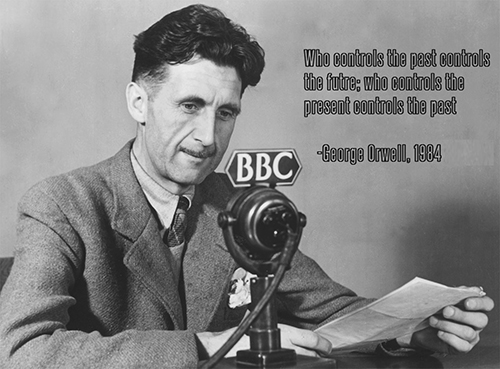
“Who controls the past controls the future. Who controls the present controls the past!”
— George Orwell
March 2000
Personal Liberty is under an assault from a counter culture bent on absolute control of our government and the American way of life. Have I lost my mind — probably, but not on this issue. This statement sounds like I am outside staring at the sky awaiting the arrival of black helicopters. If I had made this comment 20 years ago, around the table, over a few beers you would still be able to hear the laughter. In the same setting today, the reaction would be quite different — disbelief, fear, and discomfort would replace the laughter. Not because the audience disagreed with the statement, but because someone said “such a thing” in public. The insidious, unrelenting Thought Police tasked with destroying “intolerance” with an iron fist have stifled us. We now find ourselves on the outside barely able to look in.
“When I use a word,” Humpty Dumpty said, in a rather scornful tone, “it means just what I choose it to mean — neither more nor less.” “The question is,” said Alice, “whether you can make words mean so many different things.” “The question is,” said Humpty Dumpty, “which is to be the master — that’s all.”
— Lewis Carroll,
Through the Looking Glass
A general malaise infects our culture. The common person knows that a “misplaced” opinion or humorous comment about a “protected” group can destroy their lives. Equality of opportunity has given way to equality of outcome, personal rights to group rights. Personal rights bring personal wealth, personal success, and competition, and those who don’t make the grade are left behind. The counter culture believes in false equality predicated on the lowest common denominator.
To the counter culture, “social justice” has come to mean “protection” for certain groups from attacks by the “enemy” (principally white heterosexual males). It seems that everything we say, or do, can somehow exemplify our intolerance or downright hatred for a “protected” group. The great elixir of mankind, humor, should be avoided altogether. In fact, humor seems to be non-existent in the lexicon of the Thought Police. The ironical self-deprecating humor that was the hallmark of our nation’s immigrants is now considered to be hate speech on the part of the “enemy.” Even if you are the brunt of your own joke, the counter culture believes there exists an underlying “intolerance” that lurks dormant and insidiously hidden in your psyche that must be purged by the counter culture. Ultimately, it is not just our freedom of speech that is under attack, it is the freedom of thought.
“The price paid for intellectual pacification is the sacrifice of the entire moral courage of the human mind.”
— John Stuart Mill
To avoid falling into this “trap” we have developed a habit of self-censorship that has become so unconscious we fail to recognize the mind-numbing subliminal effort involved in maintaining the correct speech necessary to escape the wrath of the Thought Police. At some point it is easier to avoid thinking, and subsequently, disengage.
We are becoming a lobotomized society in which everyone believes that it’s every man for himself. A considerable number of Americans fail to recognize the counter culture’s agenda, and believe that the counter culture is interested in “inclusion” and constructive dialogue. They have become the unwitting foot soldiers that practice appeasement as a way to reconciliation. History shows us that the appeasers (after their usefulness expires) are the last to be executed.
Control The Debate
Frame the debate! Dehumanize your enemy! Call your adversary a sexist, racist or bigot, and you will no longer need to answer his arguments. He is now faced with defending his character. In the courts, there is a presumption of innocence until proven otherwise. However, in the court of public opinion if you are charged with sexism the burden of proof falls squarely on the shoulders of the accused. This is precisely how ideologues entrench themselves in a system; they exploit and ruin those on whose backs they rode to power. They begin by working in the establishment, and through insinuation and infiltration rather than through confrontation, they erode the system from within, all the while claiming that the root of the problem stems from the old guard, and its ideals. Thus, we find ourselves in a situation where the counter culture not only controls the answers but the questions asked. It is attempting to control how we understand the daily events of our lives.
Control History
“Who controls the past controls the future. Who controls the present controls the past!”
— George Orwell
“To destroy a people, you must first sever their roots.”
— Alexander Solzhenitsyn
When attempting to destroy your enemy, destroy the record of their past, and fill the void with a new history. Dishonor or disgrace his heroes, and you can demoralize his people. Besmirch, and degrade your adversary to the point that any and all outrageous comments will go unchallenged. Sit back and watch the crows devour what is left of the past and your future!
Yours in Hope, Etienne