(BPT) – By Dr. Bela Sood, MD, child and adolescent psychiatrist and senior mental health policy professor at Children’s Hospital of Richmond at VCU.
This pandemic is unlike anything we’ve ever experienced, so how can we help our children cope, especially when we’re also feeling anxious? The key lies in acknowledging our own fears and concerns, while understanding how each individual child handles emotional challenges.
Parenting is hard. Parenting during a pandemic can feel especially challenging as you balance changes in work, home and school. Here’s how you can provide support and reassurance, whatever your child’s stage of development.
Start with yourself
Even infants pick up on their parents’ moods, so your emotional state will affect how your children cope.
As instructed on airplanes, during turbulence you should put on your own oxygen mask before helping others. The same is true of turbulent times: Take care of yourself first.
Reflect on how you feel: Are you angry about disrupted routines? Worried about the future? Missing loved ones? When you’re stressed, practice self-care: Exercise, meditate or talk with a friend. This will help you feel more “centered” so you can model calm, positive attitudes and behavior.
Limit media exposure
It’s easy to become overwhelmed by negative news. Stay with your children during news reports and encourage them to ask questions. Limit your own exposure too, as it can affect your mood.
Consider your child’s stage of development
Babies and toddlers won’t understand what’s happening, but they respond to emotional cues. Though it’s not always easy, if you can stay calm and positive, they’re more likely to relax.
Maintain routines, as all children thrive on predictable schedules. Knowing when to expect meals, playtime and bedtime helps them feel more safe and secure.
Preschoolers have many questions about everything, but keep your explanations simple. Discuss the virus as being like a very bad cold or flu when explaining why everyone is wearing masks or why they can’t go on play dates.
Validate your child’s feelings by saying, “I understand you’re upset right now,” or “It’s okay to miss grandma. I miss her too.”
Let your children connect with others safely. Make video calls to relatives or socialize with a small group of neighbors outdoors while practicing social distancing. Help your child write letters to friends.
School-aged children are more peer-oriented, but they still appreciate spending time with parents. It’s a great opportunity to start new hobbies together, while also letting them pursue their own interests.
If your children appear anxious, angry or sad, encourage them to talk about it. Share how you’re feeling, too. Establish a weekly “check-in” dinner where everyone has a turn to express their feelings.
Include children in chores and activities that give them a feeling of control. Let them assume responsibilities like folding laundry or cleaning, offering choices about what activities they prefer.
Teenagers are beginning to separate psychologically from their parents, so being forced to be together all day can be tough on them, as well as on parents! Older teens are missing out on significant milestones, like homecoming, sports or performing arts, which may be important parts of their identities.
Put yourself in your teen’s shoes. This period is hardest for teens who derive energy from peer interactions. Show empathy by saying, “This must be so disappointing for you.” Help them find creative ways to make this time memorable and connect with peers who practice social distancing. The weekly family dinner may be the perfect time to listen to your teen and problem-solve together.
Warning signs
It’s normal for kids to occasionally seem sad, anxious or angry. Encourage them to voice their feelings and acknowledge that it’s okay for them to feel that way.
If your child becomes increasingly withdrawn, disconnected or obsessed with video games or other self-isolating activities, it may be a signal that they’re preoccupied with worries about the future or other topics. Try drawing them out to determine whether you should seek their pediatrician’s advice. It’s challenging to keep children entertained at home 24/7, so don’t be too hard on yourself. Offer additional social support from close friends and relatives.
If you think it would help them to get counseling and they’re reluctant, tell them that when you’re in trouble, you seek help. Let them choose whether to participate or not. If your child is unwilling to talk to a counselor, you may find it helpful to see a therapist to share observations of your child, get a better understanding of what may be happening and develop strategies to support them.
(BPT) – Before COVID-19, you probably didn’t put much thought into washing your hands. A bit of soap and a quick lather seemed adequate. Now, hand washing is center stage as a main step to fight the spread of the virus and help people of all ages stay healthy.
Regular hand washing is one of the best ways to remove germs, avoid getting sick and prevent the spread of germs to others, according to the United States Centers for Disease Control and Prevention. This not only helps with the COVID-19 virus, but also helps protect you from other viruses, such as cold and flu germs.
COVID-19 is efficiently killed with soap and water, which is why the CDC recommends scrubbing your hands several times a day. However, parents and caregivers may struggle with getting their kids to wash their hands the right way. From impatient toddlers to distracted teens, hand washing may not be happening correctly.
To help your family wash their hands the right way and have fun while doing it, the health experts from Colgate offer some simple steps to consider:
Step 1: Have a family meeting
Talking about hand washing casually won’t make a lasting impression. Hand washing is important, especially during the pandemic, so give it the attention it needs by calling a family meeting. Talk about how hand washing kills germs and stay positive, saying how your family wants to be a part of the solution in preventing the spread of COVID-19.
Step 2: Discuss proper hand washing
Proper hand washing is simple once you know how to do it. First, wet hands with clean water. Apply soap and scrub the entire hand for at least 20 seconds, including between the fingers. Finally, rinse and air dry or use a clean towel. Availability of soap and washing correctly is essential. That’s why Colgate is donating 1.4 million bar soaps distributed in the U.S. as part of the #SafeHands challenge, featuring instructions for effective hand washing. The bar soaps, along with other health and hygiene products like toothbrushes, toothpaste, and body wash, will be delivered to food banks and school lunch programs nationwide via Colgate’s trademark Bright Smiles, Bright Futures mobile dental vans. In total, Colgate’s product donations across the country is valued at over $8MM.
Step 3: Make it fun
What’s typically the hardest part of proper hand washing is the length of time. To make hand washing fun, sing a tune for that length of time. For example, sing “Happy Birthday” twice to hit the mark. Or, customize a favorite nursery song and sing it for that length. To the tune of “Row your boat” sing: “Wash, wash, wash your hands. Wash them every day! Scrub with soap, rinse it down, wash those germs away!”
Step 4: Praise and rewards
Make hand washing a part of children’s responsibilities, much how they are expected to make their bed and read daily. You may want to add posters and other reminders to help the family remember the importance of hand washing. Remember, positive reinforcement and recognizing a job well done goes much further than scolding when stressing new habits. You may even decide to set up a rewards program; for instance, young children get a sticker every time they wash their hands.
Mixed race woman washing her hands
Step 5: Be a role model
When encouraging your family to adopt healthy habits, it’s best to lead by example. Wash your hands regularly using the correct procedures. Sing loud and proud so people know you’re doing it for 20 seconds. Show it’s a priority for you so your family knows it should be a priority for them.
For more information on Colgate’s support of the #SafeHands Challenge and their global impact of donation more than 25 million products globally, visit ColgatePalmolive.com.
Regular handwashing is one of the best ways to remove germs, avoid getting sick, and prevent the spread of germs to others.
“Civil service statutes establish a floor for police officer employment protections, which the unions can raise through collective bargaining.”
by Robert Davis
Imagine working in an office with 1,000 coworkers. Once every five days, you get a memo saying a coworker was accused of misconduct. One day you see a video from one incident — a coworker shooting someone in the back. You ask the coworker about it and they say the other person had a gun and they feared for their life. With those magic words, you know the shooting will be justified by the company, almost no matter what the video showed.
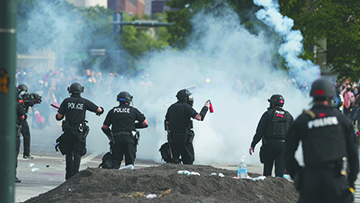
Backup: Denver Police Department called in 12 local agencies for backup amid protests.
Anywhere else and this would be unthinkable. For the Director of Denver’s public safety department Murphy Robinson and Police Chief Paul Pazen, this office is familiar. And it’s the storied history of the office that prevents police reform activists and police officers from reforming the mountain of legal protections afforded to police officers accused of misconduct.
Why? Because the city’s civil service laws were designed with a job description in mind. In turn, Denver’s police union — Denver Police Protective Association (DPPA) — learned how to coil its collective bargaining agreement around those laws to protect officer misconduct. And until this job description is reimagined, longstanding police misconduct reform seems ill-fated.
Director of Public Safety Murphy Robinson broached the topic with city council in June during a discussion on reforming DPD’s use of force policy. As a self-proclaimed student of history acknowledged that moving on from his department’s storied history is necessary to institute immediate reforms.
“We are at a place where we need to move the needle forward,” Robinson said.
His words rang hollow to protesters in attendance like Brian Hostraw, who witnessed police officers tear-gassing small children without warning, firing pepper balls and rubber bullets indiscriminately, and destroying the property of homeless individuals with impunity during the George Floyd protests.
“These are not the actions of people I trust to protect me or my family,” Hostraw said.
And there are plenty of police officers who side with Hostraw. Chief Pazen told lawmakers that a majority of his officers agree with the increased scrutiny placed on them by SB217.
But, the one reform activists are demanding most loudly in the wake of the George Floyd protests — easing the ability of police chiefs to fire officers for misconduct — is the most difficult policy to reform.
Denver began crafting legal protections for its police officers when the first settlements along Cherry Creek were staked out in 1858. Territorial governor John C. Moore organized the Rocky Mountain Rangers under a vigilante mandate to protect the miners from the prostitutes, gamblers, and thieves that followed them west. By the time the City & County was chartered in 1904, police officers were influential players in state sponsored corruption, and earned legal protections because of it.
Before being elected mayor, Robert Speer was a veteran member of the Police and Fire Board, which oversaw a diverse range of city operations from peace officer certification to public censorship. As such, he knew how to use Denver’s finest to serve his political ends and was willing to do so.
During his first two terms, Denver’s finest engaged in voter suppression, rigging elections, and shakedowns of casinos, brothels, and saloons. Speer’s motivation was obviously political — his administration of tolerated vice and honest corruption relied on an invisible hand used to ward off Speer’s competitors. Over time, Speer rewarded Denver’s finest with employment protections that unions would later use to thwart cases of police misconduct.
Clash With Police: Demonstrators clash with police at the Colorado Capitol on Saturday, May 30, 2020, during the third day of protests in Denver in response to George Floyd’s death at the hands of police in Minnesota. Photo Credit: (Joe Mahoney, Special to The Colorado Sun)
Realizing how important Denver’s finest were to his political success, Speer created the Civil Service Commission (CSC) during his third tour in office in 1916. The commission established a costly disciplinary and disqualification review processes that often incentivizes public officials to look the other way at police misconduct rather than pursue a moral victory of terminating a rotten officer.
Stephen Rushin, assistant law professor at Loyola University — Chicago, argued in his 2017 article in Duke Law Journal that police union contracts use civil service laws like a double-edge sword. First, they “establish a floor for police officer employment protections, which police unions can raise through collective bargaining.” Second, they tilt the political scales in favor of the unions during negotiations.
Employment protections are established through case law, which often results in costly legal bills for the city. In Denver, city representatives must present their entire case to officers accused of misconduct before the officer decides whether to fight it in arbitration. If arbitration returns an unfavorable result, the case is appealed through the courts, where it hopes to find a judge who will accept an assertion of qualified immunity.
Judge Carlton Reeves of the Southern District of Missouri described qualified immunity as “manufactured fiction” that has had a damning influence on how courts handle cases involving police officers in his decision in Jamison v. McClendon.
He cited a decision from the Fifth Circuit Court where qualified immunity was successfully asserted by corrections officers who were accused of keeping an inmate in a jail cell covered in fecal matter for a weekend before transferring the inmate to a cell in solitary confinement that didn’t have a working toilet or sink.
The Court’s reasoning? Qualified immunity can be asserted in cases where a law is not clearly established. In terms of the case from the Fifth Circuit, the court reasoned the timeframe in which the inmate was kept in unsanitary conditions was unsettled and, therefore, qualified immunity could be asserted.
Judge Reeves specifically addressed this logical quagmire in his opinion, stating “it is a fool’s errand to ask people who love debating whether something is debatable.”
University of Virginia law professor Rachel Harmon observed in her article The Problem of Policing in the Michigan Law Review that civil service laws empower frontline police officers “to challenge any internal managerial action that affects them on both substantive and procedural grounds in a formal adversarial process.”
In May, Denver paid $1 million to settle a case against two police officers who were terminated in 2013 after they lied about assaulting two club-goers in downtown four years earlier. Over the past three years, the city has coughed up over $14.5 million to settle cases involving officer misconduct, according to an investigation by The Denver Post.
Moral Hazard
Because of the cost of disciplining police officers, departments where misconduct is rampant are thus incentivized to withhold information unless an incident rises to a level warranting action. Whistleblower Brittany Iriart revealed in June that DPD, in fact, alters information on its internal misconduct reports to protect its officers before she was fired for violating the confidentiality clause of her employment contract.
DPD: Denver Officers clear a man who fell to the street after they used tear gas and rubber bullets to disperse the crowd of protestors on May 28, 2020.
Politically, Rushin says, because municipal expenditures such as court settlements can dominate local headlines, the result for lawmakers is a moral hazard. On one hand, they are tasked to upholding the law, yet rely on a third party who is prone to turning the other cheek to prosecute miscreant police officers.
“Municipal leaders may be incentivized to offer concessions on police disciplinary procedures because they are less likely to bear the costs of those concessions in the immediate future,” he wrote.
This issue is further complicated by the political activities of DPPA and its members individually. Since 2012, DPPA has donated over $200,000 to city council candidates, according to the city’s campaign finance data. Over the same time frame, more police officers reported donating to Mayor Michael Hancock than any other candidate for office.
Likewise Denver’s statewide union, Fraternal Order of Police Lodge #27, contributes to General Assembly candidates as in local District Attorneys races.
In her Iowa Law Review article titled Who Shouldn’t Prosecute the Police, law professor Kate Levine argues that a “structural conflict of interest arises when local prosecutors are given the discretion and responsibility to investigate and lead cases against the police,” because “prosecutors rely heavily on the police for their success.”
Levine acknowledges that no criminal case would exist without first contact from a police officer and officers can create and control facts by collecting evidence from the crime scene, interviewing witnesses, or through undercover work, all of which prosecutors can admit in court.
But, the relationship between prosecutor and officer doesn’t end when a case is closed.
DA’s need campaign donations to be elected to office. Then, they rely on police officer conduct to determine negotiating leverage during grand jury cases. The Department of Justice estimates approximately 90 percent of prosecutions end with a plea bargain.
“While cases of police brutality are unlikely to go completely unnoticed, issues of “testifying” by the police, as well as evidence planting, tampering, or withholding, and illegal intimidation tactics will never emerge unless another officer or a prosecutor addresses them,” Levine wrote.
Meanwhile, even though DPPA is a public-sector union, its negotiations with city council are kept confidential. This puts councilmembers at a political disadvantage by keeping them from crowd-sourcing reform ideas from their districts.
Councilmembers also cannot negotiate with union representatives. Instead, they must negotiate through an intermediary. This year it is Legislative Services Director Linda Jamison. Denverite reported that Jamison was not invited to the meetings until three weeks after they began.
Police unions also create leverage vicariously through local news reports on crime rates. Crime statistics from DPD show that violent crime and property crime were all higher in the previous five negotiation years. Last year’s annual report by the Office of the Independent Monitor confirmed officer complaints were higher in these years as well.
Denver City Councilmember Candi CdeBaca, District 9
According to a statement by District 9 Denver City Councilperson Candi CdeBaca, the current CBA negotiations include a measure protecting police officers from furloughs as Denver faces a budget crisis caused by the coronavirus pandemic and a two-percent salary increase.
Meanwhile, other government employees covered by career service mandates may be subject to budget-required furloughs. Currently, city projections estimate it will suffer a $226 million shortfall, of which $10 million will come out of DPD’s budget.
“This contract amounts to a uniquely beneficial agreement for DPD in the midst of hundreds of excessive use of force investigations and against a background of nationwide calls for police accountability and transparency,” CdeBaca said.
Violent crime is up 11 percent this year compared to last, according to city data.
Why Reform Hasn’t Worked (Yet)
Police reform activists currently can’t decide whether they advocate for completely tearing down the Denver Police Department or reimagining the role of police officers as a community support role, and this impasse is hindering their overall goal of easing restrictions and procedures for firing police officers for misconduct.
In August, Councilperson CdeBaca introduced legislation to abolish DPD and replace it with a peacekeeping department, a policy she claimed on social media was supported by thousands of Denverites.
Mayor Hancock called the legislation “reckless and irresponsible” in a statement shortly after it was introduced.
“The Councilwoman should exercise greater transparency and public accountability before putting something of this magnitude forward for a vote again instead of springing it on the public. I firmly stand by the men and women of our Police Department and will continue to hold accountable those who step over the line when dealing with the public,” he said.
The proposal lost at the Council level with only CdeBaca supporting it.
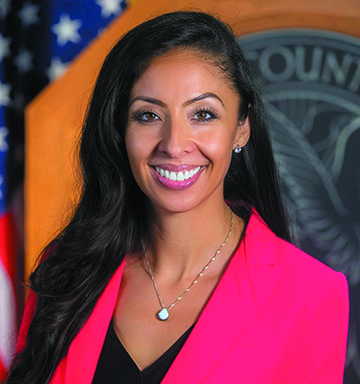
Others taking a community-centric approach include the newest appointee to the Citizen Oversight Board (COB), which oversees the body responsible for officer investigations, forensic psychologist Dr. Apryl Alexander.
As an academic, Alexander hopes to use her background to help forge new ways of thinking about community policing that doesn’t include excessive force, but includes accountability and restorative practices.
“People are looking for change in this moment,” she told Colorado Politics.
Pandemic Sparks Sweet Pop-up Music Series; Families Swing, Sway To Beat Of Groove Machine
by Glen Richardson
Music drifts on the breeze through the Valley’s quiet Cory-Merrill neighborhood on a Friday night. A group of musicians perform under a clutch of trees in front of a home as people flock to listen. They hear the unmistakable low-pitched sounds of a bass guitar, its tones forming the rhythm. Often dubbed as “feeling the beat,” the instrument’s sounds seem to vibrate through the encircled crowd.
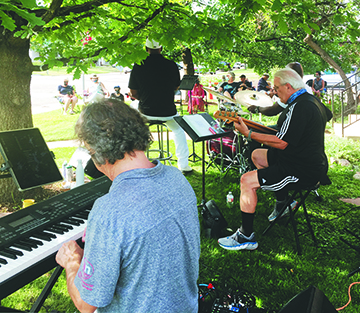
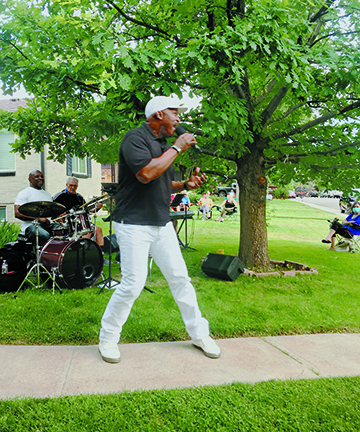
Serenading In The Shade: Musicians play under a clutch of trees in front of a home in the Cory-Merrill neighborhood. The Friday night pop-up music series lifts the neighborhood’s spirts with amazing music and good times.
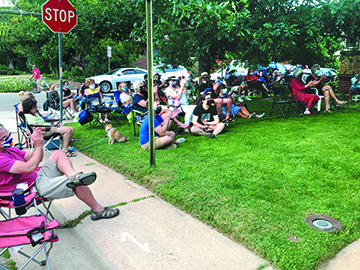
Standing or sitting on lawn chairs at homes adjacent and across the street, families are enjoying the music coming from a quartet of musicians known as the Groove Machine. Some break out in song while others dance in the street. The music seems to soothe, inspire and reassure the crowd.
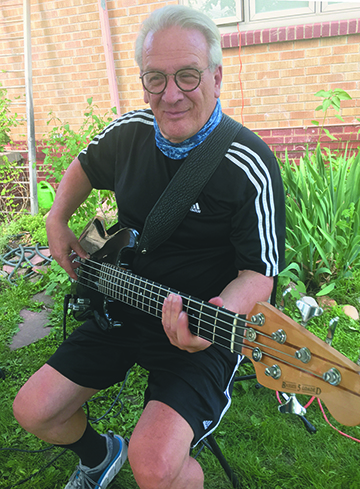
People are rocking to the guitar tones coming from neighborhood bassist Frank Baier. No novice, he has performed with the Bee Gee’s, Jackie Wilson, the Coasters and Brook Benton among others. Belting out ballads and familiar ditties for the growing crowd is singer-entertainer Odell Stroud. The troubadour with an infectious smile and soothing presence wows residents with his singing style and versatile range. A few recognize him as Officer O’Dell in episodes of Rocky’s Auto commercials that have been a part of the Colorado media landscape for more than two decades. The gathered neighborhood audience expresses its gratitude with storms of applause during and following 90 minutes of music.
Sparking Spirits
With social events, wedding and music concerts shut down by the pandemic, Baier worries about the emotional toll it is taking on musicians. He has a Deano Quartet, the FTM Jazz Trio plus a Tony Bennett Tribute Group in addition to the party-dance band Groove Machine. Between not gigging or being able to practice he was becoming jittery and edgy. That’s when his wife Christine suggested the idea of a neighborhood pop-up music series. Christine and Frank are both on the Cory-Merrill Neighborhood Association board of directors.
Concert On The Lawn: Great music in a community environment delights young and old alike on Friday evenings. Folks stand or sit on lawn chairs at homes adjacent and across the street to enjoy the sunset concerts.
Initially Frank wasn’t keen on the idea but the more he considered the notion the more sense it made. In a time when things are uncertain he was certain it would be a good way to ease the anxiety for both himself and his fellow artists. Musicians, after all, thrive on live performances. Moreover, they had plenty of time on their hands. Plus the music series would bring the neighborhood together while offering a rewarding, enjoyable way to practice and get creative.
In City Council District 6, the Cory-Merrill community is tucked between University and Colorado Boulevard south of Bonnie Brae and east of Wash Park. Neighborhoods are historically and architecturally defined by bungalows and classic ranches. Newer homes are larger, often accented with Victorian tiling and mission-style stucco.
Talented Performers
On the musical keyboard for the Groove Machine is pianist and Denverite Tim Greenhouse. He has participated in Switzerland’s prestigious annual Montreaux Jazz Festival plus played with stars such as Bob Hope. Locally he has appeared with Hazel Miller, Lannie Garrett and the Arapahoe Philharmonic.
Baier’s Bass Beat: Cory-Merrill board member and bassist Frank Baier hosts sunset serenades with his band Groove Machine. The music man, his guitar and band are having a direct and positive impact on the community.
Influenced by the Bootsy’s Rubber Band and the Dizzy Gillespie Sextet, Groove Machine’s drummer is Doug Bainbridge who toured for several years around the Pacific Rim. He worked another half-dozen years as a drummer-percussionist on television in South Korea before returning to the U.S.
Valley’s musicians have always actively supported each other, whether they benefit or not. Odell Stroud, for example, is the lead singer with the five- to10-piece party band Montage but he and Baier have often collaborated over the years. Thus when asked by Frank, he didn’t hesitate to join the pop-up music series. When drummer Bainbridge couldn’t make a recent neighborhood series, Montage’s drummer Skip Lynch — aka Skippy Dee — jumped in to hold the pocket down for the group. He has gigged with flautist Bobbie Howard — who gave him the stage name Skippy Dee — as well as The Platters, Miki Howard, Surface, and many others.
Pandemic’s Impact
The detrimental effects of the pandemic on the music industry here and around the globe are loud and clear. The Valley is home to some of the best music and concert venues in Colorado. While the local market lags behind entertainment cities like New York and LA, Denver has one of the largest per-capita ticket markets on earth. But based on current guidelines a venue the size of the Levitt Pavilion — which has a 7,500 capacity — can only admit 175 people for a concert.
Spirited Singing: Crooner Odell Stroud — lead singer for Denver’s Montage Band — belts outs songs at sunset series. His singing style and versatile range lifts peoples’ spirits and brings joy during pandemic times.
Most of this summer’s outdoor music concert series have been canceled. They include the Shady Grove Picnic Series at Four Mile Historic Park plus the summer concert series at the Denver Botanic Gardens, both produced by Swallow Hill Music. Mid-level indoor venues such as the Ogden Theatre and Fillmore Auditorium depend on major promoters AEG Presents and Live Nation, respectively. At the Ogden, seven Aug.-Sept. live performances have been cancelled, while at the Fillmore a dozen have been postponed or cancelled.
The Colorado Symphony still hasn’t confirmed a date or when they will resume full-capacity and live concerts. Already more than a dozen autumn Symphony concerts have been canceled through November. Among them are the Cleo Robinson 50th Anniversary Celebration and the Halloween Spooktacular in November. Additional coronavirus casualties include the Vienna Boys Choir Concert and the Ten Tenors Home for the Holidays concert.
Music Magic
In these pandemic times music lifts the spirits and is doing so in the Cory-Merrill neighborhood. As one attendee put it, “As a community we are appreciative and better off. Their music is exceptional and they are helping to hold up Colorado’s music scene, inspire others and create opportunities.”
Getting In The Groove: Families swing and sway to the sounds of local band Groove Machine in Cory-Merrill neighborhood. When the tone and touch of Baier’s guitar is added people get up and their feet start to move.
The musicians say doing the Friday night gigs has raised their mood while improving their music and dispositions. For his part, Frank admits “I didn’t realize how much I missed collaborating with the other musicians and playing for people.”
The sunset serenades are free but contributions to a fund kitty are welcome. The bi-weekly Friday night concerts — Thursdays when forecasters predict blustery weather — are from 6 p.m. to 7:30 p.m. Information: frankdbaier@gmail.com.