On the 27th of December of last year, Denver County Judge Johnny Barajas, using the 8th Amendment that stops cruel and unusual punishment, ruled that the urban camping ban enacted in Denver, Colorado, was unconstitutional. That, ladies and gentlemen and children of all ages, ushers in balls-to-the-wall, full blast boogie adventures in homelessness.
Like all good things it has a beginning, and the beginning of our problem of the unhoused is none other than the lizard king himself, John Hickenlooper. John Hickenlooper, when he was the Mayor of Denver, launched a program that he titled “The Ten Year Plan” to eliminate homelessness. If I recall correctly he was doing it to honor his mother, whom he took to an outstanding movie starring Linda Lovelace (winkie, winkie) as a young man. That plan not only didn’t end homelessness it put everything on turbos.
The 10 year plan has turned into the 20 year plan that has launched Hickenlooper’s stupidity, along with Michael Hancock, Denver City Council, and collective Denver media, into turning Denver into a mini San Francisco.
Hickenklooper’s legacy — Denver’s Road Home. Daily in Denver’s media, wearing rose colored glasses, we see the results of Hickenlooper’s utopian plan to do something that the late Bob Coté described as shoveling a certain substance against the tide. It just can’t be done. And now, of course, he wants to become Senator. Or does he? Depending on the moment, the day, the time, John Hickenlooper may or may not want to be Senator but he is leading in the polls.
Homelessness, Hickenlooper once said, is a sign of prosperity, and not a sign to be celebrated, but a sign, nonetheless.
Look what we have around you now. Infestations of rats, needles, on sidewalk defecation, 14th Avenue near the Colorado Capitol, Lincoln Park, Civic Center Park. And the appalling fallout when the Denver Police, trying to do their job, are met with a Denver Public School Board member and others trying to stop the police from cleaning up a rat’s nest. Denver City Councilwoman Candi CdeBaca called the camping ban an iteration of the black code vagrancy laws that were once used against the black population.
The agreed upon figure collected by Hickenlooper and Hancock in the plan to end homelessness is around $64-$65 million. Denver City Auditor Dennis Gallagher said, after auditing the program, they could not determine if that $64 to $65 million had any impact at all on reducing homelessness. The only thing we know for sure is all that money was spent.
Hickenlooper kicked it off in 2005, telling you and I he would end homelessness in 10 years. That was 2005. Now another $46 plus million has been allotted by the City of Denver and all you have to do is drive around and see the results of those millions of dollars.
We have talked about this before. You can’t feed the bears in Yellowstone. If you put a bird feeder in the backyard you’re going to get squirrels. The late Bob Coté knew the truth. Bob, in that war on homelessness, was George Patton. He knew. The 10 year program with all the collection boxes set up all over the city, all these millions of dollars, take a walk down the 16th Street Mall. Enough is enough.
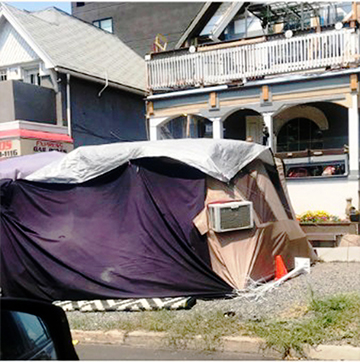
Air conditioning for the Denver homeless.
The man who did everything he could to turn Denver into what it is today, now wants to be the next U.S. Senator. I’m not telling you Cory Gardner is any day at the beach, but I think we said it before. In the words of Barry McGuire in that telling song, Eve of Destruction: “Look around you, boy, it’s bound to scare you, boy.” And you tell me we’re not on the eve of destruction?
Denver’s Odd Couple Alienates Glendale Residents, Businesses At Meeting Tay Anderson And Emily Sirota Called An ‘Embarrassment’
by Mark Smiley
After a week of consternation, the Glendale City Council elected at its meeting on July 21, 2020, to support Governor Jared Polis and his statewide mask mandate and to opt out of the controversial, and seemingly highly unpopular, mask mandate of the Tri-County Health Department (TCHD).
Bully: Known as the young political bully of Denver, Tay Anderson who sits on the Denver Public Schools board, snickered and mocked at citizens who did not support his position on Tri-County Health Department’s mask order.
It was expected to be a relatively mundane meeting of the Glendale City Council on Tuesday, July 14, 2020, called to discuss whether Glendale should adopt a mask ordinance closer to Denver’s or instead stay within TCHD’s mask order which applies to the counties of Adams, Arapahoe and Douglas.
TCHD’s board voted to implement the mandate on Wednesday, July 8, 2020, by a close 5 to 4 vote. The order also allowed each county and its individual municipalities the option to opt out by July 24, 2020. At the time of publication, Douglas County, Castle Rock, Bennett, Parker, and Brighton had already chosen to opt out. Douglas County indicated that it was giving notice that it was dropping out of TCHD altogether.
The July 14th Council Meeting
But what was supposed to be a relatively noncontroversial, technical meeting on what was the better choice for Glendale, turned into a wild donnybrook when two Denver elected officials, Tay Anderson (member of the Denver School Board) and Emily Sirota (a recently appointed State House Representative), decided to make the meeting a cause celeb. They notified local television stations that they, and their supporters, planned to go to the meeting and disrupt it. Two of the local television stations live streamed the entire two and one-half hour meeting.
Embarrassment: Emily Sirota joined Tay Anderson and a few others to encourage Glendale’s City Council not to adopt an ordinance similar to Denver’s order to opt out of TCHD’s mask order.
The City Council, at the end of meeting, continued it until the following Tuesday to give the city staff a chance to prepare a resolution in line with Denver’s for the City Council to consider.
The Odd Couple In Action
Standing at the back of the room leaning against the wall, Anderson and Sirota appeared to giggle, laugh and mock any Glendale residents who did not speak in favor of their position. Anderson shouted from the back of the room for the Council to shut down when an opponent went over three minutes, not withstanding the fact the Council did not limit anyone to three minutes.
Mayor Dunafon felt compelled to repeatedly admonish Anderson and Sirota to stop harassing and laughing at people who came to the podium who did not agree with them. Anderson appeared to be the worse of the pair. The 21-year-old demands people address him as “Director” or “Director Anderson,” claiming the title as a result of being on the Board of Directors for the Denver Public Schools.
When he spoke, he threatened to recall members of the City Council unless they voted for the TCHD order, but did not explain why if the Denver order was appropriate for Denver, which surrounds Glendale and is the city he lives in, why it wasn’t appropriate for Glendale. In a moment of apparent hubris, he declared that: “I am not the mayor of Denver — Yet!”
Known as the young bully of Denver politics he had also threatened recall for Greenwood Village Council members if they did not vote to rescind Resolution 40-20 on police immunity. He successfully threatened the Stapleton neighborhood to change its name, even though it had undergone a vigorous election just recently and had voted to keep the Stapleton name. Anderson had said he and his cohorts would march and take over the streets of Stapleton unless they acceded to his demands, which they did.
Threatens: Tay Anderson argues before the Glendale City Council at the July 14, 2020, special meeting. He closed his statements by threatening a recall against those that voted to opt out of TCHD’s mask order.
Emily Sirota, State Representative for House District 9, was very concerned at the prospect of Glendale not adopting TCHD’s order rather than one closer to Denver’s. She declared: “Both residents of Glendale and those who live in surrounding parts of Denver who often frequent businesses and restaurants in Glendale are very concerned and if you opt out of this order, they won’t feel comfortable shopping here.”
Other Public Testimony At Council Meeting
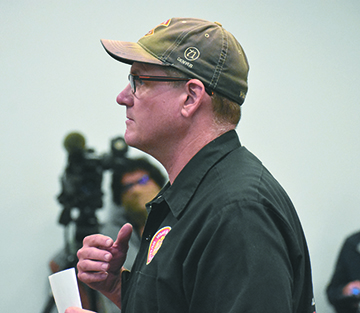
Veteran: Chris Shiroma, a veteran, pleaded with Glendale City Council to opt out of the TCHD mask order citing the difficulty people in his situation have in finding a job.
In an effort to convince the City Council to remain under TCHD’s mask mandate, Anderson and Sirota organized a group to email members of the City Council throughout the day and appear before the council during the public comments portion of the meeting. To their surprise, there were more people signed up to speak on behalf of opting out of mandatory mask requirements altogether at the meeting, although the City Council did not appear to consider that an acceptable option. In total, 23 people signed up to address the Council.
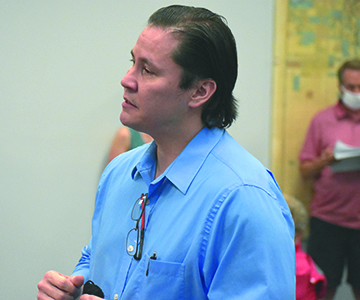
Restaurateur: David Peterson, owner of the Bull & Bush Brewery, spoke in favor of opting out of the TCHD mask order. He indicated it would be difficult to police as a business owner.
“Who is responsible for policing this?” asked David Peterson, owner of the Bull and Bush Brewery in Glendale. “We have enough going on as it is. I don’t need to be the police and enforcer of this mandate.” Peterson referenced the clause in the mandate that requires members to be in the same household to dine together. Peterson already requires masks to enter his restaurant.
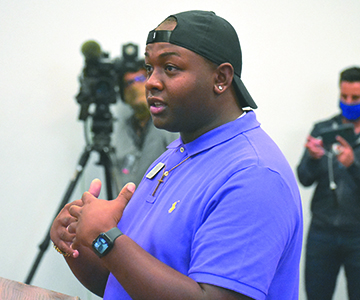
Nurse: Lance Anthony, longtime Glendale resident, called the mask order “insane” and asked the City Council to opt out.
Lance Anthony, a longtime resident of Glendale, simply said, “Opt out, this is insane. If you can smell cigarette smoke through your mask, it is not working.” Anthony who has been a paramedic and a nurse pointed directly at Anderson and Sirota and demanded they stop interrupting the meeting and harassing everyday citizens.
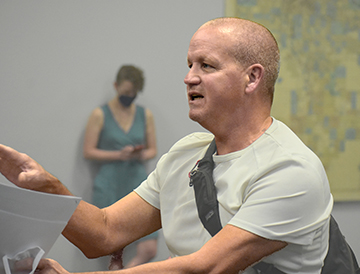
“I think people can make their own decisions and a requirement to wear a mask should not be mandated,” said Ricky King, former Glendale City Councilmember and Glendale employee for 22 years.
Citizen Comment: Morgan Watters spoke at both the special meeting held on July 14 and the regularly scheduled July 21 meeting. She was supportive of Tri-County’s mask order but appeared to ultimately understand the action taken by Glendale City Council.
Public comments lasted just under one hour and after listening to all testimony, City Council decided to consult with their constituents individually and reconvene on Tuesday, July 21, 2020.
TCHD’s Dr. Douglas’ Antics Condemned
Dr. Douglas
Strangely, Sirota approached Deputy City Manager Chuck Line on a number of occasions referring to emails she was receiving from the head of TCHD, Dr. John M. Douglas, indicating that TCHD was going to change the order to address the household controversy. It is a mystery why Dr. Douglas would communicate with Sirota who does not live or work in Glendale, rather than with Glendale officials.
The general disgust with the antics and lack of professionalism of Douglas was exemplified by the comments of Glendale City Manager Linda Cassaday at the meeting. She pointed out she had been on a two hour Zoom conference call with Douglas who failed to ever note the same to her. It was apparent that Douglas was watching the
Glendale proceeding on the live stream and was making positions up as the meeting was going on. In fact, as of the July 21 meeting no changes had, in fact, been made. After the meeting there were calls for the immediate resignation of Dr. Douglas from TCHD.
Sidekick: Emily Sirota, District 9 House Representative, teamed with Tay Anderson on opposing citizens who did not agree with their position. She, along with Anderson, were called an “embarrassment” by some.
Sirota is the wife of David Sirota, author, journalist, former radio host, and former writer for Bernie Sanders. David Sirota has many friends and acquaintances in Glendale and so his wife’s conduct shocked many people. One attendee stated: “I really like David, but she is apparently just an ultimate ‘Karen.’ Why she wants to be the sidekick to an obese, balding, bully punk like Tay Anderson is beyond me. She is not the person I assumed her to be. Unlike David she sure isn’t making any friends among the residents of Glendale or anywhere else from what I can tell.”
Governor Polis Intervenes
But upending the applecart on Thursday, July 16, 2020, Governor Polis issued a statewide mask mandate as the number of COVID-19 cases were showing what he called a “significant uptick.” The order for wearing a face mask applies to everyone in the state who is age 10 and older whenever they are anywhere in public and indoors. People who have medical conditions or disabilities that prevent them from wearing face masks are exempt. On July 21, he issued another edict, last call for alcohol is 10 p.m., effective for 30 days. The question for Glendale then became supporting the Governor’s order or that of TCHD.
At the Glendale City Council meeting on July 14, 2020, Deputy City Manager Chuck Line explained that among the problems with the TCHD’s mandate is that it groups people into “households” instead of simply limiting a group’s size in restaurants, businesses and outdoor recreation. This means, under TCHD’s mandate, people must wear a mask and maintain six feet of social distancing while at restaurants, businesses and outdoors unless they reside in the same home. It was pointed out that the average age in Glendale is 27 and 58% of the residents live alone in apartments. That means that a majority of Glendale residents could never go to a Glendale restaurant with anyone, including their parents and children.
The TCHD mandate appeared to have been drawn for wealthy individuals in single family homes in towns like Cherry Hills Village and not urban areas like Glendale where there are only two single family homes.
Council Takes Action
At that meeting the City Council voted 7 to 0 to support the Governor’s mask order and opt out of the TCHD order. The vote was almost unanimously praised at the podium by speakers from residents and business owners alike.
The Equipment, Operators For Pre-Pandemic Passenger Load
by Glen Richardson
It has been a ridership roller coaster for RTD buses and trains since the pandemic hit in March, and the roads and tracks ahead look bleak. The ritual of standing shoulder-to-shoulder with strangers during rush hour is history, eradicated by the coronavirus.
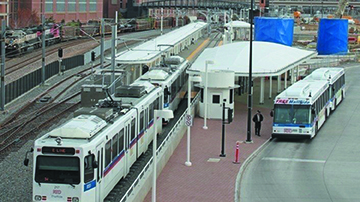
Triple Threat: RTD needs to triple the number of trains and buses it has in order to serve the same number of passengers the agency had prior to the pandemic.
While the agency grapples with a path forward, it also faces plummeting ridership and tax revenue. Even if RTD’s financial projections — originally forecast as a $1.1 billion revenue loss through 2026 — drops to just 9% vs. the originally predicted 24% — the road ahead remains treacherous and volatile.
Social distancing rules will not only impede but essentially preclude a rebound. Why? To operate what was a pre-pandemic commuter load back in January, now requires three times the equipment and operators because of the cap on number of passengers. Bottom Line: The agency will likely not be able to restore service to its pre-pandemic levels — or anything close to it.
Huge Debt Burden
RTD was in a delicate financial spot even before the coronavirus. By adding five new train lines since 2012 — a fifth is expected to open in Sept. — the agency is drowning in debt. RTD is due to pay $252 million in debt and interest this year alone. That’s why the agency had made a $40 million cut in its 2020 budget. Even if RTD loses significantly less than the quarter-billion dollars originally projected for 2020, the budget is still a full blown problem.
RTD’s FasTrack program has never met the yearly forecasts following voter approval of the package in 2004. The recession that followed made the difference between forecasted and actual revenue even larger. Thus, RTD took out loans to build many of the train lines it promised voters in 2004.
That’s why now it’s saddled with massive debt payments. RTD now estimates that more than 90% of the $194 million in FasTracks sales tax revenue it expects to collect in 2021 will go to debt service.
Cost Cutting
Crowded Cars Eradicated: Standing shoulder-to-shoulder with strangers has been eradicated by the coronavirus. As a result RTD now needs three times the equipment and operators for a pre-pandemic passenger load.
“We have an incredible system right now but it came as an expense,” admits Heather McKillop, RTD’s financial officer. “It comes as a long-term expense that has to be paid off.”
In addition to the lower-than-expected sales tax revenue, staff must also deal with higher-than-expected operations and maintenance costs for its new train lines plus an aging system that needs repair.
The agency is now cutting cost by delaying projects and freezing administrative hiring. RTD is also reportedly considering furlough days for all workers. Collective bargaining agreements with drivers, however, don’t allow for furloughs and likely won’t apply to them. Given the recent hiring and retention problems with drivers, that is probably a good thing.
Altering Schedules
Among the possible solutions is altering schedules to avoid crowded trains while increasing frequency throughout the day rather than being concentrated at rush hour. That assumes, of course employers are willing to stagger work hours to ease crowding in public transportation. Even so, the agency must demonstrate that the system is clean, safe and that social distancing is mandated.
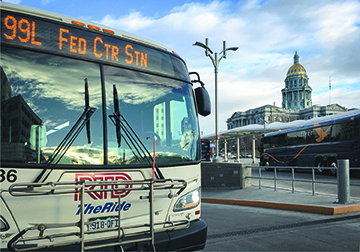
Aging Buses: As coronavirus costs soar, RTD must also maintain an aging bus line that needs repair. In addition, operation and maintenance costs for new train lines is higher than expected.
As with so many other businesses, the scary part for RTD is the potential duration of the crisis — it isn’t going away anytime soon.
RTD resumed fare collection and front-door boarding on all buses July 1 and passengers are required to wear face covering. Nevertheless they’re only buying time with the virus, they’re not removing it from the equation. The agency must also face the fact many previous riders may continue to work remotely — even if only some of the time — when the coronavirus ends.
Reimagining RTD
“The world has changed, we recognize that and we are reimagining RTD to support this new normal and these new challenges,” says Bill Van Meter, assistant general manager of planning.
Much of RTD’s budget gap for 2020 will be funded by a large grant from the Coronavirus Aid, Relief & Economic Security Act (CARES). RTD leadership admits, however, that they cannot count on a second round of funding.
The agency is continuing to reduce costs and streamline to close the large financial gap. Cuts made to the 2020 budget under the worst-case scenario may result in a surplus by the end of the year, which would be carried forward to the 2021 budget. That would help offset projected losses of sales and use tax revenue, decreased fare collection and the unlikely allocation of additional CARES Act funding.
Riding Healthy
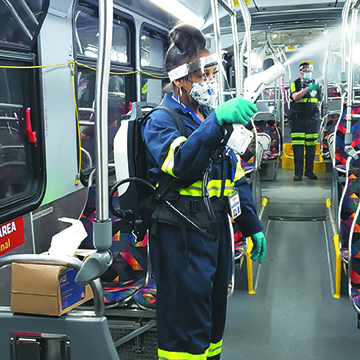
Healthy Ride: Beyond social distancing, electrostatic cleaning of cars is an added burden for agency saddled with huge debt, higher-than-expected operations and maintenance costs for its new train lines plus an aging system that needs repair.
Denver and state health officials say social distancing — at least six feet from other passengers — must be maintained. RTD claims it is adding additional vehicles on busy routes to help maintain the required space between passengers.
RTD is also requiring face covering among both passengers and operators. Staying quiet, as conversation — especially yelling or singing — amplify the spread of the virus. “A quiet car is a safer car,” they say.
Finally, health officials urge passengers to use hand sanitizers or wipes after riding buses and trains.
Jayson Penn Indicted By Federal Grand Jury In Denver; Feds Find A Chicken Conspiracy At Greeley-Based Firm
by Glen Richardson
A federal grand jury in Denver has indicted Jayson Penn, the CEO of Greeley-based Pilgrim’s Pride, and three other current or former chicken industry executives for price fixing. The grand jury in U.S. District Court here indicted all four with one count of conspiring to fix prices for broiler chickens from at least 2012 through 2017. A trial is scheduled to begin this month (August).
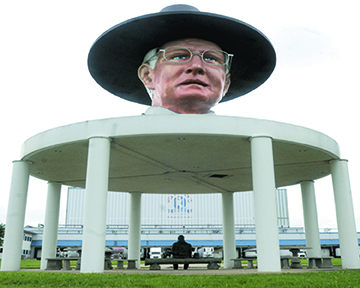
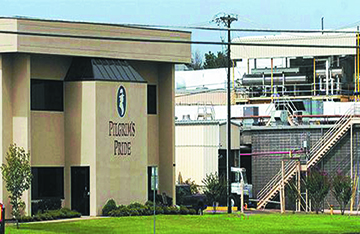
Scratching Out A Living: Headquarters of the second-largest U.S. chicken company Pilgrim’s Pride is in Greeley. The entrance includes a bust of founder Lonnie “Bo” Pilgrim. The firm reported annual revenue last year (2019) of $11.41 billion.
The indictments came after grocers, retailers and consumers accused Pilgrim’s Pride, Tyson Foods Inc., and other poultry processors in a lawsuit of conspiring since 2008 to inflate prices for broiler chickens. Fabio Sandrio, chief financial officer, is serving as interim president and CEO.
The other executives allegedly involved in the scheme include former Pilgrim’s Pride vice president Roger Austin, Claxton Poultry Farms President Mikell Fries, and Scott Brady, a former Pilgrim’s Price executive who joined Claxton in 2012. Pilgrim’s Pride supplies chicken for Costco and Yum Brands’ KFC, while Claxton is a supplier for Chick-fil-A.
$11.4 Billion Income
Pilgrim’s Pride is the second-largest U.S. chicken company, with reported annual revenue last year (2019) of $11.41 billion. It is majority-owned by Brazilian meat giant JBS. Tyson Foods Inc. — the largest U.S. poultry processor by sales — meanwhile says it is cooperating in the Justice Department’s probe into the matter, under a leniency program that will let Tyson avoid criminal prosecution.
Penn pleaded not guilty to the federal charges, while a judge barred him from contacting poultry buyers allegedly victimized by the scheme. He also agreed to surrender his passport and not leave the country.
U.S. Magistrate Judge Kristen Mix said at the hearing that Mr. Penn can remain free on personal recognizance, and can travel. She imposed conditions on his actions while he awaits trial, most notably that he can’t contact employees of eight companies that are customers of Pilgrim’s and are alleged victims of price-fixing by Mr. Penn and co-conspirators. The Judge also said Mr. Penn couldn’t contact price negotiators at other chicken suppliers who allegedly participated in the price fixing.
Penn On Paid Leave
Jayson Penn joined Pilgrim’s in March of 2011 as Senior Vice President of the Commercial Business Group. He moved up to President of Pilgrim’s USA in 2017 and was promoted to President-CEO in March of 2019.
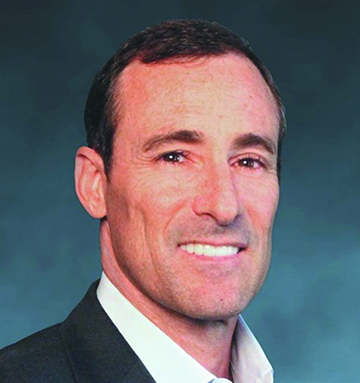
Indicted CEO: Jayson Penn, the CEO of Greeley-based Pilgrim’s Pride, has been placed on paid leave following pleading not guilty to the federal charge.
Pilgrim’s Board placed Penn on leave with pay following the hearing. He makes $4,418,340 as President-CEO at Pilgrim’s Pride.
“The Board takes the recent allegations very seriously and believes it is in the best interest of both Jayson and the company that he is given the opportunity to focus on his legal defense at this time,” Board Chairman Gilberto Tomazoni said in a statement.
Ruffled Feathers
“After years of talk, the feds finally pounced,” observe legal experts familiar with how the Department of Justice executes prosecutions of business organizations. They say it is one of the stranger examples of alleged market-rigging in a long history of cases, made more unusual in that the chief executive of a company that big is actually facing criminal charges and as many as 10 years in prison. The maximum fine may be increased to twice the gain derived from the crime or twice the loss suffered by victims if either amount is greater than $1 million, according to the Department of Justice.
Chicken House Pride: Founder Bo Pilgrim, at right, performed in ads dressed in pilgrim garb with a pet chicken named “Henrietta.” His Texas mansion was nicknamed “Cluckingham Palace” by neighbors. He sold the company to JBS in 2009 and it was moved to Greeley.
The charges the U.S. Justice Department laid out in its indictment appear to document executives at competing companies colluding to share pricing and bidding information from 2012 through 2017 in the cut-throat world of commodity chicken. Makan Delrahim, the head of the government’s antitrust division, said in a statement: “Executives who cheat American consumers, restaurateurs, and grocers, and compromise the integrity of our food supply, will be held responsible for their actions.”
Vertically integrated, Pilgrim’s Pride is involved in breeding, hatching, raising, processing and distributing chicken. The company produces some 11 billion pounds of chicken products annually and serves more than 6,000 retail food outlets, distributors and food service operators.
Chicken Feed Start
Pilgrim’s Pride traces its roots to Pittsburg, Texas, where Lonnie Alfred “Bo” Pilgrim opened a chicken feed store in 1946 with his older brother, Aubrey. They grew the fledgling company by handing out free chicks along with purchased bags of feed sold to customers.
Bo Pilgrim would often dress in pilgrim garb, complete with a pet chicken named “Henrietta,” to perform in advertisements. The extravagant Texas mansion where he lived was dubbed “Cluckingham Palace.” Set on 43 acres, it had 10 bathrooms, an indoor pool, cinema and gymnasium.
He sold the international poultry operation to Brazilian company JBS in 2009, and its headquarters was moved to Greeley. He died in 2017 at age 89.