We are now well into the first year of
Mayor Michael Hancock’s final and desultory third term. Ugly high-density and
poorly constructed apartment buildings are still going up everywhere, while
parks and open space are destroyed and predatory bike lanes arise that severely
impede the flow of traffic in the city, making some neighborhoods far less
enjoyable and livable than just five years ago. The mayor continues to spend
much of his time in Atlanta, where he can engage in his favorite pastime,
chasing skirts, far from the scrutiny of the citizens he rules.
What is different in his Honor’s third term
is the 13-member City Council that acts like an actual city council and not
simply a rubber stamp Politburo for a tin pot dictator. Incredibly in the
entire time in office as mayor he has not vetoed a single piece of legislation
aside from his recent veto of a form of a pit bull ban, approved by the City
Council by a 7 to 4 margin. It will take nine votes to overcome the veto. Even
Governor Polis is opposed to the legislation. He shared a picture of him and
his pit bull on social media.
We don’t particularly like City Council
feeling the need to legislate various aspects of many people’s lives either,
but that is not the point. In his first two terms, the city council members
would not dare to pass anything that he did not approve of for fear of
retribution. Perhaps the sudden signs of political courage are a result of Mr.
Hancock being a lame duck mayor who can’t run for another term, unless, of
course, he pulls a “Bloomberg” at the last minute.
But we think it is more of the makeup of
the members of the present council. In 2015 the citizens of Denver elected four
potential rebel new council members — Wayne New, Rafael Espinoza, Kevin Flynn
and Paul Kashmann — who defeated the choices of the mayor and the high-density
developers. The citizens hoped and expected the new members to fight the good
fight but, in fact, nothing changed. Rafael Espinoza behind-the-scenes urged
and virtually begged his fellow council members to once, just once, stand up to
the mayor, but they simply would not.
The election last spring also brought in
four new potential rebel council members — Chris Hines, Candi CDeBaca, Amanda
Sandoval, and Amanda Sawyer — who most council observers expected to be
co-opted just like the 2015 class. But they greatly underestimated Ms. CdeBaca.
She had upset Albus Brooks who was not only the close friend and political ally
of the mayor’s, but the favorite to be the next mayor of Denver. A radical, she
wasted no time in informing the mayor that there was a new sheriff in town and
she was not going to be one more poodle council member.
Amanda Sawyer crushed another close ally of
the mayor, Mary Beth Susman, in District 5 in the 2019 election. She was viewed
by some as not having the grit of Ms. CdeBaca and perhaps far too dependent on
her political sisters from Emerge, a program that trains Democrat women for
local political office, and which helped her get elected in 2019.
But by and large Sawyer has demonstrated
that she is made of the right stuff. One of the problems with the prior
councils is they let the mayor’s staff and appointees push them around. The
mayor’s men and women had little or no respect for what they viewed as weak and
cowardly elected officials on the City Council.
Employees from Denver’s Department of
Transportation and Infrastructure (DOTI) were regularly showing up late for
meetings, leaving early and failing to provide information about projects.
After nine months of this type of conduct Councilwoman Sawyer had enough of it.
She went to Human Resources and the Mayor’s Office to complain that this
conduct was putting her constituents in danger. When they laughed her off, she
further indicated that she would vote against any and all DOTI projects until
the situation was remedied.
The mayor was shocked. He was simply
treating City Council members in the same manner he always had. He quickly went
to sycophantic Denver media to trash her, which they did. The DOTI Executive
Director Eulois Cleckley told the press that the whole matter “really boils
down to a personality conflict.” That is to say that Ms. Sawyer is very
difficult to work with, which would surprise anyone who knows her. Cleckley
went on to declare, “I was a little disappointed. Having tactics like this that
potentially can delay our services or projects. It actually hurts our ability
to do what’s right for the city and county of Denver.”
Ms. Sawyer said she felt she was being
attacked essentially for being a whistleblower. She declared “that this has
turned into a campaign to smear me so that this changes the conversation, and
that’s not fair.” She is of course right. Sawyer backed down about the voting
part, but she had placed a marker about how she expected to be treated on
behalf of her constituents.
Next time she needs to bring along a few of
her fellow council members who need to let the mayor’s personnel know that
Council members are the elected officials and not them. We await that day which
we hope will occur in the very near future.
Breaking Down Denver’s Rising Levels Of Air Pollution
by Luke Schmaltz
It’s rush hour on a Denver weekday
afternoon and bumper to bumper traffic is making the ride home a frustrating
punishment rather than a jettison to freedom. Then suddenly a jogger flies past
your window and a pang of guilt overcomes you that you are not getting your
cardiovascular exercise for the day.
But is that wannabe Forrest Gump really
engaging in a healthy activity? What the exercise-crazed spandex-clad hordes of
Denver may not be aware of is that hyperventilating amid throngs of automobiles
ain’t all it’s cracked up to be. The air circulating through your lungs is
saturated with elevated levels of ozone. On many a smoggy day, (there were over
100 in 2019) the air hanging over the city is what the Environmental Protection
Agency calls “in serious violation” of Air Quality Index (AQI) standards.
Essentially, by breathing rapidly and deeply next to a busy Denver street, you
may slowly be poisoning yourself.
A Man-made Hazard
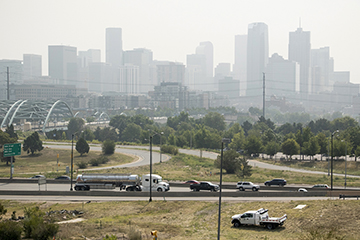
Polluted Skyline: The Denver skyline takes on a New Jersey-esque complexion roughly one out of every three days.
A series of circumstances have coalesced to
form what could be considered a perfect storm of pollution across the city.
Increasing volumes of car exhaust due to population explosion, carbon emissions
from oil and gas mining operations, smoke from fireplaces and woodburning
stoves, emissions from power plants and industrial furnaces and sunlight
reacting with molecular oxygen particles has elevated the ozone levels past the
70 parts per billion (PPB) maximum recommended by the EPA. The aforementioned
100+ days in 2019 involved ozone levels past 80 PPB. The national ambient air
quality standards (NAAQS) were redefined in 2015 after extensive research into
the detrimental health effects of common air pollutants such as ground-level
ozone, particulate matter, lead, sulfur dioxide, nitrogen dioxide and carbon
monoxide.
In Collaboration With Nature
Smokestacks: Smokestacks may not paint the sky black, but they deliver convincing shades of brown and gray.
What’s more, a global warming-driven
weather phenomenon known as temperature inversions are acting like an invisible
lid — trapping pollution in the troposphere rather than allowing it to
dissipate up through the stratosphere. Yes, the infamous brown cloud of the
1980s that Denver was internationally mocked for is back once again. This time
around, however, like fugly apartment buildings, a whitewashed retail landscape
and gentrification itself — this phenomenon is taking place in metropolitan
areas across the nation.
In a nutshell, ground-level ozone is
volatile organic compounds (VOCs) and nitrogen oxides (NOx) reacting with
sunlight and atmospheric air molecules. The Denver Regional Council of
Governments estimates that every day, between 250,000 and 350,000 cars are
being driven across the metro region. This transportation sector is the second
largest contributor of greenhouse gases next to industrial emissions. Plus,
there are over 23,000 active oil and natural gas wells across the front range
as well as numerous power plants across the Denver metro region.
A New Agency To The Rescue?
As of January 1, 2020, the Denver
Department of Public Works was renamed the Department of Transportation and
Infrastructure (DOTI) in a symbolic display meant to mark a new chapter of
planned environmental objectives. Among DOTI’s concerns is the Climate Action
Plan launched by the City of Denver in 2007 and rebooted in 2015. This “plan”
presents an “80×50” objective — meaning that through new measures and policies
the city aims for an 80% reduction of emissions (from the 2005 baseline) by
2050. A recent heavy-handed screed issued by Mayor Michael Hancock’s office
outlines a protocol of “aggressive and decisive action” for reducing emissions
through new renewable energy programs, energy efficiency and low operational
cost of electric vehicles. This letter celebrates Denver as having “a long
history of trailblazing when it comes to climate change.” If that is so, why do
pollution levels continue to rise? All of the industrial facilities, oil wells
and natural gas mines on operation require permits, correct? It would seem that
progress, when left to bureaucracy, is inevitably hindered by the inherent
sluggishness of government. Either that, or the tax revenue generated by these
facilities is simply too hard to pass up. Regardless, it would seem that the
climate action plan (CAP) is really just a bunch of crap.
It’s Up To You
Traffic: Many are involved but it’s nobody’s fault.
Like traffic jams — where many people are involved but are usually no singular person’s fault, pollution is the cumulative result of many people simply going about their daily business. As willing participants, the responsibility to reduce emissions should be taken up by the populace without being prompted by finger wagging and knuckle cracking from the hand of big brother. The EPA outlines a simple protocol of steps anyone can take at any time to reduce pollution. For example, you can walk, ride your bike, carpool or take the bus instead of driving a single occupant vehicle. Use slow-burning logs instead of wood in your fireplace, properly inflate your times for better fuel efficiency, use environmentally safe cleaning products and paint, reduce use of air conditioners and furnaces and mulch yard waste instead of simply throwing it away. But, and be realistic, you already knew all this, didn’t you? The issue is whether or not you care enough to endure a bit of inconvenience to do your small part, or if you’re going to carry on as usual — assuming that your neighbors and fellow citizens will pick up the slack while you lumber forth in a smog-laden haze. Theoretically, that’s fine enough, but the problem is — they are probably thinking the exact same thing about you.
Denver’s South Pearl Street saw three
businesses exit the market between November and December 2019, becoming the
latest victims to the city’s rising minimum wage and property taxes.
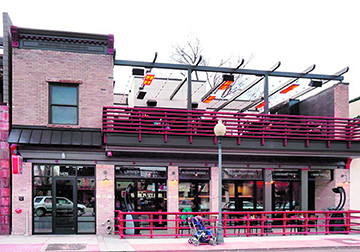
Tavern: Slumping sales and high taxes forced The Tavern Platt Park to close its doors on December 31, 2019.
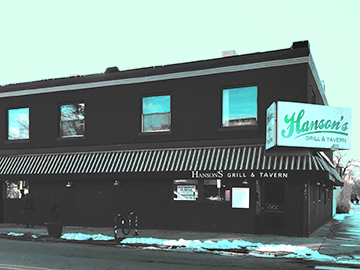
Hanson’s Grill & Tavern, a 21-year
neighborhood staple, shut its doors in December. The Platt Park Tavern closed
on New Year’s Eve after four years of business, and Palizo Italiano closed in
November after just two years.
While it’s reasonable for neighborhood
residents to be concerned about the health of their local shopping district,
Mark Gill, Vice President of the Pearl Street Merchants Association says the
closures remind him of a time in South Pearl’s recent past.
“Seven or eight years ago we had a similar
situation where three restaurants all closed at once,” Gill told the Glendale
Cherry Creek Chronicle in an interview. “People were worried then, but the
neighborhood bounced back just fine, in my opinion.”
As a 21-year veteran of the neighborhood,
including the last 14 years as a member of the Merchants Association and an
owner of two buildings in the neighborhood, Gill says the neighborhood has seen
a steady upward trend. However, that hasn’t kept him from seeing some of the
issues businesses in the area face.
“The nature of the neighborhood hasn’t
really changed much,” Gill said. “A majority of the businesses are mom-and-pop.
But, there’s no denying that rents and property values are going up.”
The Chronicle reached out to Hanson’s, the
Platt Park Tavern and Palizo Italiano for comment but didn’t receive a
response.
Outdated Gallagher Problems
The state’s population boom and continued
residential development that follows are causing problems for businesses all
over Denver because of the criteria set forth in the Gallagher Amendment, a
state constitutional amendment passed in 1982 that altered the way Colorado
assessed and collected property taxes.
Long Standing Grill & Tavern: Hanson’s stood at the corner of Louisiana and South Pearl for over two decades before closing shortly before the New Year 2020.
Before the amendment was passed, Colorado
collected its property taxes through a complex set of formulas that most
property tax professionals couldn’t fully comprehend. Afterward, Gallagher
effectively decreased the assessment rates whenever statewide residential
property values increased faster than business property values.
The problem? By maintaining this constant
ratio between residential and business property tax assessments, Gallagher has
essentially prevented Colorado from capitalizing on its expansive residential
growth, leaving businesses to pick up the revenue shortfalls.
The Platt Park Tavern provides a perfect
example of this problem. In 2019, the land and real estate tied to the business
was assessed at value of over $4.5 million. The Tavern ended up paying a little
more than $123,000 in property taxes, according to Denver County property tax
records. In 2018, the business paid just under $97,000 in property taxes.
Meanwhile, a 32,000 sq. ft. mansion in
Cherry Hills Village valued at $22 million paid just under $74,000 in property
taxes for the same year. The mansion’s property tax assessment has dropped
nearly 24 percent since 2016 as well.
For perspective, a residential property
with a tax assessment comparable to the Tavern’s paid roughly $37,000 in
property taxes, according to Zillow.
“Right now, we’re seeing far more residential
development than we were two or three decades ago,” Gill said. “In the end
businesses end up paying for a larger part of a shrinking pie.”
New Minimum Wage Problems
Outside of the property tax issue, small
businesses in Denver have to contend with a minimum wage that is slated to
reach nearly $16 per hour by 2022.
For restaurants, a business with
notoriously tight profit margins, even the slightest increase in labor costs
can be detrimental.
The Colorado Restaurant Association reports
that over 200 new restaurants opened in Denver in 2019. On top of that, the
explosive growth of Colorado’s population and its increased reliance on tourism
to bring new faces to the Centennial State has sent restaurant sales
skyrocketing to $13.9 billion annually.
But, between the lines, Denver’s restaurant
scene is becoming more homogenized with chain and franchise restaurants taking
up most of the retail space in Denver County. Local staples like the original
Snarf’s Sandwiches has had to move through multiple locations as it battles
against its labor costs and property tax assessments.
Even The Denver Post is not sold on the
idea that increasing the minimum wage is right for Colorado. In an article from
October 2019, the Post lamented the wage increase as “an exacerbation of the
cost of living issues in Denver.”
Currently, a restaurant worker making the
city’s $12 per hour minimum will need to work 103 hours per week to afford an
average one-bedroom apartment costing $1,652 per month without paying more than
30 percent of their income on rent.
Meanwhile, restaurant owners are concerned
that the new wage hikes won’t be enough to account for the industry labor
shortage.
“Everything we’ve been hearing from our
members, (they) have been saying, ‘How do we find more workers? We need more
people to be working in our establishments,’” Carolyn Livingston, the
spokeswoman for the Colorado Restaurant Association, told CBS 7.
About one-tenth of Colorado’s workforce
works in the restaurant industry. However, the state’s record-low unemployment
rate has elongated the replacement rate once an employee decides to leave.
Sign Of What’s To Come?
Still, there are signs that South Pearl
Street will pull through. One aspect Gill always points to is that there are
hardly any “For Sale” signs hung in the windows of Pearl Street businesses. In
fact, most are sold by word of mouth these days, Gill says.
The neighborhood is also planning on adding
arches at the Jewel, Iowa, and Louisiana entrances as the Merchants Association
awaits the next rotation of businesses. Gill hopes the aesthetic additions will
help spur growth in the area for years to come.
“South Pearl will rebound. These businesses closing at the same time was just a coincidence,” Gill said. “There will always be people coming and going, and people wanting to come in once the others have left.”
Every 10 years, United States citizens are
asked to respond to the Census which is a questionnaire designed to count the
number of people living in the country. According to the Constitution, the
results of the Census are used to determine the number of United States House
of Representatives each state is designated. Additionally, over $675 billion in
federal funds, grants, and support to states, counties, and communities is
allocated based on information gathered from the Census data. These funds are
then spent nationwide to support essential programs, roads, schools, hospitals,
and more.
State officials use Census results to
redraw the boundaries of their congressional and state legislative districts adapting
to population shifts. Exemplifying its historical significance, the first
Census was completed in 1790 — more than a year after the inauguration of
President Washington and soon before the second session of the first Congress
concluded. Because this data represents such an important part of Colorado’s
future, the United States Census Bureau is recruiting for a variety of
temporary jobs, including Census takers, to assist with the nationwide 2020
count.
“Applying to work as a Census taker is a
great way to make extra money and line up spring and summer employment ahead of
time,” says Laurie Cipriano, Media Specialist for the U.S. Department of
Commerce and U.S. Census Bureau. “Census taker positions offer flexible hours,
paid training, weekly compensation, and reimbursement for expenses such as
mileage for employees doing fieldwork.”
People of all backgrounds are encouraged to
apply, including college students and retirees who are looking for extra income
or a second job. While hourly pay rates vary by position and location, the
Arapahoe County rate is listed between $18.50 and $20.50 and Denver County is
listed as $20.50.
“Participating in the Census is extremely
important because these population changes determine the state’s representation
at the federal level and have a tremendous effect on how our state money is
allocated,” explains Greater Glendale Chamber of Commerce Chief Operating
Officer Jeff Allen. “Additionally, everyone’s responses are protected by law
and cannot be shared with a federal or state agency.”
Deemed the largest peacetime deployment of
civil servants across the country, the Census counts every person living in the
United States as of April 1, 2020, which is officially designated as Census
Day. By this date, most homes will receive an invitation to participate online,
by phone, or by mail. For households that do not self-respond, the national
door-to-door enumeration begins in May and ends in July. Additionally, for the
first time ever, citizens have the option to fill out the form online making
the process easy, safe, and secure.
For those interested in Census taker positions, the selection process is underway, with paid training occurring in March and April. Visit www.2020census.gov/jobs for more information.