Boulder Barbers

by Jessica Hughes
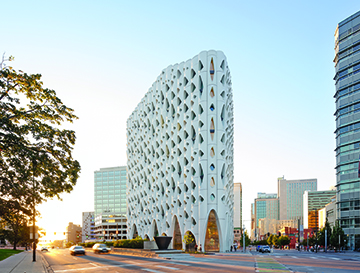
The exterior design of the Populus Hotel is meant to resemble the iconic Colorado aspen tree. Photo by Jason O’Rear
A new hotel has been planted near Civic Center Park in downtown Denver. The Populus Hotel, the nation’s first carbon-positive hotel, opened its doors to the public on October 14 — almost three years after breaking ground in April 2022.
Developed by local real estate developer, Urban Villages, and designed by AD100 architecture firm, Studio Gang, the 265-room, 13-story hotel is turning heads with its distinct design and sustainability efforts. Meant to resemble Colorado’s iconic aspen tree, the hotel’s stark, white-washed exterior, dotted with windows in 20 different shaped “aspen eyes” is the backdrop to the Mile High City’s most cutting-edge hotel.
Focusing on bringing nature back into the city, the entire hotel replicates a natural living organism, the aspen tree. From the “forest floor” lobby to its open-air rooftop bar, the entire experience is meant to make you feel a part of nature in the middle of downtown.
While the Aspen-eye-shaped windows are the hotel’s most distinct design element, the hotel’s interior design also seamlessly captures nature’s elements while maintaining a strong commitment to environmental stewardship through carefully selected sustainable materials. The lobby showcases this approach with its ceiling featuring repurposed wood snow fencing from Wyoming. Guest rooms reflect the same eco-conscious philosophy, incorporating carpeting made from recycled biodegradable materials and headboards constructed from naturally fallen beetle-kill pine trees.
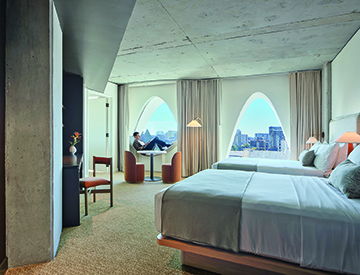
Modern and efficient guest rooms with aspen-eye windows stand out with picture-perfect views of downtown. Photo by Steve Hall
“This is a design concept that focuses on bringing nature back into the city,” says George Prine, the General Manager of the Populus. “Being in Colorado, it feels natural to have a hotel that highlights the beautiful nature around us, making nature all a part of the experience.”
Two restaurant concepts anchor the 265 rooms, with Pasque restaurant on the ground floor, and the rooftop restaurant and terrace, Stellar Jay, where the views of the state capitol building, the Denver Art Museum, and the Denver Public Library take center stage. But the views don’t stop there. Guests will enjoy picture-perfect views through the aspen-eye windows, framing downtown Denver’s iconic buildings and distant mountains.
Accommodations span from the Grove and Aspen rooms to the premium Pando Suite, which crowns the top floor.
But the hotel’s design isn’t the only thing that has garnered all the attention. As the nation’s first carbon-positive hotel, the Populus has also ushered in a new standard in the hospitality industry of what it means to be environmentally sustainable.
Populus reduced its operational carbon footprint through a combination of sustainable design and construction techniques, including the use of low-carbon concrete, an insulated façade system, and GFRC rain screen. And to reduce its carbon footprint even more, Populus is Colorado’s only hotel without a parking lot. But to be carbon-positive, not just carbon-neutral or net-zero, the Populus goes beyond cutting carbon emissions, it is committed to putting more “positive” effects back into the environment.
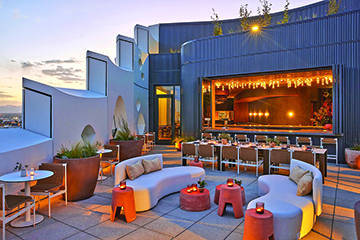
Stellar Jay rooftop terrace invites guests to take in the views and a crafty cocktail. Photo by Yoshihiro Makino
The Populus worked with the U.S. Forest Service and other agencies to further offset its carbon footprint by planting over 70,000 trees (172+ acres) in Gunnison County. In fact, at the heart of the hotel’s efforts to be the first “carbon positive” hotel in the U.S., the Populus will offer its One Night, One Tree program — planting a tree for every night’s stay. In partnership with the National Forest Foundation (NFF), Populus will plant one tree for every night’s stay.
The hotel’s two unique dining concepts are also making headlines with their goal to turn 100% food waste into compost to be shared with local farmers. Pasque, an all-day dining destination on the hotel’s lobby floor, and Stellar Jay, the lively rooftop restaurant and bar, are setting a new standard of food from table to farm, establishing a circular solution for food waste.
To achieve this, Populus will be the first hotel in downtown Denver to use unique “Food Cycling’’ technology from BioGreen 360. Using this technology, the hotel aims to divert 100% of its food waste away from landfills and turn it into all-natural compost that it will give back to local farmers in Colorado.
“The opening of Populus marks an incredibly significant milestone and represents a new model of environmentally conscious hospitality that will forever change the guest experience for mindful travelers, while adding vibrancy to the city of Denver,” said Jon Buerge, President of Urban Villages. “We are excited to watch Populus come to life as the center of a thriving community, becoming everything from the new neighborhood hotspot to a must-visit hotel destination, all while inspiring the industry to rethink how hotels can prioritize the health of the planet in a positive, engaging, and meaningful way.”
by Mark Smiley
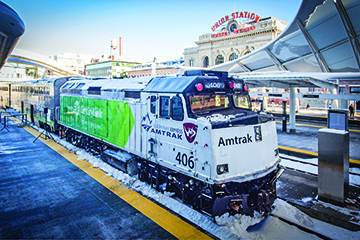
January 9, 2025, marked the first Thursday for the Amtrak Winter Park Express to operate under its new regular service schedule. And January 13 marked the first Monday that the train runs regularly.
The new Thursday and Monday runs, which will last until March 31, are in addition to the usual Friday, Saturday, and Sunday service that passengers have come to expect of the ski train.
The new five-days-a-week service, which also comes with lower fares, is a result of increased funding from the Colorado Department of Transportation. The route, which runs from Denver Union Station to the slopes at the Winter Park Resort, also stops at the Fraser-Winter Park station.
“We hope Coloradans and visitors to our state will take advantage of this expanded service,” said CDOT Executive Director Shoshana Lew. “Folks riding the Winter Park Express can bring their skis, boards, and gear at no additional cost, and there are two more train cars now to carry more people and their stuff.
“With fares more than 40% less than previous years, this is a great deal.”
In addition to being able to purchase food and beverages aboard the Winter Park Express, passengers can enjoy panoramic views of the Rockies from the Sightseer Lounge car.
The train departs Denver Union Station at 7 a.m. and arrives at Winter Park at 9:11 a.m. The return trip departs from Fraser-Winter Park station at 4:05 p.m., then departs Winter Park Resort station at 4:35 p.m. and arrives in Denver at 7:05 p.m. One-way fares start at $19 or $9.50 for kids. For tickets, go to amtrak.com/winterparkexpress.
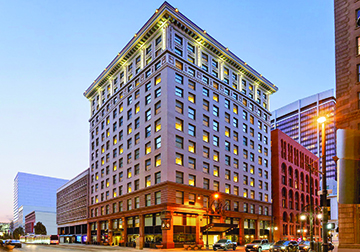
City’s 2025 Working Budget To Increase By Only 0.6%; An Added 1.1% Drop In Home Prices Is Predicted By Mid-2025
by Glen Richardson
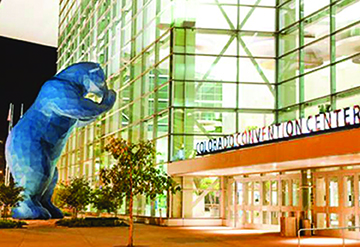
Conventions Rebound: The Colorado Convention Center is rebounding from the tailspin caused by homelessness and crime downtown. More than a half-dozen conventions with 10,000 or more attendees are booked for 2025.
Aside from home prices, Denver’s Outlook for 2025 remains strong. Nevertheless, in the aftermath of the millions spent last year on the immigrant influx, the city is cutting its full-time staff by 200 people.
The Mile High City’s 2025 operating budget is set at $4.4 billion. Quietly and unanimously approved by the Denver City Council, it is just 0.6% more than the $1.75 billion spent in 2024.
This is the first time in a decade — other than the pandemic — that the city is reducing full-time employees. The city will lower staff by not filling vacant positions, rather than through layoffs or furloughs. The cutback is expected to create $30 million in savings.
Tourism Rebound
The Mile High City’s conventions and tourism that was put in a tailspin by homelessness and crime downtown, is expected to make a significant rebound in 2025. Already more than a half-dozen conventions with 10,000 or more attendees have been booked in Denver.
The National Corn Growers Assn. is bringing 11,000 to Denver March 2-4. They will be followed by 11,000 or more for the American Water Works in June. Then in September and October three conventions with 15,000 to 17,000 attendees are booked: The Congress & Expos National Safety Council, Sept. 15-17; the American Academy of Pediatrics, Sept. 25-30; and the Assn. of Chiefs of Police, Oct. 18-21.
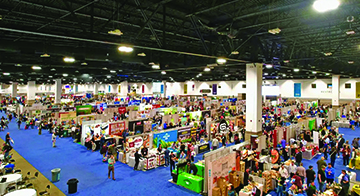
Denver Trade Show: The 2025 Dot Foods Innovations show will be held at the Colorado Convention Center from April 15-17, 2025.
“In 2025, we are literally up about 15% over 2019 — the year that saw record travel spending of $24.2 billion and attendance of 813,662,” — according to Richard Scharf, CEO of Visit Denver, the city’s convention and visitor’s bureau. The city’s 2025 Destination Plan includes initiatives to expand convention infrastructure, attract more events, create new attractions, and improve connectivity. Moreover, Denver was named to Condé Nast Traveler’s list of Best Places to Go in North America and the Caribbean in 2025.
GDP Outpaces U.S.
A study by Coworking Café ranks Denver 13th among the best large cities for economic growth. The Mile High City recorded some of the largest rises in earnings, housing units, education attainment, and employment rates.
Metro Denver’s GDP (Gross Domestic Product) is estimated to have increased by 2.9% during Q3 of 2024. GDP represents the total monetary value of all final goods and services produced within a market — in this case Denver.
Over the past four quarters, metro Denver’s GDP growth has outpaced that of the U.S., averaging 3.0% versus a national average of 2.7%.
Urban Upgrade
Little Gem: Near the Convention Center, the Magnolia is the only Denver hotel to make Meeting & Convention Magazine’s “Best Hotels.”
A study from the National Community Reinvestment Coalition recently found that Denver is the second-most gentrified city — change due to influx of affluent residents & investments — in the entire country.
With LoDo (Lower Downtown) and LoHi (Lower Highlands) already hot spots, a new wave of neighborhoods is poised for explosive growth in 2025, Mile High observers are predicting.
Neighborhoods experiencing new residents and money are North Park Hill, West Colfax, plus West Barnum. Southwest of downtown, with a suburban feel, Barnum’s northern boundary is the Sixth Ave. Freeway, the eastern boundary is Federal Blvd., Alameda Ave. to the south, with Perry St. on the west.
Still Seller’s Market
While the housing market improved for buyers during 2024, it remains tight enough that real estate authorities indicate that 2025 is likely to remain a seller’s market in most sections of Denver.
By October of 2024, Mile High home prices were up 3.1% from a year earlier, selling for a median price of $593,000. On average, homes city-wide were selling after 34 days on the market, compared to just 19 days in 2023.
Interest rates will be pivotal to Denver’s 2025 real estate outlook. Short-term rates are anticipated to decline, but the steadiness of long-term rates remain uncertain. In October, government-sponsored Fannie Mae predicted that the 30-year mortgage rate would be 6% by the end of 2024, dropping to 5.60% by Q5 of 2025.
Crime Challenge
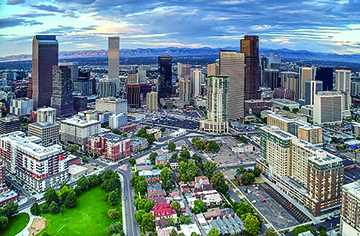
Highrise Haven: Skyscrapers seem like they pop-up overnight in the Mile High City. Denver is the second most gentrified in the nation.
Crime remains one of Denver’s biggest challenges. Denver’s violent crime rate through mid-Nov. 2024 was 7.3 crimes per 1,000 residents, a decrease compared to the last two years.
Violent gun crime is down 14.5%, and nonfatal shootings are down nearly 20%. Nonetheless, Denver still has a higher-than- average crime rate, and ranks high among cities with the highest homicide rate per capita.
The violent crime rate in Denver is more than double the national median. Similarly, the chance of experiencing a property crime in Denver is 1 in 16, far exceeding Colorado’s average of 1 in 32 or the national median.
Hotels Stay Soft
Hotel occupancy downtown, however, is anticipating gains of just 1.5% in 2025. That pace will put revenue per available room (RevPAR growth) at about 3.0% in 2025. Sluggish occupancy gains are despite the renovated convention center and airport development.
Downtown has about 13,000 hotel rooms near the Colorado Convention Center, plus more than 51,000 rooms the city classifies as “first-class.” Newer hotels such as the Populus at Civic Center Park have rece
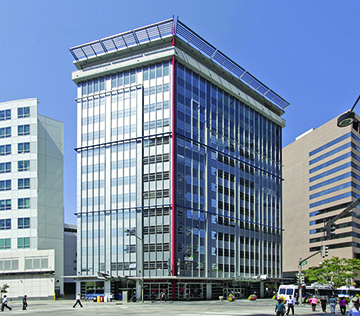
Crude Conversion: Converting the Petroleum Bldg. and other downtown structures is slow due to construction costs and interest rates.
ived extensive publicity.
Nevertheless, only one hotel in the Mile High City — the Magnolia Hotel — made Meetings & Conventions Magazine’s Best Hotels, far less than other major U.S. convention cities.
Even so, the Magnolia was only given a Silver Ranking, behind the JW Marriott, Houston.
Downtown Dilemma
With office buildings the last gasp of another era, as 2025 begins downtown Denver has to resolve what it wants to become, and quickly. Office space is glutted, and several buildings are in default. In the third quarter of 2024, office vacancy hit 30.6%, the first time it’s been above 30% since 2000.
Even more disturbing and worrisome, downtown restaurants and retailers are increasingly struggling. That’s huge because those are jobs about to be lost. Doubly distressing, it also impacts people’s perception of downtown when the streets are not active and busy. Furthermore, it cuts into Denver’s sales tax revenue.
Moody’s is predicting that office real estate value downtown will get messier in the year ahead. Values, they say, will likely continue plunging through 2025. The free-fall: A humungous 26% decline!