by Mark Smiley | Aug 23, 2024 | Uncategorized
$2,000 To Be Presented To Deserving Educators For Classroom Expenses Biweekly
by Mark Smiley

Contributions: A snapshot of what local McDonald’s contribute to the state economy.
Rocky Mountain McDonald’s Owner/Operators are once again providing K-12 teachers the opportunity to apply for $2,000 to improve the learning experiences for their students during the 2024-2025 school year. The program is going into its third school year. A class will be selected every other week when school is in session, equating to 16 school presentations per school year and $32,000 going to local teachers to help with classroom expenses. To date, the program has already awarded educators in the Rocky Mountain area $58,000. “
K-12 educators can apply for these funds through a simple application found by logging on to rmoa-one-class.squarespace.com. Those who apply should be prepared to answer the question, “How would you use this money to improve the learning opportunities for your students?”
“It’s a great program and I have been on the team all three years,” said Brian Boselli, McDonald’s Owner/Operator. “I have been part of a of couple presentations myself. It’s fantastic seeing the big smiles on the teachers faces. Our teachers do so much for the kids. Often times they need to spend some of their own hard earned money on school supplies. This is a way we can help them out.”
Local operators like Boselli are supported by The Ronald McDonald House Charities which have three locations in Colorado: Aurora, Denver, and Colorado Springs. “We work closely with local McDonald’s Owner/Operators in the region and are so grateful not only for the monetary donations they and their customers make each year, but also for their volunteer hours,” said Laura Cordes, CEO, Ronald McDonald House Charities of Denver. “We often have volunteers from McDonald’s at our Houses helping serve dinner to our families, answer phones for our annual radiothon, and serve on our Board of Directors.”
McDonald’s Owner/Operators are residents who live and work in their communities, sending their kids to local schools and running their businesses just like any other small business. They employ over 13,000 people locally and make over $75 million in local supplier purchases annually, contributing to the local economy.
“Mile Hi Foods is a distributor within the Rocky Mountain Region for the McDonald’s brand and has supplied the local, Denver, owner/operator community for over

One Class At A Time: K-12 teachers have the opportunity to apply for $2,000 to improve the learning experiences for their students during the 2024-2025 school year through McDonald’s One Class a Time program.
100 years,” said Kristy Taddonio, President at Mile Hi Companies. “The company provides three hundred plus job opportunities, purchases goods such as fresh produce from Colorado farms and meats from local companies, and helps to reduce carbon emissions within the city as part of the McDonald’s and Mile Hi sustainability plan. Mile Hi Foods values its great partnership with McDonald’s and its relationship with the Colorado community.”
The local operators donate their time, food, and money regularly to community organizations and schools. McDonald’s Rocky Mountain region includes approximately 45 local franchisees who care about their communities where they do business and that’s how “One Class at a Time” was hatched: the desire to help where it’s needed the most. Overall, there are 200 McDonald’s in the state, employing over 16,300 people. All of them are locally owned and operated.
Local Owner/Operators have supported the Colorado Parent Teacher Association for over 18 years. They also support communities through their 27+ year partnership with the Gospel Music Hall of Fame and their Annual “Academy Awards” and Scholarships Event in Denver and their ongoing support of the Colorado Hispanic Chamber and their support of local schools, just to name a few.
For more information on the Ronal McDonald House Charities Denver, visit rmhc-denver.org.
by Mark Smiley | Aug 23, 2024 | Glendale City News
by Mark Smiley
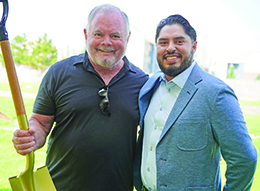
Glendale Mayor Mike Dunafon (left), and Central Street Capital President Isiah Salazar proudly display the shovel that officially broke ground on the Four Mile District. Photo courtesy of Iris Miceli Photography
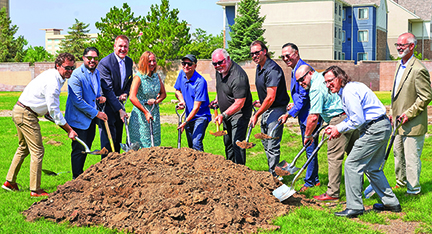
On July 25, 2024, Glendale officials and Central Street Capital break ground on Glendale’s new Four Mile District. Photo courtesy of Iris Miceli Photography
The much-anticipated groundbreaking ceremony for the Four Mile District was held on July 25, 2024, for a 10-acre entertainment district in Glendale. With a few stops and starts and obstacles over the last decade, forward progress is happening, and the $150 million project is underway.
In 2020, it appeared that Lincoln Property Company, a Dallas based international real estate firm, would develop the district and plans seemed to be moving forward on what was then known as Glendale 180.
The project is now being developed by Central Street Capital, a family office founded by health care entrepreneur Rob Salazar. Central Street Capital has been investing in projects for 25 years including the Assembly Student Living on the Auraria Campus.
The Four Mile District is a nod to the Four Mile Historic Park, which is home to one of Colorado’s oldest standing structures, the Four Mile House Museum. The development site is along Glendale’s popular Virginia Avenue which many know it as home to the nation’s busiest Target and the popular gentleman’s club, Shotgun Willie’s.
In order to make room for the 10-acre entertainment district, the wastewater treatment facility, was decommissioned and demolished in 2006. The land and office building formerly occupied by Gamma Construction was purchased by the City of Glendale and also demolished.
One confirmed tenant, Alamo Drafthouse, a movie theatre, will have nine screens and consume approximately 40,000 square feet. A groundbreaking is scheduled for next year with an anticipated grand opening of late 2026 or early 2027.
The rest of the space will be occupied by retail, restaurants, parking garages, and outdoor plazas. There are also plans for a hotel but it is unclear how that will co-exist with Staybridge Suites which is already next to the yet to be built district.
This district will be classified as a common consumption area, allowing visitors to walk around with alcoholic beverages, and bars to serve until 4 a.m. The City of Glendale owns the land where the entertainment district will be built. However, a 2021 development agreement that Central Street and the city reached allows Central Street to purchase it for $1 when a certain amount of progress is completed.
Mayor Mike Dunafon called Glendale “the Vatica n of liberty and Luxemburg of freedom,” and said Glendale “had the No. 1 entertainment district in Colorado before LoDo” while addressing the attendees at the groundbreaking ceremony. Dunafon indicated it was undone by state regulation, but Four Mile District will hopefully return Glendale to the entertainment hub it once was.
During the 1960s and 1970s, the city was home to a variety of now well-known establishments that attracted visitors from across metro Denver. Colorado Mine Company (home of the “Fool’s Gold” which was Elvis’ favorite sandwich), Cork ’N Cleaver, Celebrity Sports Center (owned by Disney), Cooper Theater, The Riviera (The Riv), Soda Straw, Sportspage, The Lift, and Tommy Wong’s Island are long gone but fondly remembered. Additionally, Andy’s Smorgasbord became Shotgun Willie’s Country Western Bar which is now Shotgun Willie’s Show Club and, almost five decades later, Bull & Bush Brewery is still a favorite.
The start of the construction will be the not so glamourous improvements to 7-acres of the property. It will include the creation of a private road, and stormwater and power infrastructure. The parking garage will be the next item to construct and work on that will begin November 2024.
With a fence surrounding the former Creekside Park and markers placed all over the property, it appears the project is moving full steam ahead. More updates in this publication will be forthcoming.

by Mark Smiley | Aug 23, 2024 | General Featured
by Mark Smiley

Megan McNeil, who reported for the Glendale Cherry Creek Chronicle before moving to Arizona, has written her first book.

The beautifully written and illustrated “The Silver Lining” is available at Amazon.
Megan McNeil is a former reporter for this publication and since leaving the newspaper, moved to Tucson, Arizona, and became a television reporter for Channel 13 News in Tucson. She left the station in 2022 to pursue her dream of writing books. McNeil graduated with a BA in Electronic Media and a Political Science minor from San Marcos Texas State and shortly thereafter, began her career with the Glendale Cherry Creek Chronicle. She has fond memories of the start to her career at this publication.
McNeil joined the Glendale Cherry Creek Chronicle staff in October 2015 and wrote articles until her 2017 departure including a piece on Tiny Houses in Denver which in 2015, were just starting to become prevalent. “I used to write these horrible stories as a child, but I that’s where my passion for writing started,” said McNeil. “In college it developed into journalistic writing as I became more aware of the world around me.”
McNeil has now written a children’s book for ages 5-10 which came out in May 2024. This 34-page paperback book is beautifully illustrated by Venus Angelica and tells the story about a little cloud with a big decision to make. Which cloud will it be? The cloud sets out on a fun-filled journey across the skies, meeting cloudy characters along the way. Get to know what makes each cloud unique and how to spot them in the sky. Will the little cloud find out what it is meant to be? And what lesson will it learn along the way?
In this “whatever you are be a good one” story, colorful illustrations, and a heartwarming tale make learning fun. This scientific children’s book about clouds is great for kids 5-10 and guided reading for younger children. A pronunciation guide helps young readers with cloud names.
The Silver Lining retails for $12 on Amazon and can be purchased at https://a.co/d/07xuWjIT.

by Editorial Board | Aug 23, 2024 | Editorials
Editorial —
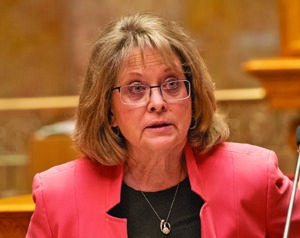
Senator Barbara Kirkmeyer

Philip Anschutz

Governor Jared Polis
Colorado Governor Jared Polis has called another special session to address the problems with extraordinarily high property taxes caused by the elimination of the Gallagher Amendment to the State Constitution in 2020. The Gallagher Amendment was originally adopted in 1982 and froze the homeowner real property tax rate at 7.15%.
The repeal of the Gallagher Amendment was backed by chambers of commerce, business groups, and Colorado Concern, a consortium of wealthy businessmen. The repeal was passed by a 58% to 42% margin. Then came the sticker shock to homeowners.
Polis, afraid of political backlash, called a special season of the state legislature in 2023 to address the issue. But the session granted only short-term minimal relief to homeowners while robbing taxpayers of state Tabor refunds to benefit low-income taxpayers. Republicans like State Senator (and moral reprobate) Barbara Kirkmeyer celebrated that con job on homeowners along with Democrat legislators.
This is one of the times the business class is in sync with the governmental entities which have become bloated with tax revenues as a result of the repeal of the Gallagher Amendment.
Advance Colorado, a political advocacy group funded by Phil Anschutz, proposed, to control the anger of the homeowners, two ballot issues that would address the problem, but that is little more than a ruse to make sure the business and governmental classes control the process.
The governor has now called a second special session for August 26 which has been preceded by a negotiation between the different sides. With Advance Colorado on the side of homeowners and Colorado Concern on the side of businesses.
But it is really a negotiation between Phil Anschutz and Phil Anschutz. The billionaire is a prominent member of Colorado Concern and the main donor of Advance Colorado.
By the time you read this editorial the special session will be over, and you will be able to assess how screwed over the average homeowner was. Of course, it could be that that problem has been solved and homeowners having prevailed with a fair solution. It could happen even if it has almost never happened in Colorado history in similar circumstances. There is always a first time! We wait with bated breath.
— Editorial Board