by Peter Boyles | Jun 20, 2024 | Blasting with Boyles
OPINION

President John L. Lewis
I’ve talked about this many times before, but I grew up in a little steel mill coal mine town on the Allegheny River. And coal miners were a very special part of the men I witnessed growing up. There are two stories that I always remember. One was in the 7th grade and they had school announcements on the public address system when kids lost their parents, or something would happen. The announcement would come before school started. We sat alphabetically and with a name that begins “Bo” the girl behind me had a name that began with “Ca” and the announcement came that her father had died in a coal mine. The infamous Newfield Mine. The roof had fallen in on her dad and I don’t think they ever got his body out.
Later that day I was playing first base with the first organized ball team I played on, and one of the air shafts from the coal mine came up on an angle about 50 yards behind third base. I remember standing on the bag and thinking that Barbara’s father was down there, and I realized how dangerous that job was.
Later, I was working in a steel mill 4-12 p.m. and we got off at midnight. If you know steel mills or coal mines there are bars surrounding all the gates where the men went in and out. And across the railroad tracks from the mill I worked at was a bar-restaurant that actually advertised that they had color TV and it was air conditioned.
That was the place that we headed. It was the summer of 1964. We were talking politics, and these old miners and mill workers would come in there, watch TV and nurse beers in the evening. The wise ass that I am now was who I was then, and the old guys were all named Skee, or Stash, or Stanu, and I asked this old man who he was voting for in the presidential. He turned to me and said who’s running? And I said Lyndon Johnson and Barry Goldwater. And he looked at me and said my president is John L. Lewis. And I remember thinking what a fool he was until later I realized that the great John L. had done more for that guy than all the presidents put together.
John L. got vacation pay, safety in the mines, better pay. The Newfield coal mine had an incredibly bloody history. Management actually kept machine guns, tear gas bombs, and rifles to try and stop strikers and organizers.
To this day it angers me when some guy driving down I-25 in his BMW, sipping white wine in the evening with vacation pay, retirement plans, and medical benefits, says terrible things about the old unions. The unions won that for him as well.
Now comes Joe Biden. The publisher of this paper Chuck Bonniwell, Mark Crowley our site engineer, and myself were at the Trump convention in Cleveland in 2016. Walking around were two honest to God West Virginia coal miners. Their hard hats were covered with stickers, and they were beat up from hitting the sides of the mines. And I went over and introduced myself and they were the real deal, and they were there for Donald Trump. Hillary was threatening to shut down coal mining in America. Now Joe Biden wants to shut down coal mines and replace them with wind and solar. And I’m watching these greenies celebrate the kinds of men I just talked about losing their jobs.
Biden’s crack down on coal powered plants, new rules requiring coal plants and gas plants to match carbon captured technology and mitigate 90 percent of emissions, and instead of trying to meet those requirements, they’ll just close the mines. Pushing these men into retirement. It’s a sad day.
The choice that’s coming for us is in November, when we find ourselves really stumped by both candidates. This green agenda under a reelected Joe Biden is going to be costly. While our biggest rival, the Peoples Republic of China, has doubled its coal fired power growth to 2,400 coal fired power stations since the year 2000. They’ve doubled their coal fired plants and Joe Biden is closing ours down.
Can anybody on the Front Range imagine the impact on Colorado Springs and Pueblo where the coal plants are? You think those bird killer wind turbines are going to run the Front Range? I guess it just looks good on paper. And it makes me more of a Trump guy, and I hate Trump.
— Peter Boyles
by Valley Gadfly | May 20, 2024 | Glendale City News
You Knead To Know Denver Is No Longer In A Pizza Rut; Mile High Scores 82 Out Of 100, 14% Higher Than The Average City
by Glen Richardson
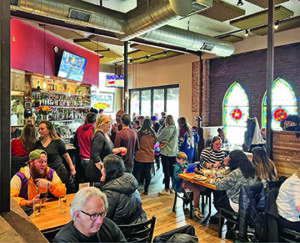
Top In Town: Angelo’s Taverna on E. 6th Ave. is city’s longtime favorite pizza eatery. Google rates it 4.6 stars on 2,983 reviews. Yelp ranks Larimer Square’s Osteria Marco best restaurant.
Step aside, New York and Chicago. Denver is the best pizza city in America. Pizza restaurants in Denver are among the highest rated on Yelp, and pizza prices here are more affordable than most metros. Moreover, demand for pizza is so strong that pizza prices are rising faster than overall inflation — 4.0% compared to 3.5%.
Denver ranked 7th last year. Furthermore, five years ago people coming to Denver from Pizza meccas (New York, Chicago, or Connecticut) couldn’t find anything tolerable in Denver. “Residents didn’t know. . . or had ever tasted good pizza,” locals recall.
Today, pizza restaurants in the Mile High City average 4.05 stars out of 5 on Yelp — one of the highest averages in the country. Buying a cheese pizza each week for a year in Denver requires 1.03% of the median annual income — 30% less that the income required in the average city reviewed (1.47%). Denver beat out popular pizza cities — including New York, Chicago, and Detroit — in part because of lower prices, but just as important, due to far better pizzeria reviews!
Top At 4.05 Stars
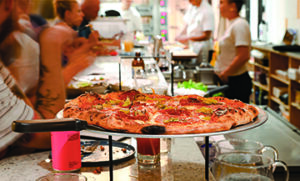
Pizza Popularity: Denver is the best pizza city in America. Pizzerias — including Redeemer Pizza on Larimer, shown, are among the highest rated on Yelp.
Clever Real Estate ranks the country’s 50 largest metros in the nation. They use data-driven metrics, based on the quality of pizza restaurants per capita: Google search trends, Yelp reviews, plus two surveys of 1,000 Americans, and multiple affordability metrics. Here’s how Denver’s pizza scene surpassed the competition:
Denver pizza restaurants averaged 4.05 out of 5 stars on Yelp — better than the average city’s 3.89 stars and New York’s 3.93 stars. Plus, Denver pizza is more affordable. Based on local prices and incomes, buying one large cheese pizza each week for a year would cost the typical resident 1.03% of their annual income. Nationally, the figure is 1.47%, and in New York, it’s 1.77%.
Giles Flanagin admits change in the local pizza scene has been dramatic in the past few years. Cofounder in 2015 of Denver-based Blue Pan Pizza, he says countless top pizzerias have opened since. Eateries he defines as “small businesses with a passion for pizza, dough, fermentation and quality.” Denver residents, he adds, are supporting high-quality products with high-quality ingredients. Thus, growth has been very rapid, featuring a lot of different pizza styles all done very, very well.
Denver Diversity
Denver’s pizza diversity — as discussed by Flanagin — can easily be found on a local pizza map. Mile High pizzerias offer New York-style thin-crust pizza, Chicago-style deep-dish pizzas, Sicilian pies; and even Connecticut’s signature New Haven-style pie.
But, but that’s just the beginning: Once known as “cow town,” pizzerias in the Queen City of the Plains now feature eclectic offerings like breakfast pizza, plus exotic toppings like Guinness cheese, Sichuan sauerkraut, crème fraiche, limoncello-marinated chicken, and pistachio pesto.
The creativity never stops: Consider a Middle Eastern lamb pizza, a sweet potato, goat’s cheese & pine nut pizza, or a Tandoori chicken pizza. Or, maybe a veggie supreme or dessert pizza.
Top Restaurants
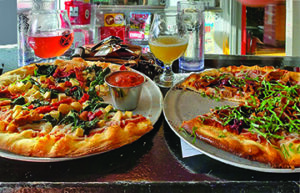
Delightful Duo: Being the epicenter of the west’s beer culture enhances Denver’s pizza popularity. Pizza and beer make a classic pair, bringing out the best of each other’s complementary flavors.
Yelp ranks Osteria Marco on Larimer Square as Denver’s top pizza restaurant. It is known for hand-tossed pizzas such as Artisan, Fig & Gorgonzola, and Carne. The cozy basement eatery also serves Italian plates. Information: 303-534-9855. They also list Marc’s Coal Fire — an Italian eatery-bar by Coors Field — that serves Neapolitan and New York-style pizza with choice of toppings. Information: 303-396-7000.
Many residents and the Chronicle rate Angelo’s Taverna on E. 6th Ave. as the Mile High’s top pizza restaurant. Google ranks it 4.7 stars based on 2,532 reviews; Yelp gives it 4.5 for 1,501 reviews. Information: 303-744-3366. Esters Neighborhood Pub on S. Holly in Virginia Village — albeit not strictly a pizza restaurant — also has seriously delicious pizza in a welcoming atmosphere. Information: 303-955-4904.
Among local pizza spots, some of the most popular newcomers are Dough Counter on S. Colorado Blvd. that specializes in New York and Sicilian-style pies. Information: 303-997-8977; and funky pizza joint Blue Pan — with a location on E. 12th Ave. — that brought the crispy pan pizza style to the Mile High City. Information: 720-519-0944. Furthermore, new dough spots keep popping up: Rolling Pin Pizza is among the latest, opened in early April at 1514 York St., followed by Eat’Ya Pizza on the 16th Steet Mall in early May.
Pizza Passion
Denver scored 14% higher than the average city based on pizza passion. The city’s score was 82 out of 100, compared to the average city’s score of 72. The ranking includes placing No.1 out of 50 cities for
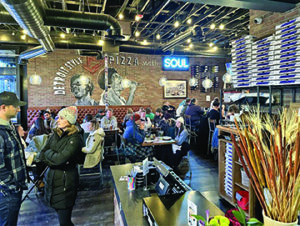
Passion For Pizza: Blue Pan Pizza that opened here in 2015 is in the forefront of Denver’s pizza revolution. Due to technique and quality, their Detroit-style pizza remains a crowd favorite.
online search interest in pan pizza. The metric measures how often locals are searching Google for pizza, and pizza-related terminology.
The abundance of options ranges from Neapolitan and Detroit-style, to square-cut tavern pies of the Midwest, to the New Haven-inspired wood-fired pies.
With 72 breweries, Denver is the epicenter of beer culture in the West, enhancing the popularity of local pizza. Pizza and beer make a classic pair, because they bring out the best of each other’s complementary flavors. The fresh crisp flavor of beer cuts through the creamy cheese, enhancing the herbs in the pizza sauce, and balancing the acidity.
Mile High Mozzarella

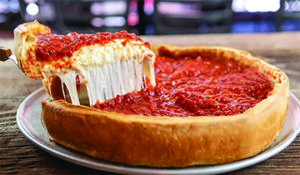
Shape Of Taste: Photos show square Detroit pizza, top, and a Chicago-style round deep-dish pizza. City also has rectangular Sicilian pies, New York circular shape; plus, oblong New Haven pies.
The Mile High City’s pizza popularity isn’t due to Denver’s Italian community. Less than 5% of the city’s 2024 population of 708,948 are of Italian descent. Most of today’s local pizza aficionados, moreover, are unaware that a Denver-based company is the world’s top mozzarella pizza producer.
 Leprino Foods — headquartered in a three-story building on West 38th Ave. at Quivas St. — sells more than a billion pounds of cheese a year. It is the same site where, in 1950, Italian immigrant Mike Leprino Sr. started making small batches of cheese by hand from the back of his neighborhood grocery store. Mike’s 73-year-old son, chairman, and chief executive Jim Leprino ($2.3 billion 2024 net worth), runs the company.
In 1958, after chain grocery stores forced the local Leprino food market to close, the Leprino cheese empire was started with $615. Today, Leprino uses up to 7% of the nation’s total milk supply. The company controls as much as 85% of the market for pizza cheese, while selling to Pizza Hut, Domino’s, Papa John’s, and Little Caesars. Able to invest in technology that dairy farmers can’t afford, the company has more than 50 patents, plus an estimated 7% net margin.
by Ashe in America | May 20, 2024 | Feature Story Bottom Left
ASHE IN AMERICA — OPINION
The end of the legislative session is always a sigh of relief, but the end of the 74th General Assembly feels like we just negotiated a ceasefire.
Basic liberty has been under direct assault since Speaker McCluskie gaveled in this national punchline on January 10, 2024, and several Colorado activists, legislators, and independent media deserve our recognition and gratitude for preventing worse outcomes.
First, let’s talk about the children.
This session saw unprecedented attacks on child safety, such as eroding parental authority and legalizing grooming across education and foster care. Erin Lee and protectkidscolo rado.org, “a broad coalition of parents, grandparents, and concerned citizens,” have been working nonstop this session to advocate “for policies that promote children’s well-being.” Lee and team are currently petitioning for ballot initiatives to combat the rainbow communists’ legislative “wins” — all of which make kids more vulnerable to predatory adults.
If you think predatory adults in our state are a myth, check out The Colorado Show where we’ve detailed the alarming volume of recent arrests for crimes against children. Representatives Brandi Bradley (R-HD39), Stephanie Luck (R-HD60), and Scott Bottoms (R-HD15) are also recognized for officially opposing this sinister agenda.
Next, let’s talk about guns.
Disarmament was a high priority for the radicals under the dome, and they succeeded in passing many of their most aggressive infringements upon our inalienable right to self-defense. In just 120 days, McCluskie and pals passed seven unconstitutional “laws” which, according to the decision in Marbury vs. Madison (1803), are immediately null and void.
These include new powers and funding for CBI to infringe upon Colorado gun owners (SB-003) and a new registry via credit card companies (SB-066), as well as campus vulnerability (SB-131), new taxes (HB-1348), and permits (HB-1353), and more.
But it could have been much worse.
It’s not worse due the incredible advocacy of Taylor Rhodes, Ian Escalante, and Rocky Mountain Gun Owners, who whipped public opposition to the anti-gun, anti-American agenda. As a direct result of their advocacy, the commies failed to mandate private insurance (HB-1270), expand restrictions on gun ownership (SB-107), and make kids more vulnerable at school (HB-1310).
Critically, RMGO led the effort to kill the “Assault Weapons Ban” (HB-1292), a broad and brazenly unconstitutional attack on gun ownership and our right to individual self-defense.
As Escalante said on X, “We got some big wins. But we MUST kick these people out of office so we can IMMEDIATELY start running bills to repeal the laws they’ve passed…” Indeed.
In addition to the activists and legislators, the line was held by unowned journalists which, in Colorado, requires courage and a strong stomach. Shout outs to the crew here at GCCC, Free State Colorado, The Chuck & Julie Show, Colorado Free Press, RinoWatch, and all the rest who have refused to back down and be silenced.
Finally, let’s talk about the 74th General Assembly’s Undeniable MVP.
One of the features of Colorado’s Rainbow Communism is banning words and phrases to limit, and even silence, debate. The Speaker took this tactic to the next level this session, and no one challenged her more than Representative Ken DeGraaf (R-HD22).
My Highlights tab on X is dedicated to Colorado, mostly clips of the legislature, and DeGraaf is featured in many of the videos, often as he is gaveled down for debunking commie arguments or otherwise embarrassing them. He’s fact- and science-based. He’s masterful and entertaining. We don’t deserve him. We need more of him.
In November, we can make that happen, but you must get informed NOW and vote for freedom and sanity in June.
What’s next?
Enjoy the ceasefire, but don’t get complacent. Relax, take a breath, even take a whole break. Be sure to give thanks to everyone who fought to protect you and your kids this session and rejoice that the ruling class is finally leaving the dome.
Then refocus. And if you haven’t been involved to this point, get focused.
As we head in earnest into riot, I mean, election season, remember that freedom is only possible by constantly struggling for it. Self-governing is an action verb.
See you at the special session.
Ashe in America is a writer and activist. Find all her work at linktree.com/asheinamerica.
by Jessica Hughes | May 20, 2024 | Travel
by Jessica Hughes
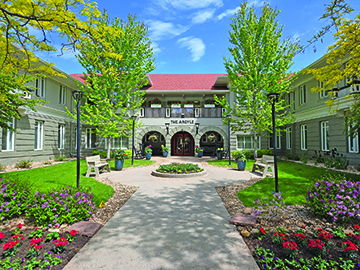
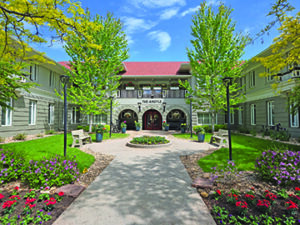 With the rising cost of living and the grip of inflation on monthly budgets, coupled with the potential loss of Social Security, affording retirement is becoming an increasingly distant prospect for aging Baby Boomers and Millennials alike. Compounding this challenge is the continued escalation in the cost of assisted living facilities, and the dwindling number of such facilities accepting Medicaid. This combination makes finding a quality, yet affordable, assisted living facility for seniors an ever-growing challenge, underscoring the immense value and significance of places like The Argyle in Denver.
The Argyle is a well-known non-profit senior living facility in Denver that works to provide affordable, high-quality living accommodations and services to low- and moderate-income seniors in Denver. This long-time legend in senior assisted living just celebrated its 150th anniversary last month.
Coinciding with this historic occasion, the facility unveiled its latest renovations, a promising indicator that it will continue serving the community for years to come. With an unprecedented demand for assisted living care on the horizon — statistics suggest that 7 out of 10 individuals will require such services in their lifetime — and projections estimating an additional one million beds will be needed by 2040 to accommodate the growing elderly population, establishments like The Argyle take on heightened significance in meeting the escalating need for quality care.
Over the years, the Argyle has maintained its non-profit status, which Executive Director of the Argyle, Tom Carlson, explains is why they can offer affordable, high-quality living accommodations and services to its seniors.
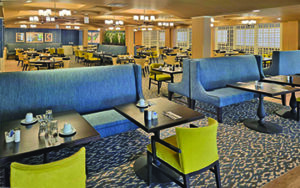
Renovated dining room at The Argyle.
“We are a non-profit. We don’t have a large corporation or investment company that we need to make large payments to every month like most other Senior living communities do. We have been in this location since 1900 and to my knowledge, we don’t have a mortgage,” says Carlson. “We have a board of nine members who are non-paid volunteers, some of which are in the accounting field. They oversee us to make sure we are being good stewards of our money.”
As a non-profit senior living facility, the Argyle offers high-quality care for lower to moderate-income seniors at an affordable monthly rate. Current monthly costs for assisted living residents of The Argyle start at $2,800, while the median cost of a private, single-bedroom unit in an assisted living facility in the U.S. is $4,803 per month.
“A non-profit is not sending money to an investment company or a large corporation. Non-profits are just that, non-profits; they have to use their money by putting it back into the community, their staff, or their residents,” says Carlson. “As a result, non-profits usually pay their staff higher, ensuring they have better more qualified staff resulting in, my opinion, better care.”
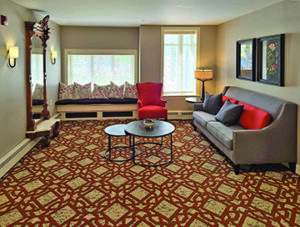
Renovated lobby at The Argyle.
The facility’s mission to offer quality care for moderate-income seniors is a “tradition” that extends back to its original roots in 1874 when two women, Mrs. Ann Figg and Mrs. Vincent, met with their friends at Trinity Methodist Church in Denver to address the growing homeless population, affecting mostly women. They came together to create an inclusive retirement community that felt like home, regardless of financial circumstances. So, in 1875, The Old Ladies Home opened its doors to elderly women in Denver.
“In the 1870s, this was a very revolutionary idea. Things were very different then and women were not given the same opportunities as men, especially older women. And the thought of caring for seniors who are not your loved ones during that time was unheard of,” says Carlson. “They saw a need and brought it to the community to help this underserved population.”
By 1900, the facility relocated to its current location in the Berkeley/Highlands neighborhood, inspiring its name change to the Argyle. Beyond its name change, the Argyle evolved into assisted living for all seniors in need, not just women.
“In 1984 we started letting men live here,” says Carlson. “We have also reached out to our other underserved populations including the black community, the Hispanic community, and the LGBTQ community to let them all know they are welcome here and will be treated with dignity and respect while keeping our core mission of serving seniors.”
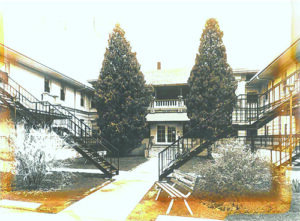
The Argyle in 1979
In 1988, the original building was demolished and in 1990, a new building was constructed to enhance the quality of the facility while providing more rooms for residents. Carlson explains the much-needed renovations kept the old-world charm but gave the facility a fresh look. The historic front facade was saved, returning the building to its original design, and more than 200 pieces of furniture and artwork were restored.
Beyond its restored aesthetics, the Argyle offers a wellness center with trained physical therapists on staff who create a personal one-on-one training session for each resident who wants one. “This is free to all, no insurance is billed. This is just one example of the many benefits of The Argyle,” says Carlson. “We have many activities and outings, including Rockies games and shows at the Buell Theater.”
But for aging Baby Boomers and Millennials, the cost for high-quality assisted living will have to come down to affordable retirement in facilities similar to the Argyle. “I see the Baby Boomers and Millennials wanting to move to senior communities when they are at the right age. Maintenance-free lifestyle, someone to make your meals, do your laundry and have a full activities calendar of things to do with your peers,” says Carlson. “The issue is going to be the cost. It is said that the boomers have far less in savings at this stage in their life than the prior generation and with millennials, the verdict is still out if they will be able to afford senior living.”
Photos provided by The Argyle