by Mark Smiley | May 25, 2018 | Feature Story Bottom Left
by Mark Smiley
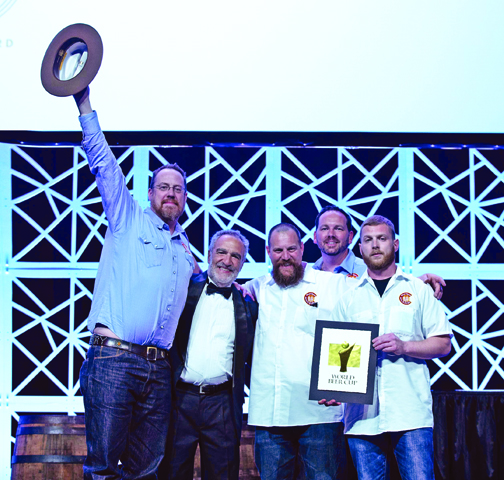
Gold Medal: The Bull & Bush accepted the Gold Medal for their Big Ben Brown Ale at the 2018 World Beer Cup award ceremony on May 3, 2018. Photo © Brewers Association
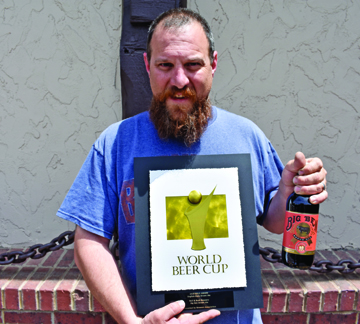
Bragging Rights: Gabe Moline, Master Brewer at the Bull & Bush is proud of the recent Gold Medal for Big Ben Brown Ale. He now boasts the best brown ale in the world until the next competition in 2020.
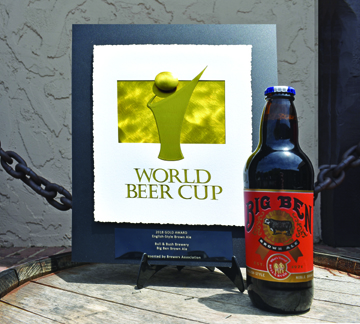
The Bull & Bush Brewery, a staple in Glendale for 47 years, competed in the 2018 World Beer Cup in Nashville, Tenn., and brought home the Gold Medal in the English Brown Ale category at the May 3, 2018, ceremony. It is the fifth World Beer Cup Gold Medal the Bull & Bush has won since they started brewing beer in 1997.
“What’s really important is winning consistently,” said Erik Peterson, co-owner of the Bull & Bush. “Winning an award on a consistent basis is huge.”
“There are a lot of guys in that room just wanting to get something,” said Gabe Moline, Master Brewer at the Bull & Bush. “Everybody works hard on their beers.”
The World Beer Cup is sponsored by The Brewers Association (BA), the not-for-profit trade association dedicated to small and independent American craft brewers. The ceremony which is held every two years is the largest competition to date; the awards were presented at the conclusion of the Craft Brewers Conference & BrewExpo America® at Music City Center in Nashville.
Breweries from 15 countries received medals and the average number of beers entered per category was 82 (up from 69 in 2016). In 2018, 295 judges came from 33 countries and 72% of the judges came from outside the United States. 28% of the judges came from the U.S. On top of that, there were 101 categories of beer in the competition.
8,234 beers from 2,515 breweries entered the competition. Brewers were allowed to enter four beers. The Bull & Bush faced competition from over 90 other breweries and after not winning any medals for the other three beers entered, they knew they had one more chance at a medal before being annou
Best in the World: The Big Ben Brown Ale has been brewed at the Bull & Bush for almost 20 years. It picked up a Gold Medal at the 2018 World Beer Cup in Nashville.
nced the winner of the Gold Medal.
“The competition is getting so big and any kind of award is truly stunning anymore,” said Peterson. Since winning, requests have come in from tap houses to carry the gold medal beer. Big Ben Brown Ale is bottled and sold in local liquor stores.
For more information on the World Beer Cup, visit worldbeercup.org and for the Bull & Bush, visit bullandbush.com. Their brewery is located in the village of Glendale at 4700 Cherry Creek Drive South.
by Mark Smiley | Apr 27, 2018 | Feature Story Bottom Left
I have often said that the internet has done more to divide and enrage us as a society than most people probably anticipated when Al Gore created it. The power of social media can be great when we get constant feeds of kittens playing with giant balls of twine, but usually it’s just people screaming about guns, Trump, the police and how cruise ships are filled with dangerous viruses. Honestly can anyone tell me that we are truly better off with the internet than we were before it? We are a bunch of whining, celebrity-obsessed, political junkies who use this little handheld device to try to convert those who have opinions different than our own, and we wield this power with extreme prejudice.
BUT, and this is a big BUT, there are a few AWESOME things that have emerged from the internet cesspool. In my opinion the very best thing the internet and our cell phones have given us are ride-sharing apps like Uber and Lyft. These apps have allowed so many people access to fast, reliable, cheap transportation that didn’t previously exist in cities like Denver, Des Moines or Detroit.
Sure, if you live in Manhattan or Chicago there are taxis everywhere (if they are willing to pick you up), but in most cities the wait for a taxi can be too long and the prices too arbitrary. Uber/Lyft have an ingenious product that allows us to quickly get a ride, allows us to know who the driver is before the car arrives (and how other passengers have rated the driver), and even lets us know the price before we order the ride.
Plus it allows people who need full or part-time work an opportunity to make some money on a schedule that works for them. Unlike taxi drivers, Uber/Lyft drivers know who they are picking up and they can decide based on the passenger rating if they even want to pick them up. While it is not a perfect system, it has significantly reduced the amount of DUIs we have seen in our office as many people would prefer an easy, cheap ride compared to an expensive, life-changing DUI. This is technology working for us in a self-contained system that makes sense and is easy to use and understand. Hooray Uber/Lyft!
However, the influx of paid drivers on the roads has not been without the drawbacks. While our law firm has seen a decrease in DUIs (That’s a Good Thing!) we have seen an increase in automobile accidents that occur where our clients are either passengers in an Uber/Lyft, have been hit by an Uber/Lyft driver, or are Uber/Lyft drivers themselves and have suffered injuries.
So, the question we are often asked is: “Can I file a claim against Uber/Lyft for these injuries?” And the answer is absolutely YES. In fact, Uber/Lyft acts just like any other business. These are massive companies with significant liability insurance policies in case you have suffered a bad injury (as a passenger or while driving your own car). In addition, and this is critical, you can still use your own medical payment coverage on your auto policy to help defray the costs of medical expenses while the case is resolving.
Further, in catastrophic injury claims your own underinsured/uninsured motorist (UM/UIM) coverage can also work in conjunction with Uber/Lyft’s coverage to maximize your recovery. As I’ve stated many times before, when discussing automobile insurance, the best investment you can make for yourself and family is to purchase as much UM/UIM coverage as possible through your own auto policy. Trust me. I’m not an insurance broker, I don’t make a penny if you buy more insurance, but I have seen the effects of what happens when insurance brokers don’t do their jobs correctly. Remember: Purchase the maximum medical payment coverage and maximum UM/UIM coverage available.
If you are an Uber/Lyft driver you might need help too. We have represented many of you who were injured by another careless driver and you have the right to recover for your injuries. Be aware that your own personal automobile policy may NOT offer you the same medical payment or UM/UIM benefits if you were driving your car for Uber/Lyft at the time of the accident.
Automobile insurance carriers are getting smarter (and cheaper) and they don’t want to act as your worker’s compensation in the event of a workplace accident. It’s important you understand your coverages in the event you are involved in a catastrophic accident. The worst time to find out you have bad insurance coverage is after the accident has already occurred. And don’t think for a second that Uber/Lyft will pay you work comp benefits if injured, this is usually an add-on you need to have purchased through the company.
So, to the thousands of you using Uber/ Lyft in the Denver metro area I say good job! Way to be responsible. The other drivers who are busy tweeting obscenities, smoking weed or taking selfies never think about how their bad decisions could ruin another person’s life. For all the bad the internet has given us it’s nice to have a few products out there that make a real difference in our lives. But if you are involved in an accident in any fashion with an Uber/ Lyft driver (or a taxi cab for that matter) you have options and we would be happy to help you! Now you can resume your normal internet surfing.
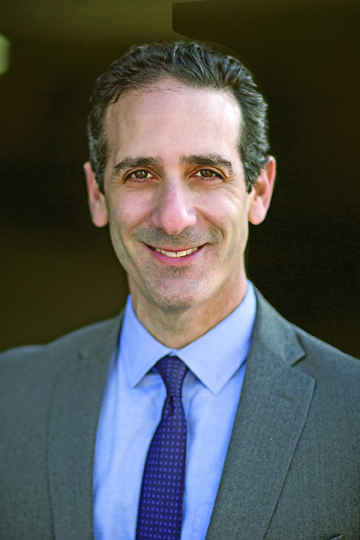
Danny is a managing partner of Foster, Graham, Milstein & Calisher (FGMC). His practice focuses on personal injury. The law firm of FGMC, located in Cherry Creek, is a full service law firm focusing on: criminal defense, personal injury, real estate, litigation, liquor licensing, construction law, tax/estate planning, bankruptcy and zoning. This article does not create an attorney-client relationship and is for informational use only (what do you expect from an attorney!)
Danny Foster, Esq.
by Mark Smiley | Mar 1, 2018 | Feature Story Bottom Left
by Ruthy Wexler
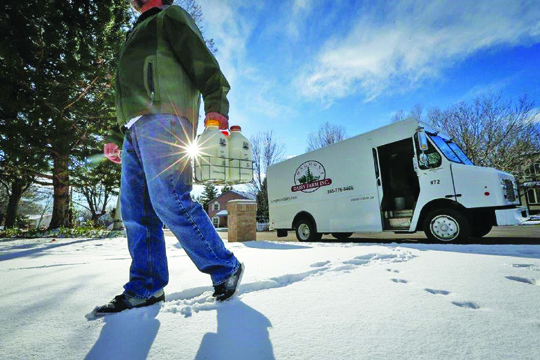
Home Delivery: Part of what makes Longmont Dairy unique is the positive, loyal and individual way they treat employees, who tend to remain with the company. Workers are rewarded and celebrated for good performance; e.g., if route drivers have very low errors, they’ll earn free days off. Promotions are almost always done from within. LDF’s operation manager began as a route driver 14 years ago and worked his way up.
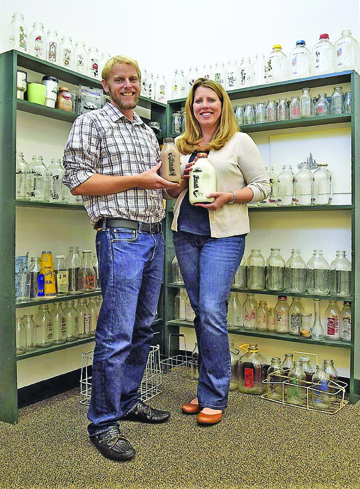
Co-Owners: Katie Herrmann and Dan Boyd, co-owners of Longmont Dairy Farm, pose with a variety of glass bottles, which their customers swear make the milk taste more delicious. Step-siblings, Katie and Dan, grew up working at Longmont Dairy. Both left Colorado to try their wings in other states and other jobs. Then, at coincidentally the same time, both decided to return home and enter the family business. In 2015, they bought in.
In the good old days, doctors made house calls, businesses answered phones and milk got delivered. Glendale itself was long called “Cowtown” due to the many dairies that used to be located there. But wait! Longmont Dairy — one of two remaining farms in Colorado that sells milk directly to customers — has just expanded into Cherry Creek, Glendale and Wash Park. Now residents in those neighborhoods can sign up to have bottles of fresh milk (and other products) delivered straight to their door.
Tradition!
“We’re very proud it’s only 48 hours, roughly, between the time our 550 cows are milked, and drivers get that milk to customers,” says Katie Herrmann, who, along with stepbrother Dan Boyd, is the third generation to run this family business.
Longmont Dairy began in 1965 when three fellows with experience in the dairy industry — Jim Boyd, Reese Boatman and Karl Obluda — bought a small herd of cows and built a processing plant behind the Boyds’ home in Longmont, Colo. By then, science had made milk from faraway dairies safe to drink, so increasing numbers were buying it in supermarkets. But the trio decided to create what they loved: an old-fashioned dairy.
By 1988, when Reese Boatman and Jim Boyd (remaining partners) retired, certain traditions had been established: producing the best possible product by feeding cows with the best quality grain and “serving customers beyond their expectations.”
Jim’s son David, along with his wife Susan (Herrmann’s mother), took over next. Although the couple modernized and grew the business substantially — reorganizing it as Longmont Dairy Farm, Inc. (LDF) — they kept what mattered, including home delivery, which had been almost entirely phased out across the country.
In 1991, a crisis arose: only one manufacturer of glass milk bottles remained in the U.S. Reluctantly, David and Susan began to explore other containers. Then — just as they were running out — their bottle cap supplier decided to produce the bottles.
Local
Herrmann and Boyd are aware they are carrying on a legacy.
Both grew up working at the dairy. Both left Colorado to figure out what they wanted from life — which, it turned out after some years, was to circle back home and buy into the business.
Despite opposite skill sets — Herrmann oversees marketing and customer service; Boyd’s in charge of the plant and trucks — they share one vision: to run Longmont Dairy with that same combination of business acumen and old-fashioned values.
Not the easiest balancing act — especially in a world where Amazon Fresh can deliver all your groceries almost immediately.
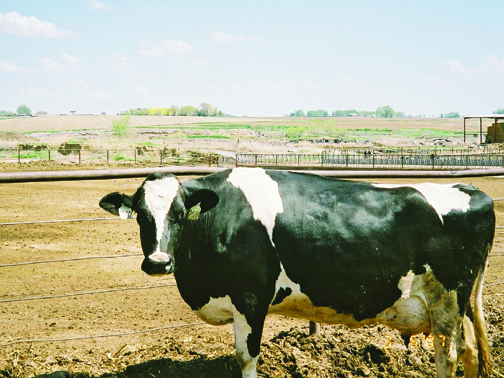
Longmont Dairy’s Own Cows: To maintain quality, they decided to offer milk produced by only their own cows and bottled in their plant. The cows are milked around the clock, the milk is sent from the farm to their processing plant where it is bottled within 24 hours. Then, at 10 p.m., the deliveries start, and milk is on the customers’ doorsteps before breakfast.
“Our hope,” says Herrmann, “is people will continue to support a local business that provides a premium product.”
Understanding Milk
“There are misconceptions about milk and labels,” Herrmann explains. “We give our cows high quality feed from local farmers. Our milk is very clean and natural. But since the herd’s feed is not ‘certified organic,’ and we do treat them with antibiotics when they’re sick, we can’t call our milk organic. However, we do not use supplemental growth hormones or steroids.
“People think if it’s not labeled organic, milk might contain antibiotics. Not possible. Because any residue of antibiotics in milk is illegal. Every day, we do a ‘snap test’ — and if there’s even a smidgeon of antibiotic residue, the entire tank is disposed of.”
Caps For Sale!
After Herrmann and Boyd began a Park Hill route two years ago, they began getting calls: when will you be in other Denver neighborhoods? That’s when they made plans to expand in this direction. “It’s much easier to open up a route next to an existing route,” explains Boyd. “But there are challenges. Our drivers are out at night. These new neighborhoods are denser than suburban areas, making that a bit tricky. But our drivers are tenacious, skilled and dependable.”
“Another challenge is that residents in new neighbo
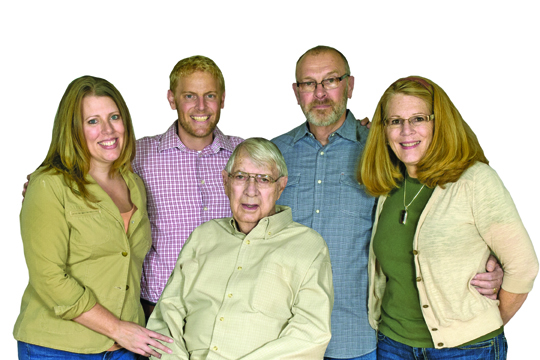
Generations: Longmont Dairy Farm began as an “old fashioned dairy” with clear values: giving customers the best possible product along with service beyond expectation. Those values have been handed down and honored by family members. Here are three generations together: left to right, top row: Katie Herrmann, Dan Boyd, David Boyd (Dan’s father, Katie’s stepfather), Susan Boyd (Katie’s mother); front row: Jim Boyd (who has since passed away), one of the three men who started the business in 1965.
rhoods aren’t familiar with what makes us different,” adds Herrmann. “Like our core values, protecting the environment with reusable bottles and recyclable caps. And giving back to communities.”
Longmont Dairy not only partners with local charities and organizations and gives milk to two Ronald MacDonald houses, they help hundreds of schools with their Milk Caps for MOOOLA program.
Any school within LDF’s delivery area can sign up. They set up a box for all the LDF bottle caps students collect and Longmont pays five cents for each cap. To date, 5 million caps have been turned in and Longmont has given schools over $250,000.
“It’s the easiest way to earn money for your school,” enthuses Jenny Kahn, secretary at the William Roberts K-8 School in Stapleton. “With Longmont’s check, we created a scholarship fund for the 8th grade trip. Plus, the kids were aware they were helping the environment.”
Local Goodness
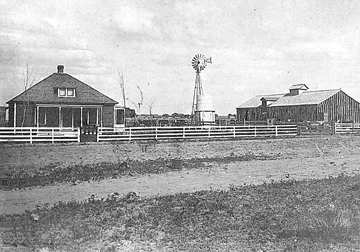
Former Cowtown: Glendale throughout much of its history has been a booming town by adopting whatever Denver rejects. At the beginning of the 20th century Denver regulated out of business many of its dairy operations which Glendale welcomed with such open arms that the city became known as Cowtown.
Caps can be returned from any LDF bottle, including half & half, chocolate milk, eggnog and “protein milk.” Longmont’s products have grown in variety, but the emphasis remains local — or natural. “Eggs, from a farm north of Fort Lupton,” lists Herrmann. “Granola and oatmeal from Wheatridge. Cheese from Oregon. Mary Mountain Cookie Dough from Fort Collins …”
Several “new, really exciting” products will soon be added, “after our plant expansion,” says Herrmann. “But we’re not revealing what they are until early summer. We want our customers to be surprised.”
For more information, call 303-776-8466 or visit www.longmontdairy.com.