by Amber Wyatt | Feb 18, 2026 | General Featured
by Amber Wyatt
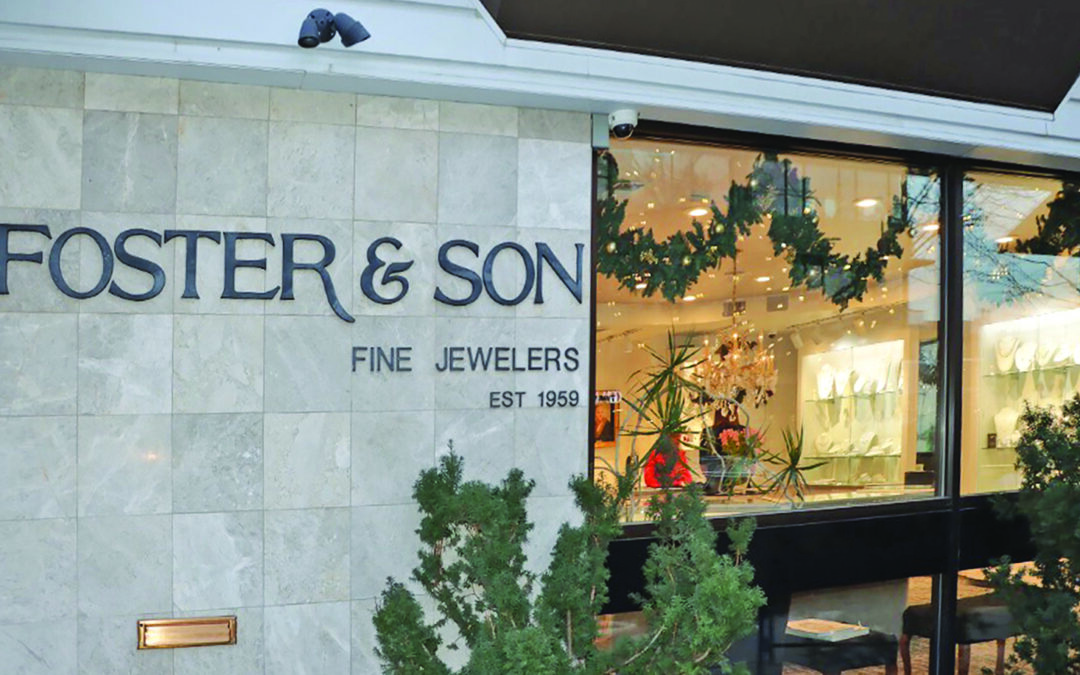
The iconic facade of Foster & Son Jewelers where craftsmanship, heritage, and brilliance meet.
By any measure, Cherry Creek North has changed dramatically over the past decade. New mixed-use developments rise where parking lots once sat, national brands rotate in and out, and office foot traffic ebbs and flows with rapidly growing technology. Yet tucked between luxury storefronts and minimalist façades are artisans who have quietly shaped the district’s character for decades. Their stories reveal not just resilience, but a deep commitment to community.
Few businesses in Cherry Creek can trace their roots as deeply as Foster & Son Jewelers, a family-owned institution that has been serving the neighborhood since 1959. Long before Cherry Creek became a nationally recognized retail destination, Patricia Foster, known to most as Patty, opened a small jewelry shop in Cherry Creek called “The 14 Karat,” an ode to the 1859 Gold Rush to the Rockies. At the time, the area was still defining its identity, and Patty’s shop quickly became a trusted fixture for craftsmanship, honesty, and glamour.
As Cherry Creek grew, so did the business. Patty’s son, Brien Foster, joined the team in 1987, bringing a new generation of expertise, with his wife Cindi. Together they worked hard to preserve the values that built the shop’s reputation like reliability, community-involvement, and elegance. With the duo’s involvement, the store evolved into Foster & Son Jewelers, a name that reflects both its family roots and its long-standing commitment to quality. Today, Brien’s son Tucker and his wife Katie Foster continue to lead the business, the third generation of the Foster family to work behind the counter.

Brien and Cindy Foster on their wedding day.
Last week, I spent about an hour catching up with Tucker Foster at Foster & Son Jewelers, along with his wife, Katie, and it was one of those conversations that reminds you how much heart and history live inside a family business. Tucker lit up talking about his specialty, Cuban link chains and studded-out grills, and even showed me a few custom pieces he’s currently crafting for a local celebrity whose name, of course, could not be disclosed. A testament to how times have changed.
We also talked about the importance of lineage and carrying the Foster legacy forward, a tradition that has shaped the brand for generations. The couples’ daughter Sadie proudly holds the title of dynasty princess for now, but Tucker assured me that role is only temporary and that an heir to the Foster throne is very much in the plans. Katie shared many of the family anecdotes with me, like the tale of Brien assembling the glistening centerpiece of the store, a chandelier Patty ordered in China which came entirely with Chinese instructions.
Tucker not only has a hand in shaping the business, because, “In many ways,” he admits, “the business shaped him.” Tucker shared stories from his childhood that felt like something out of a movie: making bows for the gift-wrapped jewelry pieces customers bought for their loved ones, then sneaking around the corner to the old Wizard’s Chest location to hunt for Pokémon cards. Today, he and Katie are building their own chapter of the Foster story keeping both the craftsmanship and the family tradition alive but adapting effortlessly to the changes 67 years in the making.
An eclectic selection of wines.
 In an era when many jewelry purchases are made online or through national chains, Foster & Son remains a traditional, full-service jeweler, offering custom design, repairs, appraisals, and fine jewelry curated with care. “While it’s awesome to go to Tiffany and Co and the blue box is absolutely stunning,” Tucker said, “you can get a better experience that’s more personalized and less expensive working with a family jeweler.” Their relevance lies not only in longevity, but in relationships. Many customers have been coming to the store for decades returning for engagement rings, anniversary gifts, family repairs, and milestones that span generations.
“In the past, value was in effort. Today, it’s in a brand name,” Tucker says. Oftentimes that brand is a symbol of something. People who shop with Foster and Sons wear the symbol of community, importance of family, and supporting a legacy. Brands like Tiffany & Co, however, charge customers substantial amounts just to wear the name.
That sense of trust has allowed Foster & Son to adapt as Cherry Creek’s retail landscape has shifted. While the neighborhood has seen luxury brands come and go, the Foster family has remained anchored by personal service and expertise that cannot be replicated online. Their in-store experience emphasizes conversation, education, and comfort, values that resonate in a district increasingly focused on experience-driven retail.
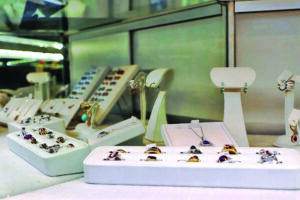
Front counter display of various jewelry types.
Foster & Son’s continued presence also reflects Cherry Creek’s evolution from a neighborhood shopping area to a dynamic cultural district. Through decades of development, economic shifts, and changing consumer habits, the store has remained a constant, quietly shaping the character of the area as much as responding to it.
The story of The Vineyard Wine Shop begins with its founder, Robbie Wilson, who established the shop in 1971 after falling in love with wine while living in California. As Clif Louis explains, “Robbie Wilson was the original owner, he got moved over to San Francisco, fell in love with wine, came back to Denver and said, ‘I want to open a wine store!’”
What began as a modest basement operation, accessible only through an alley, quickly became something special. “In 1971 to get to the front door, you’d come down the alley, go through the door, and down the stairs. It was only 500 feet of space to put wine,” Louis recalls, adding that Wilson’s wife Val handcrafted the stained glass windows and shelving that remain in the shop today. From the start, The Vineyard offered a thoughtful, intimate environment focused on discovery and quality rather than convenience.

Tucker, Katie, and Sadie Foster.
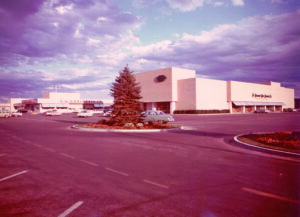
The Cherry Creek Mall photographed around 1960.
The second chapter of The Vineyard’s history began when a young Clif Louis entered the picture in the early 1980s. Driven by a lifelong appreciation for wine sparked by his father who “was stationed over in France, he fell in love with French wines, we always had wine at dinner, and dad let me pick the wine.”
Louis approached Wilson looking for work. “I said, ‘I’ll do anything. I just want to learn about wine.’ So he hired me as the stock boy for $4 an hour,” Louis says, noting how quickly he realized how much there was to learn about the industry. After just a year, Wilson offered a life-changing opportunity. “He said, ‘Clif, why don’t you buy me out?’ and I bought him out slowly over three years.” Louis explains.
From that point on, Louis carried forward the same philosophy of accessibility, warmth, and expertise that Wilson had built. “We weren’t the big box mentality. We didn’t want to force customers to buy a $100 bottle when a $20 bottle was just as good,” he says. “We weren’t snooty wine people. We like to sell wine to drink it.”
Under Wilson and Louis’ leadership, The Vineyard became deeply rooted in Cherry Creek’s retail culture as a staple of high society. Louis’ wife Rosella owned The Brass Bed for decades, and today their children continue the multi-generational tradition with White Peacock just down the street. “We both got into retail, and then my kids got into retail, so it really became a family thing here in Cherry Creek,” Louis shares.
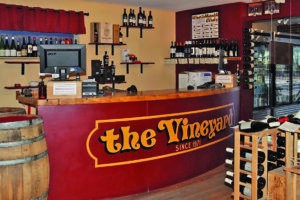
The Vineyard Wines original front counter.
Today, The Vineyard remains anchored by the kind of personal service that can’t be replicated online. “Everyone who works here is taking wine classes, they’re trying to get their degrees in wine,” Louis explains. “When a customer comes in, they talk to somebody. We help them find exactly what they like.” And despite assumptions about Cherry Creek pricing, value remains central. “People think we only sell $100 bottles of wine, and that’s not the case. Most of our wines are around $20,” he says, emphasizing the shop’s commitment to quality at every price point.
That personal connection has helped The Vineyard weather major shifts in retail, including grocery stores entering the wine market. “When they passed the law allowing wine in grocery stores, that hit our sales pretty bad, probably down 30%,” Louis admits, yet he remains confident in what sets The Vineyard apart: “In the big box stores you just pull wine off the shelf. Here, everyone’s an expert. We talk, we educate, we connect.”
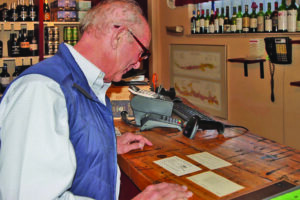
Clif Louis looks back on old mailers the company distributed.
Despite evolving development and competition, Louis has no plans to leave. After more than four decades, what keeps him rooted isn’t foot traffic or trends, it’s loyalty, history, and relationships built bottle by bottle. “We’ve had very loyal customers. A lot of them know my first name,” he says simply.
As Cherry Creek continues to modernize, The Vineyard stands as proof that progress doesn’t have to erase craftsmanship. Behind its shelves of carefully curated wine is a legacy built on curiosity, community, and conversation, one that continues to carry forward the spirit Robbie Wilson first poured into a small basement shop back in 1971.
Below: Current heiress of the Foster family business, Sadie Foster, daughter of Tucker and

by Mark Smiley | Feb 1, 2026 | General Featured

Jim Gaffigan performs at the Paramount Theatre on January 24, 2026.
By Mark Smiley
On January 24, 2026, the historic Paramount Theatre in downtown Denver was filled with laughter as one of America’s most beloved stand-up comics, Jim Gaffigan, brought his Everything Is Wonderful! tour to a sold-out audience.
Gaffigan’s appearance, part of a highly anticipated continuation of his 2026 tour, delivered the warm humor and sharp observational wit that has made him a fixture in comedy for decades. The Paramount’s ornate 1920s interior provided an ideal backdrop for an evening of accessible, family friendly entertainment that kept the crowd laughing from start to finish.
From the opening moments, Gaffigan displayed his characteristic ease onstage. His delivery was unhurried yet razor sharp, with each punchline landing precisely. True to form, he mined everyday life for laughs, touching on food obsessions, parenting mishaps, and the small absurdities of modern living. The material felt fresh for longtime fans while remaining instantly relatable for newcomers.
Highlights of the evening included Gaffigan’s playful routines about culinary indulgences and his self-deprecating takes on family life. His comic timing never faltered, and his ability to shift smoothly between quick one-liners and longer narrative bits kept the energy high throughout the set. The entire show ran about an hour and a half which included an opener, typical for a headlining performance, yet there were moments when it felt like the laughs could have continued well into the night.
The Paramount audience was fully engaged, capturing the communal joy that only live comedy can create. Even the familiar challenges of Denver traffic an d crowded parking did little to dampen spirits, as fans arrived with a shared sense of anticipation.
At a time when stand-up comedy often leans toward the abrasive or confrontational, Gaffigan’s easygoing, conversational style stands apart. His humor is clean without being timid and sharp without being cynical. For audiences seeking a night of laughter that feels both comforting and clever, Jim Gaffigan’s performance at the Paramount Theatre delivered exactly that.

by Mark Smiley | Jan 16, 2026 | General Featured
by Mark Smiley
The space formerly occupied by The Pub on Pearl in Denver’s Wash Park neighborhood, where Dry Dock Brewing Co. is set to open a new location later this spring. Dry Dock purchased the property for $2.5M.
One of Colorado’s most established craft breweries is preparing to make its mark in the heart of Denver’s Wash Park neighborhood. Dry Dock Brewing Co., a longtime staple of the state’s craft beer scene, is slated to open a new location this spring at Pub on Pearl, bringing its award-winning beers and community-driven approach to the popular Pearl Street corridor.
Founded in 2005, Dry Dock Brewing Co. has earned a strong reputation across the Front Range as a pioneer of Colorado’s modern craft beer movement. Based in Aurora, the brewery was the city’s first microbrewery and has since grown steadily while maintaining a focus on quality, accessibility, and neighborhood connections. Its expansion into Wash Park represents a significant step, introducing the brand to a new audience while anchoring itself in one of Denver’s most active and recognizable districts.
The new Dry Dock location will operate out of Pub on Pearl, a longtime neighborhood gathering spot known for its relaxed atmosphere and central location just blocks from Washington Park. The partnership is expected to preserve the familiar feel of Pub on Pearl while incorporating Dry Dock’s full lineup of flagship beers, seasonal offerings, and rotating specialty brews. Brewery representatives have indicated that the Wash Park location will emphasize a welcoming, community-oriented taproom experience rather than large-scale production.
For many Wash Park residents, the addition of Dry Dock is a natural fit. The area is known for its walkability, bike traffic, and steady flow of visitors throughout the year, particularly during the warmer months. As spring arrives, the neighborhood typically sees an uptick in foot traffic from park-goers, joggers, and cyclists, making the timing of the opening especially notable.
Local business owners and neighbors have expressed optimism that the arrival of a well-known brewery could further strengthen the Pearl Street corridor, which has become a destination for dining, casual nightlife, and social gathering. Established breweries opening satellite or partnership locations have become an increasingly common trend in Denver, reflecting a shift toward smaller, neighborhood-focused taprooms that integrate into existing commercial districts.
Dry Dock’s move also highlights the continued resilience of Denver’s craft beer industry, which has faced significant challenges in recent years. Rather than rapid expansion, many breweries are choosing strategic, community-based growth — an approach that aligns closely with Wash Park’s character.
While an exact opening date has not yet been announced, Dry Dock officials have confirmed the location is expected to open this spring. Additional details regarding hours, events, and possible renovations to the space are anticipated as the opening approaches.
For Wash Park residents and visitors, the arrival of Dry Dock Brewing Co. at Pub on Pearl promises a blend of familiarity and something new: a trusted Colorado brewery paired with a beloved neighborhood venue, just in time for patio season.

by Jeff Shultz | Nov 17, 2025 | General Featured
by Jeff Shultz
 A south Denver health care charity is preparing for a pending health care crisis. The passing of HR-1 on July 4, 2025, threatens Affordable Care Act subsidies that made health care affordable for hundreds of thousands of Colorado residents, according to Doctors Care Development and Marketing Director Elizabeth Hockaday.
“A plan that used to have a $100 deductible and $1 monthly premium payments will soon become a $5,000 deductible and $1,200 monthly premium,” says Hockaday. “That’s highly unaffordable for those struggling financially.”
Doctors Care, a nonprofit medical clinic in South Metro Denver, is doing what they can to help reduce the financial barriers. “Doctors Care is an integrated primary care clinic. In addition to well and sick visits, the organization has behavioral and women’s health services onsite and provides programs to help address social determinants of health, and health insurance navigation and enrollment,” Hockaday said.
“Doctors Care is located in Littleton and mainly serves Arapahoe County,” says Hockaday, “but our reach is much larger, extending to Denver, Douglas, and Jefferson Counties to name a few.”
Doctors Care serves over 3,000 people annually through their integrated primary care clinic. “Our patients primarily consist of uninsured individuals and Medicaid-eligible working families who face significant challenges in accessing health care.”
Financially, 90% of DC’s clients are below 250% of the Federal Poverty Level, according to Hockaday. This means a family of four makes around $80,000 annually.
“Seventy percent of our clients are on Medicaid or Child Health Plan Plus (CHP+), with 28 percent uninsured and the remaining two percent privately insured.”
Doctors Care’s financial strategy consists of earned income (copays and medical reimbursements from Medicaid and private insurance), volunteerism, and charitable giving. “In the past, the organization often showed a larger amount coming from earned income than donations, around a 60/40 split.
“With state and federal policy changes affecting reimbursement rates and health insurance availability to Doctors Care’s population shifting, the organization has seen that percentage flip.
“Charitable giving has become more crucial to the sustainability of the organization and its operations.”
According to Hockaday, changes looming from the federal spending bill is creating a “blast from the past” for Doctors Care’s financial landscape.“The bill is recreating a time when health insurance was less accessible due to cost and eligibility,” Hockaday explained.
According to The Kaiser Family Foundation, the federal bill creates a significant gap in healthcare access for hundreds of thousands of Coloradans.
“The foundation estimates the bill will cause approximately 130,000 Coloradans to become uninsured due to changes in the Medicaid program,” she said. “An additional 18,000 state residents will lose insurance to changes to Affordable Care Act (ACA) and around 6,000 from changes to Medicare and policy interactions.”
The foundation also estimates an additional 38,000 could lose their insurance because of the administration’s ACA Marketplace Integrity and Affordability rule finalized earlier this year. In total, Hockaday said 190,000 Coloradans’ coverage is and will be threatened.
“When you add the total impact to Doctors Care, the numbers are stark,” she added. “Since the Public Health Emergency’s Continuous Coverage Unwind that began in 2023, Doctors Care has watched its uninsured populations significantly grow from 8 percent to 23 percent. Doctors Care is expecting that number to rise again in 2026 to 30-40 percent.”
According to Hockaday, it costs DC $785 per visit to conduct uncompensated care for these populations.
“While that creates a significant financial loss for the organization, it is no match to the access barriers that uninsured individuals are now facing,” added Hockaday. “Cost continues to be a barrier for Coloradans when it comes to accessing the healthcare system.”
“The Colorado Health Institute’s Colorado Health Access Survey consistently reports that 1 in 5 Coloradans skip needed care due to cost. This leads to an increase in mortality rates, communities suffering from increased illness, and more.”
Hockaday has a solution to this new health care crisis for Coloradans. “Invest in your community,” she said.“Early giving for Colorado Gives Day began November 1 and continues through December 9.” Hockaday says giving to Doctors Care, or organizations that support food security or housing stability, helps people stay healthy.
“If cost is a barrier, then investing in nonprofits that help to alleviate said barriers will have an amazing impact on our communities.”
For more information on Doctors Care visit www.doctorscare.org.

by Editorial Board | Sep 29, 2025 | General Featured
Guest Editorial

Bianka Emerson
by Bianka Emerson
Bianka Emerson is President of Colorado Black Women for Political Action and is a gubernatorial appointee to the Environmental Justice Advisory Board for the Colorado Department of Public Health and Environment.
In America, turning on the kitchen faucet for a safe glass of water should be a given, not a gamble. Yet for far too many communities already burdened by environmental hazards, that simple act comes with fear and uncertainty
The tragedy of Flint, Michigan, is never far from mind, even here in Colorado. Every time I fill a glass, I want to trust that the water is safe. I want to trust that the taxes I pay, and the water bills I shoulder, are funding a system built to protect my health, not quietly threaten it. And I want my family, friends, neighbors, and people I fight for every day to share same trust.
But too many of us can’t.
One reason is simple: we don’t even know how many lead pipes still exist in our drinking water system. That uncertainty is the shadow of Flint, a reminder that what we don’t know can harm us.
And lead isn’t the only danger.
Polyvinyl chloride, or PVC, is one of the materials commonly used for pipes in drinking water systems today. PVC is promoted by the industry as a quick fix, but that convenience comes at the expense of long-term public health. Especially because there is an ugly truth that gets buried in the sales pitch by the plastics industry: PVC contains toxic chemicals that can leach into our drinking water. And as with lead, the communities most likely to bear the risks are the same ones already overburdened by environmental hazards.
This is a clear case of environmental inequity, with the heaviest burdens falling on communities already overexposed to pollution and under-protected by infrastructure.
PVC is made from vinyl chloride, a known human carcinogen. Its production releases dioxins and other dangerous byproducts into the air, often in or near neighborhoods with limited resources and political influence. From manufacturing to disposal, PVC leaves a toxic footprint. And when used in drinking water systems, the danger doesn’t stop at the factory gates as chemical additives can migrate into the water itself, especially as the pipes age, degrade, or are exposed to high temperatures.
The push for PVC fits right into this inequitable pattern. When city councils and utility boards opt for PVC, they’re making long-term decisions. And when those pipes begin to degrade, as all plastic inevitably does, it won’t be the contractors or suppliers who suffer the consequences: it will be us who are drinking water laced with endocrine-disrupting chemicals; it will be elders with compromised immune systems; and it will be pregnant women, children just starting their lives, and babies, all of whom are uniquely vulnerable.
What’s worse, PVC production itself is an environmental justice disaster. Look at Cancer Alley in Louisiana, an 85-mile stretch of the Mississippi River lined with more than 150 petrochemical plants. Many of those plants, including PVC manufacturers, operate in communities where residents face some of the nation’s highest cancer rates due to chronic industrial pollution. Residents there suffer some of the highest cancer rates in the nation. The same corporations making the PVC pipes pitched as “safe” for our water are also polluting the air these communities breathe.
Drinking water utilities in Colorado should adopt a precautionary principle: if a material poses a plausible risk to human health, it doesn’t belong in our drinking water systems. Safer alternatives exist, and they don’t come with the same long-term health liabilities.
Second, communities must have a seat at the table in infrastructure decisions. Too often, these choices are made behind closed doors, with little public notice or opportunity for input. Residents deserve transparency about the materials being used in our water systems and the health risks they carry.
Finally, we need national standards that address the environmental justice dimensions of water infrastructure. The U.S. Environmental Protection Agency should not only regulate chemicals leaching from drinking water pipes but also consider the life-cycle pollution of materials like PVC, especially in vulnerable communities. The EPA is already investigating the human health risks associated with vinyl chloride, which tells us just how dangerous that chemical is.
For generations, the health of marginalized communities has been the price of cheap infrastructure. PVC is just the latest chapter in that story. We have the knowledge, the resources, and the alternatives to write a different ending, and it’s one where safe water is a universal right, not a privilege reserved for some.
The pipes we choose today will carry water into our children’s bodies for generations. Let’s make sure those pipes carry life, not poison.
by Jeff Shultz | Sep 22, 2025 | General Featured
by Jeff Shultz
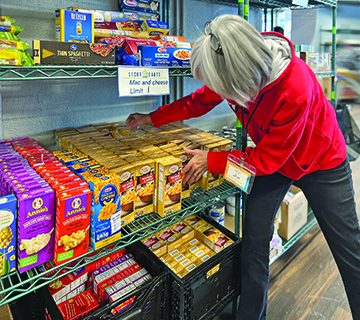
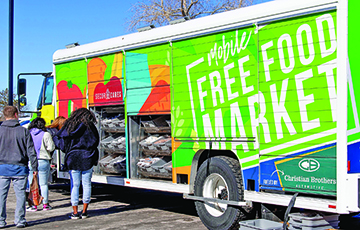
A volunteer at SECORCares works at restocking shelves at the food bank’s Free Food Market, located in Parker. The market serves approximately 450 families per week.
Depending on what side of the aisle you sit on, the bill known as “One Big Beautiful Bill” is either good for Colorado or will have a negative impact on the state. According to the House Ways and Means Office the bill will help families across the nation, including Colorado.
The typical family will get up to $10,900 in additional take-home pay and workers will see increased wages up to $7,200. According to the House and Ways Means Office, households earning less than $100,000 will benefit from a potential 12 percent tax cut.
However, rural Colorado families may not see all of the benefits of The BBB.
According to The Bell Policy Center, a non-profit group who monitors economic mobility in Colorado, the bill will have a devastating impact on Colorado’s rural communities.
According to BPC, rural areas in Colorado, especially those in southeast Colorado, are some of the poorest in Colorado.
“It’s important to recognize that income is not equally distributed across Colorado,” BPC said.
BPC reports that urban, suburban, and mountain resort communities have high concentrations of upper income families. To pay for the tax cuts in the BBB, according to Bell, the bill makes huge cuts to long-standing social safety net programs such as Medicaid and Supplemental Nutrition Assistance Program (SNAP).
SNAP is an important revenue source for one Douglas County area food bank.
SECORCares is a food bank service that reaches approximately 3,000 families per week through its three free food programs in Arapahoe, Douglas, and Elbert counties.
“At our brick-and-mortar Free Food Market, we currently serve about 450 families each week,” according to Brie Dilley, Executive Director of SECORCares.
“Beyond the Market, we extend our reach through two additional programs: our Mobile Market, which brings food directly into neighborhoods, and Food for Thought, our backpack program providing school-aged children with nutritious food to take home for the weekend,” she said.
SECOR’s Mobile Market delivers food directly into neighborhoods. SECORCares is a food bank service that reaches approximately 3,000 families per week through its three free food programs in Arapahoe, Douglas, and Elbert counties.
The backpack program is a partnership with 35 schools in the three county region SECOR serves.
Dilley added the proposed changes to programs like SNAP may cause some families to push the panic button. “The greatest impact of these changes is felt by the people we serve. Reductions in social safety nets often push families from ‘barely scraping by’ into full-blown crisis.”
“Unfortunately, reducing and/or complicating SNAP benefits does not diminish food insecurity, it shifts the burden from the government to the nonprofit sector,” Dilley added.
Proposed changes to such programs are coming at a bad time for SECOR, as the demand for SECOR’s services has increased over the past three years.
Dilley said between 2022 and 2023 SECOR experienced a 200 percent increase in helping area families.
“We attribute this dramatic rise to the trifecta of inflation and economic instability, the Denver-area migrant crisis, and the end of COVID-19 emergency allotments,” she said
Dilley added that the demand has remained so high it has forced SECOR to place a cap on its services.
“While it’s difficult to project exactly how many more families we would serve if we expanded appointment slots, our best estimate is an increase to around 600 families each week in our Free Food Market — about 150 more than we currently serve,” she said.
Sadly, SECOR is seeing a troubling trend, Dilley added.
“We are also seeing a growing number of returning guests — families who had once relied on us, found stability for a few years, and are now back.”
Dilley said SECOR welcomes them back with “open arms” but their stories are heartbreaking.
“Many believed they had reached steady ground, only to find that stability wasn’t quite enough to withstand today’s economic challenges,” she said.
SECOR is primarily dependent on private donors and local grocers through SECOR’s grocery rescue program.
According to Dilley, both sources provided more than 1.2 million pounds of food for guests last year. “Sadly, we are now seeing a decline in both of these critical areas. Grocery rescue donations are down significantly, and we’re hearing from more and more donors who — because of the same economic pressures our guests face — must scale back their giving,” Dilley said.
“One of our favorite stories to share has always been about former guests becoming donors. Unfortunately, in this season, we are also seeing the reverse.”
For more information on SECOR visit www.secorcares.com.
Photos courtesy of SECORCares