by Regan Bervar | Mar 18, 2022 | General Featured
“Progressives want livable, walkable cities, but by allowing the continued operation of open-air drug scenes, they are making cities unlivable and unwalkable, as well as inhumane.”
 by Luke Schmaltz
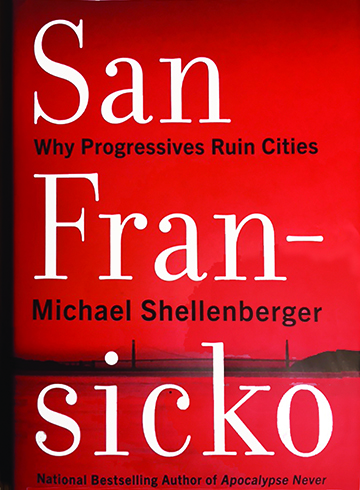
In his recently published 350+ page opus, author Michael Shellenberger tackles the daunting task of unwrapping a multi-layered crisis which has reached a critical state in California’s City by the Bay.
For those who may be unaware, San Francisco, CA, is a city in the grips of a social, political, and humanitarian nightmare. Decriminalization of illicit drugs and mass adoption of progressive “harm reduction” policies have backfired, plunging the city into an epidemic of addiction. One resident, business owner Adam Mesnick, is quoted as saying, “What’s happening is not even liberal. It’s not realistic. It’s fantasy land. This is a severe drug addiction crisis that needs greater intervention or everyone’s just going to die from fentanyl.”
San Franshitsco
Shellenberger describes how homelessness and rampant drug abuse are coupled with a statewide housing market that is grotesquely lopsided. This is apparent by the skyrocketing rental rates and property values which are pricing out many average citizens — even those with full-time jobs. The result is a populace with a large percentage of “unhoused” aka “homeless” people. In 2019, over 30,000 incidents of public defecation were reported in San Francisco, while California as a whole was found to account for 51% of all unhoused people in the entire United States.
Harm Induction
Shellenberger exposes “harm reduction” sites and so-called “Safe Sleeping Spaces” as the open-air drug scenes that they are. “Harm reduction” is a term used for government-approved areas which supply everything (equipment-wise) an addict needs in order to successfully inject narcotics such as methamphetamine, heroin, and fentanyl. NGO (non-governmental organization) workers provide addicts with tourniquets, cooking kits, syringes, and needles in an effort to somehow “reduce harm.” Shellenberger calls the practice what it truly is — “harm induction.” These NGOs are key drivers of the homeless epidemic, disguising a sadistic policy of aiding addiction behind the auspices of altruism.
Housing First
Shellenberger shines a harsh light on “housing first” which is the battle cry of many homeless advocates. This line of thinking advocates the reduction of access to overnight shelters and instead, insists on housing for addicts and mentally ill people without requiring sobriety, medication, and treatment. Shellenberger presents evidence that this policy does not effectively address the core issues which cause homelessness. To the contrary, by taking treatment for mental illness and drug addiction out of the equation — the issue spins further out of control.
A Huge Industry
Shellenberger goes to superhuman lengths to uncover, document, support, and reinforce the fact that homelessness and open-air drug scenes across the state are worsening in spite of the fact that taxpayer-funded spending on the issues is at an all-time high. The Homeless Industrial Complex, as absurd as it may sound, is very real and very much as counterintuitive and dysfunctional as the title suggests. While hundreds of millions of taxpayer funds are siphoned into this system, half of the money goes to staff salaries. It does not take a genius to realize that if they fix the problem, the cash cow is essentially taken from the milking parlor and put out to pasture.
A Legislative Nightmare
San Fransicko also presents a smorgasbord of political abominations which are adding fuel to the fire. Specifically, the decriminalization of the possession and use of illegal drugs is making it easier than ever for dealers to blatantly serve their market without fear of penalties. Meanwhile, deliberate reduction of the severity of crimes such as shoplifting, burglary, trespassing, and grand larceny has created a black-market industry which favors criminal behavior which is used to support addiction.
Crazy Town
Shellenberger further demonstrates how an unaddressed mental health epidemic is not only a miscarriage of the civil duties of elected government officials, but their pawning it off onto NGOs is downright irresponsible. The simple fact of the matter is that allowing those with untreated mental illness to openly and freely obtain and inject themselves with methamphetamines, fentanyl, and heroin is in no way a solution to a very serious problem.
A Viable Solution
Shellenberger goes on to suggest a comprehensive treatment solution for the mental health crisis via a plausible institution he dubs “Cal-Psych” which would “efficiently and humanely treat the seriously mentally ill and addicts, while providing housing to the homeless on a contingency-based system. Cal-Psych’s CEO would be best-in-class and report directly to the governor. It is only in this way that the voters could hold the governor accountable for the crises on the streets.”
Whether Shellenberger will be taken up on his offer to provide a plausible solution is anyone’s guess. Regardless, if homelessness, open-air drug scenes, rising crime, and increasing danger in your city concerns you, San Fransicko is required reading.
Image by article author
Michael Shellenberger exposes the flaws of a system gripped by addiction, psychosis and inhumane conditions.

by Jessica Hughes | Mar 4, 2022 | General Featured
by Jessica Hughes
Fireplace: A fireplace is the centerpiece to the lounge where guests can mingle and enjoy social hour. Photo provided by Hotel Clio
The JW Marriott in Cherry Creek North embarked on a multi-million-dollar renovation and will make its transformation into the Hotel Clio, a Luxury Collection Hotel, on March 15, 2022.
Hotel Clio showcases a newly reimagined lobby, gathering spaces, and guest rooms and suites. The inspired urban oasis features the work of design-duo Mark Wilson and Yoko Ishihara of the California-based Wilson Ishihara, who drew on inspiration from the history of the hotel’s location.
“Hotels listed in Marriott’s luxury collection are typically rooted in the history of the area,” says Sean McNamara, the property’s director of sales and marketing. “So, while this isn’t a historical building itself, it is the first hotel in Cherry Creek and we sought to tell the story of the destination through its design.”
One such design element includes the lobby floor that is meant to resemble a riverbed glistening with flecks of gold and a marbled tile with tributary-like details. These and other unique design features combine the precise physical attributes of the confluence of the South Platte River and Cherry Creek nearby, along with the area’s history of the Gold Rush.

Rooms: Rooms with mountain views at Hotel Clio. Photo provided by Hotel Clio
The hotel features 193 luxurious rooms and six spacious suites, plus 10,000 square feet of event and meeting space. Rooms and suites feature five-piece marble bathrooms, spacious closets, pillow-top mattresses, and large picture windows for unobstructed views of the Front Range.
Inspired and connected through food and beverage, the hotel’s in-house restaurant, Toro Latin Kitchen & Lounge, replaces the long-standing Second Home restaurant. While not much of the set-up has changed the food has. In partnership with celebrity chef, Richard Sandoval, Toro is a culinary experience to be celebrated.
With menu items such as their Sweet Corn Empanadas, fresh ceviche, Bison Tiradito, and Blackened Tuna Tacos, there’s a little something for everyone. The restaurant also features a drink named the Casual Encounter, served in a stand-alone glass case complete with Laws four-grain bourbon and dry ice.
The restaurant is open for breakfast and dinner, or their Bottomless Weekend Brunch. The lobby bar allows guests to pull from their own personal stash by renting a Tequila locker where personal collections of high-end tequilas can be stored.
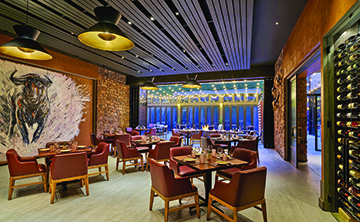
New Restaurant: The Toro dining room has replaced the long-standing Second Home restaurant in Denver’s Cherry Creek North. Photo provided by Hotel Clio
Clio will offer a concierge service, plus curated epicurean moments and experiences. Such experiences include happy hour mixology, guacamole demonstration, and a ceviche class at their ceviche bar (open to the public and guests for $25).
“As we transition into this new luxury hotel concept, we like to think of Hotel Clio as the Muse of Cherry Creek,” McNamara notes. “We want our guests to experience the same sense of inspiration that we all feel being connected to this incredible neighborhood.”
For more information, visit www.hotelcliocherrycreek.com.

by Regan Bervar | Dec 17, 2021 | General Featured
“You don’t build a business, you build people, then people build the business.”
by Luke Schmaltz
Just as 2020 was hijacked by Covid-19, 2021 was stifled by the Delta variant, and now it seems that 2022 is being preemptively overshadowed by Omicron.
The fear, confusion, and hysteria being whipped up in anticipation of the new variant is yet another example of how the pandemic ultramarathon is wearing down the fundamental American values of body autonomy and personal freedom.
On September 9, 2021, President Biden issued vaccine mandates for all Federal contractors, Federal employees, and Medicare- and Medicaid-funded healthcare workers. This was followed by a November 4th requirement issued by the Department of Labor’s Occupational Safety Hazard Administration (OSHA) that all companies with 100 or more workers ensure that each of their employees are either vaccinated for Covid-19 or tested on a weekly basis. Weeks later, the latter order was blocked by Federal judges in Kentucky and Louisiana — both citing the unconstitutionality of the decree.
The New Abnormal

Workers: Must retail and hospitality workers become the front-line soldiers in an underfunded war?
Should this pattern continue, regardless of blockages by Federal judges, the next logical step in this progression is a vaccine mandate for all businesses — including those that fall under the “small business” umbrella and happen to employ 48% of the entire American workforce — according to a recent report by Florida TaxWatch. Should such an Executive order be foisted on business owners and managers, perhaps after that will follow an order requiring that all persons who enter a business must show proof of vaccination. At this point, should circumstances progress to such an extreme, is when the specter of encroaching doom begins to loom over small businesses and family-owned enterprises like the shadow of a fast-approaching storm.
Unlike pandemics of the pre-Internet age, today’s vaccine hesitancy is at an unprecedented disparity with compliance. This division is fueled by everything from religious beliefs to folks citing fact-based studies on post-inoculation health issues and, of course, a litany of unfounded myths about the vaccines turning people into magnetic zombies, 5G antennas, and premature corpses.
Deja Vu
Compliance issues aside, a major underlying concern is that a small business mandate could foist the job of policing vaccine compliance onto the shoulders of Mom and Pop who are simply trying to make an honest living at the corner store. Essentially, those who serve their neighbors everyday — whether it is a meal, an oil change, a dry-cleaning order, or any one of 1,000 other services — will become the de facto enforcers of government policy on a street level, one on one basis. In a profoundly stressed labor market, this additional requirement of doing business may overwhelm some establishments, placing them in jeopardy of being shut down for failing (or refusing) to harangue every last patron for a vaccine card. Think about it: A populace of stressed-out, paranoid citizens prying into the personal matters of their neighbors at the behest of the government. Sound familiar?
Dysfunction Junction
OSHA: This agency administers rules which require compliance lettering illustration with icons for web banner, flyer
Across the Denver commercial landscape, it is universally agreed upon — among customers and proprietors alike — that all anyone really wants is for business to return to something resembling pre-pandemic normalcy. Covid-19 and its growing ranks of variants, however, do not share this outlook — and thus the current predicament. Meanwhile, the labor market limps along like an extended case of walking pneumonia as small businesses struggle to hire workers. If retail stores, contractors and every branch of the hospitality industry are scrambling to fill positions, chances are good that the government agency tasked with enforcing the speculated vaccine mandates will be understaffed as well. Over the last 18+ months, most Denver residents have seen the astonishing effects of unenforced policies. They are scattered across the sidewalks, alleyways and parking lots of the city — human casualties of a rampant, unmitigated dope epidemic.
Not In The Job Description
A vaccine mandate on the workers and patrons of small businesses could potentially decrease productivity and increase operating costs — as employees will have to shift their main concern of serving customers to first snooping into private medical histories. A secondary effect of this dynamic could be the systematic erosion of trust between the proprietors, the customers, and the workers who take care of their needs. And of course, don’t forget about the archetypical nosey-ass, Yelp-reviewing, tattletale busybodies who — with nothing better to do — will be policing the actions of workers and posting about the poor souls who have become default enforcers of government policy. Should things come to this, one might speculate that people will simply stop leaving home to do business and revert back to the unthinkable — going online to fulfill every need and giving even more money to Jeff Bezos.
The current consensus among small business owners is that they are willing to comply with mask mandates so that they can, at the very least, keep doing business. Owners, customers, and workers alike all pine for the days of yore. Yet, when presented with the speculative scenario of vaccine mandates which would have to be enforced by each business lest they be fined and possibly shut down, most respondents are, for now, staying tight-lipped. After calls to dozens of Denver restaurants, retailers and the like, a few folks willing to offer opinions were finally found.
The Bookies
Mandate: A vaccine mandate on the workers and patrons of small businesses could potentially decrease productivity and increase operating costs.
This book retailer and gift shop at 4315 E. Mississippi Ave. was recently acquired by Nicole Sullivan, owner of northwest Denver’s inimitable BookBar. Anna, perhaps the friendliest customer service person in all of Denver, answered the phone and offered a bit of relevant insight. “The mask mandate gave us more confidence to post it [the policy] on the door,” she begins. “But a vaccine mandate? I don’t even know how you would even begin to enforce that,” she explains. “I wouldn’t want to put anyone at the door checking vaccine cards. I think it’s OK for big places where people congregate a lot, but this is a store. We already went through all of that at the beginning, making sure people had masks on. Thankfully most people do.”
Staybridge Suites Hotel
While this Glendale outpost of high-end hospitality at 4220 E. Virginia Ave. is part of a worldwide conglomerate of hotels, commentary from hotel manager Max Kiker offers some valuable insights into the proposed vaccine mandate scenario. “We are a huge business, so the [current] mandate would apply to us,” he says. When asked about his managerial team’s “for or against” stance on a vaccine mandate, he continues, “Right now we are neutral. There are too many conflicting views out there, but it would impact our business because we have already lost people because of the mask mandate,” He explains. “There are enough labor issues right now and this would compound them.”
Dr. Proctor’s Bar
This Glendale neighborhood treasure at 4201 E. Mississippi Ave. is known for plenty of pool tables, great food, big screen TVs, and has been a local go-to since 1981. The daytime bartender, Susie, is quick to point out, “We are a small bar and regardless of what it [vaccine mandate] would come down to, we can’t afford to lose our liquor license, so we enforce everything. As far as the mask mandate goes,” she continues, “We are enforcing it as much as we can. Some people are compliant, and some people are just absolutely ignorant about it. If you can’t wear your mask, you gotta leave,” she explains.
Whether citizens working in retail, hospitality, and other iterations of small business have to either become spies, de facto law enforcers, or criminals by default — only time will tell. If small businesses must enforce vaccine mandates, the current state of civic division will pale in comparison to the ensuing social breakdown.
by Regan Bervar | Oct 22, 2021 | General Featured
“When the going gets weird, the weird turn pro.”
by Luke Schmaltz
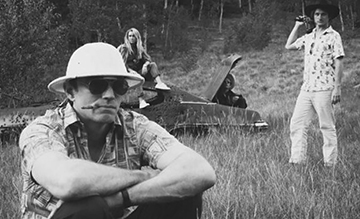
Fear and Loathing in Aspen — a forthcoming film set in Colorado’s most notorious mountain town — is packed with parallels to current issues, rich with the warm, grainy texture of 20th Century celluloid, and thick with finely tuned, bittersweet irony.
Unlike predecessors, this film offers a more subtle, nuanced interpretation of the outlandish escapades of the late writer — Hunter S. Thompson. Director Bobby Kennedy III delivers a concise, thoughtful, and well-rounded narrative of Thompson’s 1970 run for Sheriff of Pitkin County, Colorado, on the Freak Power ticket.
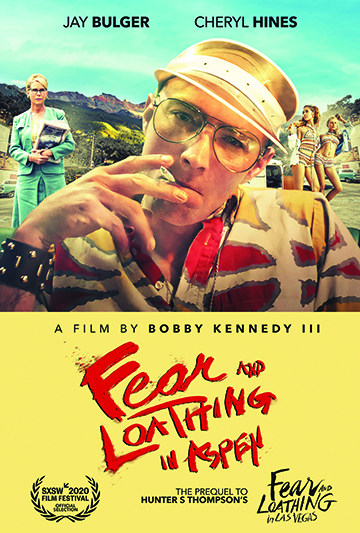
Hit Movie: Fear and Loathing in Aspen is a direct hit with many of today’s hot-button issues.
In one scene, Thompson (masterfully played by Jay Bulger) says, “The freaks — they’re everywhere … and they can vote.” He continues his commentary on the local counterculture with more poignant observations, “One of the main things I’ve learned out here is there are all kinds of very capable people wandering around with no place to use their energy. If we can put this energy to work, we’ll have a helluva tool on our hands.”
Throughout the piece, Bulger, who bears an uncanny resemblance to his subject, manages to deliver a convincing portrayal of Thompson while somehow avoiding the character tropes, overblown mannerisms, and hyper-exaggerated speech patterns Thompson’s persona has elicited from those who have portrayed him in the past. Here, viewers are treated to a glimpse into the psyche of a deeply complex character without having to endure the gallivanting around and flailing about of cinematic forebears. Rather, Bulger delves deeper into the humanity of the character, using a somewhat even-keeled anchor point to mount emotional plunges and manic ascents.
Visually, the film pays on-target homage to the wobbly, hand-held 8mm footage that captured many moments of the actual events in the story. Kennedy masterfully rotates between smoothly edited, narrative scenes, and grainy handheld sequences that, were it not for impeccable continuity, could be mistaken for amateur found footage from 1970.
Parallels Abound
Although the story is 50+ years old, the film zaps a cattle prod to a number of today’s hot-button issues. Thompson’s Freak Power party runs the very essence of a grassroots political campaign, echoing current political concerns such as voter reluctance, voter suppression, and election fraud. Meanwhile, the “freaks” of the Aspen Valley — fringe-dwelling refugees of the status-quo — are eerily reminiscent of the drug-addled tent-dwellers of today’s Denver, although in the movie they represent heroism, positive change, and social evolution. And then, there are the conservative gentrifiers who are systematically overtaking Aspen and making Thompson’s proposed utopia an all-but-impossible pipedream. Given the overrun, overdeveloped, and overpriced state of Pitkin County today, it makes you wonder how vastly different that sector of Colorado would look had Thompson been victorious.
A Brazen Platform
Portrayal: Actor Jay Bulger delivers a nuanced, spot-on portrayal of a pop culture legend.
As one would expect, his platform was as sweeping and rebellious as the man’s reputation. “We will sod the streets at once” he begins. “Rip up all city streets with jackhammers and use the junk asphalt, after melting, to create a huge parking and auto storage lot on the outskirts of town. We will change the name of Aspen, by public referendum, to Fat City, to prevent land rapers, greedheads, and human jackals from capitalizing on the name ‘Aspen.’ Aspen, Colorado, would no longer exist, and the psychic alterations of this change would be massive in the world of commerce. By this approach, making hundreds or even thousands of individuals personally responsible for protecting the animals, fish, and birds that live here, we would create a sort of de facto game preserve without the harsh restrictions that will be forced on us if these bloodthirsty geeks keep swarming in here every autumn to shoot everything they see.”
Acerbic, To Wit

In Character: Jay Bulger stays entrenched in character throughout the film.
Alas, the irony that Bobby Kennedy III deals out to viewers is deeply poetic. He skillfully helms a cinematic vehicle that is clearly aimed at the establishment, the status quo, the Good Ol’ Boys Club that his grandfather and great uncle (Bobby and John F. Kennedy) attempted to topple.
While the outcome of Thompson’s run for Sheriff of Pitkin County is well known, Fear and Loathing in Aspen is not to be dismissed for simply retelling the bittersweet parable of an American underdog. Lest it be forgotten, this country was founded by rebels with revolutionary thinking and radical solutions. As Bulger soliloquizes at the end of the third act, “If you ever get the chance to sweep the fatbacks off their feet, don’t f@*k it up.”
Fear and Loathing in Aspen is indie filmmaking at its finest, hearkening back to the glorious cinematic movement of the 1990s where formula, big name actors, plotless blather, and CGI sensory overload were not the order of the day. This film deserves a fair shot at the permaculture, for sheer entertainment value as well as historical significance. Should you crave a cinematic experience that requires a bit of thinking, a fair modicum of empathy and a healthy sense of the ridiculous — this film is for you.
by Mark Smiley | Sep 27, 2021 | General Featured
by Mark Smiley
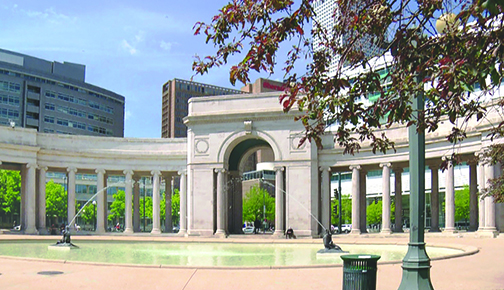
Closed: Civic Center Park will be closed for at least two months due to it being a violent, drug, and rat infested area. Many Denver residents are upset with the rise in crime and drug use in the area.
The City and County of Denver closed Civic Center Park and adjacent areas to the public in order to abate significant public safety and environmental health risks that have grown over the past several months and to rehabilitate one of the centerpieces of Denver’s parks system.
The park closed on Wednesday, September 15, 2021. According to the city, the park will be restored to a stable and safe state that is welcoming for all Denver residents.
“The current challenges within Civic Center Park have reached a tipping point, creating conditions that put the public’s health and safety at risk,” Mayor Michael B. Hancock said. “This cannot and will not be allowed to continue. This is the people’s park and we are taking steps so that everyone can once again feel safe and welcomed there.”
“We are seeing our city getting overwhelmed by crime and sanitation issues,” said Mike Silverberg, Denver resident. “People are afraid to go downtown an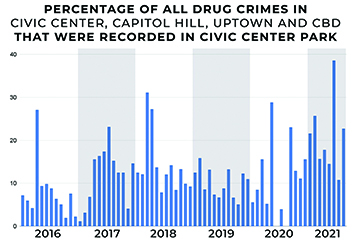 ymore, and now what was a crown jewel park has been fenced off and closed. The latest consequence of Denver’s “friendly” modeling of San Fran, Seattle, and Portland-type policies and acceptance by the silent majority that this is, and growing crime rates, are acceptable.”
Over the course of the last several weeks, officials from Denver Public Health & Environment have been monitoring conditions in Civic Center Park, Pioneer Fountain at the corner of Broadway and Colfax, and MacIntosh Park Plaza at 15th Ave. and Cleveland St. for health and environmental hazards which create ongoing unhealthy conditions for all users of the park. Many unsafe conditions were noted, including: litter and food waste that attract bugs and rodents; dozens of rodent burrows; human and pet waste which contribute to the spread of disease and impact water quality; and improperly discarded needles and other drug paraphernalia that creates risks to people v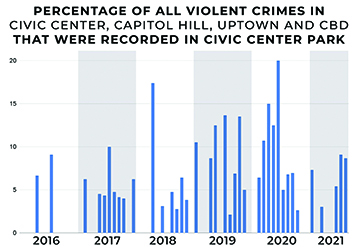 isiting the area and to workers tasked with maintaining the area.
In recent weeks, excessive amounts of trash have accumulated each day, consisting of discarded food, as well as human and hazardous waste, resulting in additional labor hours and rodent infestation. Graffiti and fire damage to the historical stone structures will require professional restoration. A thorough evaluation of the park is also required to ensure all hazardous waste is properly identified and removed.
In addition to the public health risks observed in Civic Center, the park and surrounding areas have become a hotspot for violence, crime, drug sales, and substance misuse, jeopardizing the public’s ability to safely enjoy one of Denver’s treasured outdoor spaces.
The closure is temporary, and Civic Center Park will re-open when abatement measures have been completed and the park is safe for everyone to use. Organizers of scheduled events in Civic Center Park are being contacted for relocation to other park properties.
According to a CBS Denver report, the closure could last as long as two months. The city, however, did not provide any additional information about the timeline of the closure. “When work is complete and all public health issues have been mitigated, Civic Center Park and surrounding areas will be reopened,” read a city press release.
by Mark Smiley | Aug 27, 2021 | General Featured
by Jessica Hughes

Colorful Murals at the RiNo Artpark. Photo credit: Scott Colby
A new arts center is coming to Denver’s RiNo neighborhood this month. The grand opening for the RiNo ArtPark will be held the weekend of September 24-26. Designed to be a creative hub in the Five Points neighborhood, the ArtPark will seek to spark innovation and bring people together through the arts.
What was once operated by the Denver Police Department, the original building was scheduled for demolition. The RiNo Art District advocated to save the buildings and turn them into something the community could use. Partnering with the Denver Public Library, Focus Points Family Resource Center, and RedLine Contemporary Art Center, the RiNo ArtPark will feature a community hub for resident artists and education programs and a new branch of the Denver Public Library for the entire community to enjoy.
Another unique feature of the park is the Comal Heritage Food Incubator, a culinary training program for immigrants and refugees interested in restaurant entrepreneurship. The program is currently running under the Focus Points Family Resource Center and will expand its presence at the hub.
Beyond the physical structures of the park, its design explores the intersections of nature, recreation, and culture by combining green spaces that engage the South Platte River and the surrounding natural areas.
RiNo ArtPark Grand Opening
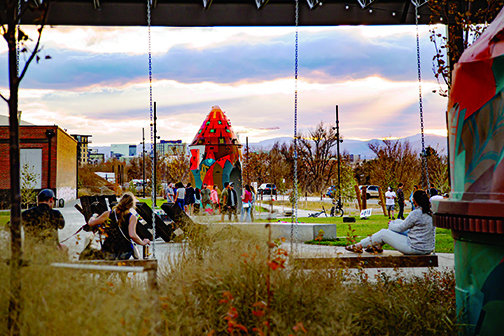
Outdoor space at RiNo ArtPark capturing the Denver skyline. Photo credit: Scott Colby
The entire Denver community is invited to the Grand Opening of ArtPark. Throughout the weekend, visitors will have an opportunity to tour the new Tres Birds-designed ArtPark building, attend workshops, demonstrations, art activations, and see live music, exhibits, performances, and more.
In addition to a host of FREE family-friendly events throughout the weekend, RiNo Art District will host the Lawn Salon, a ticketed fundraising event to support ongoing programming at ArtPark. This year’s outdoor bash is a twisted picnic, a one-of-a-kind “lawn salon” experience, with interactive art, a giant flaming disco ball, music curated by local DJs, live and silent auctions, dinner, drinks, and fun surprises.
Events
Friday, September 24:
FREE Open House 3-7 p.m.
ArtPark Public Art Dedication Ceremony: 3 p.m.
The dedication ceremony welcomes the newest public artworks into the Denver’s collection! Artists Jaime Molina and Pedro Barrios, with the help from Tres Birds Workshop, will unveil their latest works at this dedication ceremony — three old industrial cement mixers have been transformed into sculptural additions to the park.
Saturday, September 25:
FREE Youth Activities: 10 a.m.-2 p.m.
On Saturday, friends and family will enjoy a book sale, hosted by the Denver Public Library, a yoga art class, paper flower making, pinata class, and a live performance by Los Mocohetes. The Lawn Salon fundraiser will also be held on Saturday, from 6 to 9 p.m.
Sunday, September 26:
FREE Family Celebration 10 a.m.-2 p.m.
On Sunday, free events will include ArtPark Al Fresco Art Workshops, paper marbling classes, yarn bombing classes, the book sale, and fun activities such as the bubble tower and bounce house. Food trucks are scheduled to be there from 10 a.m. to 2 p.m.
Events throughout the weekend will be held in and around ArtPark, located at 35th and Arkins Court, Denver, 80205. Events are FREE all weekend except for the Lawn Salon Fundraiser on Saturday.
To learn more about the RiNo ArtPark and to purchase tickets to the Lawn Salon, visit them at rinoartpark.com.