by Mark Smiley | Mar 19, 2021 | Main Articles
Wash Park Home Built In The 1890s Faces Wrecking Ball; ‘Park Won’t Be The Same If Home Is Razed,’ Residents Stress
by Glen Richardson
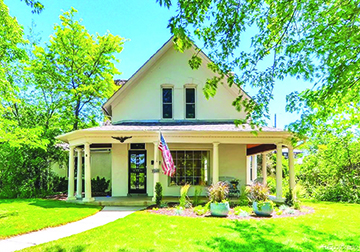
Stunning Site: Home, sweet historic home’s prominent location creates an established and familiar feature for both Wash Park and the Mile High City.
In a neighborhood where real estate is in high demand, demolition threatens a rare Wash Park Queen Anne home built no later than 1890. Neighbors were surprised and shocked when a demolition notice was posted at the 800 S. Franklin St. home by the City & County of Denver.
The oldest occupiable property from the 19th Century remaining in the neighborhood, it is located on a large corner lot across Franklin St. from Wash Park and across E. Ohio Ave. from St. John’s Church. The home is a rare remaining example of the Queen Anne Style in West Washington Park.
Representing the distinctive visible characteristics of a Queen Anne, it has the asymmetrical massing including projecting octagonal bays, steep gabled roofs, deep classical eaves and hooded windows. The porch features Tuscan order columns and classical entablature — an architectural section located above the columns on the building’s exterior. Largely developed 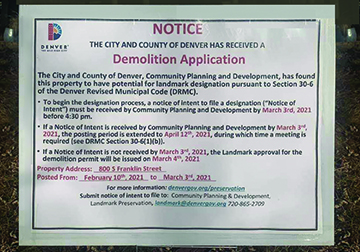 in the period between the world wars, many of the houses in the neighborhood were constructed in more revivalist or eclectic styles such as Tudor revival or Craftsman.
Saving Historic Site
Ironically the bid to bulldoze the $2,300,000 home was posted in March as Historic Denver began celebrating five-decades of saving and highlighting historic treasures under threat of annihilation. The non-profit got started by saving the Molly Brown House from demolition in 1970. The organization is hosting a 50th bash at the Molly Brown House Museum now through Sept. 19. The celebration includes a “50 Actions for 50 Places” campaign for sites worthy of preservation action.
Sixth generation Coloradan Drew Carder — who has spent nearly his entire life in Wash Park — is among the neighborhood admirers and supports nominating the Franklin St. home as a community mecca worthy of preservation protection. He says he doesn’t know much about the home other than it is one of the last remaining pieces of the neighborhood’s history. “I feel like this community should be given more of a chance to respond.”
Like Carder, Justin Moorland has spent most of his life in or around Wash Park. Today he lives on the 600 block of S. Gilpin, one block away from the Franklin St. house. “It has always been my favorite home at the park. I find it unique because of its obvious age, modesty and setting. It is truly from another era.” Admits Liz Schanker, “I guess that proximity gives me extra incentive to save the home.” She lives right next door to 800 S. Franklin and says she has lived in Wash Park long enough to be able to imagine the structure that would go up on the site and doesn’t want that to happen. “There is a plethora of new, urban mansions in the neighborhood but only one white farmhouse that predates the park.”
Stunning Setting

Stunning Site: Home, sweet historic home’s prominent location creates an established and familiar feature for both Wash Park and the Mile High City.
Set far back from Franklin St., the home has an unusually large front yard at the corner of E. Ohio. Because of the house’s large, open lot and prominent location, it creates an established and familiar feature for both Wash Park and the Mile High City. One of the neighborhood’s first buildings, it was constructed before the City of Denver became the City and County of Denver. Moreover, despite its age the house retains a high degree of integrity.
The original Queen Anne structure has experienced some alterations including the stuccoing of the masonry, the northern addition plus alterations to some window openings. Nonetheless, it still retains integrity of design, materials and workmanship to communicate its Queen Anne style. The home is in its original locations, and while the area around the house has been altered over time, the house retains its setting through its relationship to Washington Park and Smith Lake. The interior includes a breakfast nook, vaulted ceilings, walk-in closets and fireplace. The structure is encircled by a wrap-around front porch.
Bid To Bulldoze
Wash Park developer-builder Aaron Grant is the person seeking demolition of the historic home. He is owner-managing-broker of South Gaylord St.-based Grant Real Estate Co. Retailers and residents will recall it was his firm that bulldozed long-standing stores along Denver’s second oldest commercial block to build Park Coworking. The company website claims, “We maintain history and character in the Wash Park neighborhood through real estate design and development.”
In conversations with relatives of the owner who sold the house to Grant Real Estate, neighbors were purportedly told that Grant articulated to them “what they wanted to hear as a seller.”
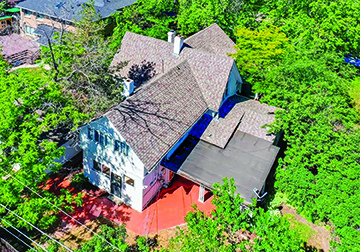
Treasure Threatened: Demolition threatens this rare Queen Ann home located across Franklin St. from Wash Park. The oldest occupiable property from the 19th Century remaining in the neighborhood, the house has retained a high degree of integrity despite its age.
At the time he was purchasing the property, Grant also allegedly indicated that he wanted to keep the shell of the home and remodel the interior. “We know now this was probably never his intent,” they say.
Noteworthy Owners
According to the Denver Assessor’s records, 800 S. Franklin St. was constructed in 1890. If the date is accurate, it would make the house one of the earliest remaining buildings in the West Wash Park neighborhood. Additionally, it confirms the house was built prior to the City of Denver becoming the City and County of Denver, which was not until 1902.
The earliest record of home ownership was by lumber tycoon Joseph Sterling who started Sterling Lumber & Investment Co. Records suggest, however, the house may be older that 1890 as a 1900 fire destroyed building records prior to 1890. The last prominent person to live in the Franklin home was William H. Burnett, a distinguished jurist who served on the Denver County Court for 17 years.
In 1964 Burnett served as President of the Judicial Research Foundation and became head of the American Bar Association’s Section of Judicial Administration. The judge lived at the Franklin St. address with his wife Margaret from 1963 until his death in 1973. He was at the height of his career when he lived at the address, therefore the property bears a strong association with him and his significance as a local judge and reformer.

by Regan Bervar | Mar 19, 2021 | Main Articles
“Humans are startlingly bad at detecting fraud Even when we’re on the lookout for signs of deception, studies show, our accuracy is hardly better than chance.” – Maria Konnikova
 by Luke Schmaltz
Over the last year, the pandemic has proven that there is no level of trickery that is too low for some people.
Humanity’s ever-industrious scammer contingent will seemingly stop at nothing to achieve its prime objective — to separate you from your money. The current populace of frightened, poorly informed, emotionally vulnerable people has created a lush marketplace for fraud. Folks who desperately want to stop isolating, masking and disinfecting their lives away and get back to living them instead are falling victim to COVID-19 vaccine scams.
These ploys are disguised as websites, emails, phone calls, text messages and — yes — personal visits to your home. The perpetrators make an offer, convince victims to provide personal information or money and then they disappear. Here are some of the scams currently underway and how to spot them.
Free Vaccines: The vaccines from Johnson & Johnson, Moderna and other companies should be free, no exceptions. Image: Johnson & JohnsonFree Vaccines: The vaccines from Johnson & Johnson, Moderna and other companies should be free, no exceptions. Image: Johnson & Johnson
All Vaccines Should Be Free
Moderna, Johnson & Johnson, Pfizer and their emerging vaccine-making counterparts are being compensated by the U.S. Government. There should be no cost to you other than a small administration fee, if any. If someone approaches you via phone call, text message, email, or in-person visit with an offer to “sell” you a dose or a vial of vaccine, report them to the Federal Trade Commission (FTC) at ReportFraud.ftc.gov. Sinovac is a China-based company which has tested a successful vaccine, yet this is not approved for distribution in the United States. Regardless, several social media campaigns were running ads claiming to be making this vaccine available for American consumers — for a price.
Scammers Have Bad Grammar
Anyone with a computer, an internet connection and a few basic skills can make websites and send emails. Since most of the vaccine scams are purported by criminals who are overseas, their lack of skill with the English language will be apparent in the text of the email or website landing page. In the case of an email, look for basic mistakes in punctuation, pluralization, spelling and euphemistic language. Also, no signature on an email is a red flag as is any email that appears to be from a government agency, pharmaceutical company, or a vaccine distributor. Websites offering vaccines will be using a specific set of keywords in their titles to attract traffic. Be on the lookout for terms such as “private vaccine, testing update, COVID validator, cure COVID, testing update, Corona vaccine and COVID -19.”
Phishy Phone Calls

Phone Scams: Phone calls from scammers are the main way scammers separate people from their money.
Stateside scammers or those with a believable command over American English may call you out of the blue. They will claim to be working in some sort of an official capacity, either for a pharmaceutical company, a healthcare provider, the Centers for Disease Control (CDC) or some branch of the U.S. Government. The next giveaway is that they will ask you to “verify” your identity by providing them with some sort of personal information whether it is your Medicaid policy number, your birth date or your SSN. Some of them may go so far as to tell you they are going to show up and personally administer the vaccine for you. Remember this: whether on the phone or via email, verifiers are liars.
Bad Business
BBB: The Denver Better Business Bureau is keeping tabs on local and international scammers via their Scam Tracker Tool.
Meanwhile, the Denver chapter of the Better Business Bureau is keeping tabs on these scammers. Content and PR Specialist Keylen Villagrana offers insight into an array of both international and locally-run
scams. “Fake unemployment claims, stimulus check scams, puppy scams ([they] are rising as more people are working from home) and employment scams for work-from-home positions. [There is] even an elaborate romance scam operating overseas where victims are turned into ‘money mules’ in order for scammers to retrieve fake unemployment claim money. They use victims for their U.S. based bank account and ask them to wire money to a bank account [that is] very likely overseas. (Wire transfers can’t be traced),” she says. Of all the current ruses, one is unanimously more popular than the others. Villagrana explains, “Consumers are contacted after they have received the COVID-19 vaccine (although many are contacted that haven’t even received the vaccine), to take a survey and in exchange for a ‘gift.’ All they have to do is pay for shipping and handling ranging from $2.99-$19.99 depending on
the gift they choose. Most never receive anything and some have reported unauthorized charges.” Folks are in luck, however, as this agency keeps a running tally on all past and current scams via their “Scam Tracker” tool available here: www. bbb.org/scamtracker.
Trash Can Treasure
Ads such as the one mentioned above claiming to be selling vaccines should be disregarded. The messaging features such as Facebook Messenger are also avenues scammers will take to try and get your attention through personal messages containing “incredible” deals on Covid-19 vaccines. The main rule of thumb here: if it sounds too good to be true, it’s a scam.

Legitimate Source: Immunize Colorado is one of the legitimate sources of “real” vaccinations.
Some Lines Can’t Be Skipped
Yet another scenario involves scammers who claim to be able to do the legwork for you and “track down” your vaccination. Others offer a similar service by promising that they can use their contacts in the medical industry to help you “skip the line” and get a vaccination sooner than the current tiered rollout system allows. These are scams that will require the service fee be paid in advance and once the money is sent, that’s all she wrote.
Thankfully, legitimate sources are standing by to provide citizens with answers about the specific tiers of the vaccine rollout and where the efforts are on the projected timeline. You can find out more by going to Colorado Vaccine Equity www.colorado vaccineequity.org, Immunize Colorado www. immunizecolorado.org and the Colorado Department of Health and Environment covid19.colorado.gov.
by Mark Smiley | Feb 19, 2021 | Main Articles
Glimmer Of Hope As My Fair Lady Is Set For August Opening; Renovated Clocktower Cabaret, Cleo Parker Dance Already Open
by Glen Richardson
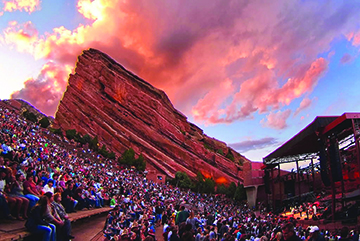
Red Rocks Recovery: Opening of the 4,000-person Red Rocks Amphitheatre when the weather warms up would be a sure sign Denver’s urban heart is pumping again. AEG Presents has yet to signal it is booking summer concerts.
From restaurants to retail the Cherry Creek Valley is slowly reopening for business. But Denver’s urban heart — live concerts, theatre, comedy and the creative arts — remain mostly shut down creating an economic calamity that has drained the cultural lifeblood of the city.
Up until now the city’s pace-setting institutions — the Denver Center for Performing Arts (DCPA), Red Rocks Amphitheatre and the Colorado Convention Center — have been dark since the pandemic hit. So have a half dozen other theaters plus key dance, music and performance spaces. Reopening has proved far more daunting than anyone could have imagined.
Statewide mass Covid-19 vaccinations efforts plus restrictions lowered to Level Yellow in 33 counties, including Denver, have reignited hope and anticipation that venues and productions will begin reopening this summer. The opening light switch, in fact, has already been flipped at several spots and entertainment insider chatter suggests that opening could be imminent at additional venues by summer-fall.
Glimmer Of Hope

Against All Odds: The Denver Center for Performing Arts is tentatively planning to present Broadway’s touring version of My Fair Lady in the Buell Theatre Aug. 11-22. All of DCPA’s venues have been closed since the pandemic hit.
With summer solstice just 112 days subsequently to March 1, there are signs that the cloud of Covid-19 is starting to lift and the city’s cultural scene will reignite.
The Denver Center for the Performing Arts has announced that Saturday Night Alive will return June 12. The 40-year-old fundraiser has been reconceived in order to follow public gathering restrictions. “Currently, we hope to welcome both a virtual audience as well as on-site guests,” explains DCPA President-CEO Janice Sinden. “We envision an evening that can accommodate a smaller, in-person gathering and leverage the HD broadcast capabilities of the Seawell Ballroom.”
Furthermore, DCPA is tentatively planning to present Broadway’s touring version of My Fair Lady in the Buell Theatre Aug. 11-22. From the Lincoln Center Theater, the New York Times says revival of the musical “reminds you how indispensable great theatre can be.”
Small Venue Test

Convention Comeback: Meetings, tradeshows at the Colorado Convention Center aren’t likely in large number until the second half of the year. Booked through 2023, the city seeks to hang onto the business.
On its 15th anniversary The Clocktower Cabaret under the historic D&F Clocktower on the 16th Street Mall launched live shows beginning Valentine’s Day. Additional shows are expected this month in the nonprofit company’s 240-seat theater following months of renovation.
Cleo Parker Robinson Dance has also reopened her 240-seat theater in the former church site at 119 Park Ave. West. Official opening followed frenzied work to renovate the 24,000-sq.-ft. complex. Up to 20 area performing arts companies that have survived the pandemic are lined up to rent the space. Included are spin-off dance companies Moraporvida Dance, Nu-World Contemporary Dance Theatre and Feel The Movement.
Larimer Lounge is testing the waters with a Denver-via-Ecuador pop artist Neoma concert on July 10 followed by rock combo Matt Rouch & The Noise Upstairs the next day. Then on July 24 indie folk duo Shovelin Stone is scheduled to perform. The Larimer Lounge’s sister club, Globe Hall, is serving a barbecue dinner and a show and if all goes well, that venue will begin hosting shows of its own. While the Larimer Lounge experiments with dinner service, restaurants are reversing the test by trying out concerts to build business during the pandemic. Lost City Café in River North, for instance, plans to kick off a summer-long benefit series on its patio.
Ratings, Tech & Cash

Dancing Into Renovated Digs: Cleo Parker Robinson Dance has also reopened its 240-seat theater on Park Ave. West. Up to 20 area performing art companies that have survived the pandemic are lined up to use the space.
Official ratings, technology and money are also key factors playing into the comeback of concerts and events. If, for example, the state moved the pandemic dial to Blue, DCPA would be able to entertain 175 guests in the newly-renovated Wolf Theatre. Moreover, fundraisers and weddings could host up to 175 guests in the Seawell Ballroom.
The pandemic has triggered technology while also altering event formats. After going digital last year, City Park Jazz is bringing back the free live concert, but with a mix of both virtual and live programming.
With a $2 million anonymous gift, the Colorado Symphony is now able to pay its employees through this summer. Moreover, Conductor Christopher Dragon’s contract was renewed through the 2022-24 season. Likely, it will also mean Boettcher Concert Hall will have additional live concerts plus the return of Symphony concerts to Red Rocks.
Sway Of Promoters
Recapturing Denver’s pre-pandemic momentum will require the booking of touring entertainers, shows and events by Denver’s two major event promoters AEG Presents and Live Nation. Founded by Philip Anschutz, AEG is the exclusive ticket seller for all Denver venues including Red Rocks. Summer shows here remain iffy despite the warmup including those booked by AEG at the Bluebird, Ogden and Gothic Theatres.
The odds aren’t much better at the Marquis Theatre or Summit and Fillmore Auditoriums that Live Nation books. Variety, however, did report Live Nation was “confident live music would return this summer.”
Financially it normally doesn’t make sense for national touring musicals or shows to visit Denver if they can’t also perform elsewhere around the country. Bottom Line: Shows and entertainers coming to Denver earlier than this fall (2021) will likely be one-offs, series from a single artist at a single venue, or regional tours playing unconventional venues.
Bedeviled Path Back

Fundraiser First: The showcase of live theatre has announced that the 40-year-old fundraiser Saturday Night Alive is returning June 12. Event will feature both on-site guests and a virtual audience.
The trajectory of infections, vaccinations and “overall behavior” will determine the number and size of this year’s summer-fall openings. The fear, of course, is that it only takes one super-spreader event to ruin it for everyone. Just as Denver seemed like it was finally in a place where people could plant a flag on the ground and claim a fresh start, trouble erupted.
After reopening three weeks earlier, the 40,000-sq.-ft. Grizzly Rose — known for hosting country music and featuring a 2,500-sq.-ft. dance floor — was caught by TV and social media cameras packed with hundreds of people inside the dance hall without masks when only 50 people were permissible.
Owner Scott Durland quickly closed the venue just north of Denver off I-25 voluntarily. Just two days later, however, Tri-County Health ordered the site shut down until further notice. The club had been cited for the same violations last fall.
by Ashe in America | Feb 19, 2021 | Main Articles
by Robert Davis
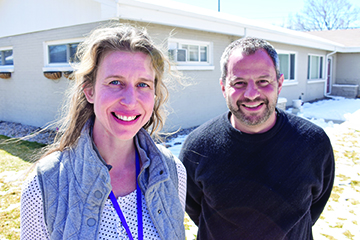
They’re Back: Jason Lewiston, whose Green Flats project was defeated in 2018, is back proposing a project called The Holly Street Townhomes. Also pictured is Anna DeWitt, who owns one of the homes being sold to make way for the new development.
A proposed development on S. Holly Street in Denver’s Hilltop neighborhood is reviving old baggage between neighbors who don’t want change and a developer with leverage to muscle.
Known as The Holly Street Townhomes, the project will combine five parcels between 219 and 227 S. Holly to create a multi-family, co-living complex. Each of the six townhomes contains four individual units which are sold as “shares” of the group home. The units are priced at $150,000 for about 600 sq. ft. for a bedroom, kitchenette, bathroom, and sitting area.
Florence Sebern, who lives in the neighborhood, said the Townhomes are eerily familiar to the Green Flats project her neighbors defeated in 2018. Through an intricate petitioning process, residents were able to force City Council to require a supermajority of 10 votes to pass the necessary rezoning request.
After only eight Council members voted for the project, developer Jason Lewiston told Denverite the setback was a “metaphor for the future of Denver. Are we going to retain whites-only, single-family zoning … or are we going to get past race-based zoning from the 1960s?”
Now that Lewiston is back, this time on the heels of a controversial overhaul to the city’s zoning code, some residents are feeling blackballed by their elected officials.
“Some people in Denver have a particular disdain for Hilltop residents as white, privileged, and somehow willing to surrender to whatever a developer wants to build,” Sebern told the Glendale Cherry Creek Chronicle in an interview.
Sebern also described the timing of Lewiston’s re-appearance in the neighborhood as “curious.”
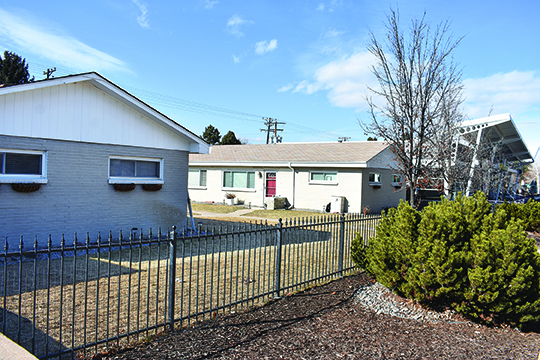
Destined For Scraping: These townhomes on South Holly Street in the Hilltop neighborhood would be leveled to make way for a multi-family, co-living complex.
Lewiston formed a co-living agency called The Co-Own Company in June 2020 while the Denver housing market was resting. Research by the National Association of Realtors found the Denver metro area experienced a one-year price growth of one percent over that summer.
Even though the Townhomes currently do not hold a building permit with the city, the units are already listed on the MLS. And since the project could not have been built in Hilltop before the Group Living Amendment passed, Sebern concluded the development plan had to be submitted with some foreknowledge that the amendment would pass.
Sarah Wells, Co-Own’s director of sales, was a voting member of the Group Living Advisory Committee (GLAC) while Gosia Kung, an architect, sits on the Denver Planning Board.
Members of both groups are appointed by the Mayor. GLAC disbanded after the amendment passed and members of the Planning Board are appointed for three-year terms on a volunteer basis. All Planning Board members hold outside employment with other firms, corporations, and nonprofit organizations.
Meanwhile, Denver’s form-based zoning code is designed to create predictable outcomes for developers. All zoning permits must be shown to be consistent with a previously approved Large Development Framework, Infrastructure Master Plan, General Development Plan, Regulating Plan, or Site Development Plan. Furthermore, it cannot “substantially or permanently injure the appropriate use of adjacent conforming properties.”

Inexpensive Homes: The Holly Street Townhome units are priced at $150,000 for about 600 sq. ft. for a bedroom, kitchenette, bathroom, and sitting area.
But, Wells said the neighborhood wasn’t chosen to stir up trouble. Instead, Co-Own wanted to bring the project to Hilltop because of its proximity to downtown, its parks, restaurants, and shops.
“Additionally, the lot we’ve chosen already houses a multi-unit building so it allows us to create a new complex that is similar, will have the same number of units and will blend in well with the surrounding area. The architectural style we’re using is intended to complement established neighborhoods and provide a beautiful place for people to live affordably and earn an ownership stake,” she added in an email.
Hilltop is one of Denver’s most expensive neighborhoods with an average home value north of $1 million, according to Zillow. The proposed Townhomes will sell for a combined $600,000 in total, nearly double what Lewiston was asking for in Green Flats.
Overall, the Townhomes will attract more density to the neighborhood as well. Green Flats was designed to offer affordable options for the families and teachers of nearby Carson Elementary or Hill Middle School. The Townhomes will consume more land which may leave less room for off-street parking.
For teachers like Anna DeWitt, who owns one of the homes being sold for the development and teaches French at North High School, the Townhomes represent a chance for Denver to begin embracing its future.
“The Townhomes offer millennials and middle class workers a chance to build equity through a new type of living,” she told the Chronicle. “This can help a lot of people get out of living paycheck to paycheck. What’s wrong with that?”

by Laura Lieff | Feb 19, 2021 | Main Articles
 by Laura Lieff
Glendale is forming the biggest, fastest and most athletic rugby team in the world. The question is whether the team will be able to win rugby games. Glendale has had men’s, women’s, and kids’ rugby teams for almost a fifth of a century and its teams have won various national championships. In 2017 it formed a professional men’s team and was one of the founders of Major League Rugby but dropped out last year when the leadership switched over its emphasis to foreign born players over Americans.
Super Athlete: NFL Combine sensation and social media star Terron Beckham is one of many star athletes that will be playing on the mega rugby team to take on the world’s best teams.
For many years, a goal of the rugby union has been for America to be able to field a highly competitive team that could take on the top teams in the world in the quadrennial Rugby World Cup, and thereby open up rugby to the enormous American market. The international governing body for rugby union, now named World Rugby, contributed millions of dollars to the American governing body USA Rugby to produce such a team which has proven to be an unmitigated disaster. USA Rugby went into bankruptcy and the American team, called the Eagles, was so pitiful at the last World Cup that it tied for last among the 32 national teams. The Eagles did not win a single game, losing to the likes of the national team for Tonga. That island nation has a population of a little over 100,000 which is one tenth of the population of Rhode Island.
That was the last straw for Glendale Mayor Mike Dunafon who played rugby in the Caribbean after briefly playing professional football with the Denver Broncos. He decided to form an all-American team with players who were in the XFL, CFL or NFL, or were top athletes in other sports, who bring the size, strength, and speed to potentially play rugby at a high level.
But will it work? Can you take great American athletes who have never played rugby and turn them into a team that can take on the very best at the sport whose players have played rugby almost their entire lives? It is the ultimate “nature versus nurture” battle in sports.
International Criticism
Many in the international rugby world think that Glendale and Dunafon are crazy and that is being kind. They believe that the only way to rugby excellence is through youth programs which is the way it is done in the rest of the world. Unsurprisingly, the new Glendale program has received far more press attention overseas than in America. One of Britain’s largest newspapers, The Guardian, has written extensively on Glendale rugby.
The comment sections on international coverage say it all. Referring to a longtime New Zealand-born rugby coach, one commentator said: “Andrew Douglas is absolutely correct in saying [American] football players make sh*t rugby players.” Another commentator declared, “Teaching a dude rugby at age 25 is sheer stupidity.”
Another critic opined, “This [Glendale] way of thinking just blows me away. It is such an arrogant statement to think that America has such great athletic prowess that is can overcome their inherent lack of rugby IQ. Another believes that not only would Glendale be crushed by the New Zealand national team (called the All Blacks) but any of its better amateur teams would win ‘by 100 points.’”
But Dunafon does not care about the criticism. He stated: “It is highly unlikely that rugby is going to be able to supplant football and soccer in our schools anytime in the near future. The youth program approach has resulted in America being crushed by tiny nations like Tonga in the World Cup. We are going to try a different approach as the traditional method has not generated any success. We will just have to find out whether taking the road less traveled by, can make all the difference.”
Scouting And Recruitment

Practice Underway In Glendale: From left to right, Leonard Sagapolutele, Gelen Robinson, and Chase Stehling are practicing their front row technique.
 Glendale’s scouting and recruiting efforts have been impressive. Glendale’s Director of Rugby Mark Bullock and his staff have reviewed over 4,000 athletes across the country and 30 were vetted and invited to November tryout.
“We’re recruiting highly articulate, motivated, intelligent athletes,” Bullock adds. “The mix that creates success is a dedication to the purpose of the team, combined with athleticism. I’ve been pleasantly surprised, thrilled actually, with the caliber of people we’ve recruited so far.”
At this point, 29 players have contracts and Glendale is looking for a total of 40. According to City Manager Linda Cassaday, recruiting will continue until that number is reached.
“We wanted to train these athletes in a full-time training environment and that’s exactly what we’re doing,” explains Cassaday. “Making rugby their full-time job is going to positively impact the players’ ability to learn and play the sport. Not everyone will be successful but we’re hoping that most of them will be.”
Funding

Tall Glass Of Water: Vincent Boumann has played professional basketball around the world and will play lock for the XOs.
The City is funding the estimated $3 million annual cost of the project and seeking sponsors. Players are paid $1,500 a month, are living rent-free in two-bedroom apartments, and are being provided three meals a day and insurance coverage.
“No one has ever done this before,” says Cassaday. “Other organizations can keep doing what they’ve always been doing which is training youth and then continuing that training through high school and college. We’ve chosen a different pathway and are excited about it. This program is part of our economic development plan. It puts Glendale on the map and brings visitors in to enjoy all the bars, restaurants, hotels, and retail we have to offer.”
Players Under Contract
Players who have made the team and signed contracts include:
Vincent Boumann: a 6’9”, 265-pound basketball player who was a center for Western Oregon University and who has spent the last several years playing professional basketball around the world.

College Star: 6’4” 285 pound Casey McDermont-Vai is joining the Glendale team after starring as a tight end at Texas Christian University and playing for the Seattle Seahawks of the NFL.
Gelen Robinson: a 6’1”, 285-pound defensive tackle from Purdue University’s football team, who also played in the Canadian Football League.

Gelen Robinson: a 6’1”, 285-pound defensive tackle from Purdue University’s football team, who also played in the Canadian Football League.
Taniela Tupou: a 6’2”, 295-pound former NFL and University of Washington player.
Casey McDermott-Vai: a 6’4”, 285-pound former Texas Christian University tight end who had a short stint in the NFL with the Seattle Seahawks.
DJ Stewart: a 6’2”, 225-pound athlete whose background includes both football and bobsledding for Olympic Team USA.
Terron Beckham: a cousin of Cleveland Browns wide receiver Odell Beckham Jr., who ran a 4.47 second, 40-yard dash and had a 47-inch vertical jump at the NFL combine. Beckham has 529,000 followers on Instagram.
Glendale is continuing to bring recruits in for evaluation and hopes to have Brock Lutes in for an evaluation this week. The 6’4”, 215-pound former college point guard recently tried out for the NFL’s San Francisco 49ers.
Looking Ahead
 While the RugbyTown Crossover Academy is a new experiment, the caliber of players is garnering attention. According to Team Manager Peter Pasque, the Colorado XO (named for crossover) players are as big and fast as some NFL teams.
Pending Covid-19 restrictions, the first Glendale XO home game is scheduled for Saturday, April 3 at Infinity Park. Although no fans will be allowed to attend due to the pandemic, the game will be streamed live.
Whether Glendale can pull off teaching former basketball, football, baseball, and track stars how to play rugby remains to be seen. But if the video on the Crossover Academy website is any indication, these athletes are focused, fast, strong, and ready to play.
For more information visit www.crossoveracademy.infinityparkatglendale.com.

by Ashe in America | Jan 22, 2021 | Main Articles
by Robert Davis
Ride Share: CDOT expects rideshare usage to grow by 140% within a decade, potentially resulting in a 50% increase in carbon emissions if current road usage trends stay constant.
Denver resident Brian Fritts nearly died during his last Lyft ride, and a loophole in Colorado’s rules for rideshare companies could force him to pay $173,000 in medical expenses.
Fritts’ driver was involved in a hit-and-run accident on northbound I-25 south of the 6th Avenue exit. First responders found the back of the car — where Fritts was sitting — covered in blood. Doctors told Fritts he was lucky to be alive before outfitting him with a rod and six screws in his neck and fusing five vertebrae.
When Fritts presented both Lyft and the driver’s insurance companies with his claim and medical bills, neither insurer accepted liability. To make matters worse, state law doesn’t require rideshare companies like Lyft and Uber to carry the insurance coverage that would make them bear responsibility for patron injuries.
According to Fritts’ lawyer, Eric Faddis, this must change.
“No reasonable person believes that if they utilize rideshare services and sustain catastrophic injuries as a result thereof, the rideshare company will abandon them, make no efforts to rectify the grievous loss, wash its hands of the tragedy, and go on about their business while their patron’s life is changed forever, leaving the rider with no legal recourse at all,” Faddis told Glendale Cherry Creek Chronicle.
Regulatory Entrepreneurship
Legal scholars Elizabeth Pollman and Jordan Barry argue in the Southern California Law Review that companies like Uber and Lyft are intentionally designed to avoid these insurance hazards.
Known as regulatory entrepreneurship, Pollman and Barry describe the business practice as “a line of business in which changing the law is a significant part of the business plan.” The best known example is Uber.
Uber challenged the notoriously regulated taxicab industry to modernize, according to both Pollman and Barry. And while pundits debated the legality of the business altogether, Uber proved its value in markets like New York and Chicago. Soon thereafter, states scrambled to figure out appropriate regulations.
Different than regulatory arbitrageurs, who mold their behavior to effect favorable regulation, regulatory entrepreneurs try to make their business practices part of the law and “do not necessarily care whether they effect a legal change on a de facto or de jure basis,” according to Pollman and Barry.
Oftentimes this results in states crafting half-hearted regulations because neither side fully understands the business model.

Legal Scholars: Elizabeth Pollman, above, and Jordan Barry, far right, argue in the Southern California Law Review that companies like Uber and Lyft are intentionally designed to avoid insurance hazards.
Colorado became the first state to regulate rideshares in 2014 and placed the companies under the auspices of the Public Utilities Commission (PUC).
In 2015, the Division of Insurance (DOI) recommended rideshares should carry minimum insurance coverages of $50,000 per auto accident, $100,000 for bodily injury, and $30,000 for property damage — the same requirements as taxicab companies.
DOI made this determination by examining 128 claims involving taxicabs between 2010 and 2012. Of that total, only two claims rose above $100,000 in payments, according to the agency’s report.
However, these recommendations appear devoid of several important considerations, according to Faddis. Chief among them is the oversight to require rideshares to carry Uninsured/Underinsured Motorist’s insurance, which Faddis says could provide injured patrons a “way of putting their life back together.”
“In my opinion, that is a huge legislative gap that places thousands of Coloradans at risk,” Faddis added.
Buying Influence
Regulatory entrepreneurs are also heavily engaged in politics because it is a winning strategy to either effectuate profitable legal change or preserve a favorable regulatory environment, according to Pollman and Barry.
Campaign finance disclosures show both Uber and Lyft have developed strong ties to Colorado’s elected officials, primarily those wearing Blue. However, the companies take different approaches. Lyft seems to prefer campaign donations and lobbying the General Assembly while Uber is absorbed in state issues and PUC regulations.
Of the 208 recorded lobbying activities on behalf of Uber, 90 were directed at PUC, according to the Secretary of State’s office. Similarly, Lyft did not lobby any PUC regulations, but has logged 153 activities on behalf of state legislation.
As for campaign contributions, Lyft has spent $41,775 on state-level campaign and political action committee (PAC) donations since January 2020. Most of the donations went to politicians with ties to the state business, labor, and transportation committees.
Sens. James Coleman (D-Denver), Bob Woodward (R-Larimer), and Kevin Priola (R-Adams), all of whom sit on the Senate Business, Labor & Technology Committee, took money from Lyft. The company also donated to Reps. Dylan Roberts (D-Eagle) and Tom Sullivan (D-Centennial), who are the respective Chair and Vice Chair of the House Business Affairs & Labor Committee.
On the other side, Uber did not spend any money on Colorado campaigns last year. Instead, the company wrote a $15,000 check in support of Proposition CC, which allows the state to keep funds over its annual revenue limit to spend on education and transportation.
However, the Center for Responsive Politics found Uber hired a lobbying firm with strong ties to state lawmakers — Brownstein Hyatt Farber Schreck. In the last 15 years, Brownstein Hyatt has given over $373,000 to local causes, primarily to Democrat-controlled PACs, according to campaign finance data.
Further Measures
While state lawmakers once derided rideshares as a business model that clogs up the roads, they’re now looking to them as a way to reduce overall road usage.
In 2019, the Colorado Department of Transportation (CDOT) calculated road usage by rideshares only accounts for up to 8% of the state’s total. Even so, the agency expects rideshare usage to grow by 140% within a decade, potentially resulting in a 50% increase in carbon emissions if current road usage trends stay constant.
To combat this issue, CDOT recommended lawmakers craft legislation to create a uniform fee schedule and incentivizing the use of electric vehicles among rideshares. Lawmakers have also discussed adding additional fuel taxes and road usage taxes during the 2021 regular session.
However, no discussions have involved closing the insurance loophole that nearly ended Fritts’ life. To Faddis, Coloradans should be aware of the risks they’re hailing when they get in a rideshare.
“These rideshare services need to do the right thing and pay claims for patrons injured as a result of using their services; otherwise, all Coloradans need to know that they are not protected in this scenario and, as a result, using a rideshare service is extremely hazardous,” Faddis said.