Great American Beer Festival (GABF) celebrated its 33rd year the weekend of October 5, 2019. The Colorado Convention Center once again served as the venue sprawling 584,000 square feet of space for over 800 breweries to pour over 4,000 different types of beers.
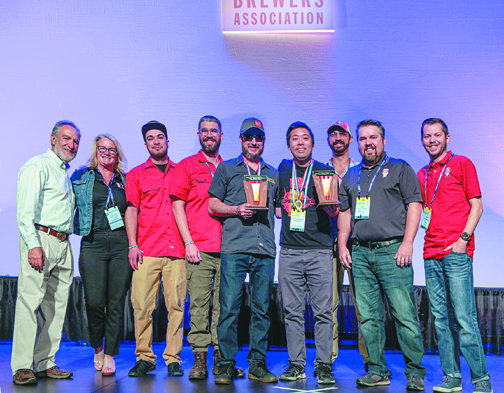
Comrade Brewing, located at 7667 E. Iliff Ave. in Denver, was named 2019 Small Brewing Company of the Year and Small Brewing Company Brewer of the Year by the Brewers Association at the awards ceremony held on Saturday, October 5, after receiving gold medals for two of its India Pale Ales, Superpower IPA and More Dodge Less Ram. These are the fourth and fifth medals the brewery has won since opening in 2014.
“We still can’t believe what happened at
the Great American Beer Festival,” said David Lin, Founder of Comrade Brewing
Co. “We always try to make the best beer we can and this year the judges
thought so too. We’re incredibly proud of the brewing team Marks Lanham and Rio
Urioste. It’s an honor to win small brewing company of the year and we’ll
continue to do our best here in southeast Denver.”
Gold Medals: Comrade Brewing Co. received gold medals for two of its India Pale Ales, Superpower IPA and More Dodge Less Ram.
The Small Brewing Company of the Year category is one of the most competitive as most breweries in the country brew between 1,000 and 14,999 barrels of beer per year. This is quite the achievement for a brewery which has a simple philosophy. “We make beer we like to drink and whatever is left over, we sell,” said Marks Lanham, Brewmaster for Comrade Brewing Co.
Superpower IPA was awarded a gold medal in
the American-Style Strong Pale Ale category, which had 131 entries. Superpower
IPA is an American IPA with loads of Pacific Northwest hops that lend huge pine
and grapefruit hop aroma and citrus flavors. Its bitterness is balanced with a
crisp, light malt character and is available year-round at the Comrade Brewing
tasting room.
More Dodge Less Ram, a triple-dry hopped
sister of Superpower IPA, took gold in the second most-entered category,
American-Style India Pale Ale, which had 342 entries. More Dodge Less Ram was
the first beer that Comrade brewed after a Dodge Ram plowed into the brewery
three years ago.
“I told David on August 25 we were going to
win this year,” said Lanham. “It’s been a challenging year for both of us.
David got married and had a child. I had less fortunate things happen to me.
When these things happen, it drives me to do better.”
A total of 322 judges from 18 countries do
blind tastes to evaluate the beers in defined style categories. This year,
2,295 breweries from around the country, Puerto Rico and the Virgin Islands
submitted entries. There were 9,497 entries overall.
Caskmates: Jameson has long celebrated the timeless pairing of whiskey and beer. This year, Jameson Caskmates Irish Whiskey is proud to be partnering with local craft breweries from across the U.S. to be part of the Jameson Caskmates Brewery Partner program. Each of these outstanding breweries has created a unique Jameson barrel-aged beer, inspired by their love of Jameson’s whiskey and their unique neighborhoods. Jameson had a big presence at GABF for the second year in a row featuring breweries using their barrels for brewing.
“This year’s GABF competition was the
largest and most competitive to date,” said Chris Swersey, competition manager,
Great American Beer Festival. “The beers and talent were as impressive as ever,
and we congratulate this year’s winners for their achievements in brewing.”
In addition to the medal winners, there are
standout and under-the-radar beers that by the end of the festival, word has
spread. 2019 was no different for these exciting, and at times, adventurous
beers. These reporters were successful in trying over 150 beers over the three
days of GABF, and the following beers deserve attention. While it is difficult
to rank them based on favorites, all of them were outstanding beers, and most
of them had large lines waiting to try them before the weekend was finished.
Local favorite WeldWerks Brewing Co. from Greeley, Colorado, always has a long line. They seem to have the most unique beers year after year at the GABF. Last year’s Spaghetti Gose was the talk amongst many of the patrons. This year would be no different. WeldWerks brewed yet another masterful concoction called Taco Gose. It tastes just like you would expect it to with those ingredients — Taco Sauce Beer. When it is served with a mini taquito, it tastes even better.
“For 2019, we knew we had to up the ante so
we took things a step further by partnering with the folks at Horsetooth Hot
Sauce in Fort Collins to create a completely unique hot sauce, based on their
venerable The Green Hot Sauce, but aged for an extended amount of time in a
freshly emptied Medianoche barrel,” said Neil Fisher Co-Owner, Head Brewer of
WeldWerks Brewing Co. “Immediately after the barrel was emptied, we used the
hot sauce barrel to age our Taco Gose, brewed with over 600 lbs. of fire roasted
tomatoes, sea salt, chili powder, paprika, oregano, onion powder, garlic
powder, and cumin. The result was Hot Sauce Barrel Aged Taco Gose, and it was
one of the first beers we kicked at all four sessions of GABF this year.”
WeldWerks is the most innovative brewery in this beer crazy state and it’s no wonder that they needed a GABF volunteer to manage the line for every session of this year’s event. In fact, the line was so long one evening, the fire marshal paid a visit to reroute how the line was formed.
“Fortunately, for those not as excited
about our savory sours, we had nine other beers available at the fest,
including four variants of Medianoche, our barrel-aged Imperial Stout,” said
Fisher. “According to Untappd metrics from GABF, three of the beers we poured
ranked in the top 10 out of more than 4,000 beers at the fest and all 10 of our
beers ranked in the top 150. We also finished the fest as the highest rated
brewery and the most checked-in brewery out of more than 800 breweries at the
fest. Those stats, coupled with the two medals we brought home from the
competition, make 2019’s Great American Beer Festival a tough one to top for
us.”
The next group of beers were complete surprises to these reporters and deserve to be mentioned with any award-winning beer that is found at GABF. Ology Brewing Co. from Tallahassee, Florida, brought the latest in their Juice Lab series. Ology rotates fruit for this series and this version had blueberries and raspberries in the brew. If you can imagine drinking a beer smoothie infused with an incredible amount of fruit, this is the beer you would crave. It is difficult to settle on a favorite beer of the entire festival, but this one is at the top. It is a fantastic beer and another brewery added to the must visit list.
Great Notion Brewing located in Portland, Oregon, had lines growing throughout the weekend. Blueberry Muffin and Sticky Bun were crowd favorites and as you stood in line to get their beers you overheard countless festival goers marveling at these two beers. Blueberry Muffin was perfect for anyone who was hoping to remember what a homemade blueberry muffin tasted like. Sticky Bun is an 11.3% ABV monster imperial breakfast stout with melted brown sugar, toasted pecan and cinnamon. It is almost like the sticky buns were fresh out of the oven.
Another beer on the list of notes was right there with Juice Lab as a favorite — Wake and Cake brewed by Burning Barrel Brewing Co. out of Rancho Cordova, California. This beer is a desert-inspired pasty sour loaded with pineapple, coconut, passion fruit, vanilla and marshmallows. A 9% beer that had so much flavor, it made you get back in line to try it again, and again to make sure you didn’t miss one of those flavors listed above.
Last but not least, remember in the ’70s when Coors was only sold west of Texas? The Tank Brewing Co. is following in their elusive footsteps, but in reverse. Their exceptional craft beer that’s brewed in Miami, is not currently available outside of Florida, so the GABF provides a rare window of opportunity for beer lovers to sample their award-winning liquid innovations. This included La Finca Miami (World Beer Cup 2018 Gold Medal winner).
Time To Get Silly: David Peterson, owner of the Bull & Bush Brewery, second from left, enjoys being silly with beer enthusiasts at The Great American Beer Festival on Thursday, October 3, 2019.
GABF never disappoints when it comes to
unique beers. And the ones listed here are just the beginning. If you do your
research, you can try so many different styles and types of beer. Don’t be
afraid to step outside of a comfort zone. If you are, you might just miss some
great beers.
Mark your calendar for 2020 as the 34th Annual Great American Beer Festival is set for September 24-26, 2020. Visit www.greatamericanbeerfestival.com for more information and for a list of all winners.
At a time when Coloradans are desperately
pleading for improved and new roadways the agency in charge of the same, the
Colorado Department of Transportation (CDOT), is mired in the greatest crisis
of its long-storied existence according to insiders.
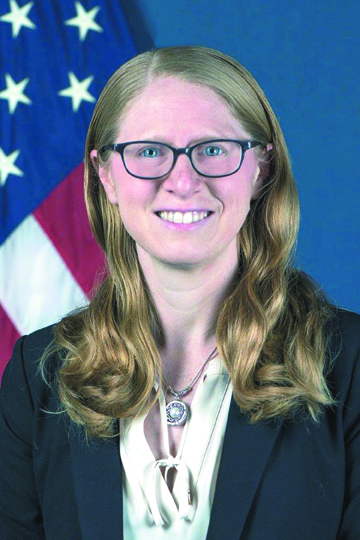
CDOT Executive Director: Shoshana Lew, a history major in college, became the head of CDOT at age 35 with no engineering or construction management experience due to political connections in Washington, D.C.
Formed in 1917 to administer state
government transportation responsibilities it long had the reputation for the
most competent and least politically comprised department in Colorado
government. Unfortunately, according to people who currently work with CDOT,
that is no longer the case.
Perfect Storm
The convergence of two events has turned
CDOT upside down. The first was the Orwellian named “Keep Jobs in Colorado Act
of 2013.” Previously under CRS Sec. 24-92-109 all public projects in excess of
$50,000 had to be “awarded by competitive bid.” The drawbacks to this method
include occasional “bid rigging” by competing contractors. In addition, so-called
“change orders” can drive up costs of a competitively bid project. But overall
this method, which was used for decades by CDOT, was the least subjective and
generally viewed fairest method to have projects completed at the lowest cost.
The 2013 act substituted the “lowest bid”
method with the so-called “best value” model in which bids come in as either
(1) Design Build; or (2) Construction Manager/General Contractor (CMGC). While
these techniques have various theoretical advantages, especially for unique
highly complex projects, including potentially cutting down the time to
complete a project, it is a highly subjective selection process with the
opportunity for corruption massively increased. To prevent cronyism and
exorbitant cost increases, it requires high expertise and absolute diligence on
the part of CDOT. What CDOT got was the exact opposite.
Shoddy Construction: The massive sinkhole on Highway 36 is but the most glaring example of shoddy construction by CDOT a little over five years after the bridge was built.
Washington Insider
In December 2018, Governor Jared Polis
appointed 35-year-old Shoshana Lew as his new Executive Director, a history
major at Harvard University with an M.A. in American History from Northwestern.
She replaced Governor Hickenlooper’s appointment of 56-year-old Michael Lewis,
an engineer with extensive public construction management experience. Lew’s
appointment was a shock to CDOT employees.
Lew’s primary qualification, according to
insiders, was her close relationship to Michelle Obama who called the newly
elected governor for a favor — find a job for Shoshana Lew. Lew is the daughter
of President Obama’s Chief of Staff and later Secretary of the Treasury, Jack
Lew. Ms. Lew is considered by some as an example of how the rich and well
connected can use their positions to secure favored treatment in and outside of
government.
While originally intending to get a
doctorate in history and become a history professor, she instead joined the
Washington based liberal Brookings Institute as a policy analyst. Almost
magically, although in her 20s with no experience, she entered the Obama
administration and soon became a senior adviser at the U.S. Department of the
Interior’s Bureau of Ocean Energy Management and policy adviser at the White
House Domestic Policy Council. With no financial background whatsoever, she
next was appointed Chief Financial Officer of U.S. Department of Transportation
(USDOT) as well as garnering other impressive titles.
Pomp And Circumstance: Shoshana Lew, age 29, arrives at the White House for a state function with her father Jack Lew, U.S. Treasury Secretary. She quickly rose up the bureaucratic ladder with the Obama administration. Image Credit: REUTERS/Yuri Gripas – stock.adobe.com
As the Obama administration began winding down, she parlayed her position as CFO of USDOT to become the Chief Operating Officer (COO) of Rhode Island Department of Transportation (RIDOT) in the spring of 2017. After a controversial reign as COO for RIDOT of just over one year she was appointed Executive Director of CDOT in December 2018 by Governor Polis — a job, according to CDOT employees, she was wholly ill prepared for. CDOT employs over 3,300 people and has an annual budget in excess of $4.5 billion.
Are Our Darn Roads Even On Her List?
On October 7, 2019, Lew gave an interview
with Colorado Public Radio to discuss her job as Executive Director. A
horrified listener, Jane Glenn of Sterling, wrote to the South Platte Sentinel:
Basically, she’s bike lanes, big buses,
walking paths, light rail, and electric cars.
Are our darn roads even on her list?
The answer is, of course, no. She is a
history major with no background in engineering or construction management.
But, of course, there are plenty of people in and outside of CDOT who have
years of experience in both of those fields and with the hen house opened up
with a largely clueless Executive Director and the CMGC bidding process easy to
abuse, they rushed to take advantage.
Revolving Door
CDOT has had a massive exit of its top
personnel, all of whom have left once they became eligible for early retirement
with PERA benefits. They joined consulting firms who now have overtaken the
jobs, including design, testing and inspection, that CDOT once performed
internally. If you have a firm for any such functions and are not heavily
filled with former CDOT employees, you are highly unlikely to be contracted
with CDOT.
I-25 Congestion: In interviews Lew has evidenced little interest in improving existing roads or the building of new roads in Colorado, notwithstanding Colorado failing to keep up with the massive influx of new residents over the last decade.
In theory under the CMGC method, the owner
has a different construction manager and general contractor, but not in
Colorado, where the functions are combined with one more check and balance
disappearing. CDOT no longer has enough civil engineers to begin the design
process to start a project and must hire a design firm filled with former CDOT
employees. The design firm often works with CMGC entities on other projects, so
each has every reason not to cut costs or bring up any areas of conflict of
interest to the attention of CDOT.
The CMGC bidding process for a CDOT project
is supposed to be competitive, even if highly subjective. However, local
construction firms have ceased to enter the process since only one of two
national and international firms are chosen for any important project. The two
firms are Kraemer North America who is owned by Obayashi Corporation, one of
Japan’s largest construction firms, and Kiewit Corporation, a Fortune 500
contracting firm based out of Omaha, Nebraska. Over 75% of the $3.2 billion in
recent CDOT contracts have gone to these two firms with the percentage ever
increasing.
The 2013 law which mandated the change in
bidding, the “Keep Jobs in Colorado Act,” has essentially ensured that Colorado
firms and their employees are almost never hired, except for smaller CDOT
projects that Kraemer and Kiewit are not interested in. There is one group of
Colorado residents that has handsomely profited from the new regimen and that
is the scores of former CDOT employees who have joined the dozens of consulting
firms hired by CDOT. Not only are they scoring six figure salaries, but are
also enjoying their PERA benefits, essentially doing the same job they did at
CDOT at a fraction of the remuneration. CDOT itself evolved into little more
than an admin organization and, in part, that too will be outsourced over time,
although the CDOT state budget is not expected to diminish.
Added Cost
It is estimated that the excess profits by
Kraemer and Kiewit, and the tens of millions of dollars paid to consulting
firms filled with ex-CDOT employees, adds as much as 30% to the cost of every
CDOT project and that percentage is expected to grow in coming years. It is
questioned why Colorado taxpayers would want to pay more taxpayer money to a
department as corrupt and inefficient as CDOT which is headed up by an
individual as uninterested in roads as Shoshana Lew.
Personal Favor: Governor Polis reportedly appointed Shoshana Lew as the Executive Director of CDOT as a personal favor to Michelle Obama. Jack Lew, the father of Shoshana Lew, was the Chief of Staff to President Obama as well as later his Secretary of the Treasury.
As for Ms. Lew she has not only garnered
the disrespect of the people she oversees, but her ineptitude has reportedly
angered at least some of the 11 commissioners from across the state who oversee
CDOT. Her job is apparently safe, however, unless and until Governor Polis
cares enough to stop the total destruction of, what once was, one of the most
respected government agencies in Colorado.
In Part II of this series on CDOT we will review individual projects that CDOT has undertaken in recent years including the infamous Highway 36 sinkhole and why taxpayers can expect more shoddy workmanship and massive cost overruns.
The original article mistakenly indicated that CDOT has 330 employees. The number is actually 3,300. A zero was inadvertently omitted.
Court records obtained by Glendale Cherry Creek Chronicle
detail how Biological Resource Center (BRC), a willed body donation company
headquartered in Arizona, illegally brokered infected body parts for profit.
FBI Raid: A former Arizona body donation center is facing multiple lawsuits after an FBI raid revealed body parts piled on top of each other, a cooler filled with male body parts and a head sewn onto another body.
Four years ago, the families who donated their loved ones to
BRC filed a civil lawsuit alleging that BRC misled some customers to believe
that their deceased would be left intact after donation. Instead, BRC dismembered
the bodies and sold the parts across domestic and international borders. The
lawsuit is ready to stand trial in the Maricopa County Superior Court on
October 21.
One invoice recorded the sale of two heads for $500 apiece
to a medical school in Israel. On another, a pair of shoulders went to Athens,
Greece, for just $300. Someone’s arms made their way into a surgical workshop
for $750.
This happened to families in Arizona, Michigan, and
Illinois.
“It’s really body snatching without them having to dig up
the graves,” Michael Burg, a Denver-based attorney representing eight of the
plaintiffs, said in a press release about the case. “[BRC] lied to them.”
Background
The initial FBI investigation began in 2013 after officers
in Houston caught wind of International Biological, Inc. (IBI), a body
brokerage, shipping body parts across the southern border. State agencies
recovered thousands of bodies and dozens of boxes of records from IBI’s offices
in Michigan. Those records also implicated BRC and Anatomical Services, Inc.
(ASI) in the crime.
Body Parts: Agents found “infected heads,” a small woman’s head sewn onto a large male torso and hanging on a wall “like Frankenstein,” and body parts stacked on top of one another with no identification tags. (Courtesy of YouTube)
After a lengthy investigation, it was determined that the
three companies had been acting as one since at least 2008, when it began
selling body parts to international clientele.
As a brokerage, the business marketed itself as one that
didn’t sell infected parts. But, the investigation found that it made most of
their money from bodies of people who suffered from sepsis, hepatitis B, C, and
HIV, even when family death records explicitly stated so.
BRC’s warehousing process exposed much of its inventory to
cross-contamination. A deposition from one of the FBI officers who raided BRC’s
Arizona office revealed that body parts were often organiz-ed by limb after
they were dismembered with infected parts mixed with clean ones.
Customers were never given access to any of the death
certificates, medical records from donors, or medical social history
questionnaires administered by BRC among caregivers or next-of-kin. If a
customer found out the body they purchased was infected, BRC would offer to
sell the body at a discounted rate in order to ensure the sale.
This is not the first time BRC owners Stephen and Sally Gore
have been in a courtroom over their business practices. AZCentral reported that
Stephen Gore had pled guilty to federal charges for the illegal use and sale of
human body parts in 2014. He was sentenced to four years in prison, but served
no time because of good behavior.
“Placement” And “Matching”
BRC also told donor families that they treated the deceased
with dignity and respect. They offered services like the recovery of and
“placement” and “matching” of tissue with scientists and medical researchers to
unsuspecting customers. They printed details of these services in brochures and
pamphlets that were given out in their offices.
To an untrained ear, this language sounds as if the deceased
will be kept intact during transportation. But, as one customer who worked in
the non-profit organ donation industry noted in her deposition, the terms
“placement” and “matching” are code words for dismemberment.
“These words are meant to disguise the fact that BRC was
helping medical providers find organ donors even after body donors asked them
not to,” she said.
That customer’s mother came to be known as BRCIL-2013164.
Her whole body was sold to IBI for $5,000 because her body contained hepatitis
B. It was later dismembered and shipped on an international course.
Lawsuit Filed: A lawsuit has been filed around what Denver-based law firm Burg Simpson has long called the “body parts case,” involving families who unwillingly and unknowingly donated their loved ones to a body donation program set up by the Biological Resource Center, Inc. in the U.S. under the false pretense of furthering medical research.
Will Power
Typically, an individual’s last will and testament dictates
how their body will be disposed of after death. However, enforcing the power of
wills can be tricky because it falls under the broad domain of gift law.
According to the Clinical Journal of The American Society of
Nephrology, the primary law governing organ donation in the United States is
the Uniform Anatomical Gift Act (UAGA). UAGA was enacted as a part of the
Uniform Codes, which are passed from state to state.
UAGA is “uniquely designed to support the system of
transplantation” in that it “excludes [transplantation] from the federal
prohibition, and because the donee of the anatomic gift is the transplant
recipient, such payments do not abrogate the legal construct of organ donation
as a gift.”
A key aspect of the law is consent, which differs from what
doctor’s refer to as “informed consent.” Organ donors must consent for their
organs to be harvested for transplants, which is as simple as having “ORGAN
DONOR” on your driver’s license.
On the other hand, doctors are required to gain informed
consent before treating a patient. Informed consent describes the process of
discussing the risks and benefits of all available means of treatment with a
patient. Since body donations don’t include the element of risk or benefit to
the deceased because the transaction occurs after death, therefore, informed
consent is not necessary.
BRC prepared questionnaires for customers asking if they
wanted the deceased’s body organs to be placed and matched. However, those
services didn’t only extend to those who marked “YES.”
Arizona has an especially lax enforcement system for these
laws, which helped make it one of the nation’s hotspots for whole body
donations. The entity in charge of overseeing these companies, Arizona’s State
Health Department, focused its resources on combatting the opioid crisis
instead of cracking down on illegal organ harvesting, according to an AZCentral
report.
In contrast, Colorado has strict laws governing the
operation of body donation companies and funeral homes, both of which are
regulated under the same statutes. For starters, someone who owns a funeral
home cannot simultaneously own a body donation company. Colorado also requires
owners of either company to maintain records of where human remains are
distributed.
Nearly 4,000 people — approximately seven percent of the
state’s population — are whole body donors. That is roughly five-times the
national average, the Illinois-based Cremation Association of North America
says.
This ecosystem helped BRC expand its territory across the
Atlantic.
BRC made little effort to conceal its business dealings,
according to the court documents. Potential customers would contact BRC’s
office in Illinois. If that location didn’t have the requested body parts, Gore
provided the body part from Arizona. Records for all of the transactions were
stored in each of the company’s offices.
To Burg and the other lawyers representing the plaintiffs,
the case does not question organ donation as a whole. It asks if the consent of
the dead matters as much as the will of the living.
“If someone says we’ll pay for expenses and cremation and
your loved one’s body will go to specific places (to help cure diseases), you
are pretty much going to say, ‘Sure, why not?’” Burg told AZCentral. “Am I
saying none of these places are legitimate? No. But there have been a sufficient
number of cases where misrepresentations have been made. There’s a price list
for everything from a head to a shoulder, like they are a side of beef. They
make money, absolutely, because there’s no cost in getting the bodies.”
Following a 17-year career, City Manager for the City of
Glendale Jerry Peters has announced his retirement effective October 31, 2019.
Peters was appointed by the Glendale City Council in 2004 after serving as
Deputy City Manager under then City Manager Cliff Dodge for two years. Peters
holds the record as longest tenured City Manager in Glendale history (15
years), surpassing Gary Sears (1985-1987) by three years. Peters has assisted
in overseeing big changes in the landscape of the city.
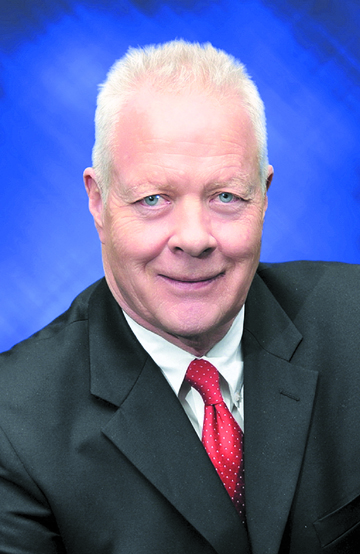
Retiring: Jerry Peters, City Manager of Glendale, announced his retirement effective October 31, 2019. Peters has been with the city since 2002.
The completion of Infinity Park along with the addition of a
professional rugby team; the construction and opening of the Glendale Sports
Center; Glendale CitySet; the expansion of Glendale’s Super Target as well as
the massive remodel in 2019; redevelopment of King Soopers; and the
extraordinary beautification of Cherry Creek Drive South, are a just few of the
major projects that occurred during his tenure.
“Jerry has played an important role in what I call the
Vatican of Freedom,” said Glendale Mayor Mike Dunafon. “His influence in
helping to build this city to what it is today is something we will be forever
grateful.”
Peters has also seen tragedy under his watch. Two fires, 11
years apart, are among them. One person perished in the fire at Spanish Gate
apartment complex in December 2003. The other fire was at Solana Apartments
(now Amli) in 2014, which only generated minor injuries. “Jerry’s handling had
a sense of calm and a steady and professional approach to both situations,”
said former Glendale City Councilmember Ricky King. “He was able to deal with
the media, the residents, and the business community with poise and grace.”
BBB: Jerry Peters cuts the ribbon for the Bed Bath and Beyond store that moved from Cherry Creek North into Glendale in 2017. Peters was witness to much change during his 15 years as City Manager of Glendale.
Peters’ relationship with current Mayor Mike Dunafon dates
back to Dunafon’s high school days at Golden High School where Peters was his
football coach. “I’ve known Jerry essentially my entire life,” said Dunafon.
“The life lessons I learned from him while I played football for him in high
school are still applicable today.” Little did Dunafon know as a high school
teenager in the early ’70s, they would be working together as Mayor and City
Manager decades later.
Mayor & Manager: Jerry Peters, pictured with Mayor Mike Dunafon, shortly after Peters became City Manager of Glendale. Peters and Dunafon’s relationship dates back to when Dunafon played football at Golden High School.
Peters’ history with Glendale predates his days as Deputy
City Manager and City Manager. He helped launch the Greater Glendale Chamber of
Commerce in 1999, operating out of the attic of the old Loews Hotel. He fondly
remembers meeting with prospective members in the lobby of the hotel or in
Tuscany, the restaurant off the lobby.
In addition to his duties as the first Executive Director of
the Chamber, he was the production assistant for the Glendale News. “In the
early days of the Glendale Cherry Creek Chronicle (then Glendale News), Jerry
was of great help in transforming the publication from a four-page black and
white limited circulation paper, to what would become the dominant voice in the
Cherry Creek Valley,” said Charles Bonniwell, Publisher of the Glendale Cherry
Creek Chronicle. “All of us will miss his steadying hand in the growth and
prosperity of Glendale.”
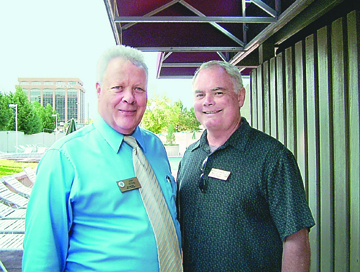
Chamber Executives: Jerry Peters, right, is pictured with Mark Smiley, far left, and Jeff Allen. All three have served as executives with the Greater Glendale Chamber of Commerce.
Dating back further, Peters helped put together the Denver
Broncos broadcasts on KOA Radio from 1978 to 2003. Peters grew up in Ogallala,
Nebraska, and graduated from University of Northern Colorado in 1967. He then
became a teacher and football coach at Golden High School until 1972, when he
became the Director of Public Relations for Colorado School of Mines.
Peters served as a Staff Sergeant in the U.S. Air Force
during the Vietnam era. He was stationed at Myrtle Beach, South Carolina, from
the early to mid-’60s.
Linda Cassaday, who has been Deputy City Manager under
Peters, was named Acting City Manager by the City Council and she will assume
Peters’ duties on November 1, 2019. “Jerry has been an incredible mentor to me
during my time with Glendale,” said Cassaday. “He displays compassionate
leadership every day in his dealings with City employees, City Council, and the
public; and he will truly be missed by us all.”
Manager & Police Chief: Jerry Peters hired Joe Haskins as Police Chief in 2013.
Chuck Line, who will continue his role as Deputy City
Manager and Community Development Director, has worked with Peters the longest.
“Jerry’s leadership over the past 15 years implementing Mayor Dunafon’s vision,
has ushered in an era with Infinity Park, a thriving commercial environment,
and a revitalization of our housing stock,” said Line. “His presence will be
missed, but his accomplishments will not.”
Riding Off Into The Sunset: Jerry Peters and wife Liz plan to travel and spend time doing the things they have been unable to do while Peters was City Manager.
Peters and wife Liz plan to enjoy retirement to its fullest
by traveling and doing things he has been unable to do while serving as City
Manager.
In June 2019, a neighborhood group, Rename St*pleton for
All, launched a campaign to change the name of the Stapleton neighborhood due
to former Denver mayor Benjamin Stapleton’s affiliation with the Ku Klux Klan.
On Monday, August 19, 2019, property owners
overwhelmingly voted against the name change.
Landslide Victory: By a 2 to 1 margin, Stapleton property owners voted to keep the name Stapleton for their neighborhood.
Of the 10,550 eligible voters, 3,590 people cast their vote,
a 34% turnout. Sixty-five percent of the property owners around the land once
occupied by Stapleton International Airport voted to keep the name which many
felt was surprising due to the amount of publicity the name change had
received. “I understand why people would want to change the name but, in the
end, I voted to keep it as is because where does it end?” said Tara Johnson,
property owner. “This is my neighborhood and I am proud of the name.”
“I was trained as an historian,” said Harold Scramstad in a
statement to the Stapleton Front Porch. “If we start holding everybody in the
past to the almost unreasonable standards that we’d set for ourselves, almost
nobody is going to measure up. We should keep the name and invest it with all
the qualities that we want a community to be — that 100 years from now, people
will say, “Stapleton, that was the experimental community that really worked
very hard to get it right.” Not, “There’s a community that in a smug or
self-satisfied way thought it was solving its problems of the future by
changing its name, because that didn’t really change anything.”
The Stapleton Master Community Association (Stapleton MCA)
oversaw the election and indicated that the amount of voters nearly tripled the
usual turnout. “We are disappointed and saddened by these results, but we are
not especially surprised,” Rename St*pleton For All, said via Facebook. “Our
work is not done. We love our neighborhood, and we invite all supporters to
join us in doing the work to make our community one that truly welcomes and
includes all.”
Stapleton served as mayor during the 1920s, ’30s and ’40s
and appointed Klansmen to lead the police department and other city offices
after his election to office in 1923 and to fight off a subsequent recall
effort. But by 1925 he opposed the Klan and helped destroy its political
influence in Denver and Colorado. “People seem to forget that Mayor Stapleton’s
ties to the KKK were short-lived and he championed the eradication of them soon
after he was elected,” said Tim Miller, property owner. “All of the good that
Mayor Stapleton did seems to have been erased from history.”
Former Mayor: Benjamin Stapleton was a five-term mayor in the 1920s, ’30s, and ’40s. His brief affiliation with the Ku Klux Klan has had some activists demanding a name change.
The charge to change the name of the neighborhood dates back
a quarter of a century. When the old airport was leveled in the 1990s and
Denver International Airport opened, the neighborhood formerly occupying
Stapleton Airport was named Stapleton. Backlash over the name dates back to
this time and was revived in 2015.
Even though this name change was rejected by voters, the
campaign has had an impact in other areas. In 2017 and 2018, the Rename
St*pleton for All group was successful at having organizations drop the name
Stapleton from their organization. The Stapleton Foundation became The
Foundation for Sustainable Urban Communities, the former Stapleton Development
Corporation now only uses the acronym SDC, and the Stapleton Citizens Advisory
Board is now just the Citizens Advisory Board.
Those efforts have continued into 2019. Earlier in August
2019, Denver Parks and Recreation agreed to rename the Stapleton Recreation
Center in Globeville, and this spring, the name of the Denver School of Science
and Technology’s original campus changed from DSST Stapleton to DSST Montview.
Not all efforts of having organizations change their name
have been successful. In May 2018, the SUN board asked Stapleton residents to
vote on whether to change the RNO’s name from “Stapleton United Neighbors” to
“Central Park United Neighbors.” A 66% vote in favor was needed and it fell
short by eight percentage points.
The vote cast on August 19, 2019, needs to be ratified by
the Stapleton MCA Board of Directors. Brookfield, the master developer has the
ability to veto the board’s decision, but it is unlikely they will go against
the vote.
Stapleton: Stapleton is a neighborhood located northeast of downtown Denver, on the site of the decommissioned Stapleton International Airport, which closed in 1995. Now referred to as the Stapleton Community, it contains nine neighborhoods, nine schools public/ private, 50 parks, several shopping and business districts, and a visitor center.
“For an entire generation, Stapleton was an airport — it did
not cause racial issues,” said Richard Caldwell in a statement to the Stapleton
Front Porch. “It was the place the Space Shuttle landed on a 747; the Beatles,
Nixon, and The Rolling Stones landed. We all lined the fences to watch planes
come and go, people from all backgrounds and races — and we got along fine.”
Bikes vs. Scooters: Some Denver commuters, including bicyclists, are concerned that scooters will create even more traffic on already congested streets.
Scooters have become an alternative to cars for many people,
especially city residents with quick commutes. In 2018, Denver made over a
thousand electric scooters (e-scooters) publicly available to citizens via
companies such as Bird and Lime. Since, scooters are becoming an increasingly
popular mode of transportation. With their increasing popularity lies a traffic
jam and possible safety issues on sidewalks. Denver Public Works is considering
a city ordinance that will ban e-scooters from sidewalks and allow them to be
legally operated in the bike lane. This legislation has Denver citizens
expressing polarizing viewpoints regarding where the scooters should operate.
While some residents are in favor of scooters scooting left to the bike lanes,
other citizens are opposed and offer their own safety concerns.
After reviewing citizens’ expressed opinions about the
scooter program, Denver Public Works is considering the ordinance in an effort
to increase the safety of people both on and off the scooters. With the recent
influx of public scooters, insurance has had little time to catch up.
“Currently, there is no mandatory liability insurance that e-scooter riders
need to carry,” Daniel Foster of Foster Graham Milstein & Calisher, LLP
informed Glendale Cherry Creek Chronicle. This leaves potential victims of
scooter riders with little recourse to retrieve compensation for injuries.
This and other factors prevail while Denver Public Works
carefully considers solutions. When speaking with the Chronicle, Public Works
Chief of Staff Nicholas Williams expressed that, “the main benefit of this
ordinance change is that it will minimize instances of scooter/ pedestrian
conflicts.” Williams went on to say, “the most common complaint I receive from
residents involves a scooter rider traveling at a high rate of speed and
endangering a pedestrian.” E-scooters can reach a speed of 15 mph.
Popular Mode Of Transportation: Last year, e-scooters zoomed past station-based rental bikes as the most popular form of shared “micro-mobility” transportation, with rental companies like Lime and Bird renting 85,000 e-scooters across the country, according to the National Association of City Transportation Officials.
This isn’t the first time legislation has been proposed for
the e-scooters. Former Denver Councilperson Mary Beth Susman sponsored the
original bill banning scooters from sidewalks. Susman admitted she was unsure
as to what this new ordinance offered but ventured a guess that it would “get
rid of” the stipulation of the original bill that stated scooters could use
sidewalks if posted speed limits exceeded 30 mph. This would seem to be the
case, as the new ordinance proposes a total ban of e-scooters from sidewalks.
Most Denver residents who spoke with the Chronicle were in
favor of the bill. Denver resident Carson Cameron expressed that scooters “clog
up the sidewalks” and hinder accessibility for people who utilize wheelchairs.
If scooter riders used the bike lanes, it would provide more accessible space
to move around. This sentiment was echoed by fellow resident, Sarah, who also
utilizes a wheelchair. E-scooters are technically still allowed on the sidewalk
if riders are traveling less than 6 mph, and their use can limit available
space for people with physical disabilities or limitations. In highly populated
areas such as downtown and Denver University, this is a concern.
Another pro of e-scooters being relegated to bike lanes is
that more citizens may be encouraged to ride their scooters, thus reducing car
emissions such as smog and other air pollutants. This is the case for resident
Jenn Vaught. “I would ride more,” Vaught responded to the Chronicle when asked
about the ordinance. Car emissions directly impact the ground ozone level and
reduce air quality. This affects everyone, particularly people who are older or
have asthma or other breathing concerns. During summer months, air quality
alerts frequently report moderate to unhealthy levels of air quality.
E-scooters may not be appreciated on sidewalks, but safe operation in bike
lanes may improve the air we breathe.
The ordinance should also ensure scooters remain in
congruence with other transportation and vehicle laws, which is important to
some Denver citizens. This was confirmed by Public Works Chief Williams who
said, “it will simplify the rules of the road to mirror those of bicycles,
which most people are already familiar with.” Resident Brenna agreed with the
idea of scooter riders following similar laws to cyclers and voiced concern for
people who operate the scooters intoxicated. If e-scooters were held to similar
standards as other vehicles, then citizens can better understand the
regulations of operating the transportation devices.
Readily Available: Companies such as Lime have electric scooters publicly available to riders in Denver.
Not all Denver residents are in favor of scooter legislation
and have their own safety concerns if e-scooters are permanently banned from
sidewalks. Some Denver commuters are concerned that scooters will create even
more traffic on already congested streets. A negative of the bill expressed by
citizens is that strictly relegating scooters to bike lanes and roads may cause
an increase in vehicle accidents. The scooters have been known to cause
accidents and most recently, a person died in a scooter related accident on
August 4, 2019. The victim, Cameron Hagan, was struck by a car while attempting
to cross the street on a scooter. He marks the first scooter-related death in
Denver.
Some citizens feel e-scooters may simply be too slow to keep
up with traffic flow. But research shows this may not be the case. Bike riders
average around 12 mph in city bike lanes, which e-scooters can exceed. This
would mean that scooter riders can at least keep up with typical bike lane
traffic flow. But some cyclers don’t want the extra traffic. “I just think it’s
already too congested,” Denver resident Michael Lewis said. Michael expressed
frustration when commuting around the Park Avenue area. “The scooters would
only add to that,” he concluded.
E-scooter riders who litter pose another concern. Although
leaving a scooter on the sidewalk unattended is not allowed, many people do it.
It contributes to clogging up the sidewalks and hindering accessibility,
mentioned prior. If scooter riders were banned from sidewalks permanently,
there could be an increase of scooters left in bike lanes or in traffic, which
again could lead to an increase of motor vehicle accidents.
While the ordinance to ban e-scooters from sidewalks is
well-intentioned and for many, long overdue, other Denver citizens pose
practical questions to the logistics of adding another transportation device to
the bike lane. There are numerous positive aspects of riding e-scooters
including but not limited to decreased pollution, and increased sidewalk
accessibility. But there are also cons such as increased road traffic and
increased accidents. Regardless of where individual Denverites stand, the
consensus on both sides is safety first. The safety of citizens on the road
should not be compromised for the safety of citizens on the sidewalk and vice
versa. Citizens for and against the bill want to feel safe, and they want
others to feel and be safe as well.