
by Mark Smiley | Oct 20, 2023 | Uncategorized
by Mark Smiley
 The 14th Denver Rare Beer Tasting was held on Friday, September 22, from 12 p.m. to 4 p.m. at the McNichols Civic Center with 63 breweries pouring some of the hardest to find beers on the planet. Pints for Prostates sponsored a free health screening before the event, which is a five minute blood test valued at $700.
The all-inclusive ticket included four hours of beer sampling, the opportunity to meet the people who brewed them, buffet lunch, collectible tasting glass, t-shirt, and program.
The brewery roster this year had many fan favorites from the previous 13 events, along with 22 first-timers and one other that previously only participated remotely during COVID. This year breweries from 24 states participated, including 18 from Colorado. The beers poured at the Denver Rare Beer Tasting represented a range of styles and many represented one-time small production runs or the last remaining supplies of a noteworthy brew.
“Not only is the event a chance for beer fans to get to try limited edition beers, it is an opportunity for them to take charge of their health,” said Rick Lyke, founder of Pints for Prostates. “The generosity of the participating breweries enables Pints for Prostates to reach people through the universal language of beer with an important health message. We’ve been able to provide free health screenings for thousands of men over the years because the craft beer community has made the Denver Rare Beer Tasting an annual celebration of beer passion.”
“We created the Denver Rare Beer Tasting to be a special experience for beer fans and brewers, with a mission,” said Lyke. “This is not only one of the top annual craft beer events in the country, it’s also a time to remind people about the importance of early detection in fighting prostate cancer. A simple blood test in 2008 saved my life and we want guys to understand that paying attention to regular health screenings can help them to take charge of their health.”
Learn more about Pints for Prostates and how they use the funds they raise by visiting pintsforprostates.org. The website has a transparency page that provides details on the 501(c)3 charity, including complete IRS filings.

by Jessica Hughes | Oct 20, 2023 | Uncategorized
by Jessica Hughes
In the mid to late 1800s, gold and silver are what brought people to Victor, a historic mining town located outside of Cripple Creek. But now another treasure brings visitors to this small mining town, only you don’t have to dig underground to find it.
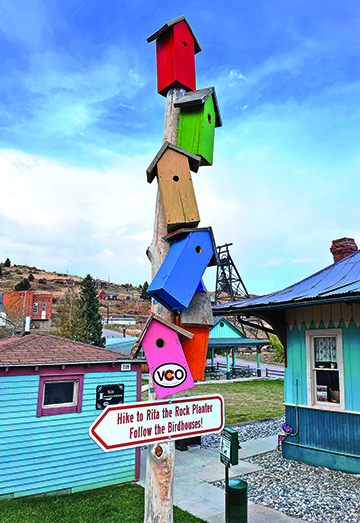
Colorful birdhouses guide the way to Rita.
A larger-than-life troll, Rita the Rock Planter, by Danish recycle art activist, Thomas Dambo, has made its way to Victor. Dambo, who refers to himself as a “recycle artist,” believes in turning trash into art and uses recycled materials to make his famous trolls.
Rita is now one of 119 trolls found all over the world, melting the hearts of the young and old with their charming faces and playful demeaner. Dambo and his crew, plus volunteers who often travel long distances to help build these whimsical sculptures, build the trolls using local scrap wood and recycled materials, placing them amongst nature to naturally die out and return to the earth’s soil. He uses these materials to show the world how much potential and beauty lays hidden in our trash.
All in a span of 12 days, it took a crew of 100 local volunteers, Dambo himself, and his crew to finish Rita the Rock Planter. But Rita wasn’t Colorado’s first troll sculpture. In 2018, “Isak Heartstone,” a 15-foot troll made of foraged sticks and recycled wood, was installed by Dambo and his team on the outskirts of Breckenridge. Isak garnered so much attention and love from visitors, the local residents resisted its newest resident who brought in excessive foot traffic. After much debate, the city council made the decision to relocate the troll near the Illinois Gulch trailhead.
So far, Rita’s presence hasn’t caused any problems, in fact she’s brought in nothing but love and affection from locals and visitors alike. The town of Victor has accepted Rita with open arms by thoughtfully placing colorful birdhouses throughout its downtown streets, guiding the way to the trailhead. Her location is even sketched on the town’s map and her picture has been added to Victor’s welcome sign on H WY 67 — making it nearly impossible to miss Rita.
Visitors can find Rita gathering rocks atop the Little Grouse Mountain Overlook. There are two parking lots at the trailhe
Rita the Rock Planter is the 119th troll artist Thomas Dambo has built.
ad, a lower and an upper lot. To hike the full one-mile loop, start at the lower parking
lot, or begin at the upper lot for a shortened version of the hike. You’ll know when you’re there with old mining relics of the American Eagle Mine at the trail’s entrance and the story of Rita welcoming you — “A hundred suns, that is how long a nap is for a troll. When Rita woke again, her mountain side has grown a hole. The humans must have dug them in their search for shine rock. But someone could fall in, so Rita went to tidy up.”
To see where all of Dambo’s trolls live, X marks the spot
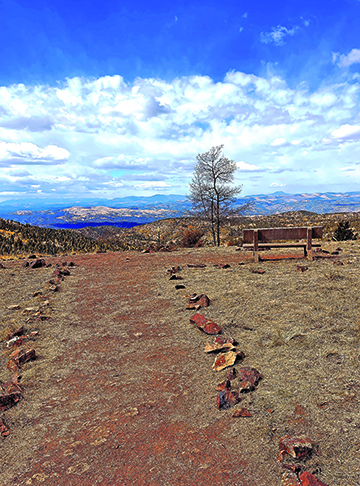
Views from the Little Grouse Mountain Overlook.
on his Troll Map. Learn more about Dambo and trolls visit thomasdambo.com.
All images by Jessica Hughes
by Mark Smiley | Jul 28, 2023 | Uncategorized
By Akilah Graham
The Colorado Option was sold by politicians in Denver and other advocates on promises of increased savings. I, along with so many other Coloradans, waited anxiously as the new system was passed and implemented. Today, we’re still waiting and wondering: where are the Colorado Option savings?
I am troubled by what I’ve seen as the Colorado Option has been implemented. The State-backed health plan is failing to deliver the savings that were promised. But even more concerning, the Colorado Option is actually leading to increased costs and is decreasing access to the high quality coverage and care that Coloradans depend on. The Black community has long struggled to see or benefit from savings promised in our health care system. I never considered whether I’d have to ask if the Colorado Option is making things worse.
Industry experts recently conducted a study that shows non-Colorado Option plans are the most affordable for the vast majority of Coloradans. In fact, non-Colorado Option Plans are the lowest cost on-exchange plans in 60 of 64 counties for the bronze tier, and 54 of 64 counties for the important silver tier.
Not only is the Colorado Option failing to deliver savings, but it is also driving insurance providers out of the state. The Colorado Option employs premium reduction targets, which mandate that insurance providers reduce their premiums; in other words, price controls.
The 2023 premium reduction target was five percent, which 85 percent of Colorado Option Plans offered in the individual market failed to meet. Naturally, insurance providers and industry experts are concerned that even more providers will be unable to meet next year’s 10 percent reduction target.
Instead of trying to meet unrealistic price controls or pricing their plans at unsustainable losses, several prominent health insurance providers had to pack their bags and exit the state’s insurance marketplace. Insurance providers simply can’t afford to meet these reduction targets.
On top of the premium reduction targets, additional restrictions enforced by the Division of Insurance will make it nearly impossible to attract new health insurance providers to the state. And Colorado patients and consumers are the ones who will suffer from the lack of competition.
Like so many government-controlled health care systems, the Colorado Option is dependent on health care providers accepting reduced reimbursement rates for the care they give. But Colorado as a whole is already suffering from a terrible health care provider shortage. Disadvantaged and marginalized communities are feeling the effects the most. Lower reimbursement rates will force health care providers to choose between passing increased costs onto patients (who likely can’t afford it), or cutting high-cost services – and some will be forced to close altogether. It goes without saying that it will make it next to impossible to attract new doctors and other health care professionals to replace them. Any system that continues to drive provider shortages is bad news for Colorado patients.
The primary question – “where are the Colorado Option Savings?” – is only the first one that comes to mind; this year’s implementation now leaves us with many additional concerns. Instead of seeking to double down on the failed Colorado Option in 2024, lawmakers should take the time to study what went wrong, in an effort to determine how best to deliver high-quality, affordable coverage and care to Coloradans across our great and diverse state.
Ms. Graham is one of the founders of the Colorado Black Arts Festival and a leader in numerous community and religious organizations.