by Jessica Hughes

New gathering areas were added to the pedestrian corridor to encourage a social atmosphere.
The 16th Street Mall gets a revamp and rebrand as part of a $175 million project. But as the project nears its completion, will this much-needed makeover resurrect a once “ghost town” in the middle of the Mile High City?
Since roughly 2019, the 16th Street Mall has developed a reputation for crime, high rent prices, and dwindling crowds, becoming a shadow of its former self. What was once a bustling pedestrian promenade lined with packed restaurants and steady foot traffic had turned quiet — abandoned storefronts, growing concerns over safety, and a pandemic-era slowdown left locals and tourists alike steering clear.
Now, the Mile High City is betting big with a $175 million renovation and rebranding project to bring the street back to life. As the extensive renovation project nears completion this fall, the city isn’t just rebuilding a street — it’s rebranding it, hoping to shift perceptions, welcome back businesses, and offer Denverites a public space they can safely enjoy.
The project, which broke ground in April 2022, spans from Market Street to Broadway on 16th Street, with the full project set to complete this fall. The city’s hope is that the reimagined space will show off 16th Street as a hub for live music, outdoor recreation, sports culture, sidewalk sales, and more.
Britt Diehl, Senior Director of External Affairs and Marketing at the Downtown Denver Partnership (DDP), says it’s all about creating an experience. “Highlights of the renovations include an installation of new granite pavers in a similar rattlesnake design by renowned architect I.M. Pei to what was previously on the corridor, but with better drainage and greater surface friction to improve pedestrian safety,” says Diehl. “Plus, moving transit lanes to the center of 16th, eliminating the median that runs between the buses on some blocks and creating wider pedestrian walkways and new amenity zones for leisure, commerce, entertainment, and tourism. And expanding the number of trees on 16th from about 150 today to more than 200 at completion with a variety of species offering varying degrees of shade and color throughout the year.”
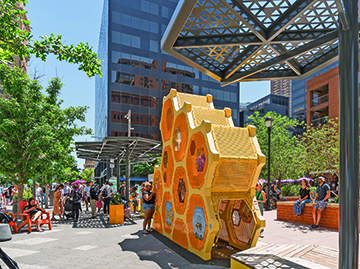
A beehive climbing structure, between Larimer and Lawrence, is just one of many new additions to 16th Street’s upgrade.
Other improvements meant to foster a sense of community and updated public gathering spaces also include more than 20 new patios installed near 16th Street businesses. Plus, new experiences and family-friendly amenities including the Howdy Trouty — three “climbable” trout, including one donning a western “troutfit!,” a beehive-themed children’s climbing structure, and many other interactive and artful installations.
“These are little moments of joy,” Diehl says — small but meaningful invitations for people to engage, linger, and play.
But 16th Street’s revival isn’t just about its looks. At its core is a full-scale identity reset, which includes a new name. “The Downtown Denver Partnership, in partnership with the City & County of Denver and the 16th Street Mall project team, announced last summer the appointment of DNCO, a renowned international place branding agency, to lead the repositioning of Denver’s iconic 16th Street Mall,” says Diehl. “The repositioning work introduces a new visual identity to usher the space into its next chapter. Part of the work to positively rebrand 16th Street involved creating a new message and visual identity to highlight 16th Street’s distinct sense of place.”
In a deliberate departure from its original “mall” branding when it opened in 1982, the city has now dropped the antiquated term and is now simply 16th Street or what Diehl says is now “The Denver Way.”
“With the concept, ‘The Denver Way,’ it’s about experiencing what our city has to offer and embracing openness, originality, and uniqueness,” says Diehl. “This repositioning work — from the mark honoring street signs and downtown murals to a color palette inspired by Colorado’s natural landscape, to icons illustrated by local artist YAMZ (Brayan Montes) — has been crafted to capture our city’s spirit and provide everyone a platform to experience this world-class public space, The Denver Way.” In the immediate term, windows of vacant retail spaces have come alive with three-dimensional installations inspired by “The Denver Way” designed by local creative agency Cultivator.
Yet even as new life returns to the corridor, it’s still easy to find empty offices and storefronts along the street as a result of increased rent prices, crime, and business closures during construction and the pandemic. Restaurateur Lon Symensma, chef and owner of ChoLon Restaurant Concepts, closed two of his restaurants along the street, including the short-lived Bistro LeRoux and most recently YumCha, which later reopened as the YumCha Beer Garden in Central Park. While other businesses, like Trompeau Bakery, whose second location on 16th Street struggled, hung on, and remain open for business. To help, Deihl says the Downtown Denver Partnership and Denver Economic Development (DEDO) have been co-leading a retail recruitment strategy to fill ground-floor vacancies, an effort that will continue in years to come.
But none of this really matters if these changes don’t translate to a safer street. So, in April this year Mayor Mike Johnston announced a new downtown safety plan. In conjunction with the DDP, the plan involves a newly formed 10-officer unit for downtown and a kiosk at the corner of 16th and Arapahoe Streets for Denver Police officers.
Will all these changes make a difference? Only time will tell.
Work on 10 of its 13 blocks has been completed, with plans to complete the remaining blocks this fall. And with nearly $2 million from the Denver City Council, the DDP will open additional play areas, fund public art, and schedule musical acts. And for the remainder of the summer, the Downtown Denver Partnership has planned 90+ days of activities and events along 16th Street that include live music, vendor markets, and hosting the Skyline Beer Garden at 16th and Arapahoe this summer and will continue to bring art, music, and other “surprises and delights” to the space year-round.
Crime Challenge
The corridor, of course, became known for public drug use, homelessness, and at times violence. Police now focus on keeping the street safe by using a 10-member team of bicycle and horse-mounted officers. They now parole the strip between 14th and 18th street, from Union Station to Broadway.
Stabbing along the strip in January — prior to reopening of 16th Street — made city officials and the Denver Partnership uneasy. Denver Police Chief Ron Thomas and Mayor Mike Johnston said they were committed to increasing the number of police patrols and police presence. Thomas said more officers were being added to the department’s District 6. He suggested the department had also added additional uncommitted resources that would be used to “provide an extra layer of safety.”
Between 2020 and 2024 the strip saw 464 aggravated assaults, five murders, and 203 robbery reports. Violent property and drug crimes on 16th Street, however, dipped in 2024, according to police records. Furthermore, it was the lowest number of property crimes in the last 10 years. For the balance of this year and into 2026, the best crime will be the crime that was prevented.