by Jessica Hughes
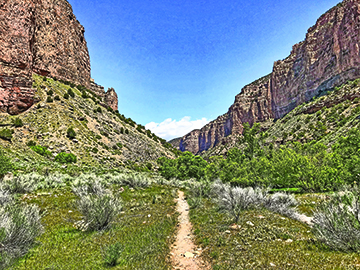
Dinosaur National Monument is one of many national parks experiencing severe budget cuts and staff shortages. Photo credit: Jessica Hughes
Often referred to as “America’s best idea,” our national parks are what many consider a national treasure, not only loved for their beauty and recreational access, but for their commitment to conservation, culture, and collective heritage.
Yet, now more than ever, our national parks are in crisis. Since the beginning of this year, they have become political pawns in a larger agenda that seems intent on undermining their mission. Behind the scenes, the foundational work of protecting landscapes and preserving cultural history is under attack.
National parks have struggled under a severe staffing crisis, losing roughly one quarter of their permanent workforce. This loss has made it increasingly hard to keep gates open, deliver basic visitor services, or carry out vital maintenance. It has also caused delays in research and critical maintenance, putting the long-term protection of America’s most iconic landscapes and cultural resources in jeopardy.
But the threats extend far beyond shrinking budgets and empty positions. Park leadership has been pressured to strip climate change information from official webpages and to remove references to slavery and LGBTQ+ history. Staff were also directed to inventory interpretive signage and museum content, and flag so-called “negative information” about past or living Americans via QR-code reporting and submit content for review. These requests are not isolated efforts, rather they reflect a sweeping effort to reshape our national park system and how American history is told.
All of this comes at a time of heightened pressure. Visitation has surged since the COVID era. Climate change is accelerating. And now, with cuts and mandates, national parks are being squeezed from every angle.
In Colorado, where more than one-third of the land is federally owned, roughly 24 million acres, parks were the busiest ever this year, with record-breaking visitation, all forced to operate with minimal staff. “The Administration ordered all NPs to remain open to maintain the appearance of a park visitor experience,” notes Tracy Coppola, the Colorado Program Manager at the National Parks Conservation Association. “It’s been tough this year.”
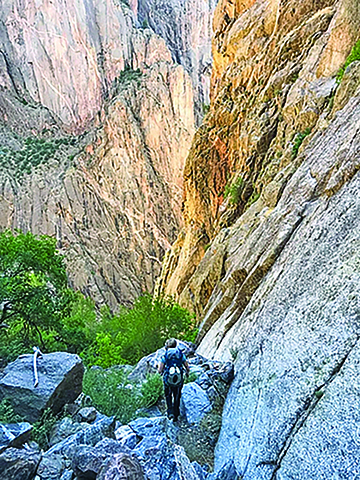
Black Canyon of the Gunnison National Park is currently operating with no maintenance crew and half its staff. Photo credit: Jessica Hughes
The Black Canyon of the Gunnison National Park was forced to operate with no maintenance crew and half of its staff. “That means Black Canyon of the Gunnison National Park is unable to fill 24 of the park’s 74 positions – a 1/3 reduction in staffing,” says Caitlyn Burford, the NPCA Senior Communications Manager. In other instances, this past summer, the park operated without rangers at the park’s North Rim, requiring signs to be posted telling visitors that search, and rescue would be slow or unavailable. And because all custodial staff had been terminated, higher-grade employees were being directed away from their regular duties to perform custodial functions.
Even amidst the government shutdown, most parks remain open with fewer amenities, and to the public, no real change is seen. But Coppola points out the front-facing staff shortages and closures aren’t the real issue.
“The challenge with the current narrative is that parks behind the scenes are scrambling. Visitors aren’t really seeing it out front; it is more behind the scenes,” explains Coppola. “It’s the scientists, conservationists, all those behind the scenes are where the parks are feeling it the most.”
Coppola refers to the staff who are hired to help protect the park’s natural and cultural resources. But with the recent cuts, places like Dinosaur National Monument, where its Cultural Resources person was fired, aren’t allowed to replace or rehire this position. And because administrative and maintenance staffing at the park is down 40%, those who remain behind the scenes, such as the park’s archeologist, are jumping in to help where they can, taking them away from what they were hired to do.
“We’re at a place where the parks are being put in an impossible situation,” says Coppola. “The future is uncertain. It is terrifying. We never thought the administration would come for the parks like they have; the parks are becoming politicized more, and we’re losing the reason why parks were created in the first place.”
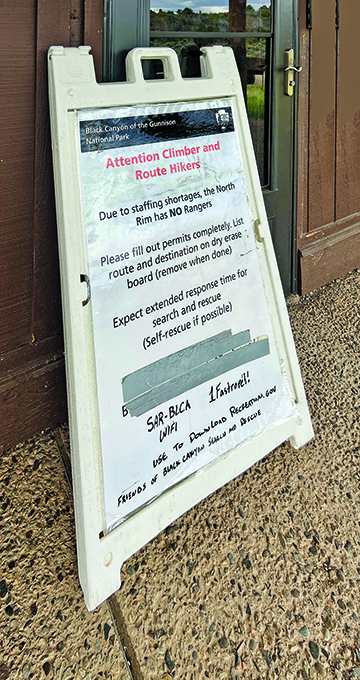
Staff shortages at national parks have led to visitors exploring at their own risk. Photo provided by National Park Conservation Association
The National Park Conservation Association is the only independent, nonpartisan organization dedicated to protecting and advocating for America’s National Park System. This year, Coppola has seen a huge pivot in the organization’s focus, most of which has been voicing how critically important park staff is, and how these cuts have put a huge strain on the park system.
“We estimate that at least 24% of park permanent staff is gone across the board,” says Coppola. “So, we’ve been using our voice to stand up for park staff.” Another big focus for the organization is the sweeping changes that could come with president’s most extreme proposed 2026 budget.
The harshest budget proposal asks Congress to cut more than $1 billion to the National Park Service, which includes a $900 million cut to the operations of our national parks. According to the NPCA’s calculations, “achieving a $900 million cut to operations would require eliminating funding and staffing for roughly 350 park sites from the smallest to some of the largest.”
The NPCA also goes on to list other Park Service-related budget cuts proposed in the President’s budget, including:
- $73 million cut to park construction funding
- $77 million cut to recreation and preservation funding
- $197 million cut to the Historic Preservation Fund
“This is the most extreme, unrealistic, and destructive National Park Service budget a president has ever proposed in the agency’s 109-year history,” according to a statement issued by National Parks Conservation Association chief executive Theresa Pierno. “It’s nothing less than an all-out assault on America’s national parks.”
It’s clear, no matter how you slice it, the future of America’s national parks is on the line.